 Lifecycle marketing
 Customer data management
 Email campaign production
 Search marketing
 CMS development
 Who we are
 How we work
 Case studies
 Testimonials
 Salesforce Marketing Cloud
 Braze
Braze HubSpot
 Marketo
 Pardot
 DataBricks
 Snowflake
 HighTouch
 RudderStack
 Segment by Twilio
 Videos
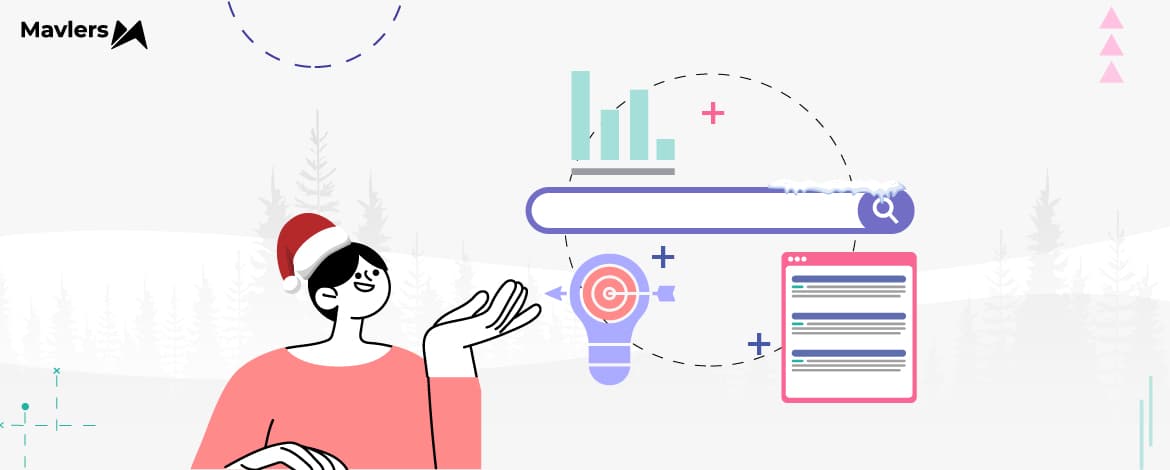
The holiday lights may not be up yet, but the shopping has already started.
In 2025, consumers are researching weeks earlier—many as early as October. They’re doing it through conversational AI, chatbot-style queries, and comparison searches. Looks nothing like the linear shopping journeys of the past.
At Mavlers, with over $43 million in managed media spend for 7,000+ global clients, we know that every holiday season brings its own mix of challenges and opportunities.
In 2025, AI-powered paid media strategies are unlocking new efficiency, but competition is fierce and the margin for error is thin.
So let’s not throw every holiday marketing tip you’ve ever heard into your ad account and hope something works. Instead, let’s combine insights from past seasons with the data shaping this one.
We’ve put together eight battle-tested, holiday paid advertising strategies to help you outperform competitors. With these holiday marketing campaign optimization, you’re all set to make this season your most profitable yet.
Holiday paid advertising strategies 2025: What’s different this year
In 2025, consumers are researching weeks earlier—many as early as October. And they’re doing it through conversational AI, chatbot-style queries, and comparison searches. Boy, that looks nothing like the linear shopping journeys of the past!
And while customers are getting savvier, they’re also getting… cautious. Shoppers this year are “timid”, says McKinsey’s Emily Reasor.
They plan to spend roughly the same as before, but they’re also:
- Shifting that spend toward needed goods.
- Watching prices closely, and
- Hunting for real value.
New tariff pressures and lingering inflation aren’t helping confidence, either.
On top of that, two-thirds of consumers now say they’ll start holiday shopping before Black Friday.
Translation: the window for high-converting holiday ad campaigns is opening sooner, the intent curve is stretching longer, and your holiday season PPC strategy has to do two things at once—nurture early interest and be ready for a compressed buying cycle when urgency strikes.
Top holiday paid advertising strategies for a high-converting 2025 season
Strategy 1: Get down to the grind earlier than your competitors
You know that saying, “Rome wasn’t built in a day”? Yeah—neither is a great holiday PPC campaign. It takes time, testing, and a bit of “what if we try this?” attitude to get ads that don’t burn through your budget but still get people clicking Buy Now.
The thing is: the holiday shopping clock has officially gone haywire. What used to be a neat November-to-December sprint is now a five- to six-month marathon that starts in summer.
New data from MarTech confirms it. Brands that don’t adjust holiday ad campaign timelines early on risk falling behind their competitors.
The National Retail Federation saw it too: shoppers are starting earlier every year. NRF President Matthew Shay even said it himself—people aren’t waiting for Black Friday anymore.
And it makes sense. Who wants to fight crowds or refresh a dozen tabs on Cyber Monday? Most people are comfortable at home, scrolling, comparing, and asking AI chatbots things like, “What’s the best noise-cancelling headphones under $200?”
That means your holiday paid advertising strategy can’t wait until November. You’ve got to be visible while people are still in the research phase—when they’re looking, not buying (yet).
Here’s what works for us at Mavlers:
Start light in early October with awareness and mid-funnel campaigns. Get your audience warm. For our bigger clients, we start even earlier, so remarketing is cheaper and sharper by November. Think of it like priming an engine—you want things humming before the real race begins.
And if you wait too long? Be ready to pay for it. Cost per mille (CPMs) increase the closer you get to the big days. Pacing evenly throughout the season keeps your budget in control.
A few musts before you roll out:
- Do your research to outperform competitors in holiday ads. Check what your competitors are doing and where the demand is rising.
- Set realistic goals. Measurable—clicks, ROI, conversions.
- Keep a close eye on your spend once ads go live.
- Choose your battleground thoughtfully. Google, Meta, Instagram, or TikTok? Every channel might not be able to justify your budget.
- Map your calendar: Diwali, Halloween, Thanksgiving, Black Friday, Cyber Monday, Christmas, and post-holiday sales.
And honestly, if all of this sounds like juggling a lot of balls (because it is), get help. Bring in pros who can handle execution and let you focus on the big-picture stuff—like staying two steps ahead of everyone else still writing “holiday campaign ideas” in November.
Strategy 2: Ride the holiday curve
Starting early is great. But if you sprint too soon and run out of steam mid-season, you’ll miss the real action. The trick is pacing your campaigns around how the holiday momentum actually builds—and fades.
At Mavlers, we call this riding the curve. Because the season doesn’t explode all at once—it rolls out in waves. And your PPC strategy should move with it. We’ve broken down how ‘holiday fatigue’ silently kills holiday ad performance—if you haven’t read that one yet, it’s worth a look.
Here’s how we like to plan it:
- Pre-Holiday (up to Nov 22)
Your warm-up phase. You use it to soft launch, create buzz, adjust budgets, and test creative angles. In short, load your ad arsenal. The focus is on audience-building and subtle reminders, with lighter prospecting campaigns.
2. Peak Holiday (Nov 27–Dec 20)
This is your focal point. The focus shifts to highly targeted campaigns as Black Friday, Cyber Monday, and Single’s Day roll around.
That’s the time to loosen your budget belt. Also, go hard on remarketing, and woo the high-intent audiences. The groundwork you laid earlier brings you the results here.
Every bid and message aims to hit shoppers right as they’re ready to buy. This is the time to be bold, but not reckless—because the competition’s frothing at the mouth, too.
3. Final Stretch (Dec 21–25)
Target the last-minute shoppers with urgency, free shipping, or “still-in-time” messaging.
4. Post-Holiday (Dec 26–Jan 1)
Don’t disappear. A lot of shoppers are poking around for post-holiday deals and using gift cards, Retarget gift-card users, promote clearance offers, or set up New Year campaigns.
The key? Don’t let your foot off the gas too early, but don’t burn rubber all the way through January either.
In nutshell: plan each phase, adjust bids, budgets, and paid ad messaging, so your campaign unfolds like a good story.
Google data backs this rhythm—traffic and CPMs start rising in September, peak late November, and cool down by January.
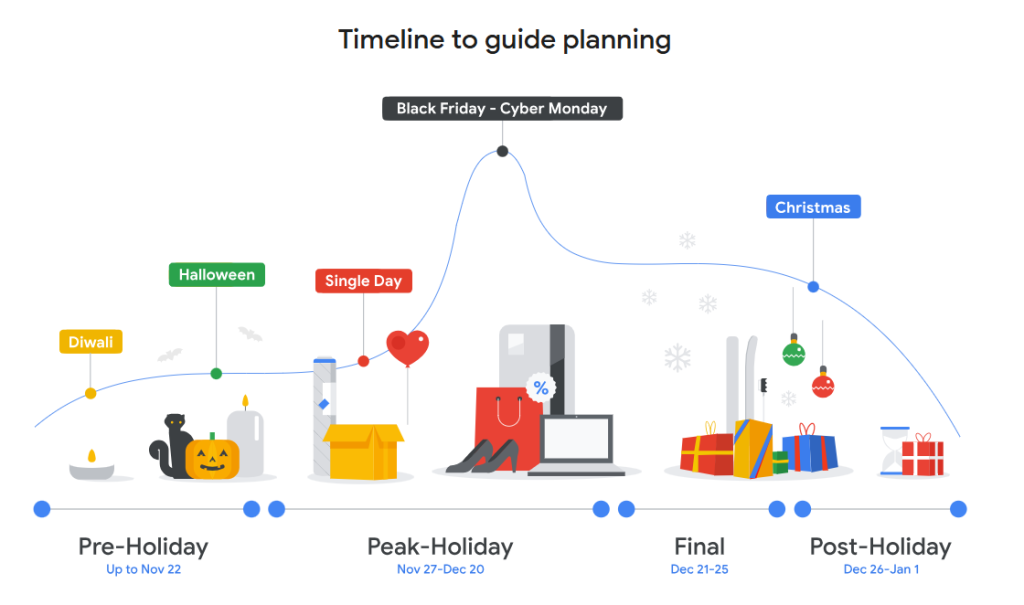
Important>>The smartest brands don’t just start early Use tools like Google Trends to spot odd spikes and moments unique to your crowd.
Strategy 3: Give shoppers the confidence to buy early
Every holiday season, shoppers keep their carts warm but hesitate to click “buy”—just in case the deal fairy drops an even bigger discount later.
That’s the anxiety you need to erase.
“In 2024, we saw a tidal wave of retailers pulling Black Friday deals forward”, confirms Emily. Some even promised, “This is our best price—if you see it cheaper later, we’ll refund the difference.”
That’s bold. Reassuringly bold.
Why does this matter for your holiday paid advertising strategies in 2025?
Because price-match guarantees get fence-sitters to make their move, sooner rather than later. When your PPC headline says, “Shop early, guaranteed best price—or we pay you the difference,” you flip the script.
Instead of shoppers worrying about missing out, they feel they’ve got nothing to lose—and you get to lock in sales before the peak CPM madness begins.
This strategy isn’t just about being generous; it’s about driving true incrementality. Early-bird buyers become loyal fans if they know your promise is ironclad, and your campaigns can claim sales you might have otherwise lost to last-minute bargain-chasers or competitors. Here’s how to pull it off:
- Put your price-match guarantee front and center in every paid ad—Google, Meta, and display. Don’t make people hunt for the promise.
- Pair the guarantee with urgency: “These are our best holiday deals—no need to wait for Black Friday.”
- Keep your fine print minimal, and your pledge visible across ads, landing pages, and emails, so trust is never in question.
A word to the wise: only offer what your P&L can handle. The best brands win not because they have the loudest sales, but because they plan (and fund) their guarantees with precision.
Strategy 4: Sprinkle seasonal keywords and get creative with the ad copy
When you get down to keyword researching, try going above and beyond the usual ones and try experimenting with those that are more likely to tug at the heart and ultimately purse strings of our target audience! Go with the ones that will have a deeper emotional connection; for instance, instead of the usual “gifts for her,” you could try “presents for doggo lovers” or “gifts for someone who has everything”. The sky is the limit here!
Keywords that capitalize on the last-minute shoppers, free shipping, or gift-wrapping incentives in the ad headline, description, or CTA, such as “holiday”, “gift”, “deal”, “offer”, “save”, “last chance,” etc., may also help strike a chord with the shoppers.
To use seasonal keywords and ad copy, you should:
- Conduct in-depth keyword research using tools such as Google Keyword Planner or Semrush to find out terms and phrases your target customers are searching for during the holidays.
- Use negative keywords to exclude irrelevant or low-intent queries that might waste your budget or lower your quality score.
- Write compelling and persuasive ad copy that highlights the benefits and value of your products or services and includes a clear call-to-action (CTA) that tells your audience what to do next, such as “shop now,” “learn more,” “sign up,” etc.
- Test multiple variations of your ad copy to see which ones perform better and optimize them accordingly.
Strategy 5: Get into the festive mood with alluring visuals and videos
Starbucks Red Cup Campaign was quite the rage and still is every holiday season simply because of the warmth and exuberance associated with the color red that brings alive the yuletide spirit in every heart out there!
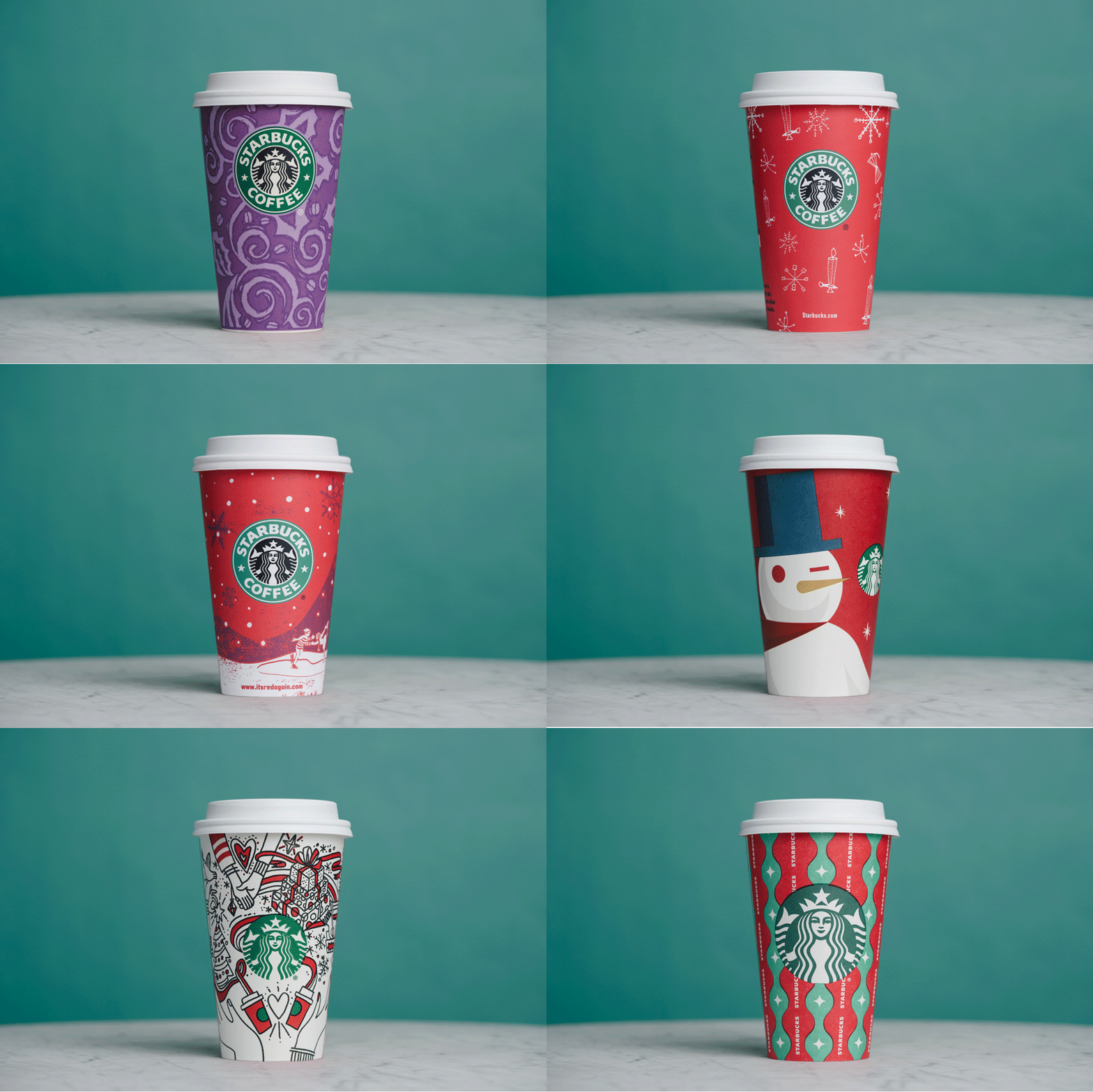
Images and videos can help you reel in more attention, increase engagement, and convey your value proposition more effectively than text alone. You want to use high-quality images and videos relevant to your offer and audience and highlight the USP and benefits of your products or services.
To use eye-catching images and videos, you should:
- Use tools such as Canva or Adobe Spark to come up with stunning images and videos for your ads.
- Leverage festive images and videos that match the theme of the holiday season, such as snowflakes, lights, ornaments, etc.
- Deploy images and videos that show your products or services in action or context, such as how they can solve a problem or fulfill your customers’ needs.
- Use images and videos that include social proof (user-generated content) or testimonials from satisfied customers or influencers who endorse your brand.
- Use visuals with a clear CTA that tells your audience what to do next.
Strategy 6: Strategically invest in remarketing and retargeting
As an advertiser, you might want to create separate PPC campaigns for reeling in new buyers as well as for retargeting those who are regular at your store. The reason is that you wouldn’t want your old customers to come across low-priced products that you specifically put up for new consumers!
When targeting those who love shopping with you, you might want to begin with a note of gratitude and extend exclusive coupon codes specifically for them.
To use remarketing and retargeting, you should:
- Segment your remarketing and retargeting audiences based on their level of interest and engagement, such as cart abandoners, page visitors, newsletter subscribers, etc.
- Tailor your ads to each segment based on their unique needs and pain points, and offer them incentives such as discounts, free shipping, coupons, etc.
- Deploy tools such as Google Ads or Facebook Pixel to create and manage your remarketing and retargeting campaigns.
- Track and measure the performance and ROI of your remarketing and retargeting campaigns.
- For instance, you could check out the remarketing PPC ads created by Mavlers.
Check out another strategy,

Strategy 7: Capitalize on geo-targeting and local extensions
These techniques help target your audience based on their location. Geo-targeting allows you to show your ads only to people who are within a certain radius or area that is relevant to your business. This can help you save money by avoiding irrelevant clicks from people who are too far away or in different regions or countries.
Local extensions allow you to add additional information about your business location, such as address, phone number, directions, hours of operation, etc., which can help you drive more traffic to your brick-and-mortar store or office.
To use geo-targeting and local extensions, you should:
- Deploy tools such as Google Ads or Facebook Ads to create and manage your geo-targeting and local extensions campaigns.
- Use location-specific keywords and ad copy that appeal to your local audience.
- Leverage images and videos that show your local store or office or feature local landmarks or events.
- Use local extensions that include a map, a click-to-call button, a directions link, or a store visit tracking feature.
Strategy 8: DON’T set it and rest
Launching high-converting holiday ad campaigns isn’t a low maintenance affair. Rather, kicking back after pressing go is exactly the kind of thing that gets brands blindsided.
You want to be the marketer who pounces on every new twist, not the one finding out about problems weeks too late.
That’s because Holiday PPC is full of curveballs. Some of your ads flounder while some take off. Maybe a keyword that was a gold mine last year is a money sink now. The only way to win is to watch your metrics with hawk-eye.
- Get alerts set up for sudden drops in conversions or spikes in cost-per-click.
- Make changes real-time. Try new ad copies, headlines, and landing pages. They deserve some of your deserve A/B love.
- When you spot a keyword that punches above its weight, double down.
- If one’s draining your budget with no provable impact, don’t hesitate to cut it loose.
Summary
It makes sense to capitalize on the holiday paid advertising strategies mentioned above, along with introducing Christmas countdowns and activating limited-time deals without appearing too salesy.
If you find yourself struggling with putting together competitive PPC campaigns for holiday season 2025, you could try relying on professional PPC experts in the house of Mavlers to cook up a delicious holiday PPC campaign for you in the lowest TAT at amazingly affordable prices. Hit us up now!
Some more reads to inspire your holiday marketing strategy-