 Lifecycle marketing
 Customer data management
 Email campaign production
 Search marketing
 CMS development
 Who we are
 How we work
 Case studies
 Testimonials
 Salesforce Marketing Cloud
 Braze
Braze HubSpot
 Marketo
 Pardot
 DataBricks
 Snowflake
 HighTouch
 RudderStack
 Segment by Twilio
 Videos
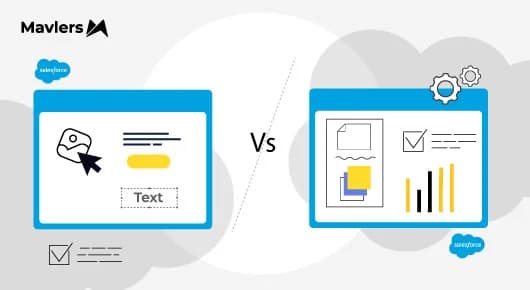
For a long stretch, Salesforce grew its marketing lineup mainly by buying companies. Pardot came in to cover B2B. Datorama brought in advanced analytics and reporting. And when they needed a powerhouse for real-time web and app customization, they acquired Evergage in 2020.
Around the same time, Salesforce started building marketing capability directly on its own core platform. That led to Data Cloud, Marketing Cloud Growth, Marketing Cloud Advanced, and Agentforce.
In short: the older products were stitched together after the fact, while the newer ones were designed as one connected system from the ground up.
That difference in origin is the root of nearly everything else we’ll cover. Let’s go.
What is Marketing Cloud Engagement?
Marketing Cloud Engagement is the platform most people simply, albeit misleadingly, call Marketing Cloud.
Its roots go back to ExactTarget, acquired by Salesforce in 2013. That history is still visible today. Log into Marketing Cloud Engagement and the web address itself still references ExactTarget.
The platform uses data extensions, which are like custom database tables that marketers can design to fit their needs. The platform runs on its own infrastructure, separate from core Salesforce.
Marketing Cloud Engagement also ships with a long list of specialized modules like:
- Email Studio
- Journey Builder
- Automation Studio
and several others. Teams comfortable writing AMPscript, SQL, or server-side JavaScript can push these tools into almost any configuration imaginable.
However, that also means you need enterprise-level skills.
Marketing Cloud Engagement is not designed for non-technical marketers to utilize on their own to create complex, multi-step journeys. But for organizations with strong technical skills, it’s not a problem.
What is Marketing Cloud Next?
Marketing Cloud Next showed up publicly at Salesforce’s Connections event in 2025.
Unlike Marketing Cloud Engagement, it’s not a separate system bolted onto Salesforce. It’s built into the core platform, with Data Cloud as the foundation.
Inside Marketing Cloud Next, campaigns are run through campaign flows, which use the same automation engine Salesforce already relies on for sales and service processes. For a marketer used to Marketing Cloud Engagement, that’s a genuine adjustment, since you’re now working with standardized data objects, not custom tables. The payoff is that reacting to events in real time becomes far more natural.
A few specific changes worth flagging:
- Personalization shifts away from AMPscript and JavaScript toward AI-generated and dynamic field values. AMPscript itself may eventually be supported in Marketing Cloud Next.
- Segmentation can move from writing SQL to simply typing a plain-language description of the audience you want, with AI doing the heavy lifting. For more advanced needs, SQL-style logic is still available if you want to go deeper.
- Business units, which exist as their own structures in Marketing Cloud Engagement, correspond directly to Data Cloud “data spaces.” Practically, this means separating your marketing operations requires separate data spaces, there’s no shortcut around it.
AI is built into Marketing Cloud Next from the very beginning. With Agentforce, marketers can describe campaign goals in simple terms. The system then drafts a brief, builds the audience, and sets up the send. The platform also automatically passes qualified leads from marketing to sales. Plus, you can pull unstructured content like images and Google Drive files right into a campaign.
One of its best features is two-way conversational messaging. Customers can text back and forth with an AI agent on channels like email and WhatsApp. If needed, a live person will join the conversation.
Marketing Cloud Engagement doesn’t offer anything like that.
SMFC Next vs SFMC Engagement differences re. Data Cloud
Marketing Cloud Next cannot run as a self-contained tool, like Marketing Cloud Engagement. It depends entirely on a clean, properly governed Data Cloud setup underneath it.
So what determines success is the quality of identity resolution and how disciplined your data governance actually is. People who’ve run several of these projects consistently flag data cleanup as the part most teams budget too little time for. It often drags on far longer than expected, and frequently requires training up the team before any marketing activation can even begin.
Pricing adds another wrinkle.
Marketing Cloud Next uses a consumption-based model. Your bill depends on how much you use it, not a fixed license fee. This makes it harder to estimate the total cost upfront, especially compared to Marketing Cloud Engagement’s more predictable pricing.
Getting an accurate cost picture takes a bit of prep work.
You will need to sit down with Salesforce before signing anything. Together, you’ll model out your expected data volume. You will also look at your channel usage and message counts in detail.
Where things stand with Marketing Cloud Next
Let’s take a moment to separate what’s real from what’s hype.
Genuinely useful right now:
- Send time optimization is available on both platforms. It uses past behavior to schedule messages for times when people are most likely to open them.
- AI filtering removes fake engagement by screening out opens from security scanners or bots.
- AI-assisted campaign brief generation can save a lot of time, but its results depend on the quality of the input data and the prompts you use.
- You can quickly segment simple audiences with little effort, as long as your data is well organized.
- Two-way conversational AI messaging is available.
Still maturing:
- Fully hands-off campaign orchestration. AI can suggest next steps, but a human is still very much needed for approvals and timing decisions.
- Deep, nuanced content personalization. It’s improving but not yet at the level of what skilled teams can build manually in Marketing Cloud Engagement.
- Recommendation quality, which is getting better but isn’t yet on par with the most sophisticated consumer recommendation engines out there.
- Scoring transparency. Sometimes a score appears without an explanation of what’s actually driving it, so someone still needs to sanity-check it.
Should you move? A practical way to think about it
This isn’t really an either/or question, it’s about fit.
Staying on Marketing Cloud Engagement tends to make sense if:
- Your team has built deep, working systems around SQL and custom data extensions
- You’re running intricate Journey Builder setups with custom-coded activities
- You depend heavily on high-volume, trigger-based sending
- Your organization’s data foundation isn’t mature yet, and you’re not ready to tackle that work right now
Moving toward Marketing Cloud Next tends to make sense if:
- Real-time segmentation is a genuine priority for your strategy.
- You want marketing, sales, and service running on one shared platform without stitching systems together.
- You’re starting completely fresh, with no existing investment in Salesforce marketing tools.
- Your Data Cloud foundation is already in decent shape, licensed and governed.
Find out how to move from Marketing Cloud Engagement to Marketing Cloud Next.
A blended approach can make sense if:
- Different parts of your operation have genuinely different needs, say, keeping transactional sends on Engagement while shifting real-time, event-driven work to Marketing Cloud Next.
- You’re not ready to fully commit in one direction yet.
Running both side by side, often through an upgraded Engagement license tier, is increasingly common and can be stable for years when it’s set up deliberately.
However, it’s not without friction. One area that is still being worked out is keeping consent records in sync between Marketing Cloud Account Engagement (Pardot) and Marketing Cloud Next. Right now, sending from both platforms at once isn’t recommended without a manual workaround, since native consent syncing between them isn’t fully built yet, though it’s reportedly on the way. Anyone running a hybrid setup should plan around this. Don’t assume it’s automatically handled.
Marketing Cloud Next vs Marketing Cloud Engagement: Key takeaways
Here’s what’s worth holding onto before making a call either way:
- Marketing Cloud Next represents a completely different way of working. Teams expecting a simple interface update tend to be caught off guard by how much actually changes underneath.
- Clean, well-governed data matters more to your outcome than how advanced your AI features are.
- Marketing Cloud Engagement isn’t going anywhere soon. It’s proven, stable, and capable. There is no indication it’s being retired, and walking away from it without a plan isn’t a smart move.
- Running both platforms together is a legitimate long-term strategy, as long as it’s planned well.
- Where marketing is heading is toward connected, unified customer data. Teams that get ahead of that shift now will have an edge later.
Summing up, the choice between Marketing Cloud Engagement and Marketing Cloud Next has less to do with technology and more to do with how mature your data practices are.
So if you’re on Engagement, there’s no reason to rush a decision.
But it’s worth taking an honest look at the state of your data. Because that’ll shape how smooth your path to Marketing Cloud Next turns out to be.