 Lifecycle marketing
 Customer data management
 Email campaign production
 Search marketing
 CMS development
 Who we are
 How we work
 Case studies
 Testimonials
 Salesforce Marketing Cloud
 Braze
Braze HubSpot
 Marketo
 Pardot
 DataBricks
 Snowflake
 HighTouch
 RudderStack
 Segment by Twilio
 Videos
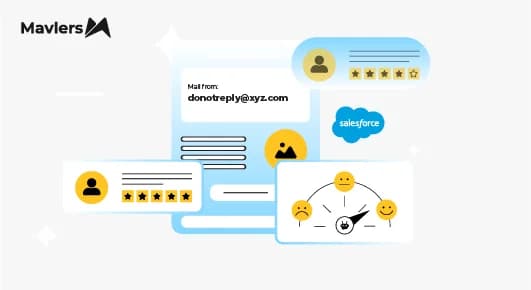
It seems easy now to swat no-reply emails without a care. But it would be unwise, although not unnatural, to protest why they came to be in the first place.
No-reply emails were actually useful for brands and companies.
Companies send millions of automated emails every day in the form of receipts, confirmations, shipping updates, password resets, etc. If even 1% of recipients responded with a quick “thanks!” or triggered an out-of-office reply, it could overwhelm the primary inbox.
No-reply addresses acted as a buffer, preventing support teams from burning out.
There were security considerations, too. Blocking inbound replies helped shield mail servers from spam and phishing attempts.
But with the advent of Agentforce, the risk of burning out human support teams can be tackled. More importantly, the development restores email’s unique identity as a 2-way channel.
As a brand, you can finally eliminate the gaps in customer relationships. That’s a huge advantage at a time when consumers prioritize email as their preferred channel of engagement.
As Salesforce Marketing Cloud experts, we see firsthand how Next’s agentic engagement opens up a brave new world of conversational email marketing.
Table of Contents
The problem with traditional no-reply emails
What is Marketing Cloud Next?
Benefits of conversational email marketing
Measuring success in conversational email marketing
The problem of attribution
What comes next?
Turn conversations into conversions with Agentforce
The problem with traditional no-reply emails
As you may have inferred from our introduction, no-reply emails were not meant for customers, but brands themselves. They were built for scale, not engagement.
The deeper issue, though, is what this signals to customers.
When a brand sends from a no-reply address, it’s effectively saying it wants your money, but not your voice. And every time a customer sees that, a small fracture forms in their trust.
Over time, this trains customers to tune the brand out entirely.
There’s also a compounding cost that often goes unnoticed, which is lost data. Customer replies are among the highest-fidelity signals a brand can receive. Blocking them starves AI models of the feedback they need to improve, leaving data strategies stale and increasingly out of step with the market.
But even generally speaking, no-reply emails can be disadvantageous in a number of ways:
- The biggest drawback is the dead end it creates. Customers often have a quick question or a clarification regarding the receipt, update, or alert they just received. Forcing them to navigate to another page and start a new ticket from scratch is unhelpful.
- If a customer can’t easily reply to ask a question or voice a concern, they are more likely to report spam or unsubscribe just to clear the clutter.
- If a customer replies to a promotional email asking, “Does this come in blue?” and gets a bounce-back error, you have likely lost a sale.
- ISPs increasingly prioritize engaged conversations. If your emails only ever go one way and never receive replies, ISPs may categorize your content as bulk graymail.
Marketing Cloud Next introduces an entirely new model of interactive email marketing, one that might challenge your approach to Agentforce if that approach is entirely traditional.
What is Marketing Cloud Next?
Marketing Cloud Next is Salesforce’s next-generation marketing platform, built natively on the Salesforce Core platform and powered by Data Cloud and Agentforce.
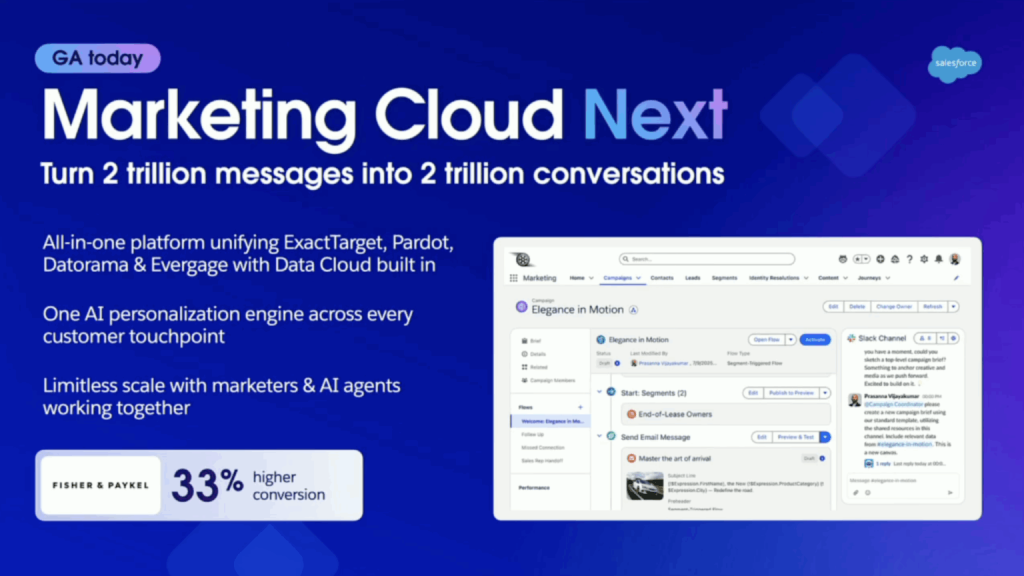
Source: Salesforce Ben
The agentic layer turns no-reply emails into interactive chats. The agent can automatically:
- Understand the customer’s message
- Determine the intent
- Respond with accurate information
- Trigger actions across journeys, sales, or support
Your email becomes a smart, always-available assistant that actually helps customers instead of redirecting them elsewhere.
Crucially, this isn’t just about handling simple queries. The platform connects to customer data wherever it lives without the need to migrate everything into a central lake first.
That means the agent reasons with a full, current picture of the customer, including not just structured data like purchase history, but unstructured context like why they returned an item or what they were browsing before they reached out.
| Marketing Cloud Next: The evolution of engagement | ||
|---|---|---|
| Traditional model | Agentic model | |
| Communication style | Broadcast-centric: One-to-many messaging. | Bi-directional: Active, two-way dialogue |
| Timing | Time-bound: Fixed schedules and “drops.” | Real-time: Always-on and instantaneous |
| Structure | Departmentally siloed: Restricted to Marketing/PR. | Organization-wide: Cross-functional participation |
| Success metrics | Quantitative: Focus on opens and clicks. | Adaptive: Focus on context and relationship depth |
Benefits of conversational email marketing
From an engagement standpoint, this is a major win for brands. Opening email up as a two-way channel drives measurable business impact:
- Customers feel heard and valued
- Open and engagement rates rise organically
- Support volume decreases
- Conversions improve because questions are answered in real time
Marketing Cloud Next enables interactive email communication through its built-in conversational AI and real-time data capabilities. Features like Einstein intent detection, dynamic journeys, and integrated customer profiles allow the system to understand the replies and respond instantly. As a matter of fact, Salesforce itself used Agentforce to work through more than 100 million dormant leads that its human sales team simply didn’t have the capacity to follow up on.
In the first three weeks, the agent worked through 8,000 of those leads and generated $500,000 in pipeline that would have otherwise been zero.
The same logic applies to service contexts.
When agents surface the right customer context automatically, service teams can have genuinely helpful, revenue-generating conversations without feeling like they’re being asked to moonlight as salespeople. That removes the traditional tension between efficiency and experience that contact center leaders have long struggled with.
Fisher & Paykel leveraged AI-driven insights to surface relevant recommendations during service interactions. The result was a 33% increase in conversion without slowing resolution times. By embedding marketing intelligence directly into service workflows, AI enables agents to deliver personalized, revenue-generating interactions seamlessly, turning every support conversation into an opportunity for growth while preserving customer experience quality.
Measuring success in conversational email marketing
Measuring success in this model also looks different.
Open rates and click-throughs tell you whether someone noticed you, not whether you helped them. The metrics that matter now include the number of meetings booked, problems resolved, and how quickly agent responses improve over time as the system learns.
| KPIs: Traditional vs. Agentic | |||
|---|---|---|---|
| Metric category | Legacy metric | Agentic metric | Objective |
| Engagement | Open rate | Inbound Response Rate | Measures the transition from a broadcast to a dialogue |
| Friction | CTR | Task Completion Rate | Measures if the user achieved their goal within the interaction |
| Intent | Bounce rate | Sentiment Shift Score | Quantifies the change in user disposition from start to finish |
| Efficiency | Cost per lead | Cost Per Resolution | Evaluates the financial efficiency of solving a customer need |
| Scalability | Send volume | Agent Deflection Rate | Measures how much intent was handled without human intervention |
One useful signal is how often an agent says “I don’t know.” A high rate early on is expected, but a steady improvement reflects a more trusted, capable system.
“Success in 2026 and beyond depends on data quality and permission management, with inactive lists and outdated data hurting performance more than any other factor. Track click quality, downstream conversions, reply rates and revenue per subscriber.”
— Brian Riback, Director of CRM & Retention, Moore
The problem of attribution
One practical challenge this model surfaces is attribution.
When a service agent closes a deal using a marketing insight, which team gets credit? This has historically been one of the most politically charged questions in any organization.
One way out is making the data visible to everyone simultaneously.
When the lineage of a deal is tracked end to end, the dynamic changes. Marketing stops being viewed as a cost center and starts being seen as a strategic partner.
So technology can actually enforce the collaboration that org charts rarely achieve on their own.
“Marketing Cloud Next is not perfect. It’s not finished. But it’s the most strategic move I’ve seen from Salesforce in years.”
— Kenny van Beeck, Head of Salesforce CRM & Marketing at Forward.eu

What comes next?
The shift from campaigns to conversations is already underway, but it points toward something even more significant on the horizon. As consumers increasingly have their own AI agents managing their inboxes, subscriptions, and purchases, the question for brands will be how their brand agent communicates with a customer’s personal agent, if and where available.
Of course, no one has all the answers right now. But you can start thinking along these lines:
- Prioritize machine-readable metadata. Ensure your offers, product specs, return policies, etc. are structured in clean code so agents can accurately read and summarize them.
- Personal agents are immune to FOMO and clickbait. To win the inbox gatekeeper, brands must provide objective value through their marketing copy.
- Define clear triggers for when a negotiation between two AI agents should be paused and handed over to their human counterparts.
In this context, it’s worth briefly considering what Colin Shaw, founder of Beyond Philosophy LLC, describes as disintermediation. “AI is beginning to disintermediate parts of the customer relationship by inserting itself between the customer and the organization — particularly at the discovery and decision stages,” he argues. Thus, according to him, agents will “relocate the most influential parts of the customer decision-making process” outside the organization’s control.
Agents will make decisions based on facts, not emotions. They’ll be digging through social media and review sites, disabling brands from steering a positive narrative at all times.
“That represents a fundamental rupture in how experiences have traditionally been designed,” as Shaw calls out. As a brand, you need to be preparing for this.
Turn conversations into conversions with Agentforce
The era of “do-not-reply” emails is ending. Marketing Cloud Next empowers brands to listen, respond, and build richer relationships right inside the inbox.
By 2030, AI is projected to be nearly universal, with adoption rates climbing to 97% across industries. Global email traffic will surge to an estimated 523 billion messages per day, reshaping how brands scale communication and engagement.
The future of email is about having better conversations with your customers.
If you need specialized guidance on Agentforce marketing, we can help. With over 10 years of experience in serving more than 800 SFMC clients, we can be your go-to execution partner.