From web development to digital marketing, we build for growth. Head to Mavlers Agency.

Mavlers Logo
Book a call

Most RudderStack implementations stay stuck as pipelines. Turn yours into a revenue engine

Your warehouse already knows who just converted, is about to churn, or is about to upgrade, but without activation, those signals go unused. We connect real-time triggers to Braze, Klaviyo, and Salesforce Marketing Cloud, sync suppression to cut paid waste, and deliver attribution your board can trust.

Mavlers turns your RudderStack CDP setup into revenue; first triggers live in 14 days.

Book a 15-min call

Your warehouse knows, your campaigns don't.
That's the gap.

Lifecycle campaigns icon

Lifecycle campaigns running on guesswork

You're sending time-based journeys while real intent signals- session frequency, feature abandonment, pricing page visits sit unused in your warehouse.

Paid retargeting icon

Paid retargeting billing you for customers you already own

Without lifecycle suppression sync, Meta and Google keep charging you to re-acquire active users, even those who converted this morning.

Churn detection icon

Churn is visible in your data 30 days early

Engagement drop-offs, declining session frequency, and feature abandonment signal churn early, but no triggers act on them. You intervene too late.

Lifecycle ROI icon

You cannot prove lifecycle ROI to the board

Retention and acquisition revenue blur together. Attribution breaks down. Finance wants a number, you don't have one that holds up.

The 5-phase revenue activation framework to close the data-revenue gap

Phase01

Revenue signal audit

Weeks 1–2

What happens here

  • Behavioral signals mapped to revenue opportunities
  • Trigger, suppression, and attribution gap audit
  • Revenue opportunity quantified before build
What you get: Gap analysis deck + revenue opportunity estimate
Phase02

Taxonomy design

Weeks 2–3

What happens here

  • Event schema built for lifecycle activation
  • Revenue-aligned event naming + tracking plan
  • RudderStack integrations with downstream MAPs like Braze, Klaviyo, SFMC, HubSpot
What you get: Tracking plan + taxonomy documentation
Phase03

Pipeline + Triggers live

Weeks 3–5

What happens here

  • Real-time triggers (churn risk, upgrade intent, conversion)
  • Instant suppression sync to Meta, Google, TikTok
  • Attribution pipeline live in warehouse
What you get: First triggers live + Paid suppression active
Phase04

Models and reporting

Weeks 5–8

What happens here

  • LTV model calibrated on cohorts
  • Churn prediction signals validated
  • Lifecycle ROI dashboard (channel + sequence level)
  • Finance-verifiable attribution
What you get: LTV model + churn prediction + ROI dashboard
Phase05

Compound returns

Month 2 onwards

What happens here

  • Monthly optimization cycles
  • New signals and triggers activated continuously
  • Attribution refined over time
  • Quarterly strategy reviews
What you get: Monthly revenue increment reports

Seeing churn after it happens?

We turn early signals like drop-offs, declining sessions, and abandonment into live triggers via RudderStack implementation and activation

From data to marketing revenue - case studies that show how it's done

FinTech scale-up: segment migration + revenue activation

Industry

FinTech Platform · B2C · 400K+ MAUs · Regulated financial services

Challenge

High costs with Segment and limited control. RudderStack used only for data collection; no behavioral triggers, suppression, or attribution. Campaigns ran on static schedules.

Solution

Mavlers migrated to self-hosted RudderStack on AWS (zero disruption), identified high-intent signals, and activated them - churn scoring to Braze, paid suppression to ad platforms, and attribution in Snowflake.

Outcome

  • 58% cost reduction ($180K → $76K).
  • Behavioral triggers live in 14 days.
  • $210K/year saved via paid suppression.
  • Board-ready ROI reporting + GDPR compliance achieved.
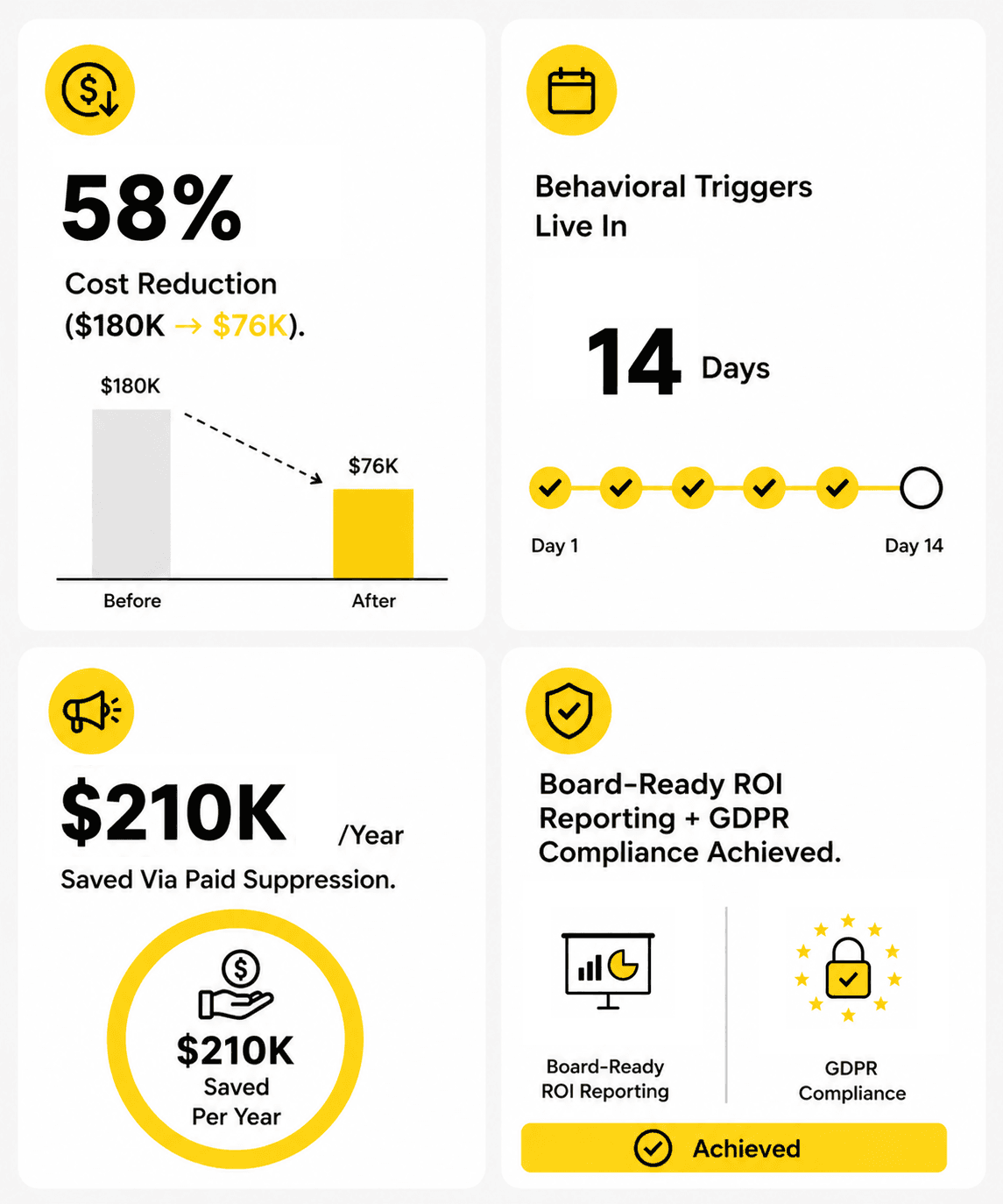
Case study 01: cost reduction, behavioral triggers live, suppression savings, ROI + GDPR compliance.

Stack

RudderStack · AWS · Snowflake · Braze · Meta · Google Ads · Hightouch
D2C Subscription brand: intent signals to revenue

Industry

D2C Subscription · 85K+ active users · Multi-market

Challenge

RudderStack collected events, but none powered campaigns. Churn model unused. Marketing relied on engineering for audiences. Paid suppression lagged by 48+ hours.

Solution

Mavlers mapped key signals to actions - churn risk to Klaviyo, upgrade intent to Salesforce Marketing Cloud, and real-time suppression via Hightouch. LTV model and ROI dashboard implemented.

Outcome

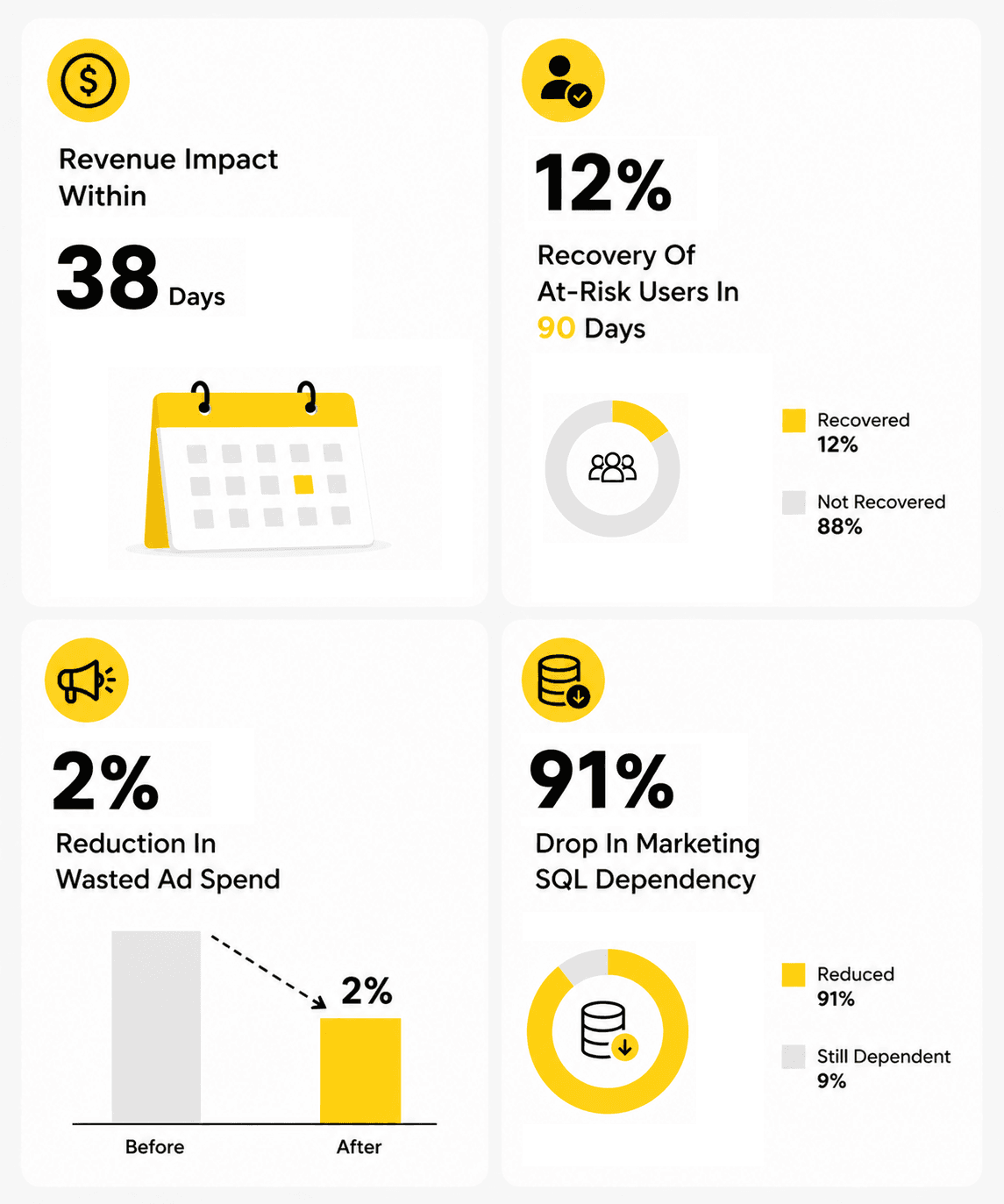
  • Revenue impact within 38 days
  • 12% recovery of at-risk users in 90 days
  • 2% reduction in wasted ad spend
  • 91% drop in marketing SQL dependency
Case study 02: revenue impact, recovery rate, ad spend reduction, marketing SQL drop metrics.

Stack

RudderStack · Klaviyo · Salesforce Marketing Cloud · Hightouch · Meta · TikTok · Snowflake

*Strict NDAs limit client disclosure; our current engagements include multiple brands and agencies.

Disney
DMA
Ogilvy
National Geographic
Penguin Random House
Incubeta
Oracle
Airtasker

In the words of our clientsheart

Cloth & Co.

Having one partner who can effectively support multiple areas of our digital presence is both efficient and valuable. The partnership works best when you can collaborate...

Daisy Burgess

Operations Manager

The Maze Group

They bring subject matter expertise to every engagement and clearly identify blockers, dependencies, and requirements. They prioritize proactive communication and problem...

Mathew Feuer

Director of Retention

PetLab Co

Mavlers was clear with communication and provided top-level support. We were on a really tight deadline to get a high priority project across the line and without them we...

Scott Bartlett

Director of Retention

Connecting the ecosystem - every tracked metric works inside your stack, not around it

Data sources — Web + Mobile

Platforms: JavaScript, iOS, Android, Flutter, React Native

SDK implementation, event taxonomy design, QA

Data sources - Cloud Apps

Platforms: Shopify, Stripe, HubSpot, Zendesk, Customer.io, Auth0

Cloud source connectors, schema mapping

Data sources - Reverse ETL

Platforms: Databricks, Snowflake, BigQuery, Redshift, PostgreSQL

Hightouch + Census Reverse ETL - warehouse audiences to MAPs/CTA
CRM and marketing (Output)

Platforms: Braze, Klaviyo, Salesforce, HubSpot, Customer.io, Mailchimp

Destination connector config, field mapping, sync scheduling

Analytics and BI (Output)

Platforms: Google Analytics, Heap, Mixpanel, Amplitude, PostHog

Event forwarding, property mapping, funnel configuration

Data warehouses (Output)

Platforms: Databricks, Snowflake, BigQuery, Amazon Redshift

Warehouse destination setup, schema management

Advertising (Output)

Platforms: Meta, TikTok, LinkedIn, Google Ads

Suppression sync, lookalike seed export, conversion API

Operations (Output)

Platforms: Slack, Kafka, RedShift, Datadog

Alerting, monitoring, pipeline health integration

One partner, full ownership from model to measurement.

No handoffs between data, marketing, and analytics. Just one Mavlers team owning dbt models, identity resolution, Hightouch integrations & activation, and downstream execution.

Mavlers- a trusted partner who owns your data pipeline + campaign execution layer

Lifecycle-optimized data architecture

Every event your product fires gets mapped to a lifecycle revenue action before a line of code is written. Your marketing team stops raising tickets. Your data starts speaking commercial.

Behavioral trigger engineering

RudderStack integrations tell you who's about to churn, ready to upgrade, or needs one more touch. We wire those signals to your channels. Sequences fire based on behavior, not calendar.

Lifecycle revenue attribution

Every email sent, every SMS delivered, every lifecycle campaign run gets tied to revenue in your warehouse. You walk into the board with channel-level ROI that finance can verify.

Paid waste elimination

Your lifecycle data knows who's already active, converting, or retained. As we sync that to Meta, Google, and TikTok in real time, you stop paying to reach people you already own.

LTV and Cohort Modeling

We build predictive LTV models on your behavioral data, so you know which cohorts compound and which ones cost you. Every lifecycle intervention gets prioritized by its revenue multiplier.

Ongoing pipeline management

We run the infrastructure, so your team runs the strategy. Pipeline monitoring, schema governance, and data quality enforcement. Clean data in, revenue decisions out.

With Mavlers, add that crucial strategy layer data agencies don't deliver

Pipeline setup and management

Hightouch PS / Self-implement

Yes

Pure data agency

Yes

Mavlers

Yes
Lifecycle-optimized event taxonomy

Hightouch PS / Self-implement

×No

Pure data agency

×No

Mavlers

Yes
Behavioral trigger-to-channel (14 days)

Hightouch PS / Self-implement

×No

Pure data agency

~Months of Build

Mavlers

Yes
Lifecycle revenue attribution

Hightouch PS / Self-implement

×No

Pure data agency

~Custom Build

Mavlers

Yes(pre-built)
Paid channel suppression syncs

Hightouch PS / Self-implement

×No

Pure data agency

×No

Mavlers

Yes
Churn prediction modeling

Hightouch PS / Self-implement

×No

Pure data agency

~Data science hire

Mavlers

Yes
LTV cohort analysis

Hightouch PS / Self-implement

×No

Pure data agency

~Possible, slow

Mavlers

Yes
Segment migration included (qualifying)

Hightouch PS / Self-implement

×No

Pure data agency

×No

Mavlers

Yes
Board-ready lifecycle ROI reporting

Hightouch PS / Self-implement

×No

Pure data agency

×No

Mavlers

Yes

See exactly what your RudderStack data should be doing, and what the gap is costing you.

Engage your way, wherever you are in your data activation journey

Revenue audit

Best for

Any company with 10K+ MAUs and a data warehouse

What's included

Revenue Signal Audit: signal map, gap analysis, and conservative ROI estimate

Typical duration

Free for qualifying clients · 5 business days

Onboarding sprint

Best for

Audit complete - gaps confirmed, ROI justified

What's included

Taxonomy design + pipeline build + triggers live + attribution model + dashboard

Typical duration

Fixed scope · Typically 6–10 weeks

Monthly retainer

Best for

Post-launch - ongoing activation and optimization

What's included

Pipeline management, new signal activation, optimization cycles, board reporting

Typical duration

Month-to-month · Structured so the first month's incremental revenue covers it

Migration sprint

Best for

Currently on Segment - evaluating RudderStack

What's included

Full Segment to RudderStack migration: audit + parallel run + cutover + validation

Typical duration

Fixed scope · 10–14 weeks · Included for qualifying onboarding clients

RudderStack or not? A quick decision guide.

RudderStack is the right fit if...

  • You already run a warehouse: Snowflake, BigQuery, or Databricks
  • Segment costs are scaling faster than usage
  • You need data sovereignty / operate in regulated industries
  • Your team wants control over the data plane (open-source flexibility)
  • You have 10K+ MAUs with rich behavioral events

Consider alternatives if...

  • You’re pre-PMF and only need basic event tracking
  • No data engineering bandwidth to manage a warehouse
  • You rely heavily on Segment’s 450+ destinations (30+ active tools)
  • Your use case is marketer-only, no SQL or warehouse workflows

A different tool may serve
you better if...

  • You’re Salesforce-first → Salesforce Data Cloud fits natively
  • You’re a small team (<5K MAUs) where infra overhead > activation value
  • You need simplicity over flexibility
  • We’ll call this out honestly in the revenue audit; no push if RudderStack CDP isn’t the right fit.

Tell us about your requirement

We'll get back to you within a few hours!

Select a service

Frequently asked questions

We already have RudderStack CDP set up. Why do we need you?

Most RudderStack integrations are built for data collection, not lifecycle activation. If your events aren't triggering revenue actions, your suppression lists aren't synced to paid channels, and your warehouse data isn't producing LTV models, you have infrastructure without outcomes. We audit what you have, close the gaps, and connect it to revenue.

How is this different from hiring a RudderStack implementation partner?

Implementation partners configure the tool. We configure the tool around lifecycle revenue outcomes. The difference shows up in what gets built: a standard implementation gives you clean data flowing to destinations. Our engagement gives you behavioral triggers firing on purchase intent, suppression lists killing paid waste, and attribution models that prove ROI to your board. Same tool. Completely different result.

We're a mid-size team. Do we have enough data to make this work?

If you have 10,000+ monthly active users and at least one connected data warehouse, there's enough signal to work with. The threshold isn't volume, it's behavioral diversity. Companies with 15,000 MAUs and good event instrumentation consistently outperform companies with 500,000 MAUs and poor taxonomy. We tell you in the revenue audit whether the signal is there.

What results can we realistically expect?

Measurable incremental revenue typically appears within 45 days. The compounding happens in months two through six as LTV models calibrate and suppression syncs tighten. We don't quote revenue projections before the audit. After the audit, we show you the specific gaps and a conservative estimate of what closing them is worth.

We're currently on Segment. Is migrating worth it?

For most companies at scale, yes. RudderStack CDP costs a fraction of Segment at equivalent volume and gives you warehouse-native control that Segment doesn't offer. The migration itself takes two to three weeks, depending on your event volume and destination complexity. We handle the migration as part of onboarding for qualifying clients. The real question isn't Segment vs. RudderStack, it's whether your CDP is connected to lifecycle revenue outcomes. That's the gap we close. We also support Segment; see our Segment services page for details.

What does the engagement actually cost?

There are two components: an onboarding engagement that covers the audit, taxonomy design, pipeline build, trigger setup, and attribution modeling; and an ongoing retainer for pipeline management, optimization, and reporting. Pricing is scoped after the revenue audit because build complexity varies significantly by stack and data volume. What we can say: the retainer is structured so that the first month's incremental revenue attributable to lifecycle activation covers it. We show you that math in the audit.

How much of our internal team's time does this require?

For the first two weeks, approximately four to six hours from whoever owns your data layer (engineer or data analyst) and two hours from your lifecycle marketing lead. After go-live, your team's involvement is strategic - reviewing reports, approving new trigger logic, and acting on the insights we surface. The infrastructure runs without ongoing engineering input from your side. That is the point.

What happens to our data? Who owns it?

You own all of it, always. We operate inside your RudderStack instance, your data warehouse, and your marketing platforms. Nothing lives on Mavlers infrastructure. Everything we build stays with you, fully documented and fully operational. No lock-in by design.

We have a data team already. Why wouldn't we build this in-house?

You can. The build timeline is typically four to six months for a team without prior lifecycle data infrastructure experience. The ongoing maintenance, schema governance, and attribution modeling require a dedicated data engineer or analytics engineer. If your data team's highest-leverage work is product analytics and feature instrumentation, lifecycle data infrastructure is a distraction. We give your team a clean boundary: they own the product data, we own the lifecycle revenue layer.

What if it doesn't work?

The revenue audit is the answer to this question. We don't take on engagements where we can't show a credible gap between what your data is doing and what it should be doing. If the audit shows the signal isn't there or that the potential ROI doesn't justify the engagement, we'll tell you. We'd rather turn down a bad fit than deliver a mediocre result. Every client we take on has a defined revenue outcome attached to the engagement from day one.

Insights to help you win with lifecycle marketing