
 Lifecycle marketing
 Customer data management
 Email campaign production
 Search marketing
 CMS development
 Who we are
 How we work
 Case studies
 Testimonials
 Work samples
 Salesforce Marketing Cloud
 Braze
Braze HubSpot
 Marketo
 Pardot
 DataBricks
 Snowflake
 HighTouch
 RudderStack
 Segment by Twilio

Every B2B database has ghosts.
- Some leads went quiet after the first inquiry.
- Some got stuck halfway through an application.
- Some were close, then the timing slipped.
In regulated industries, that silence is especially expensive because the record and intent already exist, and the infrastructure is already paid for. The real question is not whether those leads were ever valuable. It is whether they are still salvageable.
That is where a Pardot lead nurturing earns its keep. And Mavlers has addressed your needs earlier as well.
Salesforce Marketing Cloud Account Engagement (Pardot) supports rule-based Dynamic Lists, Engagement Studio journeys, and scoring/grading workflows, enabling you to segment dormant prospects, reawaken them with relevant content, and route the hottest ones back to sales with context attached.
Let’s cut to the chase.
What defines an “inactive” lead in financial services?
An inactive lead is not dead data. It is a prospect who already showed intent, then paused, making them cheaper and easier to revive than a net-new acquisition.
In practice, inactivity is usually a timing problem, not a permanent rejection. Salesforce Account Engagement tracks prospect activity through cookies, dynamic lists, and engagement history, which means you already have the raw material to identify who went quiet and when.
In our program, we defined Pardot inactive leads as prospects who had not responded for 30 to 60 days, had started but not finished an application, or had discussed a product but had not advanced. That “not now” framing matters. The lead may not be gone. It may simply be a matter of waiting for a better moment.
This is why Pardot’s lead re-engagement is so powerful.
We have seen that with the advanced strategies B2B teams use. You are not starting from zero. You are reactivating a known journey with known signals, which is dramatically more efficient than paying to find strangers again.
Old leads are not equal to dead leads. The CRM record is still a map. The job is to make it move again.
So, we created a 6-step strategy to re-engage inactive leads and turn them into funded deals.
- Build smarter audience segments with dynamic lists
- Launch automated reengagement journeys through Engagement Studio
- Deliver personalized emails with dynamic content logic
- Prioritize high-intent leads using scoring and grading
- Align sales and marketing around shared customer signals
- Measure performance and optimize through reporting and analytics
Let’s discuss them one by one.
How do you segment inactive leads using Dynamic Lists?
Dynamic Lists let you break down a large database into intent-based cohorts that automatically update as prospects change their behavior. That is what makes reengagement scalable.
The mistake most teams make is sending one blast to everyone who went cold. That is the fastest way to hit the spam folder and the slowest way to recover revenue.
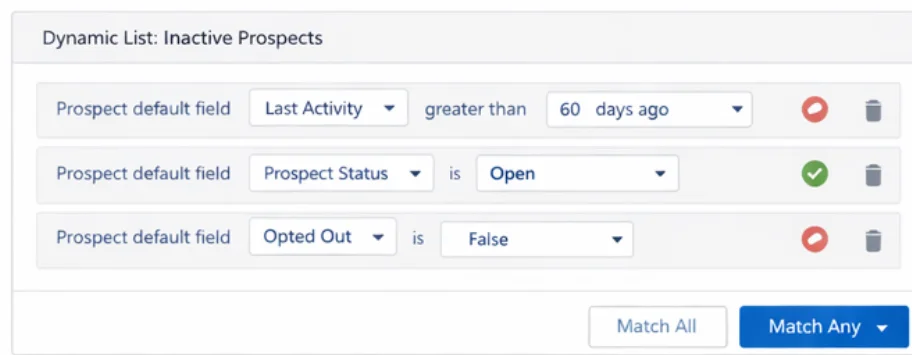
We split the database into smaller cohorts using Dynamic Lists based on prospect and custom fields such as loan type, deal stage, and product interest. Salesforce’s documentation makes it clear that Dynamic Lists are rule-based and automatically add or remove prospects as they match or no longer match criteria.
The segmentation logic was practical.
We separated form abandons, incomplete applications, no-opportunity leads, product-interest cohorts, and score bands. That gave each email a job, instead of asking one message to do everything badly.
Here is a tabular representation of the same.
| Segment | Criteria | Purpose |
| Form abandoners | Started but did not submit | Remove friction |
| Application starters | Began underwriting or onboarding | Recover intent |
| High-interest leads | Strong engagement, no close | Reopen the conversation |
| Low-score dormant leads | Quiet for 30+ days | Warm back up gradually |
That structure makes the journey feel deliberate rather than desperate.
How do you build a Pardot Engagement Studio reengagement journey?
Engagement Studio turns reengagement into a controlled sequence, and Dynamic Content makes each message feel as if it were written for a single person rather than a database.
1. Structure the journey
Engagement Studio is built for multi-step nurture logic, with branching based on prospect criteria and behavior. Salesforce’s FAQ notes it can also run simple series, but its real value is in branching paths that respond to engagement and other rules.
We used the inactive Dynamic List as the entry point and added suppression lists to exclude opted-out users and irrelevant contacts. Salesforce documents suppression lists as a way to omit prospects from list emails or engagement programs, which is exactly what prevents wasted sends and compliance mistakes.
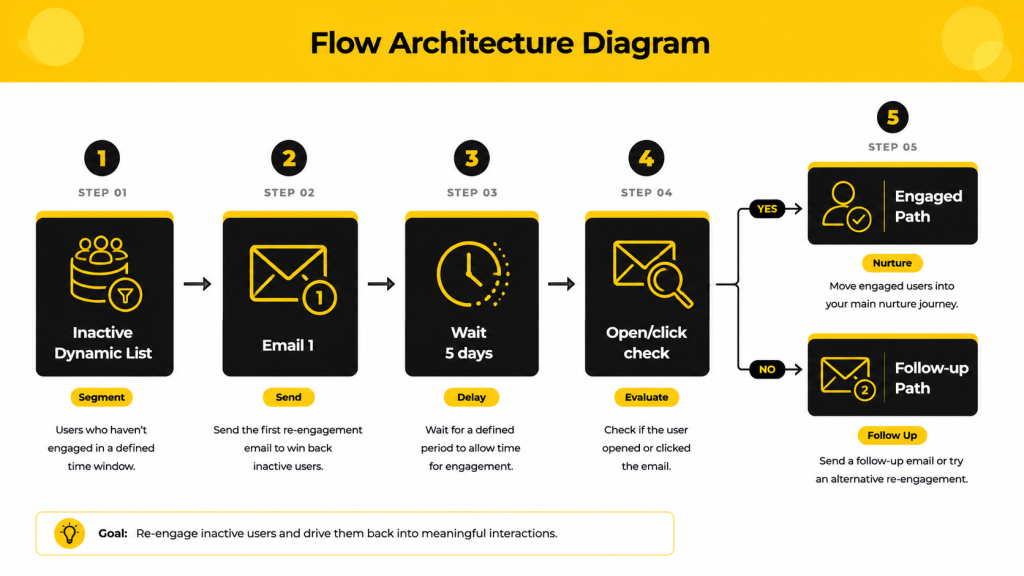
The flow was simple but disciplined:
- Send Email 1
- Wait five days
- Track opens and click behavior
- Route engaged users into the next nurture path
- Move inactive users into a follow-up sequence
That is the difference between a campaign and a system.
2. Personalize the emails using dynamic content
Generic copy does not revive silent leads. Relevant copy does.
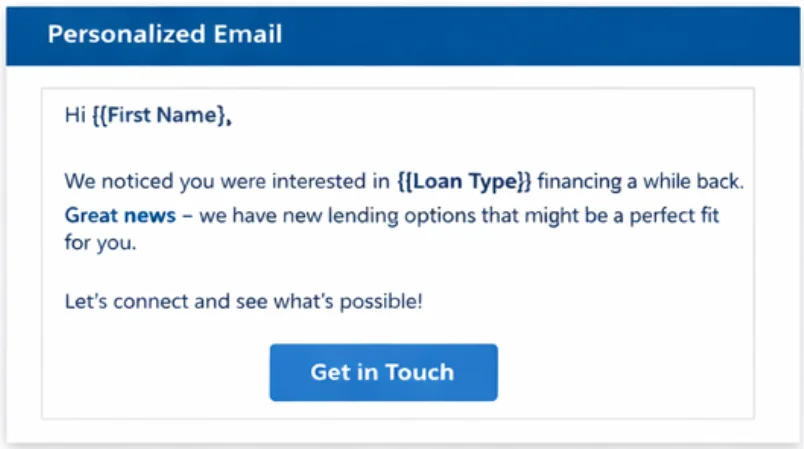
Account Engagement supports dynamic content in emails and templates, enabling you to change messaging based on prospect criteria such as interest, region, or segment. In other words, the same email framework can speak to different pain points without rebuilding the asset each time.
We used variable data such as first name, company, and product interests, but the real lift came from context.
Each email felt as if it were written especially for them.
The email said, “This is still relevant to your situation, and we remember where you left off.”
How do scoring, grading, and sales alignment drive funded deals?
Scoring and grading turn reengagement into a prioritization engine, while Salesforce tasks make sure sales respond the moment a prospect becomes active again.
This is where the database starts behaving like a revenue queue.
Account Engagement’s scoring model is based on what a prospect does, while grading reflects who they are, and Salesforce’s connector can also surface opportunity activity into the scoring model. That combination gives sales a better signal than “someone opened something once.”
Here is the handoff logic we used.
| Prospect action | Pardot / Salesforce feature used | Automated business impact |
| Score increases above threshold | Automation Rules & Lead Scoring | Assigns the prospect to the right sales user |
| Prospect clicks a key link | Engagement Studio action | Notifies the rep that dormant interest is back |
| Prospect re-engages | Salesforce Connector | Creates a task in Salesforce with full history |
That last piece is the one that changes sales behavior.
Instead of cold calling a stranger, the rep tells a story to a prospect.
They know what the lead cared about, when they went quiet, and what reactivated them. That makes the follow-up sharper, faster, and far more human.
We didn’t treat all reengaged prospects equally. We prioritized the hot ones.
Sales does better work when marketing hands over context, not just names.
What are the results and key takeaways of lead reengagement?
Success is measured by movement through the funnel, not vanity metrics. If inactive leads are becoming engaged leads and then funded deals, the workflow is doing its job.
The reporting stack matters here.
Salesforce Marketing Cloud Account Engagement (Pardot) includes standard reporting on marketing assets and prospect lifecycle, and List Email reporting gives clear visibility into sent emails, clicks, and click rates.
We tracked three things: email performance, Engagement Studio path performance, and movement from inactive to engaged.
That combination showed the real impact: silent prospects started responding again, dead deals came back to life, and the sales cycle was shorter than with net-new leads.
The lesson is straightforward.
Old leads do not equal dead leads. Timing matters more than volume, and personalized reengagement is far cheaper than starting over. Salesforce’s tooling is built for that kind of lifecycle recovery when it is used with discipline.
Wrapping up
That brings us to the business end of this article, where it’s fair to say that your old database might not be old at all.
Here are a few key takeaways.
- Old leads ≠ dead leads
- Timing matters more than messaging volume
- Personalization beats automation spam
- Reengagement is cheaper than new lead gen
Some of those “lost” deals only need the right timing, the right sequence, and the right handoff to come back to life.
Ready to unlock trapped revenue? Connect with our Pardot experts today to book a Pardot Database audit. Your dormant pipelines need a revival.