From web development to digital marketing, we build for growth. Head to Mavlers Agency.

Mavlers Logo
Book a call

Your Segment integrations are set up.You may be using less than 30%

Events flow, but activation stalls. Journeys stay in draft, suppression stays empty, and ad waste grows. Mavlers turns your Segment CDP into a revenue engine with triggered journeys across Braze, Klaviyo, and SFMC, synced suppression to paid media, and clear, board-ready ROI visibility.

First journeys go live in 14 days.

Book a 15-min call

Segment setupActivationStill struggling to see returns?

Your MTU bill grows. Your lifecycle revenue doesn’t.

You're paying for volume. Value comes from behavioral signals triggering revenue. Your bill scales with users, but your activation doesn't.

Twilio Engage is configured but not activated

A basic welcome journey isn't enough. Purchase intent, churn risk, upgrade triggers are the journeys that drive compounding revenue; they're still sitting in draft.

Meta and Google are billing you for known users

Your suppression audiences exist. They're just not synced. Every retargeted active user is a wasted spend that your CDP should have eliminated.

No one can prove what Segment is worth

Events flow. Data moves. Revenue doesn't tie back. The board asks for ROI, you show MAUs and event volume. That's not an answer finance accepts.

A 5-phase framework closing the gap between Segment's capability and your activation

Phase01

Investment vs. Return Audit

Weeks 1–2

What happens here

  • Map current Segment setup vs. full activation potential
  • Identify unused journeys, missing suppression, Protocols gaps
  • Quantify activation gaps in revenue terms
What you get: Gap analysis deck + revenue opportunity estimate
Phase02

Taxonomy and Protocols

Weeks 2–3

What happens here

  • Redesign event schema around lifecycle activation
  • Align events to revenue actions (not just UI actions)
  • Configure Segment Protocols to enforce data quality
What you get: Revised event taxonomy + Protocols ruleset
Phase03

Engage Journeys + Suppression Live

Weeks 3–6

What happens here

  • Launch behavioral journeys (churn, upgrade, win-back, referral)
  • Sync suppression audiences to Meta, Google, TikTok
  • Set up attribution flow from Engage to warehouse
What you get: First behavioral journeys live + suppression active
Phase04

Attribution and Reporting

Weeks 6–8

What happens here

  • Build lifecycle revenue attribution model
  • Tie journeys, emails, and SMS to revenue
  • Launch board-ready CDP ROI dashboard
What you get: Attribution model + CDP ROI dashboard
Phase05

Compound Returns

Month 2 onwards

What happens here

  • Run monthly optimization cycles
  • Activate new behavioral signals
  • Refine journeys, suppression, and LTV models
What you get: Monthly increment reports + journey updates

Your best customer signals aren't doing anything.

Purchase intent, churn risk, upgrade triggers; they're all in your Segment CDP data, but not in action. Mavlers wires them into journeys that drive revenue.

From data to marketing revenue- case studies that show how it's done

B2B SaaS platform: Segment/ Twilio Engage activation from zero

Industry

B2B SaaS · 100k+ users · Product-led growth

Challenge

Segment fully instrumented, but Twilio Engage underused, only a welcome journey live. No behavioral triggers, no suppression, no clear ROI. Rising CDP costs under scrutiny.

Solution

Mavlers audited gaps, restructured event taxonomy with Segment Protocols, and activated 6 behavioral journeys in Engage—churn, upgrade, adoption, win-back, expansion, referral. Suppression synced to ad platforms within 48 hours.

Outcome

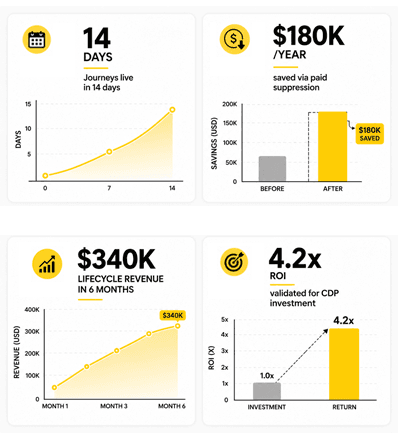
  • Journeys live in 14 days
  • $180K/year saved via paid suppression
  • $340K lifecycle revenue in 6 months
  • 4.2x ROI validated for CDP investment
Case study 01: journeys live, suppression savings, lifecycle revenue, and CDP ROI metrics.

Stack

Segment · Twilio Engage · Snowflake · Braze · Meta · Google Ads · Hightouch
D2C subscription brand: suppression syncs and LTV Modeling

Industry

D2C Subscription · 95K+ active users · Multi-market

Challenge

Segment costs rising with MTU growth. No suppression in paid channels. Twilio Engage underutilized with limited journeys, no LTV or churn modeling, no attribution.

Solution

Mavlers optimized event taxonomy (reducing excess MTUs), activated real-time suppression across paid channels, built 5 behavioral Engage journeys, and implemented LTV + attribution models tied to warehouse revenue.

Outcome

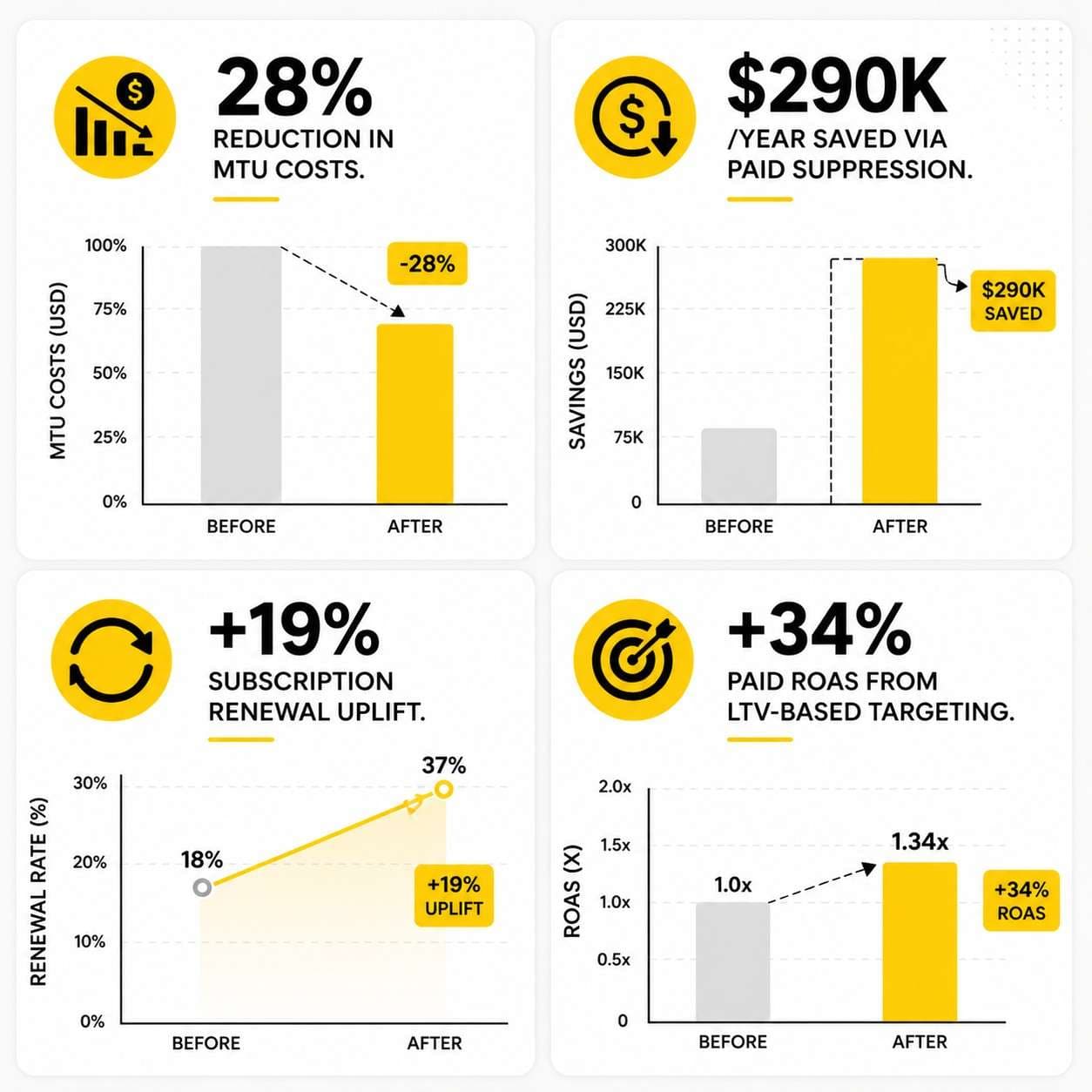
  • 28% reduction in MTU costs
  • $290K/year saved via paid suppression
  • +19% subscription renewal uplift
  • +34% paid ROAS from LTV-based targeting
Case study 02: MTU reduction, suppression savings, renewal uplift, and ROAS metrics.

Stack

Segment · Twilio Engage · Snowflake · Klaviyo · Meta · Google Ads · TikTok

*Strict NDAs limit client disclosure; our current engagements include multiple brands and agencies.

Disney
DMA
Ogilvy
National Geographic
Penguin Random House
Incubeta
Oracle
Airtasker

In the words of our clientsheart

Cloth & Co.

Having one partner who can effectively support multiple areas of our digital presence is both efficient and valuable. The partnership works best when you can collaborate...

Daisy Burgess

Operations Manager

The Maze Group

They bring subject matter expertise to every engagement and clearly identify blockers, dependencies, and requirements. They prioritize proactive communication and problem...

Mathew Feuer

Director of Retention

PetLab Co

Mavlers was clear with communication and provided top-level support. We were on a really tight deadline to get a high priority project across the line and without them we...

Scott Bartlett

Director of Retention

From data collection to activation - fully configured in Segment

Sources

Segment capability

Web (Analytics.js 2.0), iOS, Android, Server-side, Cloud Sources, Reverse ETL from warehouse

Mavlers configures

All downstream destinations via Segment Connections

Protocols

Segment capability

Schema enforcement, event validation, Blocked Events, Transformations

Mavlers configures

Enforces data quality before it reaches any destination

Personas / Engage

Segment capability

Computed Traits, Audiences, Journey Builder, Email/SMS channels

Mavlers configures

Braze, Klaviyo, SFMC, HubSpot, Iterable — full MAP ecosystem

Data Warehouses

Segment capability

Snowflake, BigQuery, Redshift, Databricks — Segment warehouse destination

Mavlers configures

Source of truth for attribution modeling and LTV scoring

Paid Media

Segment capability

Suppression + lookalike seed export

Mavlers configures

Meta Custom Audiences, Google Customer Match, TikTok

Analytics

Segment capability

Amplitude, Mixpanel, GA4, Heap, PostHog

Mavlers configures

Event forwarding with property mapping and filtering

Reverse ETL / Activation

Segment capability

Hightouch and Census — warehouse audiences back into Engage and MAPs

Mavlers configures

Bridges warehouse-computed LTV and propensity scores to Engage

You're already paying for Segment. Are you using all of it?

Most teams use a fraction of what Segment + Twilio Engage can do. Mavlers unlocks the rest.

With Mavlers, add that crucial strategy layer data agencies don't deliver

Segment implementation and management

Hightouch PS / Self-implement

Yes

Pure data agency

Yes

Mavlers

Yes
Revenue-gap audit before build

Hightouch PS / Self-implement

×No

Pure data agency

×No

Mavlers

Yes
Lifecycle-optimized event taxonomy

Hightouch PS / Self-implement

×No

Pure data agency

×No

Mavlers

Yes
Twilio Engage journey activation

Hightouch PS / Self-implement

~Partial

Pure data agency

~Months of build

Mavlers

Yes(in 14 days)
Lifecycle revenue attribution

Hightouch PS / Self-implement

×No

Pure data agency

Custom build

Mavlers

Yes(pre-built)
Paid channel suppression syncs

Hightouch PS / Self-implement

×No

Pure data agency

×No

Mavlers

Yes
Churn prediction from behavioral signals

Hightouch PS / Self-implement

×No

Pure data agency

~Data science hire

Mavlers

Yes(included)
LTV cohort analysis

Hightouch PS / Self-implement

×No

Pure data agency

Possible, slow

Mavlers

Yes(from month 1)
MTU rationalization and cost reduction

Hightouch PS / Self-implement

×No

Pure data agency

Possible

Mavlers

Yes(taxonomy-led)
RudderStack migration (if switching)

Hightouch PS / Self-implement

×No

Pure data agency

×No

Mavlers

Yes
Board-ready CDP ROI reporting

Hightouch PS / Self-implement

×No

Pure data agency

×No

Mavlers

Yes

Engage your way, wherever you are in your Segment activation journey.

Investment audit

Best for

Any Segment customer questioning CDP ROI

What's included

Investment vs. Return Gap Analysis — capability map, gap report, revenue estimate

Typical duration

Free for qualifying clients · 5 business days

Activation sprint

Best for

Audit complete — Engage journeys to build

What's included

Taxonomy + Protocols + Engage journeys live + suppression syncs + attribution model

Typical duration

Fixed scope · 6–10 weeks

Monthly retainer

Best for

Post-launch — ongoing activation optimisation

What's included

Journey management, new signal activation, monthly reporting, LTV model updates

Typical duration

Month-to-month retainer

MTU optimisation

Best for

Segment bill growing faster than value

What's included

Event taxonomy rationalisation to reduce MTU volume without losing activation coverage

Typical duration

Fixed scope · 3–4 weeks

Segment or RudderStack: which is right for you?

Segment is the right fit if...

  • You need a wide destination ecosystem (450+ connectors)
  • Your stack includes multiple long-tail SaaS tools
  • Twilio Engage is central to your lifecycle orchestration
  • You want campaigns inside the CDP (no separate MAP)
  • Your team is marketer-first with limited SQL dependency
  • Your event volume is under ~2M MAUs (MTU costs manageable)
  • You prefer built-in identity resolution (no warehouse engineering overhead)

Consider RudderStack if...

  • Your Segment MTU costs exceed $100K/year and keep rising
  • You operate in regulated industries (data sovereignty is critical)
  • You need full control over the data plane (open-source / self-hosted)
  • Your engineering team wants warehouse-native architecture
  • You already have a mature warehouse and want to avoid Personas MTU costs

Neither may be necessary if...

  • You’re pre-product-market fit (<5K MAUs) — overhead outweighs value
  • You’re deeply invested in Salesforce and can use Salesforce Data Cloud for native unification
  • You don’t yet need advanced identity, activation, or attribution layers

Tell us about your requirement

We'll get back to you within a few hours!

Select a service

Frequently asked questions

We already use Segment CDP. Why do we need you?

Using Segment and activating Segment are two different things. If your journeys run on calendar-based logic rather than behavioral signals, your suppression audiences are not synced with paid channels, and nobody can answer what Segment is returning in revenue. You have a licensed platform, not a working revenue engine.

In many cases, this also means that key data flows or Segment custom integrations required for activation are missing or incomplete. We close that gap.

How is this different from what Segment's own professional services offer?

Segment PS configures the platform correctly. We configure it around your specific lifecycle revenue outcomes. The deliverable from standard Segment integrations and Segment implementation is clean data flowing to the right destinations. Our deliverable is measurable incremental revenue from behavioral triggers, suppression savings from paid channels, and attribution that makes your CDP investment self-evidently worth it.

We have Twilio Engage, but barely use it. Where do we start?

With the audit. In almost every Engage deployment we inherit as a Segment integrations agency, the same patterns appear: welcome journey configured, everything else in draft; behavioral triggers never wired to intent signals; audience sync to paid channels missing entirely. The audit surfaces exactly where your Engage deployment is and what it should be doing. Most clients see the first journey ROI within 30 days of activation.

Our Segment bill has grown significantly. Can you help us reduce it?

Indirectly, yes. MTU costs scale with total tracked users, and part of our taxonomy work involves rationalizing which events and identities actually need to flow at what volume. More directly: our suppression sync work typically saves significantly more in paid media spend than any MTU reduction would. We focus on making the bill worth it before we focus on shrinking it, though for some clients the taxonomy work achieves 20–35% MTU reduction as a byproduct.

What results can we realistically expect?

The first suppression syncs typically show paid waste reduction within two weeks. Incremental lifecycle revenue from activated Engage journeys typically appears within 30 to 45 days. The compounding happens in months two through six as LTV models calibrate and journey logic sharpens. We show you the conservative estimate from your specific audit before any engagement begins.

We are considering RudderStack as a cost alternative. What would you recommend?

For some companies at scale, RudderStack is the right call with lower MTU costs, warehouse-native architecture, and more engineering control. For others, the breadth of Segment integrations and Engage's journey orchestration are worth the premium. The real question is not which platform, it is whether your current platform is connected to lifecycle revenue outcomes. If it is not, switching platforms solves the wrong problem. We also support RudderStack; see our RudderStack services page for details.

How much of our team's time does this require?

First two weeks: four to six hours from your Segment owner or data engineer, two hours from your lifecycle marketing lead. After activation, your team's involvement is strategic - reviewing reports, approving journey logic, and acting on the cohort insights we surface. The infrastructure runs without ongoing engineering input from your side. That is the point.

What happens to our data and our Segment configuration?

You own everything, always. We work inside your Segment workspace, your Twilio Engage account, and your data warehouse. Nothing touches Mavlers infrastructure. Every journey, every Protocol rule, and every attribution model we build is fully documented and stays with you. No dependency on us to keep it running.

We have a data team. Why would we not do this ourselves?

You can. The timeline is typically four to six months to build the lifecycle activation layer properly, which includes taxonomy redesign, journey logic, suppression infrastructure, attribution modeling. If your data team's highest-leverage work is product instrumentation and analytics, lifecycle revenue infrastructure competes with that. We give you a clean boundary: your team owns the product data layer, we own the lifecycle revenue layer on top of it.

Can Mavlers help reduce our Segment MTU bill while improving activation?

Yes, and these goals are not in conflict. Our standard engagement includes a taxonomy rationalization pass that removes unnecessary identity events and anonymous user tracking that inflates MTU counts without contributing to activation value. Clients typically see 20–35% MTU reduction through this process. Simultaneously, we activate the Engage journeys and suppression syncs that make the remaining MTU spend return far more revenue than the cost. The retainer is typically net positive within 60 days of the first journey go-live.

Insights to help you win with lifecycle marketing