From web development to digital marketing, we build for growth. Head to Mavlers Agency.

Mavlers Logo
Book a call

Turn fragmented data into measurable revenue with strategic customer data management solutions

Most CDP programs fail below the platform layer - data model, integrations, and activation. Mavlers owns strategy, implementation, migration, and operations across Segment, RudderStack, Hightouch, Snowflake, and Databricks, connecting platform investment to revenue outcomes.

It's the layer below your CDP where revenue is actually lost

The data going in is wrong

Duplicate profiles. Missing identifiers. Broken event schemas. Your CDP looks accurate, but runs on incomplete data. Segmentation, personalization, and timing all miss the mark.

Activation never happened

Data flows in, but never turns into campaigns, audiences, or predictions. The CDP becomes a storage layer, not a revenue driver.

The platform and the stack don't talk

CRM, product, paid, and analytics each hold a different version of the customer. Without an integration architecture, your campaigns run on stale or inconsistent data.

ROI is hard to show

Marketing sees impact, but not finance. Disconnected or unclear attribution keeps CDP performance out of the P&L and first on the chopping block.

Customer data management solutions that move beyond implementation to impact

CDP strategy and platform selection

Platform decisions made without a data strategy fail at implementation. We audit your data architecture, align it to business goals, define the model, and recommend the right CDP before vendor conversations begin.

  • Current-state audit: data architecture, identity gaps, integration health, activation coverage
  • Architecture decision: packaged (Segment, mParticle, Tealium) vs. composable (warehouse + Hightouch + RudderStack)
  • Vendor selection: RFP design, scoring framework, proof-of-concept scoping
  • Data model design: event taxonomy, identity resolution, consent framework
  • Business case & ROI: cost, timeline, measurable success criteria

CDP Implementation and Integration

A CDP is only as strong as the data flowing into it. We design the taxonomy, build the integration layer, and connect your entire stack to a single, trusted source of truth.

  • Full implementation: Segment, RudderStack, mParticle, Tealium, Salesforce Data Cloud
  • Event schema & tracking plan: designed and enforced from day one
  • Integration architecture: CRM, product analytics, paid media, warehouse
  • Identity resolution: deterministic + probabilistic across web, mobile, CRM, POS
  • Warehouse setup: Snowflake, BigQuery, or Databricks as canonical store

Composable CDP architecture

Not every company needs a packaged SaaS CDP. For warehouse-mature teams, a composable stack often wins on cost, flexibility, and ownership. We design both and recommend what fits your stack.

  • Warehouse-native profiles: Snowflake or BigQuery as identity spine
  • dbt model layer: RFM, LTV tiers, churn risk, product affinity, engagement scoring
  • Reverse ETL (Hightouch): audience syncs + attribute pushes across tools
  • Audience Hub: marketer-friendly audience building, no SQL required
  • Cost modeling: packaged vs. composable over a 2-year horizon

CDP migration

Switching platforms compounds risk if mishandled. We manage end-to-end migration, including data, journeys, segments, and integrations, without disrupting live campaigns or losing profile history.

  • Audit & parity mapping: all sources, destinations, audiences documented
  • Parallel-run validation: dual-platform tracking with <0.5% variance target
  • Schema migration: Segment Personas → RudderStack Profiles, or CDP traits → warehouse models
  • Journey continuity: live campaigns validated before cutover
  • Zero data loss: parity confirmed before decommissioning

Ongoing CDM operations and optimization

Post-launch is where most CDPs stall. We embed into your operations to continuously refine segmentation, identity, and activation, so performance compounds over time.

  • Schema governance: Protocol enforcement, volume monitoring, anomaly detection
  • Segmentation optimization: audience logic refined based on performance
  • Identity graph QA: merge/split audits, rule tuning, deduplication
  • Attribution maintenance: ROI dashboards updated every cycle
  • Release readiness: new features adopted as part of ongoing ops

Your CDP is live. So why isn't it driving revenue?

Most teams buy a CDP but fail at making it work. Mavlers' customer data management consulting turns your CDP into a revenue engine by fixing data, integration, activation, and attribution end-to-end.

From data to marketing revenue- case studies that show how it's done

Global retailer: Composable CDP migration from Segment

Industry

Global Retail · B2C · 8M+ customers · Multi-market

Challenge

High Segment costs ($220K/year), fragmented data across 14 sources, underused Twilio Engage, delayed paid suppression, and no revenue attribution.

Solution

After audit, Mavlers migrated to a composable CDP - Snowflake (identity), RudderStack (pipeline), Hightouch (activation). Built dbt models (RFM, LTV, churn, affinity), unified identity, and activated 14 traits across CRM and paid channels.
Outcome

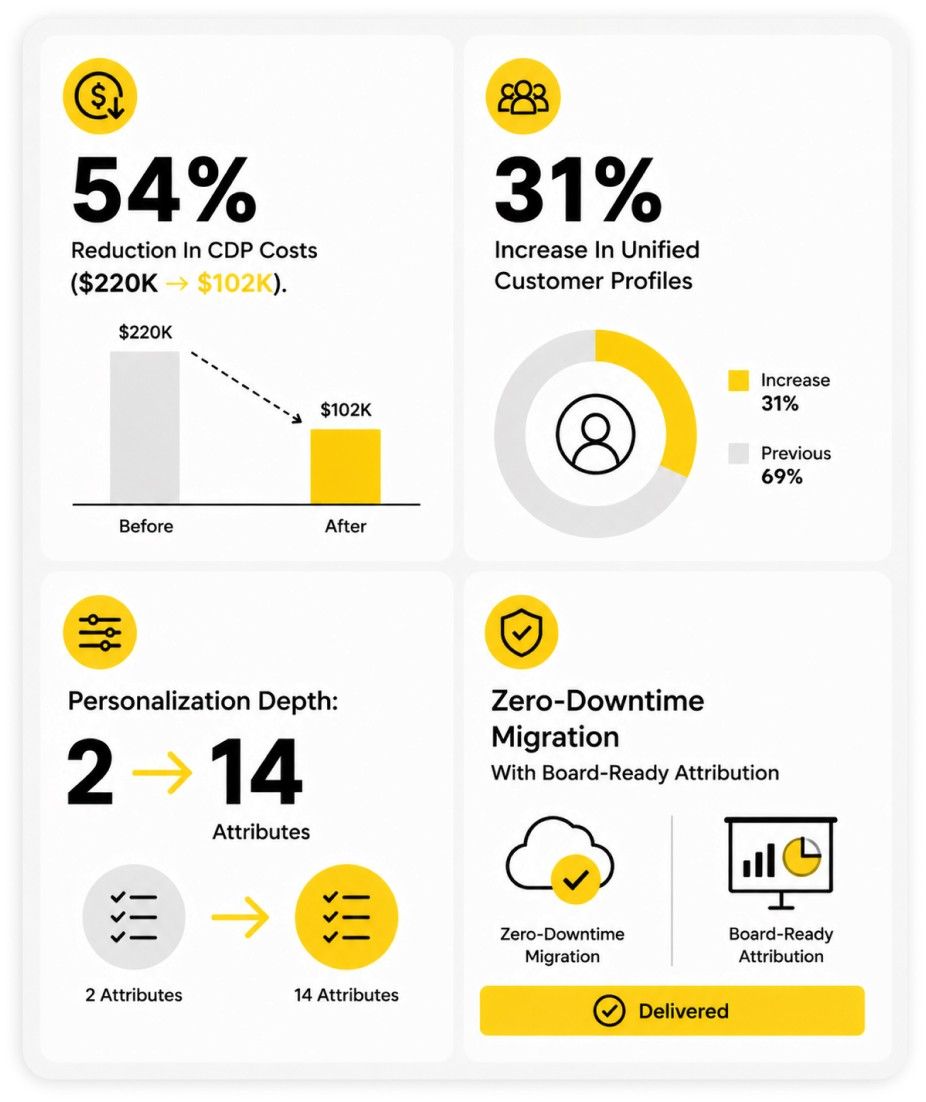
  • 54% reduction in CDP costs ($220K → $102K)
  • 31% increase in unified customer profiles
  • Personalization depth: 2 → 14 attributes
  • Zero-downtime migration with board-ready attribution
Case study 01: CDP cost reduction, unified profiles, personalization depth, zero-downtime migration metrics.

Stack

RudderStack · Snowflake · dbt · Hightouch · Braze · Meta · Google Ads
B2B SaaS scale-up: CDP implementation and activation

Industry

B2B SaaS · Enterprise · 400K+ users · Product-led growth

Challenge

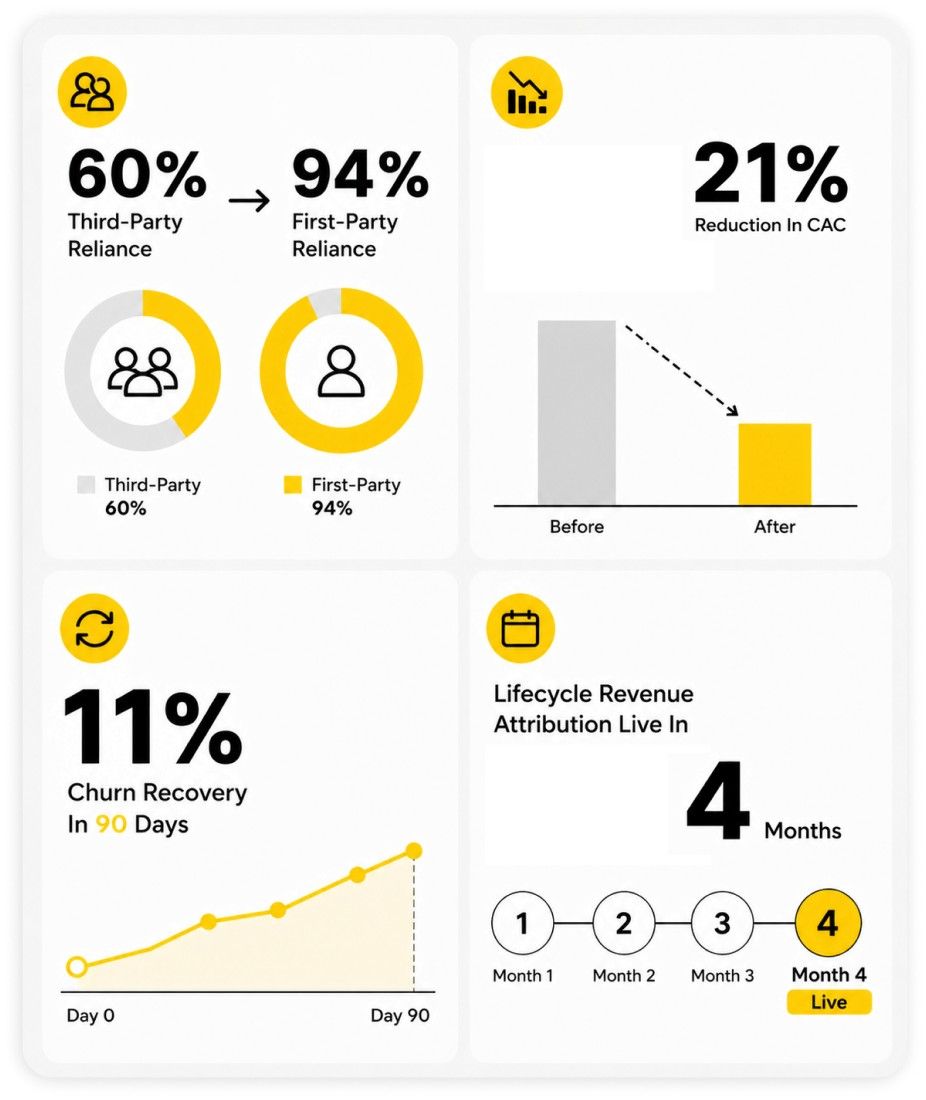
No CDP in place. Data disconnected from campaigns, heavy reliance on manual exports, last-click attribution, and 60% dependence on third-party data.

Solution

Mavlers implemented Segment with Protocols and identity resolution, configured Twilio Engage journeys (churn, upgrade, onboarding), and activated warehouse signals via Hightouch. Built first-party data capture strategy.

Outcome

  • 60% third-party reliance to 94% first-party
  • 21% reduction in CAC
  • 11% churn recovery in 90 days
  • Lifecycle revenue attribution live in 4 months
Case study 02: first-party data shift, CAC reduction, churn recovery, lifecycle attribution timeline.

Stack

Segment · Twilio Engage · Protocols · Hightouch · Snowflake · HubSpot · Braze · Meta · Google Ads
Strict NDAs limit client disclosure; our current engagements include multiple brands and agencies.

Disney
DMA
Ogilvy
National Geographic
Penguin Random House
Incubeta
Oracle
Airtasker

In the words of our clientsheart

Cloth & Co.

Having one partner who can effectively support multiple areas of our digital presence is both efficient and valuable. The partnership works best when you can collaborate...

Daisy Burgess

Operations Manager

The Maze Group

They bring subject matter expertise to every engagement and clearly identify blockers, dependencies, and requirements. They prioritize proactive communication and problem...

Mathew Feuer

Director of Retention

PetLab Co

Mavlers was clear with communication and provided top-level support. We were on a really tight deadline to get a high priority project across the line and without them we...

Scott Bartlett

Director of Retention

From current-state audit to compounding activation performance - our 6-phase CDM delivery model

Phase01

Discovery and audit

Weeks 1–2

What Mavlers delivers

  • Current-state assessment across data architecture, integration health, platform configuration, and activation gaps.
  • Identity graph audit.
  • Compliance and consent framework review.
  • Commercial objectives mapped to activation use cases.
Output / timeline: Audit report + activation gap map
Phase02

Strategy and data model

Weeks 2–4

What Mavlers delivers

  • Commercial objectives mapped to a data strategy.
  • Event taxonomy defined. CDP architecture designed around the outcomes the business needs to produce.
  • Data model documented: customer entity, event schema, identity resolution rules, consent signal flow.
Output / timeline: Data strategy + CDM blueprint
Phase03

Implementation

Weeks 4–10

What Mavlers delivers

  • Full-stack buildout. CDP configured, integrations connected, data pipelines validated.
  • Every connection tested against the commercial use cases it needs to serve.
  • Warehouse destination setup.
  • dbt model layer if composable architecture.
Output / timeline: Platform live + all integrations connected
Phase04

Testing and QA

Weeks 9–11

What Mavlers delivers

  • Segmentation logic, identity resolution, trigger conditions, and cross-channel journey logic validated before a single campaign goes live.
  • Data parity checks. Schema enforcement validated.
  • Event volume and quality baselines established.
Output / timeline: QA sign-off + validation report
Phase05

Activation and launch

Weeks 9–11

What Mavlers delivers

  • Programs deployed against the strategy. Performance monitored in real time.
  • Suppression audiences synced to paid channels.
  • Attribution pipeline live.
  • First journey triggers validated against commercial KPIs.
Output / timeline: All programmes live + attribution running
Phase06

Continuous improvement

Weeks 9–11

What Mavlers delivers

  • Ongoing refinement of segments, journeys, and data quality.
  • Schema governance. Monthly optimization cycles.
  • Attribution model maintained.
  • New signals activated as product evolves.
  • Quarterly strategy reviews.
Output / timeline: Monthly performance reports

Mavlers - your strategic customer data management solutions partner

Strategy before configuration

We start with commercial objectives and not platform setup. Data models, integrations, and activation are designed to drive measurable business outcomes, not just clean pipelines.

Certified across the full stack

Certified across Segment, RudderStack, Hightouch, Salesforce Data Cloud, Tealium, Snowflake, BigQuery, and Databricks. We recommend and build the right architecture.

Full lifecycle ownership

Strategy, implementation, migration, and optimization sit with one accountable team. We eliminate the gaps where most CDM programs break.

Revenue attribution built in

Every engagement is tied to measurable outcomes -revenue impact, retention, and activation rates; it's not just platform activity or engagement metrics.

Your data is ready, but your team can't use it?

We fix usability gaps, from audience access to activation workflows to governance, so marketing can move faster without engineering dependency.

Packaged vs. composable CDP architecture: what's right for you

What it is

Packaged CDP

Managed SaaS platform - event collection, identity, audiences, and activation in one tool

Composable CDP

Modular stack - warehouse as the data foundation, Reverse ETL as the activation layer

Data ownership

Packaged CDP

Limited - data lives in vendor infrastructure

Composable CDP

Full - all data stays in your warehouse

Cost model

Packaged CDP

MTU or event-volume based - scales rapidly with user base

Composable CDP

Warehouse compute + Reverse ETL row fees - typically 40–65% lower at scale

Integration breadth

Packaged CDP

450+ native connectors (Segment) - best out-of-the-box coverage

Composable CDP

200+ via Hightouch - covers all primary MAPs, CRMs, and ad platforms

Marketer self-serve

Packaged CDP

Strong - audience builder, journey orchestration (Twilio Engage)

Composable CDP

Strong via Hightouch Audience Hub - no-SQL audience building on warehouse data

Engineering overhead

Packaged CDP

Low - managed platform, minimal infrastructure

Composable CDP

Moderate - requires warehouse management and dbt model maintenance

Best for

Packaged CDP

Orgs needing 20+ active SaaS connectors, marketer self-serve, or Twilio Engage journey orchestration

Composable CDP

Warehouse-mature orgs (Snowflake/BigQuery already in use) prioritizing data ownership and cost control

Mavlers recommendation

Packaged CDP

Start here if your team is marketing-led and not yet warehouse-mature

Composable CDP

Start here if you have a data team, an active warehouse, and are paying MTU costs that exceed the activation value

Engage your way, wherever you are in your Snowflake activation journey

CDM Strategy Sprint

Best for

Pre-platform — evaluating CDP or composable architecture

What's included

Audit + architecture recommendation + data model + vendor selection framework

Typical duration

3–4 weeks · Fixed scope

Implementation Sprint

Best for

Platform selected — full CDM buildout

What's included

Full platform implementation + integrations + taxonomy + identity + attribution live

Typical duration

8–14 weeks · Fixed scope

Migration Sprint

Best for

Switching platforms or CDP partners

What's included

Full migration: audit + parallel run + validation + cutover. Zero data loss.

Typical duration

10–16 weeks · Fixed scope

CDM Retainer

Best for

Post-launch — ongoing operations and optimization

What's included

Schema governance + segmentation optimization + attribution reporting + release cadence

Typical duration

12+ months · Monthly retainer

Composable Sprint

Best for

Warehouse-mature org — building composable CDP layer

What's included

dbt models + Hightouch setup + audience syncs + Audience Hub + attribution

Typical duration

6–10 weeks · Fixed scope

Tell us about your requirement

We'll get back to you within a few hours!

Select a service

Frequently asked questions

We have a CDP live. What does a customer data management consulting engagement look like for us?

Customer data management consulting at Mavlers starts with an audit of your current data architecture, integration health, and activation use cases. The audit surfaces the specific gaps between what the platform was configured to do and what the business needs it to produce. From there, we scope the engagement to close those gaps.

We are evaluating CDPs and haven't selected one yet. Can you help?

Yes. Platform selection without a data strategy produces the wrong decision. We run a formal selection process, auditing your current state, mapping your objectives, and recommending the right architecture before a vendor conversation starts.

We are unhappy with our current CDP partner. How does a transition work?

We audit the existing environment, document what is working, and take over operations without disrupting live campaigns. Partner transitions are a defined engagement type. We have done them at scale.

Which CDP do you recommend?

The right platform depends on your data architecture, team structure, budget, and growth trajectory. We do not have commercial arrangements that bias our recommendations. We run the selection process and recommend accordingly. In 2025, the most important decision is usually not which CDP to choose; it's whether a packaged CDP or a composable warehouse-native architecture is the right model for your stack.

How do you measure success?

Every engagement is scoped to commercial outcomes defined at the start: revenue impact, retention improvement, activation rate, and attribution coverage. We track against those outcomes throughout the engagement, not platform activity metrics.

Do you work with companies still building the business case for a CDP?

Yes. The business case stage is where the most expensive mistakes get made. With our customer data management solutions, we help you build the case, define the requirements, and make the decision with full visibility of what implementation actually costs in time and resources.

What is a composable CDP, and do we need one?

A composable CDP replaces a packaged SaaS CDP with a modular stack: your data warehouse (Snowflake, BigQuery) as the customer identity layer, dbt for modeling and scoring, and Hightouch or Census as the Reverse ETL activation layer. For warehouse-mature organizations, it typically delivers equivalent activation capability at 40–65% lower infrastructure cost with full data ownership. It is not the right choice for every organization - the decision depends on your engineering capacity, warehouse maturity, and MAP complexity.

How long does a CDM implementation typically take?

A standard packaged CDP implementation (single market, 5–8 integrations, core use cases) takes 8–12 weeks. A composable CDP architecture (warehouse foundation + dbt models + Hightouch activation) takes 6–10 weeks. A full migration from one platform to another takes 10–16 weeks, including parallel-run validation. We scope precisely in the discovery phase and commit to the timeline at the start of the engagement.

How is CDM different from a CRM?

A CRM (Salesforce, HubSpot) is your system of record for customer relationships - it holds contacts, accounts, opportunities, and interactions. A CDP is your system of intelligence for customer behavior - it unifies behavioral event data, resolves identity across channels, and computes the signals (LTV, churn risk, engagement score) that make personalization meaningful. The two are complementary: most effective CDM architectures connect both, using the CRM as a downstream activation destination rather than a data source.

Insights to help you win with lifecycle marketing