 Lifecycle marketing
 Customer data management
 Email campaign production
 Search marketing
 CMS development
 Who we are
 How we work
 Case studies
 Testimonials
 Salesforce Marketing Cloud
 Braze
Braze HubSpot
 Marketo
 Pardot
 DataBricks
 Snowflake
 HighTouch
 RudderStack
 Segment by Twilio
 Videos
Agentforce has crossed a significant commercial threshold.
With over 8,000 deals signed and deployments spanning healthcare, financial services, retail, aviation, and beyond, it’s an enterprise commitment now.
But at the same time, a pattern has emerged. Salesforce’s own CFO described early adoption as “modest,” citing slow rollouts and low near-term ROI. Now, it has nothing to do with the platform as such. The platform is ready. As ready as a self-driving car.
The problem lies in misaligned goals, vague planning, bad data, governance, etc.
As Salesforce Marketing Cloud experts deploying Agentforce for our clients, we take a close look at where implementations break down, and also share Agentforce rollout best practices.
Why Agentforce implementations fail
1. Treating Agentforce as a standalone solution
The most common and costly mistake is treating Agentforce as a self-contained initiative.
When there’s no clear line between what the agent is meant to accomplish and what the business is trying to achieve, everything downstream suffers. Here’s what it looks like:
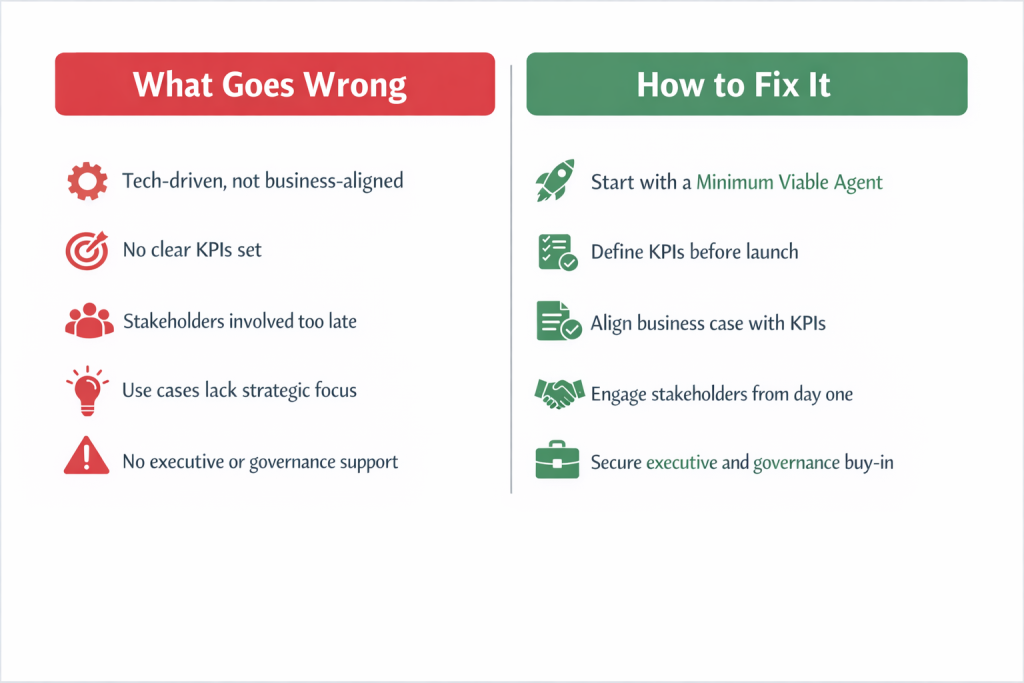
- Agents are configured around what’s technically possible rather than what’s operationally valuable, leading to a vintage-AI-era-anomaly of solutions preceding problems.
- No KPIs are defined before deployment, making performance impossible to measure. Or, when legacy KPIs are applied, they’re obviously not aligned with the agentic context.
- Business stakeholders aren’t engaged until after the agent is customized.
- Use cases are determined more out of enthusiasm than a business-centric vision, leading to underwhelming results which erode executive confidence in the platform.
Without C-level sponsorship and a cross-functional AI governance council evaluating a strategic fit, agents tend to stall at the pilot stage and never scale.
How to fix it
Implement a Minimum Viable Agent (MAV) strategy. Identify one high-impact, low-complexity use case, validate success against the defined KPIs, and scale from there. Before any agent goes into build, require business case documentation showing direct KPI alignment with sign-off from both technical and business stakeholders. Set a firm rule: no agent gets deployed without a defined success metric and a named business owner accountable for the outcome.
2. Underestimating the problem of bad data
Agentforce is only as intelligent as the data it reasons over. It relies on structured, high-integrity data to make contextual decisions and execute business processes accurately. However, if your org is shot through with bad data, handing it off to an autonomous agent can be fatal.
Bad data surfaces in a number of ways. For example:
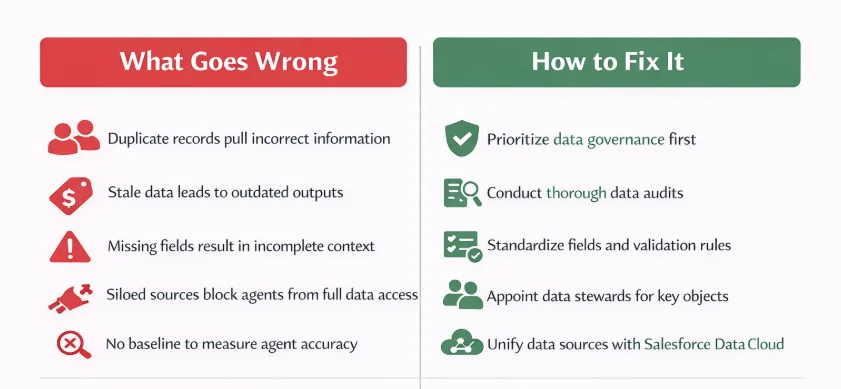
- Duplicate account or contact records cause agents to pull the wrong customer history, generating incorrect or contradictory responses.
- Stale pricing, product, or policy data leads agents to quote outdated information. It can be a significant risk in highly-regulated industries.
- Missing required fields force agents to operate on incomplete context.
- Disconnected or siloed data sources mean agents can’t access the full picture needed to complete tasks autonomously.
- No data quality baseline exists to measure agent accuracy against.
How to fix it
Treat data governance as the first phase of your implementation. Start with a structured audit. Run duplicate detection reports across all core objects, identify fields with greater than 10% null values, and map every data dependency for the actions your agents will need to perform. Standardize picklist values, implement validation rules for critical fields, and assign data stewards with ongoing responsibility for the objects your agents rely on.
Leverage Salesforce Data Cloud to unify fragmented sources. Apply vector-based indexing to unstructured content so that agents can reason over it intelligently.
3. Getting security and permissioning all wrong
Many implementations grant agents broad permissions early in deployment, arguing that controls can be tightened later once the agent is working. But ‘later’ never arrives.
Consequently, without rigorous permission scoping from the start:
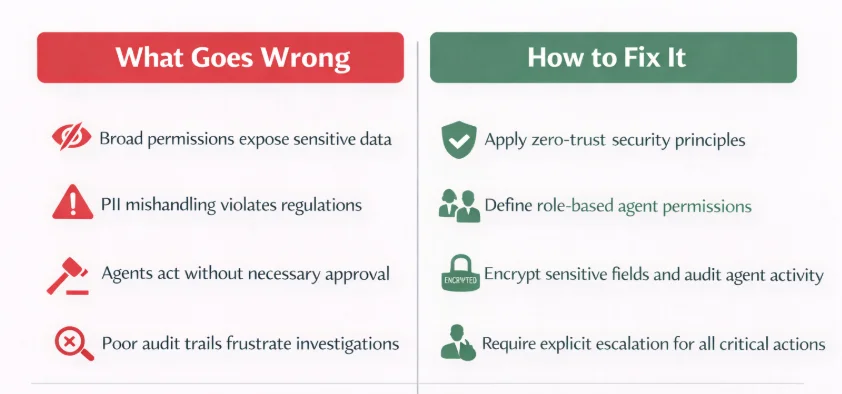
- Over-permissioned agents can access and surface data that the users they’re acting for would never be allowed to see directly.
- PII handling failures expose the organization to GDPR, HIPAA, and CCPA liability.
- An agent can execute high-stakes operations without pre-determined approval.
- Incomplete or absent audit trails make it impossible to investigate incidents or demonstrate compliance after the fact.
In all such cases, security becomes an expensive remediation exercise.
How to fix it
Apply zero-trust principles from day one. Every agent should have an explicit identity, defined permissions, and fully auditable behavior before it processes a single conversation. Define agent personas with specific role-based permissions. Implement field-level security restrictions so agents can only access the data their assigned role requires. Enable Shield Platform Encryption for sensitive fields, set up comprehensive audit trails for all agent actions, and implement session timeout policies to reduce exposure from long-running agent sessions.
For any action carrying financial, legal, or data privacy implications, build explicit escalation paths and human approval checkpoints into the agent’s logic.
Document your compliance alignment before deployment, not mid-audit.
4. Neglecting integration architecture
Any Salesforce maven worth their salt knows the platform doesn’t operate in isolation. How much less would Agentforce. It connects to CRM records, external APIs, third-party tools, and enterprise workflows. And each one of these connections is a potential failure point.
In practice, the absence of integration materializes in these ways:
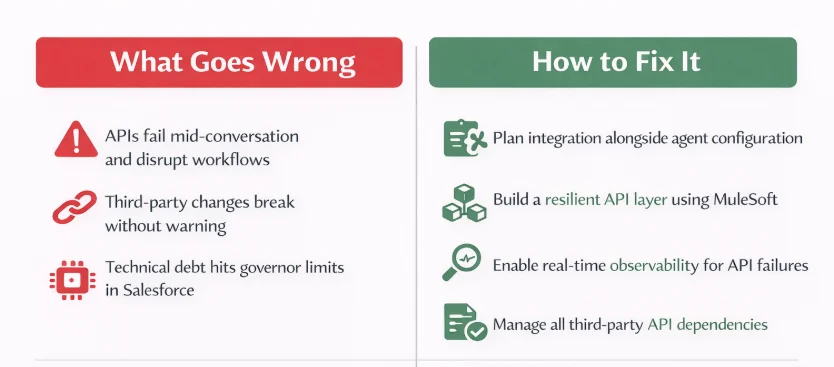
- API connection failures with third-party tools interrupt agent workflows mid-conversation, leaving customers confused or customer issues unresolved.
- Changes to external APIs ripple into agent behavior in ways that aren’t visible at once.
- Existing technical debt in Salesforce flows and automations surfaces as governor limit issues once agent traffic starts piling real load onto the org.
Advanced Turf Solutions, a large retailer with disconnected systems and mounting operational inefficiency, achieved a 95% improvement in integration reliability after deploying Agentforce. But it required designing the integration architecture alongside the agent, not retrofitting it.
How to fix it
Design your integration architecture in parallel with your agent configuration.
Start with a pre-implementation technical health check: optimize existing flows and automations, review CPU time consumption patterns, address governor limit vulnerabilities before agent traffic amplifies them, and implement bulkification best practices across your automation layer.
Use MuleSoft or an equivalent integration platform to build a governed API layer that agents can invoke reliably, with built-in resilience and fallback handling for external API failures. Implement an observability layer so your team catches failures before customers experience them.Review API dependency documentation for every third-party tool your agents call. Build change management processes that flag upstream API updates before they disrupt workflows.
5. Ignoring change management
Agentic deployment demands a DNA-level shift in how your organization does things. Alongside governance, it’s one of the most profound challenges teams face.
If you treat it as just another technology rollout, you’ll likely encounter patterns like these:
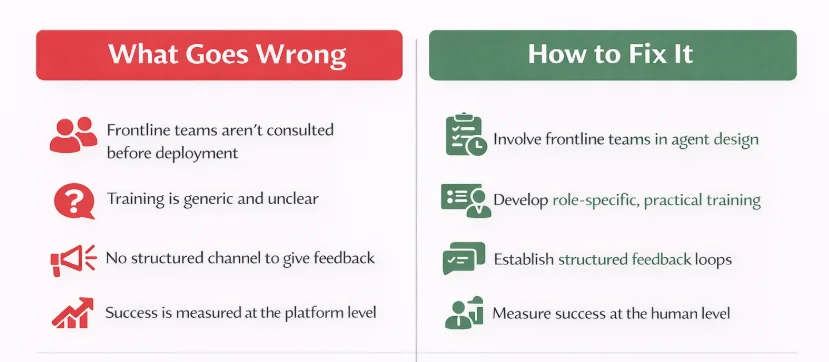
- Frontline teams aren’t involved in defining agent scope. Consequently, the agent fails to reflect how work actually gets done day to day.
- Training remains rather generic, leaving users unsure when to trust the agent, when to step in, and how to escalate effectively.
- There’s no structured feedback loop for users to flag errors or gaps.
- Success is measured at the platform level rather than the human level where real adoption happens (or doesn’t).
Indeed found that agent deployments require fundamentally changing team structures and how internal processes are designed. Linda West, VP of Business Automation at Indeed, noted that investing time upfront to understand which data sources will enrich agent context is one of the most critical parts of the entire process. And that understanding comes from a deep collaboration with the people who do the work.
How to fix it
Initiate change management before the build begins. Involve frontline teams in scoping sessions so agents are designed around real workflows. Develop role-specific training that addresses the practical questions users actually have: when should I trust the agent’s output? When should I override it? How do I escalate when something looks wrong?
Communicate clearly and repeatedly that Agentforce is designed to handle volume and repetition so people can focus on the higher-judgment work. Build structured feedback loops into your operating model so users have a formal channel to flag errors, knowledge gaps, and edge cases. Establish a weekly triage process to act on that feedback systematically. Measure adoption at the human level: are teams actually using the agent, or routing around it?
Post-deployment governance
Without ongoing performance reviews, iterative refinement, and regular permission audits, agents will gradually drift away from your core business objectives. Agentforce must be treated as a living system. That requires continuous governance, structured around three operating cycles:
- Weekly: Review agent performance metrics, identify top failure patterns, triage knowledge gaps versus logic errors, update knowledge bases, and deploy validated fixes.
- Monthly: Conduct comprehensive audits across all active agents, review permissions and security configurations for drift, analyze guardrail effectiveness, synthesize user feedback into prioritized improvements, and adjust the roadmap based on what the data is showing.
- Quarterly: Run a full governance framework review, refresh compliance certifications, assess agent ROI against original baseline projections, align stakeholders on outcomes, and plan capability expansions grounded in proven performance.
Engine, a travel platform, built exactly this kind of continuous improvement loop after deploying their Agentforce agent. The team reviewed moments in the dashboard where the agent struggled, wrote new knowledge articles for those specific cases, and redeployed. This led to $2 million in anticipated savings from queries handled without human intervention, and a customer satisfaction score that improved from 3.7 to 4.3 out of 5.
Need a Salesforce Agentforce implementation strategy?
The gap between Agentforce’s potential and its implementation is concerning.
Whenever a disruptive technology emerges, there’s a natural tendency to confuse the pathways of delegation. Every new technology demands a new philosophy of engagement.
Every external shift requires a corresponding internal one
As far as Agentforce implementation goes, one of the Marketing Cloud communities bundles it into the so-called DREAM framework, which sums up pretty much everything:
- Data excellence as your foundation
- Review with human oversight
- Ethical framework
- Aligned and clear objectives
- Measurement and improvement plan
As experts in SFMC, we can help you with Agentforce implementation. With over 10 years of experience in serving more than 800 SFMC clients, we can be your go-to execution partner. Book a free, no-obligation call with one of our SFMC experts.