Agentic AI for B2B: How Marketo and Salesforce compare, and what it means for your strategy
Salesforce Agentforce or Marketo? Discover how each platform approaches agentic AI, where they differ, and how to choose the right foundation for your B2B growth strategy.
By Chintan Doshi
7 minutes
December 5, 2025
With 63% of marketers reporting revenue gains and 61% of B2B teams already using AI to flag conversion-ready leads, the pressure to modernize your stack is unmistakable. The danger lies in choosing a platform that doesn’t fit your specific context—stalling your AI roadmap and locking you into workflows that automate the wrong tasks or demand constant manual intervention. Too many teams invest in “AI-powered” tools that never move the needle on lead quality or revenue.
At Mavlers, our Salesforce Marketing Cloud and Marketo Engage specialists have supported dozens of B2B organizations. We know which AI capabilities consistently drive conversion lift—and which ones are just shiny add-ons. And we don’t stop at implementation; we optimize these platforms to deliver measurable, scalable outcomes in an AI-first landscape.
This guide cuts through the noise and explains how Salesforce and Marketo approach agentic AI, plus which model aligns best with your growth strategy. By the end, you’ll have a clear framework to choose a platform that strengthens your competitive edge. Let’s get started!
Salesforce Agentforce vs Marketo
1. Architectural philosophy and scope
Marketo
B2B specialist, content-driven CX: The platform focuses its agent on solving the biggest problem for B2B, which is complex, multi-touch orchestration and conversion. Recent Adobe Marketo AI updates reinforce this direction.
Ecosystem: Agentic features are often powered by Adobe Sensei and Adobe Firefly (for content) and are governed by the Adobe Experience Platform (AEP).
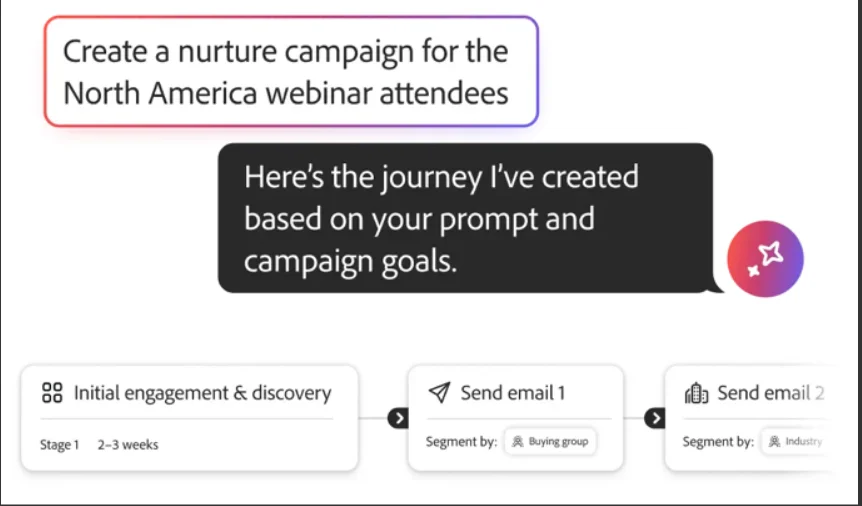
Agent focus: Marketo’s Journey Agent automates the design, setup, and optimization of long-running nurture and ABM programs, supported by Marketo Engage agentic capabilities that help marketers scale intent-driven experiences.
CRM generalist, cross-cloud authority: Salesforce focuses on addressing the entire customer experience (CX) across sales, service, and marketing.
Ecosystem: Agentic features are part of Agentforce.
Agent focus: Agentforce is a framework that includes agents for Campaign Creation, Paid Media Optimization, and Two-Way Conversation across all channels.
2. The agentic loop: How agents take action
Marketo
The Journey Agent excels at translating unstructured requests into an executable flow in Marketo.
The agent builds the journey structure, sets up necessary steps, and recommends content placeholders, significantly speeding up the initial campaign setup time.
The agent’s optimization centers on B2B attribution and lead quality. It aims to proactively detect performance anomalies in lead status, MQL conversion rates, or sales-readiness. The goal is to provide AI-recommended actions to tune the program’s transitional rules or content stream priority to maximize revenue impact.
Agentforce agents for Campaign Creation are broader. From a prompt, they can generate the audience segment (via Data Cloud), create the content (copy, subject lines), and build the entire multi-channel journey in Flow.
The agents can facilitate two-way conversations—the agent can initiate a dialogue and then autonomously respond to customer replies in real-time.
Agents focus on in-flight, real-time optimization across more channels. For instance, the Paid Media Optimization Agent monitors ad performance 24/7, suggesting or autonomously making budget reallocations based on the real-time return on ad spend.
The platform also leverages Personalization Decisioning Agents to determine the optimal channel and content at the moment of engagement.
3. Cross-functional impact
Marketo
Marketo’s strength lies in handling lead lifecycle management and ABM complexity. Marketo AI-powered agent workflows can make it effective in environments where sales alignment and lead progression rules are deeply nuanced.
While it includes enhanced CRM sync capabilities and Visual Journey Builder tools, its core agent remains focused on mastering marketing automation tasks.
Its cross-functional value comes from generating high-quality, sales-ready leads. It delivers robust account scoring that supports sales alignment and prioritization.
It provides detailed multi-touch revenue attribution that ties marketing actions directly to closed revenue, giving sales teams the evidence they need.
For example, a marketing agent can detect a high-value prospect showing urgent intent. It can autonomously create a priority task for the Sales Cloud rep. The task includes a full summary of the prospect’s web and email history.
To sum up, Marketo’s approach is characterized by a vertical, B2B-focused orchestration agent that is tightly integrated with Adobe’s creative and content ecosystem. Salesforce, on the other hand, takes a horizontal, CRM-centric approach with a suite of agents designed to operate across the entire Customer 360 platform, linking marketing, sales, service, and commerce.
Note on Marketo: While the Journey Agent is the most prominent and newly introduced agentic AI feature within Adobe Marketo Engage, the broader Adobe Experience Cloud is developing multiple purpose-built agents. Emerging themes around Adobe Agentic automation in Marketo underscore Adobe’s commitment to deep, domain-specific agent workflows.
Early adopter findings: Salesforce & Marketo
Early adopters of Salesforce are seeing significant efficiency gains across clouds, with Service Cloud pilots showing agents autonomously resolving 86% of cases.
Companies like VTT have launched Agentforce pilots in just three to four weeks.
Marketo is only just entering the agentic conversation, and Adobe’s early messaging is centered more on outlining the capabilities and strategic intent.
Marketo’s public narrative is largely theoretical, emphasizing the efficiency the Journey Agent is designed to deliver—turning unstructured inputs like campaign briefs into executable journey frameworks and cutting the time spent on manual design, setup, and governance for complex, multi-buyer B2B programs.
How does agentic AI impact B2B marketers?
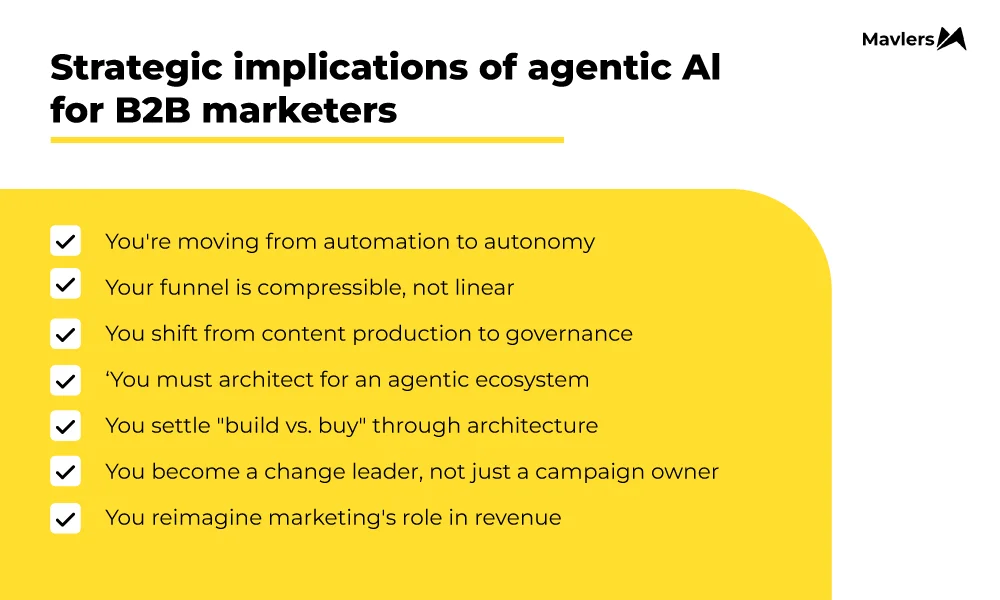
Agentic AI is reshaping the way B2B marketers think about strategy, execution, and impact. It’s not just another tool—it fundamentally changes how you operate in B2B:
You’re moving from automation to autonomy. Most marketing tech automates tasks, not decisions. Agentic AI gives you “workers” that understand objectives, interpret signals, and act independently, letting you supervise autonomous systems that proactively drive pipelines.
Your funnel is compressible, not linear. Traditional GTM relied on distinct human-owned stages. Agentic AI collapses these boundaries. Lead gen, qualification, nurturing, pricing, and customer success can run in parallel. As a result, you now rethink funnel architecture, not just optimize it.
Your personalization ceiling literally explodes. Agentic AI removes the trade-off between personalization and scale. AI agents autonomously research accounts, parse intent data, and craft bespoke, multi-touch omnichannel sequences.
You shift from content production to governance. GenAI reduces content creation from hours to seconds. Your value lies in defining tone, guardrails, messaging hierarchies, and governance that AI agents operationalize consistently across channels.
You gain exponential conversion lift. When AI orchestrates timing, personalization, channel mix, and follow-up, conversion rates jump in striking multiples.
You must architect for an agentic ecosystem. B2B marketing can’t rely on point tools. Agentic GTM needs orchestration, lead gen, qualification, deal conversion, and customer success agents working together with shared memory, not disconnected experiments.
You settle “build vs. buy” through architecture. It’s not more tools, it’s the right sequencing. Start with high-impact use cases, scale via feedback, and avoid shadow IT; otherwise, you spend more time reconciling agents than engaging customers.
You become a change leader, not just a campaign owner. BCG’s 10/20/70 rule shows that 70% of value comes from people and processes. Your biggest challenge will be adoption, talent enablement, and confidence. Your role as a marketer now spans training, alignment, and cross-functional orchestration.
You reimagine marketing’s role in revenue. As AI handles repetitive tasks, you define the North Star, codify customer experiences, shape messaging, govern channels, and integrate insights. You’re not running campaigns; rather you’re architecting an AI-powered commercial system.
But before deploying agents, you must solve the data quality problem. Without strong data hygiene and unified context, your AI agents become noise. As a marketer, you must enforce CRM cleanliness, integrations, and real-time signal ingestion. Your data layer becomes your growth engine.
There are several ways to implement a data quality layer, including free solutions from Salesforce Labs and powerful third-party AppExchange apps. A popular, free solution is the “Data Quality Analysis Dashboards” app by Salesforce Labs on the AppExchange. This package provides pre-built dashboards that utilize custom formula fields on standard objects to record data quality and completeness, offering a good starting point for detailed insights.
How to solve the data quality issue in Salesforce?
Use native Salesforce List Views and Reports to spot duplicates and incomplete records, then manually merge or export, clean, and reimport them as needed. Assign incomplete records to team members for cleanup, and generate reports that group invalid data by the responsible user so each person can correct their own entries. Finally, run Salesforce Optimizer to analyze field usage and identify unused or minimally populated fields for removal.
For Marketo, you can explore best practices in our blog on Marketo data hygiene.
Salesforce Agentforce vs Marketo: Where to start?
The complexity of agentic AI adoption can feel paralyzing, but you don’t need to boil the ocean. You need a systematic diagnostic, a single high-impact pilot, and organizational alignment before scaling. Consider the following tips to begin with:
Map where your team spends the most manual time (lead scoring, campaign optimization, nurture sequencing, budget allocation). The biggest pain point is your first pilot.
Choose one high-volume, repetitive process with clear ROI.
Establish decision authorities, escalation criteria, transparency requirements, and ethical guidelines for autonomous decision-making before you deploy anything.
Bring your CMO, VP Sales, VP Ops, and CTO into the same room and align on success metrics, resource commitments, and timelines.
Start with diagnosis, not with dreams about what’s possible. Let the friction points you find drive where you invest first. If you’d like guidance on where to begin, we’re happy to help.
Chintan Doshi
Reviewer
Head of Email & CRM at Mavlers, specializing in lifecycle marketing and marketing automation. Experience spans ecommerce, media, and enterprise brands, with deep expertise across SFMC, HubSpot, Braze, Marketo, and Klaviyo.
Susmit Panda
Content Writer
Specializes in writing on email marketing, CRM, and marketing automation platforms. Combines strong writing expertise with deep domain knowledge to create clear, insight-led content on lifecycle strategy, campaign optimization, and martech ecosystems.

 Lifecycle marketing
 Customer data management
 Email campaign production
 Search marketing
 CMS development
 Who we are
 How we work
 Case studies
 Testimonials
 Salesforce Marketing Cloud
 Braze
Braze HubSpot
 Marketo
 Pardot
 DataBricks
 Snowflake
 HighTouch
 RudderStack
 Segment by Twilio
 Videos