
 Lifecycle marketing
 Customer data management
 Email campaign production
 Search marketing
 CMS development
 Who we are
 How we work
 Case studies
 Testimonials
 Salesforce Marketing Cloud
 Braze
Braze HubSpot
 Marketo
 Pardot
 DataBricks
 Snowflake
 HighTouch
 RudderStack
 Segment by Twilio
 Videos

“The number one challenge isn’t creative block or budget. It’s that your marketing tools are basically strangers living in the same house.”
So that’s how Customer.io’s report on the challenges of lifecycle marketing puts it. As lifecycle marketing experts ourselves, it’s less surprising than it’s disheartening.
Even with composability emerging and chart-topping launches around agentic AI, nearly 53% of marketers still wrestle with the Frankenstack. These tensions often reflect deeper marketing automation data challenges that keep systems from functioning cohesively. What this boils down to is that:
- Marketers still can’t fully trust their own metrics
- The customer journey still remains a set of disconnected touchpoints
- Skilled teams are bogged down in data plumbing
- Agentic AI is underwhelming for most users
Clearly, we need to zero in on data integration. With over half of marketers struggling with integration issues still, finding a durable solution has become critical.
In today’s post, we want to help you step back, understand the real problem, and walk away with a few practical ways to solve data integration problems.
And let’s start with the truth: it’s not the tech.
The real problem isn’t technology
To begin with, this is an organizational problem disguised as a technology problem. Gene de Libero, writing in Martech, asserts, “The problem isn’t in the code or the platform. It’s not hiding in API documentation or data schemas. It’s staring us in the face from organizational charts, departmental KPIs and meeting structures where marketing, sales and IT leaders barely speak the same language.”
Generally speaking, here’s how the integration problem emerges across companies:
- Past failures stem from leading with shiny tools instead of defining what success looks like first.
- As companies grow, they form departments—and departments inevitably silo, not by intent but by design.
- Technology can now unify data across marketing, sales, and operations, but the people using it haven’t yet learned to operate as one system.
- Enterprise transformations stall because of human dynamics, not because of change-management plans—we fixate on what will change instead of how we will work together.
- When everyone is responsible for the customer experience, no one truly owns it, leading to competing priorities instead of shared outcomes.
Even stack complexity isn’t a problem in itself, as Scott Brinker says, “A complex stack in a mature martech organization, which has thoughtfully architected it, integrated it properly into their environment, and created the right enablement and governance to help teams properly leverage it, can be an amazingly powerful asset.”
If martech maturity is at the root of the issue, the technological dimension becomes equally important. As a result, any solution framework must account for both perspectives. With this dual-focused framework in place, we can explore how to tackle the challenge of integration, especially as lifecycle marketing data integration becomes a core business competency. So, let’s do that.
Related: The Trojan Cow: Why CRM Implementation Fails
Addressing data integration in lifecycle marketing
1. Start with data collection
Before optimizing workflows or evaluating new platforms, it’s crucial to address how customer information enters your ecosystem in the first place:
- Collect all data once, directly in a first-party context, and route clean, governed, consent-compliant data to every system that needs it.
- Apply governance and transformations at the point of capture, not dozens of times across disconnected tools.
- Send data server-side in real time so that every downstream system receives consistent inputs.
- Eliminate performance drag: every extra tag adds ~250 ms of latency, hurting conversions and SEO.
- Prevent accidental leakage. When you control the collection layer, you decide exactly what gets shared and where it goes.
This upstream discipline also establishes the foundation for customer data integration for marketing, especially when downstream tools depend on consistent signals.
Read: Turning Data into Dollars: Future-proofing CRM, Loyalty, & Retention
2. Build a unified data layer
The importance of a common data layer can’t be underestimated. As Scott Brinker explains, “it breaks us out of the hell of a hundred siloed app databases that has been the greatest pain point of our heterogeneous tech stacks for the past decade. All of the data across marketing — and other relevant departments, such as product, sales, and customer service — is gravitationally pooled in the warehouse/lakehouse, where it is then technically accessible to any app within your stack.”
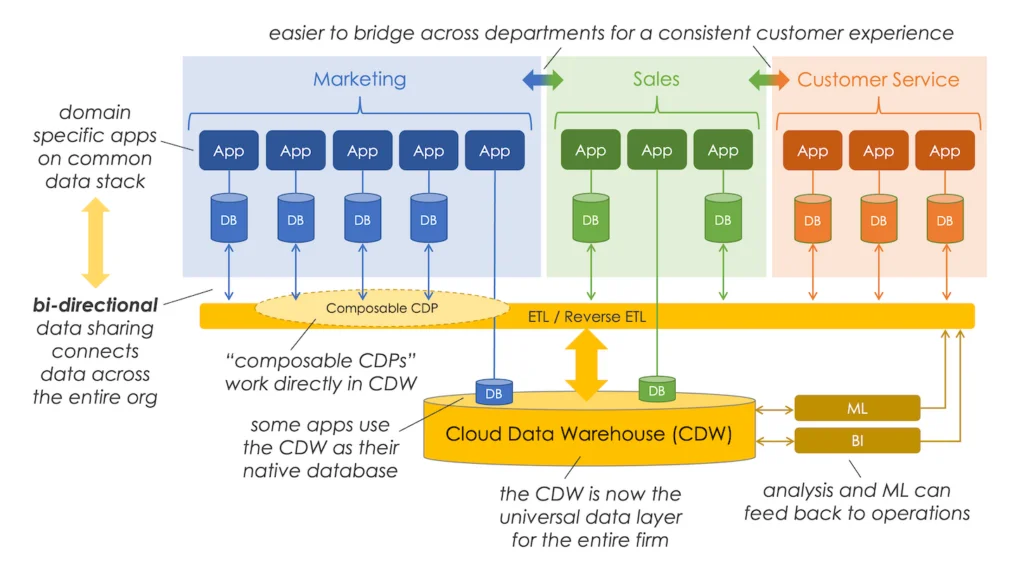
Unified data layer for martech
It’s not that marketers aren’t aware of this. Over 56% already integrate with a data lake to establish a unified data layer, according to the 2025 State of Stack Survey.
All roads lead to your data warehouse or CDP. Make it your single source of truth:
- Match, clean, and enrich data in one place, and then feed it back into frontline systems for activation.
- Get over the challenge of consolidating data from multiple sources, then tackle the messier second challenge of making that data actually make sense.
- Work with your Data Protection Officer for a single, unified customer record so the same customer isn’t fragmented across multiple systems.
A unified layer also enables customer data unification strategies to function, ensuring continuity across marketing, sales, operations, and product teams.
3. Fix the organization, not just the stack
Technology enables collaboration, but humans have to do the actual collaborating.
- Adopt a birthright access model—grant marketing, sales, and service teams default access to 90% of non-sensitive data. Remove license barriers and shift from per-seat to consumption-based pricing to truly democratize access.
- Use OAuth to extend warehouse permissions to downstream tools. Try to avoid duplicating governance in BI, marketing automation, or analytics platforms.
- Build self-service portals for restricted data—simple apps where users request access with clear documentation.
- Empower marketing, sales, and service operations as “domain stewards” who own data quality in their areas. They act as honorary members of the core data team, adding capacity and crucial business context.
- Create hybrid roles with one foot in IT and one foot in marketing—these bridges matter more than any platform feature.
- Build cross-functional teams with contributors from multiple departments working toward shared goals, not departmental KPIs. Document new workflows, RACIs, and shared goals.
- Smooth out obstacles early by asking what will break when we change this, not discovering friction points after everyone’s frustrated.
- Someone must own the customer experience end-to-end, even if delivering it requires orchestration across five departments.
Empower everyone to be data-driven, regardless of title. Challenge the idea that only “analysts” work with data—marketers, sales reps, service teams, and product managers should all see themselves as data-enabled. Eliminate access barriers, provide training, and recognize non-technical users who use data to make smarter decisions.
4. Measure what actually matters
Stop counting activities and start measuring system health. Shift toward metrics that reveal how efficiently your data moves, connects, and powers CX:
- Track match rates across systems—what percentage of records successfully connect to create unified customer profiles.
- Measure time from event to availability in activation systems because real-time data enables real-time decisions.
- Monitor addressability rate. You should know what percentage of your total traffic can actually be identified and targeted.
- Count integration points, not number of tools—bidirectional data flows matter more than how many logos are in your stack diagram.
- Focus on campaign velocity, that is, how fast can you go from idea to execution to results to iteration.
As teams improve measurement discipline, they uncover opportunities to enhance data quality in lifecycle marketing, reinforcing a virtuous cycle of better insights and faster activation.
Track people-focused KPIs alongside technical metrics. Go beyond pipeline performance and data quality by measuring workforce engagement with data tools, customer effort scores, speed-to-insight, process improvement rates, and employee satisfaction with data access. Technology exists to help people deliver value to others. Measure that.
5. Design for change, not prediction
Nobody knows what’s possible in two years, so prepare to adapt instead of trying to predict. With that in mind, consider the following tips:
- Organize your data layer now because regardless of how AI evolves, you’ll need access to well-managed data.
- Work with tools that have open APIs since that’s how automation and AI agents will coordinate between systems.
- Build capacity within your people and your strategy to react when something happens that you can’t anticipate today.
- Accept that the cost of experimentation is approaching zero, meaning iteration speed becomes your competitive advantage.
- Stop making five-year technology roadmaps. Make three-month experiments with clear success metrics and permission to pivot.
This mindset is important as lifecycle marketing data integration becomes more dynamic and less dependent on monolithic architectures.
How to design data governance
Data governance ensures that data across your organization is accurate, accessible, secure, compliant, and usable for decision-making. It combines strategy, process, ownership, tools, and people enablement into one operating system for managing data. Below is a consolidated, actionable list of what you must do:
- Define a company-wide governance vision that clarifies its purpose, expected outcomes, and how it improves decision-making and operations.
- Establish a governance model—centralized, decentralized, or federated—and define roles for owners, stewards, custodians, and consumers.
- Create a governance council and working groups that drive decisions, approve standards, resolve issues, prioritize initiatives, and align teams.
- Define data domains and subdomains, assign owners, document boundaries, and set standards for lifecycle, quality, access, and issue resolution.
- Develop a unified, version-controlled glossary that standardizes metrics, terms, calculations, and naming conventions across all platforms.
- Implement data quality frameworks with validation, deduplication, accuracy thresholds, completeness checks, timeliness SLAs, and automated monitoring.
- Map data flows and lineage, including sources, transformations, destinations, and dependencies, to ensure visibility and reliability.
- Ensure compliance with regulations and privacy requirements through retention rules, consent management, minimization, and subject-rights handling.
- Define data lifecycle and retention policies covering capture, storage, archival or deletion, and team accountability in line with legal and business needs.
- Standardize data collection across forms, APIs, event tracking, CRM fields, and integration schemas for clean, consistent, automation-ready capture.
- Implement metadata management by documenting schemas, field definitions, sensitivity levels, transformation logic, owners, and dependencies.
- Deploy governance tools such as catalogs, data quality and lineage platforms, MDM systems, and workflow automation to enforce standards.
- Establish continuous monitoring and audits with dashboards, anomaly alerts, periodic reviews, and clear issue-reporting channels.
- Embed governance in all workflows, requiring quality, compliance, naming, and documentation reviews for every new feature, campaign, automation, API.
- Promote governance through onboarding, training, playbooks, documentation, and champions to ensure adoption and consistency.
Don’t ignore the politics of data ownership. Marketing may resist sharing campaign data with sales, sales may guard customer insights, and product teams may keep roadmaps close. Unless you address data-sharing culture and incentives directly, even the best technical integrations won’t make a difference.
How to choose a data governance maturity model
Selecting the right data governance maturity model requires a structured, thoughtful approach. The points below outline the key considerations that will guide an effective and informed choice:
- Pick a model that addresses the areas most relevant to your business, ensuring flexibility and scalability for your industry, size, and needs.
- When using third-party vendors, request detailed assessment data, and not just summary reports, to interpret results in your organization’s context.
- Choose a model that complements your current governance or management frameworks or provides guidance on necessary changes.
- Consider both freely available and paid models, factoring in acquisition cost, implementation effort, and associated consulting or software tools.
- Secure executive leadership buy-in to ensure resources and reinforce program importance. Offer a shortlist of two or three models, explaining how each supports business drivers, anticipated outcomes, and resource requirements.
Robust maturity frameworks also contribute to stronger customer data unification strategies, enabling teams to scale governance alongside business evolution.
The role of agentic AI in martech integration
Customer.io’s report points out that 46% of marketers say manual work still consumes most of their time. At the same time, AI has shifted from “experimental to essential” since 2024, with adoption now reaching 85% of marketers. This needs unpacking a bit.
AI, especially agentic AI, has the potential to tackle the problem of integration. Instead of acting as another standalone tool, it becomes the integration layer—pulling data from multiple systems, stitching it in real time, and applying privacy, compliance, and permission rules. However, without governance, agentic AI is bound to fail.
Tonya Walker contends, “Marketing is racing ahead of its own readiness, dropping agents into stacks riddled with inconsistent data, weak integrations, loose governance and underdeveloped talent. As usual, MOps is left to clean up the mess — and gets blamed for slow adoption.”
Ensuring trusted agentic AI requires a strong foundation in governance, culture, and transparency. Here are the three core pillars to make it practical and effective:
- Principles-driven governance: Establish AI principles aligned with global standards and company values, operationalized through structured intake, risk reviews, inventories of AI use cases, standards, and templates that ensure consistent, compliant, and scalable decision-making.
- Culture and literacy: Embed AI literacy and role-specific training across teams, combining formal programs and informal channels, so employees understand data responsibilities, safe AI use, oversight needs, and can act confidently within governance guardrails.
- Transparency and accountability: Maintain clear communication with internal and external stakeholders through documentation, open feedback loops, and real-time support channels, ensuring continuous human oversight.
The future of lifecycle marketing
As we saw, the underlying issue isn’t the technology, it’s the lack of martech maturity. Tools aren’t failing so much as teams are struggling to use them effectively.
As a result, managing technology well has become a competitive advantage since slow onboarding, drawn-out requirement cycles, and unclear ownership now directly undermine agility and business impact. The future of lifecycle marketing rests on business fluency, and with AI now embedded in daily operations, the performance bar has risen sharply. The shift from platform-centric to business-centric martech is already underway, and the teams that adapt fastest will define what comes next.
If your organization wants to get lifecycle marketing right, we’d love to help you make that shift. Book a free, no-obligation call!