 Lifecycle marketing
 Customer data management
 Email campaign production
 Search marketing
 CMS development
 Who we are
 How we work
 Case studies
 Testimonials
 Salesforce Marketing Cloud
 Braze
Braze HubSpot
 Marketo
 Pardot
 DataBricks
 Snowflake
 HighTouch
 RudderStack
 Segment by Twilio
 Videos
We all feel it. Sends that once sang now whispers.
- Open rates wobble.
- Revenue plateaus.
- The inbox feels like a black box.
Deliverability used to be an IT checkbox. But not anymore.
It has become an uneasy triangle: behavioral psychology, on-device AI, and cross-border law. If you treat it as “just headers and authentication,” you will be surprised, often and loudly.
The trends do NOT nullify standard deliverability best practices. But, as the authors stress, the recent updates will make “staying in the inbox more difficult.”
For many, email deliverability is just a leaky pipe to patch. But at Mavlers, it’s part of the plumbing we design with intention. It’s more than just having “sent”. It’s about being seen.
With stricter spam filters, more sophisticated AI in inboxes, and evolving user behavior, deliverability is no longer a nice-to-have.
Otherwise, you’re not just burning the budget, but you’re letting down the people who trusted you with their inbox. (This is almost criminal. If there were an “Email Anonymous”, we would pay folks to join it. Trust can’t be taken for granted.)
But the email deliverability news today is different.
Buckle up, amigos. We are spilling the beans.
How have the email deliverability trends evolved
Email deliverability news today in 2026 has taken a drastic shift, given the rise of AI-powered tools and predictive analytics.
Here is a tabular representation of how quickly things can change over a year, especially amid the current fast-paced escalations in artificial intelligence.
| Deliverability Vector | 2025 Baseline | 2026 Algorithmic and Legal Reality |
| Primary engagement KPI | Open rates and basic clicks are used as indicators of success; list cleanliness reduces bounce rates. | The “Delete without reading” metric is the primary negative behavioral signal causing rapid domain reputation decay. |
| Authentication enforcement | SPF, DKIM, and DMARC are required; DMARC at p=none (monitoring) is deemed functionally acceptable. | DMARC at p=quarantine or reject is mandated; BIMI implementation with VMC is widely used to establish visual trust. |
| Microsoft infrastructure | Outlines Microsoft’s newly announced rules as a future state, aligning with Google and Yahoo. | Microsoft enforces strict policies; non-compliant or misaligned mail is rejected outright (Error 550 5.7.515). |
| Inbox display & control | Marketers actively control the narrative via optimized subject lines and hidden preheader text. | Apple intelligence overrides preheaders with on-device AI-generated summaries, forcing a total reliance on semantic live text. |
| Legal & design compliance | Mentions CAN-SPAM and GDPR specifically regarding the necessity of unsubscribe links. | European Accessibility Act (EAA) is strictly enforced globally; WCAG 2.1 AA compliance (alt-text, contrast, semantic HTML) is legally mandatory. |
| Sending Volume Strategy | Suggests maintaining consistent, high volume to keep dedicated IP addresses properly warmed. | Carbon-aware marketing mandates sending drastically fewer, highly targeted emails to reduce algorithmic fatigue and carbon footprint. |
| Data Tracking & Attribution | Implies standard tracking of subscriber interaction through URLs and embedded pixels. | Link Tracking Protection (LTP) automatically strips UTMs and click identifiers, severely blinding downstream attribution models. |
Best practices to align with new email deliverability rules
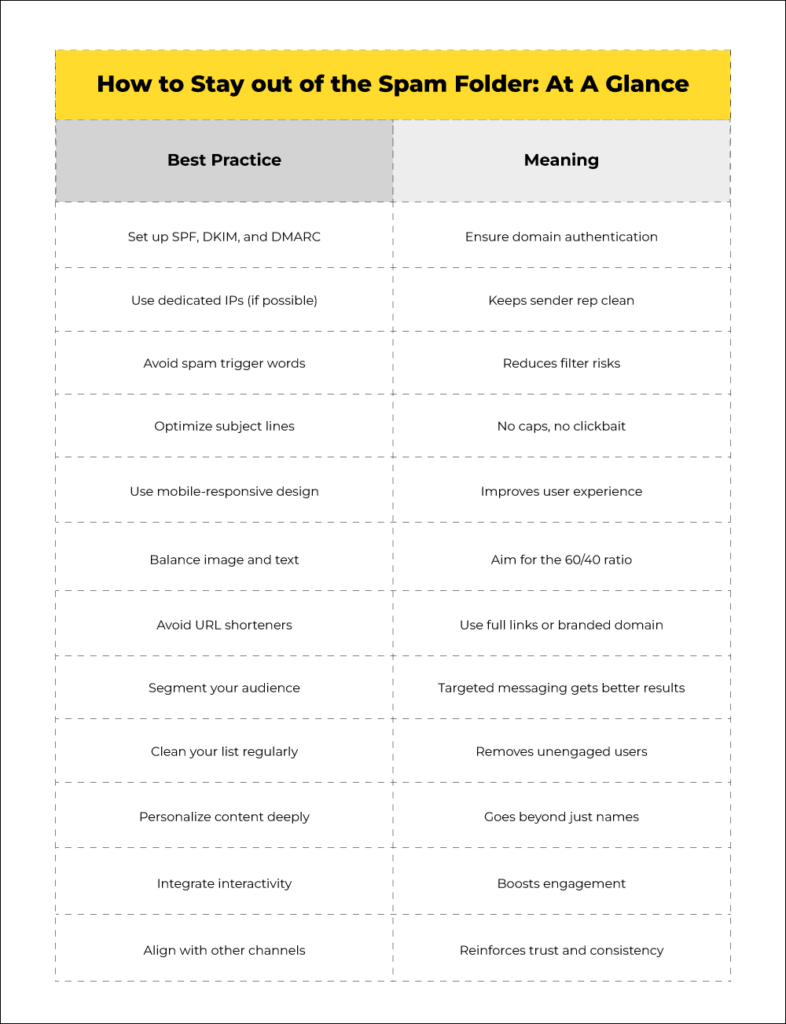
First up, you need to ensure your strategies align with the email best practices. Here are the practices the experts suggest are non-negotiable.
- Set up an email authentication
- Choose your IP wisely
- Keep your email list clean
- Send relevant, engaging emails
- Make unsubscribing easy
And once we have set up the basics right, the chances of failure diminish. Now we can tackle the newest trends that may need extra attention.
Now, let’s see what changes have taken place in the trends and how email deliverability news today lines up.
6 new email deliverability trends are rewriting the rulebook in 2026
Here are the 6 latest email deliverability trends rewriting rulebooks in 2026.
1. Death of the open rate and the rise of “delete without reading”
It’s time to ask: What the machine learning algorithms are actually watching?
Open rate used to be a proxy for attention. Today, many inbox models care more about what people do next than whether they touched a subject line.
If a recipient habitually swipes-delete-without-opening, that behavior signals negative preference faster than any complaint.
Machine learning learns those micro-behaviors and downgrades future delivery. Open rate becomes a vanity metric; deletion patterns become destiny.
What to do now (actionable):
- Stop optimizing for opens. Optimize for engagement that matters: clicks, conversions, dwell, replies.
- Track and act on delete events that your ESP exposes; treat repeated deletes as suppression triggers.
- Use predictive segmentation: combine recency, click-to-open ratio (CTOR), and delete signals into an engagement score.
- Suppress or re-engage: if a user deletes twice in a 30-day window, move to a low-pressure re-engagement flow, or pause sends.
- Move to outcome KPIs: revenue per recipient, conversion probability, and CTOR over opens.
2. Apple Intelligence: The new AI gatekeeper in your inbox
Any reasons why your carefully crafted preheader text is suddenly useless.
On-device summarizers read emails and classify them. They extract meaning, collapse content, and shove bulk into a Promotions Digest.
If your email is an image with no semantically rich text, the model can’t parse it, and it won’t surface you.
How to adapt (actionable):
- Favor semantic live HTML over image-first layouts. Headings, paragraphs, and lists are machine-friendly.
- Put meaningful text early, a clear, single-sentence value proposition at top.
- Use structured content: H1/H2-like emphasis using accessible patterns (bold, spacing) so summarizers pick the right line.
- Preserve images, but never as the only text. Always layer live copy above the fold.
- Test how your emails render in summary views (where possible) and iterate until the key sentence persists.
3. The European Accessibility Act (EAA): Compliance is now law
Formatting to strict WCAG 2.1 AA standards is mandatory.
EAA enforcement changed the rules: accessibility is no longer optional when you reach EU audiences. Poor accessibility isn’t just user friction; it’s legal risk.
Checklist (actionable):
- Text contrast at least 4.5:1 for body text; larger text 3:1 where applicable.
- Descriptive alt text for every image (not “image1.jpg”, write intent).
- Ensure keyboard operability for interactive elements: clear focus styles, logical tab order.
- Avoid conveying information by color alone. Add text or icons.
- Use semantic HTML and ARIA roles where supported by your ESP’s builder.
- Validate with automated tools and at least one manual keyboard-and-screen-reader pass.
Put accessibility into your send checklist, not as an afterthought but as release gating.
4. Microsoft’s rejection era and the push for visual trust (BIMI)
It’s time to move beyond the safety of p=none.
Microsoft tightened enforcement, and many senders started seeing the harsh SMTP 5.7.515 rejection. The path out isn’t gimmicks, it’s identity and visual trust.
Practical route (actionable):
- Harden authentication: SPF, DKIM, and DMARC with an enforceable policy (p=quarantine → p=reject) after careful testing.
- Implement BIMI: publish a square SVG logo, align your DMARC policy, and obtain a Verified Mark Certificate (VMC) to display your brand alongside authenticated mail.
- Monitor feedback loops and use strict outbound hygiene to avoid reputation hits.
- Consider a gradual DMARC rollout with aggregate feeds and monitoring before enforcement.
BIMI + VMC is the closest thing to a deliverability cheat code: visual trust in the inbox that reduces consumer doubt and provider friction.
5. Carbon-aware email marketing: Why lighter is infinitely better
You need to slash your digital footprint to boost placement.
Algorithms reward efficient experiences.
Heavy payloads = slower renders = more perceived friction = higher deletion or bury rates.
Sustainability and deliverability converge transcends.
Here are a few practical steps (actionable):
- Compress images aggressively; prefer modern formats (WebP, where supported).
- Replace ultra-large hero banners with smaller art-directed images plus live text.
- Remove unnecessary tracking pixels, or batch them on the server side.
- Limit animated GIFs; if used, keep them tiny and purposeful.
- Audit average message size, aim to halve it where possible.
Smaller emails load faster, look better on flaky mobile networks, and create less “algorithmic fatigue.” That’s good for people and for placement.
6. Privacy-first attribution: cookieless signals rule
Measure what matters without breaking trust.
Third-party cookies are gone; attribution is moving to privacy-safe, first-party signals and probabilistic models. Providers favor signals you own and consent you can prove.
What to implement (actionable):
- Prioritize server-side event collection and canonical identifiers (email_hash, customer_id).
- Instrument meaningful first-party events (page intent, add-to-cart, conversions) and funnel them to your warehouse.
- Use short-window incrementality and holdouts for causal measurement rather than relying on fragile cross-site pixels.
- Store consent and preference flags in downstream systems and honor them at send-time.
Privacy-respecting attribution is less noisy and more durable, and inbox providers prefer ecosystems that respect user consent.
Wrapping up
Engage the few, not the many.
The deliverability rulebook was quietly and in parallel rewritten: machine behavior, device AI, legal mandates, brand proof, sustainability, and privacy all intersect now.
This is not a crisis. It is a new operating model.
Audit your stack: authentication, content structure, accessibility, message weight, attribution, and your engagement rules.
If any of those pillars wobble, the inbox will remind you, loudly.
Final call to action:
- Run a comprehensive deliverability health audit this week.
- Start with authentication and message payloads.
- Then look at behavior: who deletes, who opens, who converts.
Deliverability used to be a checkbox. In 2026, it’s a strategy. Treat it like one.
Here are a few more relatable reads you should consider taking a look at.
4 AI-Powered Strategies to Supercharge Your Email Deliverability