 Lifecycle marketing
 Customer data management
 Email campaign production
 Search marketing
 CMS development
 Who we are
 How we work
 Case studies
 Testimonials
 Salesforce Marketing Cloud
 Braze
Braze HubSpot
 Marketo
 Pardot
 DataBricks
 Snowflake
 HighTouch
 RudderStack
 Segment by Twilio
 Videos
With tools like ChatGPT, Perplexity, Gemini, and Google AI Overviews now surfacing local business information, we see local search officially shifting from a “Google-first” mindset to “search everywhere”.
What we once called “SEO” now includes multiple approaches, all working toward the same goal: visibility—whether in traditional Google listings or AI-generated results. Local niche GEO, or Generative Engine Optimization, is one such approach.
Generative engine optimization for local businesses is a powerful asset for niche agencies looking to improve their local generative search visibility when users in specific locations search for relevant queries and local intent.
Although AI-driven search results are not yet on par with Google’s local search, shoppers are increasingly embracing them.
37% of consumers now start their searches with AI rather than traditional search engines. Likely because AI feels faster, clearer, and less cluttered. Local businesses across manufacturing, healthcare, education, B2B, and non-profit sectors are already seeing these shifts in buyers’ local search behavior.
This change requires local businesses—both large companies and small agencies—to optimize for AI-driven generative engines, not just the Google Local Pack. Because when AI does the talking, local SEO alone can’t always influence AI to say your name in its answers.
Semrush even predicts that AI search traffic may surpass traditional search traffic by 2028. If that becomes reality, agencies that optimize only for search engines risk becoming invisible in the new local search journey.
At the same time, while users rely on AI for quick answers, they still turn to traditional search for certainty. 47% of users use search engines to verify information before believing or acting on it provided by AI.
This means every local brand now appears twice: once in an AI-generated summary, and again in Google, where trust is verified. If those two moments don’t reinforce each other, credibility falters.
So when generative search experiences answer questions like “Who is the best service provider in this area?” with a single synthesized response, whether your brand appears depends on how well you perform in the local niche GEO.
Learn what local niche GEO is, how it differs from (and overlaps with) local SEO, what AI needs to recommend a local business, and which local AI search optimization tactics help brands earn visibility in AI answer engines.
What exactly is the local niche GEO?
Local niche GEO, or Generative Engine Optimization for local businesses, is the practice of preparing your content for direct answer extraction and inclusion in AI-generated local search results for specific locations.
The aim of optimizing for AI answer engines locally is to provide clear, authoritative information in natural language formats. This allows AI systems to easily understand your offerings and include vital details—such as your phone number, service area, and website link—as direct citations in their responses.
Why is local search tilting toward AI?
The reason for this tectonic shift is the dual need to dominate local rankings while appearing in AI-driven results.
Seth Besmertnik, CEO & Co-founder, Conductor, sums it up as–
“SEO success is no longer just about ranking for clicks—it’s about positioning your brand as the AI’s go-to source.”
Generative tools like Perplexity and ChatGPT are becoming daily habits for users who are asking AI for local recommendations and do evaluation for them.
The AI search engines respond with a single conversational answer with a short list of “best” options, sometimes with just one primary recommendation.
Large Language models (LLMs) help the generative search engines here. LLMs generate responses by synthesizing patterns from vast, pre-ingested datasets that include websites, reviews, directories, forums, and proprietary data. LLMs identify relevant information, select trusted sources, and recompose a response that feels human, coherent, and accurate.
How does traditional local SEO differ from local GEO?
Traditional local search has always focused on directory listings, map packs, and the famous “blue links.” Many of us remember the days of creating specific landing pages targeting keywords like “Middle Eastern restaurant Rogers Park, Chicago.”
With Google, to be specific, search algorithms weighed heavily on your agency’s location with respect to that of the searcher.
In that older model, results are primarily based on links and separated by source. Users then had to scour those results themselves to compare businesses and draw their own conclusions.
In this sense, Generative Engine Optimization for local businesses is a more evolved counterpart to traditional SEO.
Of course, location and closeness to the searcher still count. But local niche GEO weighs more on search intent than on distance. As modern customers use AI more as an assistant than a browser, AI-generated local answers strongly prioritise the businesses that fit the search intent best.
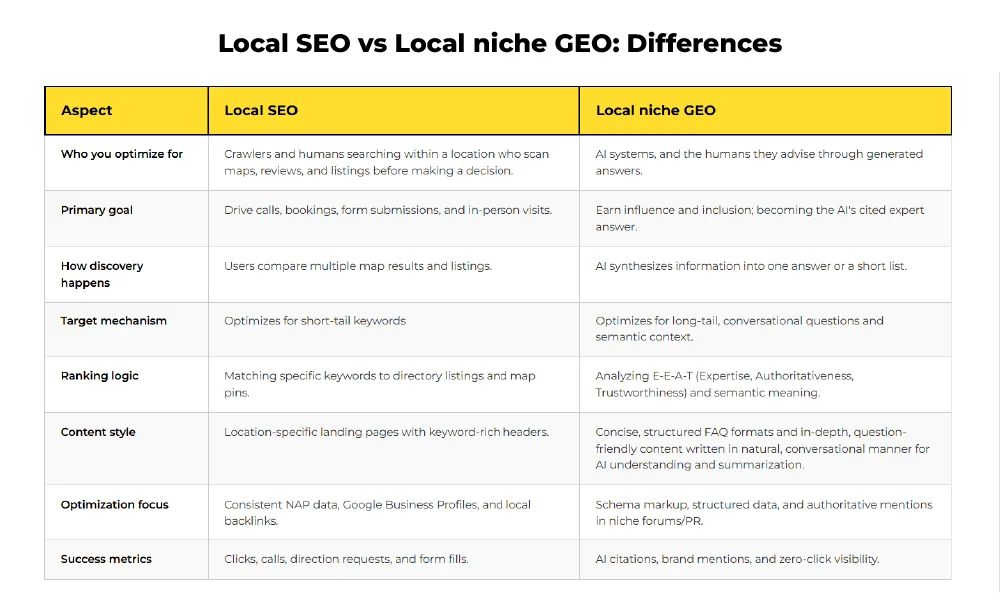
Local SEO vs Local niche GEO: Differences
Similarities between local SEO and local niche GEO
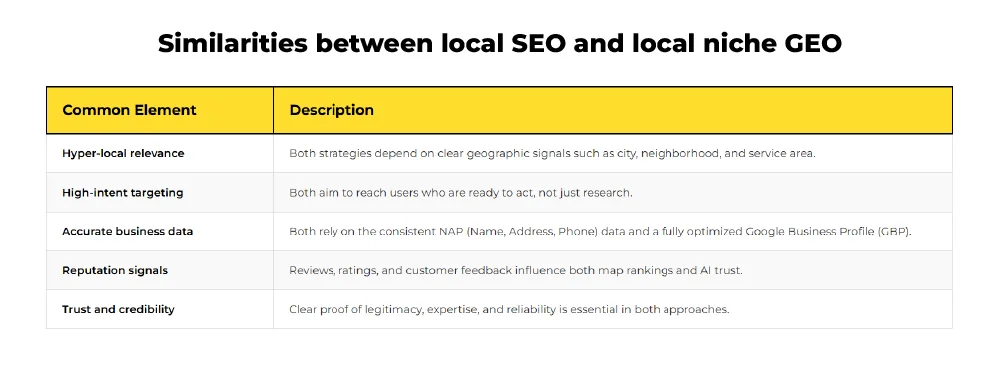
This means there is good news for brands optimizing for local generative search visibility:
If you already have a solid local SEO foundation, you’re eligible for local niche GEO success. In fact, as organic search traffic remains a key traffic pillar, a strong traditional SEO strategy remains essential for better visibility and relevance. Such as these:
- Audience-relevant, hyper-targeted, high-quality, niche content with E-E-E-A-T signals.
- Well-formatted, logically structured, and easy to parse content.
- Contextual richness and semantic coverage of the topic through synonyms, related terms, and variations that signal depth.
- Backlinks, brand mentions, and cross-web citations that build the credibility AI rewards.
- robots.txt, XML sitemaps, and a clear hierarchy to make content crawlable for machines.
- Fast and mobile-friendly website.
By building your local niche GEO strategies on the SEO foundation, you can ensure that your agency earns presence across both traditional and generative results.
How does GEO for small agencies work in practice?
When performing GEO for small agencies, you are no longer just optimizing for web crawlers. You are optimizing for a generative AI system that:
- Relies on context, not just keywords: It interprets synonyms, term variations, and the natural language used to describe your business and matches it to a wider range of queries.
- Field-specific, high-intent queries: It curates suggestions based on what emerges to be a complete and relevant answer. Something that better anticipates the search intent and also covers follow-up queries.. This helps them decide if you are the perfect match for hyper-specific queries, such as: “Where can I make reservations for an authentic Middle Eastern restaurant near Rogers Park, Chicago, that also has live music?”
- Provides direct answers: It delivers answers within the tool’s interface itself, not as separate search results.
- Cites and recontextualizes: The AI extracts key information from your original content and repurposes it to directly answer a user’s query, ensuring your brand is the one being recommended.
- Evaluates: Interprets your local expertise through relationships and contextual relevance in your local market, compared to those who are just optimizing for keywords.
As your customers become more comfortable seeking AI recommendations, local SEO becomes part of a broader visibility ecosystem that draws on multiple sources to build an understanding of your local relevance. If your online presence feels unclear, fragmented, or vague across various platforms, AI struggles to find your relevance in your niche.
This also means niche agencies with clear positioning, specialization, and consistent representation come across as local experts as AI pulls their niche service page ahead of broad competitors.
Long and short of it, this evolution of AI-powered local SEO means niche local players have opportunities like never before.
But because LLMs don’t work exactly like Google, GEO for small agencies demands an evolution of the SEO tactics that you have been applying all this time.
What data sources AI needs to recommend a local business
Your strategies for GEO for small agencies are failing miserably if you think AI models rely just on your websites and common directories to source your information. No, they don’t. In reality, AI uses a wide range of sources to ensure accurate results.
However, different generative engines don’t all pull local business information from the same places. And covering every source for every engine would be unrealistic in a single blog.
So instead, we’ve narrowed our focus. Here’s a compiled list of the common sources major generative engines like ChatGPT and Perplexity tend to draw from when surfacing local businesses. Use it for a general understanding of where local businesses should focus their efforts
These systems also change fast. Which is why the most reliable way to understand a specific engine is to ask it directly. A simple prompt like “Where do you get your local business information from?” will reveal how that model sources, evaluates, and summarizes local data.
1. Local business listings & directories
These are foundational data sources for business name, location, hours, and categories.
- Google Business Profile
- Bing Places for Business
- Yelp
- Tripadvisor
- Facebook Pages
- Foursquare
2. Established review & reputation platforms
Used to understand trust, sentiment, and popularity.
- Google Reviews
- Yelp
- Tripadvisor
- Better Business Bureau (BBB)
- Trustpilot (especially for services & B2B)
3. Smaller & regional directory sites
Often overlooked, but widely scraped and referenced by AI.
- Yellow Pages / Yellowbook
- Superpages
- CitySearch
- Hotfrog
- MerchantCircle
- DexKnows
- Insider Pages
These help AI build breadth and corroboration, even if they’re not high-traffic sites.
4. Industry-specific (niche) platforms
Used to validate relevance within a specific vertical.
- Restaurants: OpenTable, Zomato
- Hotels: Booking.com, Hotels.com
- Services & B2B: G2, Capterra, Angi
- Healthcare: niche medical directories
5. Official business websites
AI pulls directly from brand-owned sites for factual details.
- Services and offerings
- Menus, pricing, and availability
- Phone numbers, addresses, hours
- FAQ content
Websites using structured data (schema) have an upper hand in making it easier for AI to parse and reuse.
6. Third-party publications & “Best Of” lists
Highly trusted editorial sources that influence recommendations.
- Local news outlets
- City magazines
- Food & travel sites
- Industry blogs and rankings
7. Local blogs, city guides & community sites
Used to validate local relevance and real-world presence.
- Neighborhood blogs
- Tourism sites
- City guides
- Community directories
8. Maps & geographic data providers
Used to understand proximity and spatial context.
- Google Maps
- Bing Maps
- OpenStreetMap
This helps AI answer “near me” and location-sensitive queries.
9. Social platforms
Frequently referenced for current information, as social platforms are often more up to date than websites.
- Business hours
- Events and updates
- Contact details
10. Forums & user-generated discussions
Used to assess authenticity and real sentiment.
- Community forums
- Local discussion boards
Local niche GEO: How do small agencies show up in local generative search?
TL;DR
- Make your business easy for AI to understand. Clearly define your business and its services.
- Use one canonical location page per area. Align URL, title, H1, content, and LocalBusiness schema.
- Use structured data and clear entity relationships between your business, services, and locations.
- Write for real local tasks. Answer questions users ask AI.
- Add location-specific proof. Reviews, photos, staff details, and verifiable stats.
- Structure content for extraction. Each paragraph should stand alone. Use tables, FAQs, and checklists.
- Match conversational search behavior.
- Strengthen off-site trust signals.
Small agencies show up in AI-driven local search results when they make it easy for AI systems to understand three things:
- Who you are
- Where you operate
- Why you’re a safe recommendation
Positive, consistent information about your agency across the web influences AI and increases your chances of being cited in its results.
Here are some GEO strategies for small and niche local businesses to improve their local generative search visibility:
1. Turn location pages into a “Canonical Source” for AI
Location pages are a series of website pages for your targeted locations. In a GEO context, a location page becomes the prime source for an AI to draw from when answering location-specific queries like “Which agency offers best GEO services for B2B in this area?”
Done well, it can be a solid local AI search optimization by establishing you as a trusted entity that AI models can trust, summarize, and cite in local search results.
To give AI a trustworthy place to pull facts from:
- Create a dedicated page for each physical location or service area.
- Treat this page as the single source of truth for that location.
- Mark up the page with the LocalBusiness schema.
- Ensure the URL, title tag, H1, and schema all describe the same entity.
- Avoid boilerplate copy reused across locations
The following elements must be present on every location page, following a consistent, machine-readable pattern:
- Exact business name, address, phone number (NAP).
- Opening hours (including exceptions).
- Service area boundaries (cities, neighborhoods, ZIP codes).
- Primary and secondary services offered at that location.
2. Build a private knowledge graph
Traditional local SEO could do with “keyword-rich” headers and boilerplate text. Local Niche GEO replaces keyword targeting with greater clarity through unambiguous entity data.
AI-powered search engines evaluate your local agency through relationships and contextual relevance within your local market. Entity data is what helps AI determine if the business has genuine local expertise or it is just keyword-optimizing.
To build a strong entity relationship in AI’s eye, you must build a Private Knowledge Graph for every location. This isn’t your basic Schema. It’s a comprehensive ecosystem of JSON-LD and defines the relationship between different entities of your business:
- Define the business entity, the “Who” and “Where” of the business entity.
- Create detailed sub-entities for every specific service and link them back to the parent business.
- Define the experts behind the tools. Linking a lead technician to a service adds layers of E-E-A-T.
- Link your business to local landmarks, transit stops, and districts to solidify your physical footprint in the AI’s spatial logic.
For generative AI, this turns your website into a structured database that AI can query for reference rather than a marketing page.
3. Write for local tasks, not keywords
Effective Local niche GEO shifts the narrative from “What we do” to “How we solve your problem right now.” AI favours such content as it helps users complete a task immediately.
What to stop doing
- Writing pages that only target phrases like “barista near me”
- Listing services without explaining when or why someone would need them.
What to do instead
- Rewrite service sections to answer real-life questions around the services you offer, such as: “Can I walk into a pharmacy and get a prescription?
How to implement
- Add a short section on every location page called: “Common reasons customers call this location”
- Include:
- Response times
- Availability windows
- Constraints (weekends, insurance accepted, minimum order, etc.)
4. Add proof that AI can trust without interpretation
What AI looks for
- Evidence that real people use this specific location
- Signals that reduce the risk of a bad recommendation
What to add
- Location-specific reviews (not global testimonials)
- Staff names and photos
- Real photos of the premises
- Verifiable stats (years active, guarantees, response times)
How to implement
- Embed reviews directly on the location page
- Quote outcomes (“resolved in one visit,” “same-day appointment”)
- Use Review schema where applicable
Why this works
AI engines are risk-averse. Concrete proof makes your business a safer answer.
5. Write so AI can extract
You must have observed that AI models never cite an entire webpage at once. Instead, they break down content into smaller, semantically relevant chunks. And then retrieve only the specific section that answers the user’s question and ignores the irrelevant text. Plus, it synthesizes answers from multiple sources.
Hence, for optimizing for AI answer engines locally, it is essential to structure content for clarity. Each paragraph or section should answer one question only. It should be self-contained and should make sense even if the preceding or following content is removed.
If a paragraph can be extracted and dropped into an AI response without losing meaning, it’s doing its job. Vague references, “as mentioned above” or dangling pronouns limit this ability and should be avoided.
Example:
Vague: “Our team recommends doing this at least twice a year. It ensures their teeth stay healthy, and we can catch any of those issues early on before they get worse.”
Self-Contained: “Pediatric dentists recommend bi-annual dental cleanings starting at age one to prevent early childhood caries (cavities). Regular 6-month checkups allow for early detection of alignment issues and the application of preventative fluoride treatments that strengthen developing tooth enamel.”
The same principle rings true for fact blocks. Add at least one fact block per major page as they’re magnets for AI extraction. Some fact blocks for local AI search optimization:
- Tables
- Pricing blocks
- Timelines
- Comparisons,
- Checklists
- Step-by-step process
6. Match the conversational nature of local search queries
Users have become pro at giving prompts to generative search engines. They don’t prompt the way they type into Google’s search bar. They ask full questions. And explain constraints. The conversational nature of local search is a testament to the fact that they’re in to complete tasks, not browsing options.
A robust GEO strategy recognizes that Google SGE, Perplexity, and ChatGPT each have distinct “personalities,” yet they all rely on Natural Language Processing (NLP). And hence makes conversational search optimization a key strategy for AI-powered local SEO.
In fact, Generative Engine Optimization for local businesses works wonders when brands anticipate these conversational queries and create content to pre-answer those conversations.
This takes the form of sections like “Most customers ask…”, beginner-friendly FAQs, and explanations that echo how people phrase real problems. Which means don’t optimize for “emergency plumbing service”. You optimize content to answer “Can I get my leaking taps fixed after hours?”
We have an entire guide on conversational search optimization. Worth your time:
NLP And Conversational Search Optimization: A Guide To Optimize Content for Conversational Queries
7. Strengthen off-site signals for AI
Generative engines don’t trust you just because you say all these credible things about yourself. This means looking beyond the website to Off-Site GEO Signals.
AI models heavily weight user-generated content from Reddit, YouTube transcripts, and niche directories. YouTube tutorials, comparison videos, podcast transcripts, and helpful Reddit replies. Be present on the platforms where your audience seeks trusted information.
Collaborations and consistent, high-quality mentions demonstrate your expertise and local connections. For instance, when a trusted authority on a local subreddit or featured in a “Top 10” list on a city blog quotes your business. Those mentions serve as cross-references that validate your own site’s data.
Hence, ensure you have an accurate and in-depth account of your agency on the sources, such as:
- Bing Places for Business
- Google Business Profile
- Yelp, TripAdvisor, Facebook
- Industry-specific directories
- Local news or niche publications
Rather than chasing hundreds of low-quality directory listings, here’s what to do instead:
- Fully optimize profiles on platforms AI already references
- Ensure descriptions, services, and categories are detailed and memorable
8. Actively shape review language
Customer reviews are powerful. They’ve always been. But now, they’re gold.
AI gives a single synthesized answer. It’s like staking its reputation on that recommendation. To minimize risk, it performs a “flight to quality.” It doesn’t just look at your 4.8-star rating, but analyzes the text of your customer reviews to gauge your expertise.
But not a generic “Great service!” kind of review is all that effective. The one that says, “The technician diagnosed the problem on the spot, replaced the faulty valve the same day, and left the area spotless.” provides the specific “proof of experience” that an AI needs to recommend a local business confidently.
Thus, while requesting reviews from your happy customers, ensure you encourage them to mention:
- The problem
- The service provided
- The outcome
9. Optimize for more than one AI
While optimizing for AI answer engines locally, you don’t need separate strategies for each generative AI model. But you do need all the practices mentioned above, i.e.:
- Clear entities
- Structured data
- Natural language
- Specific facts
The road ahead
Local niche GEO doesn’t outdate local SEO, it raises the bar.
Local visibility is no longer a monopoly of one platform, one profile, or one algorithm. It’s influenced by how well your business can be understood, trusted, and recommended across systems—search engines and generative engines.
Is that challenging? Yes.
Is it an opportunity? Undoubtedly.
The way forward isn’t to abandon SEO fundamentals. Strong rankings, authority, and credibility remain undaunted, and AI continues to lean on them. But they’re no longer enough on their own.
To grow local generative search visibility in this new landscape, local businesses need to cement a GEO approach on top of existing SEO efforts. That means prioritizing content and signals AI engines can confidently reference: clean facts, clear structure, and original proof of experience. If you’re trying to understand how AI-driven local discovery affects your business—or struggling to achieve the local visibility you need—support can make a world of difference.
Mavlers helps businesses drive rankings, foot traffic, and revenue through a blend of proven white-hat SEO and practical AI insights.
Book a discovery call with Mavlers’ local SEO experts and see where your local GEO strategy stands today.