 Lifecycle marketing
 Customer data management
 Email campaign production
 Search marketing
 CMS development
 Who we are
 How we work
 Case studies
 Testimonials
 Salesforce Marketing Cloud
 Braze
Braze HubSpot
 Marketo
 Pardot
 DataBricks
 Snowflake
 HighTouch
 RudderStack
 Segment by Twilio
 Videos
Maybe you, like me, have been watching the recent data on AI search results and thought… Oh. Yikes.
You see Google’s AI overview, ChatGPT, Perplexity, citing YouTube 200 times more than other video platforms. TikTok, Vimeo, and Twitch were like they went unnoticed by AI systems.
You also see that video content in AI search has suddenly overtaken even Reddit as the go-to citation source in AI search. It feels like the SEO strategies we’ve spent a decade perfecting are just… evaporating.
I’ll be honest: I did panic at first. And then I didn’t.
I stopped panicking when I realized this isn’t about Google playing favorites or YouTube being a “viral” marketing channel. It’s something much more boring, yet much more powerful: Structural necessity.
We are witnessing a shift where AI engines are prioritizing structured, demonstrable, high-context content over the fragmented discussion threads of the past.
If your brand’s “how-to” knowledge is currently scattered in a 2,000-word block of text or a traditional product page, your brand is melting into the shadows. But if you understand why AI search prefers YouTube, you realize this isn’t an execution problem—it’s a formatting one.
We wrote this because we want to help you stop the panic and start the pivot.
In this guide, we’re going to look past the scary headlines to understand the “Why” behind the 200x gap. We’ll explain why AI search prefers YouTube videos, and how to boost your YouTube AI search visibility.
The data: YouTube dominates AI video citations
A recent study by BrightEdge looked under the hood of how different video platforms are cited in AI-generated answers.
The result?
Across major AI tools, YouTube is cited approximately 200 times more than any other video platform. To put that in perspective, YouTube holds about a 20% citation share across AI search results, and its nearest direct competitor, Vimeo, sits at a microscopic 0.1%.
In the AI overview YouTube results, the dominance is more conspicuous: up to 29.5% of Google’s AI Overviews and 16.6 % of AI mode cite YouTube. That’s the top domain cited across the entire platform.
AI citation share by video platform
| Platform | Citation Share |
| YouTube | ~20% |
| Vimeo | 0.1% |
| TikTok | 0.1% |
| Dailymotion | 0% |
| Twitch | 0% |
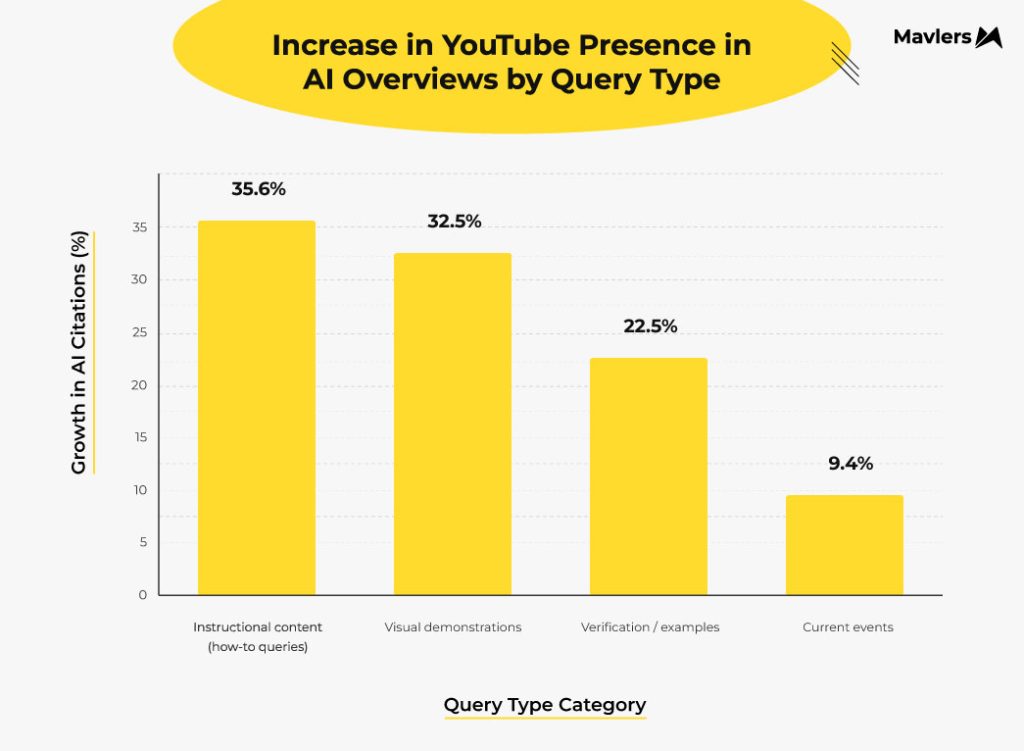
The types of queries that trigger these citations are also partly why video results appear in AI search. YouTube videos get prioritized the most for search queries involving:
- Tutorials and “how-to” explanations.
- Product demos and reviews.
- Software walkthroughs.
- Pricing and deal comparisons.
- Technical or medical demonstrations.
For example:
| Query | Likely AI Source |
| How to install WordPress | YouTube tutorial |
| iPhone 15 review | YouTube review |
| How to fix a leaking faucet | YouTube demo |
Queries where YouTube’s presence in AI Overviews increased most significantly are a dead giveaway that-
The YouTube video content feature in AI search results, where visual explanations make understanding easier and more user-friendly.
That said, is it just a “Google bias”?
You might assume this is a case of self-preferencing where Google keeps it in the family. But the data paints a different picture. If you think about it, platforms like Perplexity and ChatGPT have no corporate incentive to favor Google properties. Yet, they are also choosing YouTube for their video content in AI search.
YouTube citation share for:
- Perplexity: 9.7%
- ChatGPT: 0.2%
What we’re seeing is “Platform-Agnostic Trust.” These AI models have independently identified YouTube as the universal authority for video. It isn’t just that YouTube is big; it’s that it’s the platform the machines currently “trust” the most to serve reliable visual answers to search queries.
The key takeaways from the data
According to BrightEdge, these changes indicate that:
- With its 200× citation advantage, treating YouTube just as an awareness channel will only lead you to underutilise its potential in AI search systems.
- Leading AI search engines are ramping up YouTube citations, giving an industry-wide recognition that video is essential for “grounding” AI answers in reality.
- AI Overviews are breaking new ground beyond just summarizing web pages. To clarify complex queries and offer visual proof, they are leaning on videos.
- Yet, AI engines primarily use structured text to extract facts quickly. Once a fact is established, AI surfaces video clips, often via “Key Moments” or carousels. This provides the “proof” that a text summary cannot provide on its own.
This is a massive opportunity for brands: you can use your text content for primary authority and your video content to provide the “visual receipts” that secure your YouTube AI search visibility.
TLDR;
If your YouTube catalog is thin or misaligned with the real-world queries your customers are asking, then there are slim odds of getting mentioned in these machine-written answers. AI is looking for “visual proof,” and right now, it only has eyes for YouTube.
Dig deeper:
- How To Make Your Content AI-Citable?
- Why every SEO should care about brand mentions in the age of ChatGPT and LLMs
Why AI systems prefer YouTube videos
This brings us to the most important question for your strategy: Why? Why is the algorithm so single-mindedly focused on YouTube?
The real reason why AI search prefers YouTube is that YouTube is the most “readable” video platform on the planet.
Here is the structural breakdown of why YouTube has become the default “visual source of truth” for the synthetic web.
1. YouTube is context-dense
An AI system can’t actually “watch” your video. It ingests the metadata surrounding it. And YouTube videos provide that. A YouTube video is a context-rich, multi-layered document with-
- Transcripts and captions: YouTube provides high-quality, timestamped text for every word spoken. This is pure fuel for an LLM.
- Chapters and timestamps: That’s like an “Index” or a “Table of Contents,” for AI. AI uses it to pinpoint the exact 15 seconds that answer a user’s specific query.
- Engagement signals: Comments, likes, and watch time are the “votes” for accuracy. If a thousand people commented that a “How to fix a leak” video helped them, the AI treats that as a massive trust signal.
Essentially, why YouTube appears in AI answers so frequently is because it provides the AI with the most “proof” that the content is actually relevant.
2. YouTube content demonstrates value
Google’s AI has realized this fact, especially about the e-Commerce queries- Product pages tell you what a product is, but videos show you what it’s actually like to own it.
This is why video results appear in AI search so aggressively in retail.
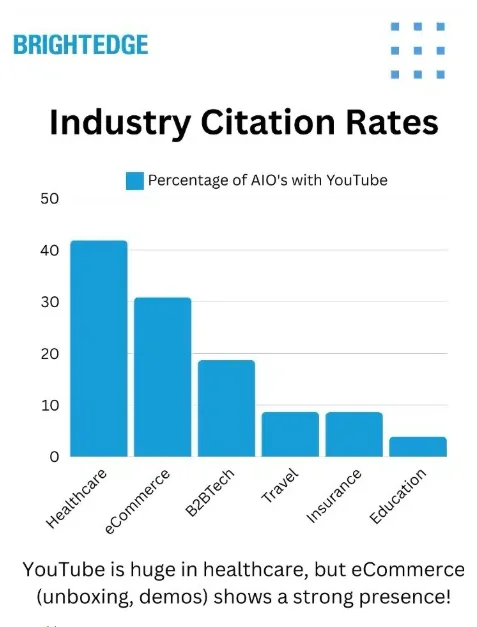
Old-school, text-heavy SEO lets down due to its lack of visual evidence. A 30-second video does the heavy-lifting that would take 2,000 words of clunky text to describe.
AI systems are increasingly biased toward information density. If a video can answer a query faster and more accurately than an article, the AI search prefers video content.
3. YouTube is the “How-to” data library
YouTube has spent nearly two decades becoming the internet’s largest library of tutorials. From consumer electronics and software walkthroughs to medical “how-to” content and DIY repairs, the scale is unmatched.
This creates a massive “Scale Advantage.” For an AI engine searching for supporting evidence, the sheer probability that a relevant, high-context explanation exists on YouTube is statistically vast. When you combine this scale with the platform’s stability (links don’t disappear as often as social media posts), you have a recipe for an AI’s favorite reference library.
Which is why YouTube videos increasingly appear in AI answers, AI Overviews, and AI-generated search results. And that’s also why brands that rely only on text-based SEO are trying to enter a car race with a horse and buggy. You might have the best horse in the world, but the race was for engines.
The bigger insight most articles miss about the AI overview YouTube results
Many articles frame this trend as: “AI search prefers YouTube.”
But the deeper pattern is slightly different.
AI search systems increasingly favor content that explains things clearly, regardless of format. A huge chunk of those explanations happens on YouTube.
In other words:
- AI is not rewarding platforms.
- AI is rewarding clear explanations.
YouTube benefits because it hosts an enormous library of instructional content.
Build a hybrid strategy where YouTube video content and AI answers meet
This brings us to the most important question: If search is shifting toward a “Video + AI” model, what does your actual workday look like?
For years, SEO was a game of silos. You had the “Blog team” working on long-form articles and landing pages. And you had the “Social team” posting content on YouTube or TikTok. Occasionally, the two would meet in the breakroom, but their strategies act as oil and water-never mix.
In 2026, those silos are a liability. AI search prefers video content because it provides visual proof, but it still pulls from blog posts and webpages. The teams that align their web content with YouTube content have a better chance of getting found in the right places during the next major shift in search.
Here’s how to establish a content ecosystem where each content format strengthens the others–
1. Combine YouTube video and written content
A YouTube video isn’t a standalone link. It’s the anchor for a full piece of written content. Combine the two, and you don’t just make your content more accessible but also create a multi-layered asset. An asset that can be indexed and surfaced across both traditional Google results and AI Overviews.
How to do it right:
- Don’t just “slap” a video on a page. Your blog post should expand on the points made in the video, not just repeat them.
- Use a clear H1/H2 structure. Use semantically related keywords in your headers. They’re loved by AI to “map” the video content to the written content.
- Use “VideoObject” schema to explicitly tell search engines what the video is about, who made it, and which “key moments” are most important. This is a massive factor in YouTube SEO for AI search.
2. Micro-Embed videos to answer specific questions
We need to get over the “one big hero video at the top” habit. To increase how videos rank in AI search answers, embed short, specific video clips throughout your long-form blog posts.
As in:
- A short clip explaining “What is AI search?”
- A product demo to back up a comparison section.
- A testimonial clip validating a case study.
3. Repurpose transcripts into structural goldmines
If you are already creating long-form video content, you are sitting on a goldmine of video content in AI search. Repurpose your webinars, podcasts, and tutorial transcripts into structured articles.
4. Connect with community discussion
While this blog has focused heavily on why AI search prefers YouTube, this doesn’t mean you should abandon community platforms like Reddit.
Content strategies may need to think in terms of: blog + video + community signals. In fact, the most effective strategy for 2026 connects blogs with YouTube videos and discussions.
- Community validation (Reddit/Comments) builds Trust.
Structured video (YouTube) builds Authority.
Written guides (Blog) build Depth.
AI systems see that a product is being discussed on Reddit, demonstrated on YouTube, and documented on your website, it has all the signals it needs to recommend you as the top answer.
The road ahead
Brands that win are the ones that stop limiting YouTube as a supplementary social channel and start expanding it as the structural data backbone of their search presence.