 Lifecycle marketing
 Customer data management
 Email campaign production
 Search marketing
 CMS development
 Who we are
 How we work
 Case studies
 Testimonials
 Salesforce Marketing Cloud
 Braze
Braze HubSpot
 Marketo
 Pardot
 DataBricks
 Snowflake
 HighTouch
 RudderStack
 Segment by Twilio
 Videos

So the other day, Bill, a colleague and a fellow Product Owner, noticed something out of place during a quarterly review.
Traffic was taking a hit, not catastrophically, but steadily.
After digging a little deeper into the cause, he found that branded search hadn’t collapsed, conversions hadn’t cratered, yet the pipeline velocity felt thinner.
In a team meeting that convened later, sales says prospects “already know the basics” when they show up.
Support says customers reference comparisons that the team never published.
While marketing says attribution models are breaking in places they can’t explain.
The interesting thing is that no one can point to a single reason for failure.
Well, because honestly, there isn’t one!
What’s happening is quieter and more structural.
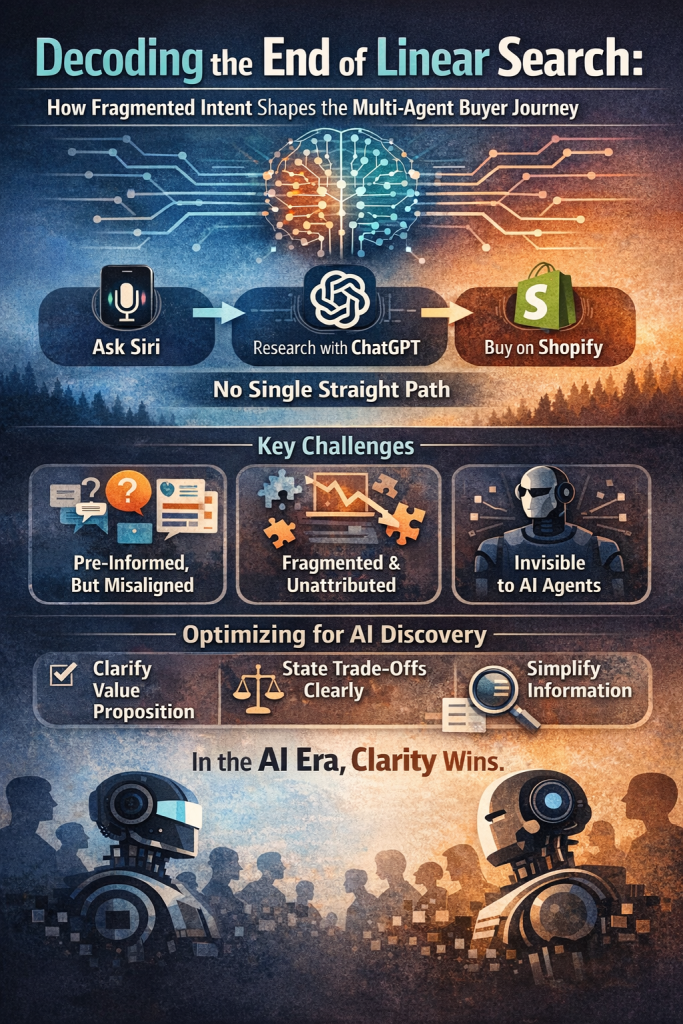
A buyer started by asking Siri a casual question. They explored options through Perplexity, refined the shortlist with ChatGPT, and completed the purchase on Shopify.
At no point did they need the brand’s website in the way analytics expects.
The intent and demand were real, but the brand just wasn’t present at the moments where meaning was formed.
This fragmented intent is now the default state of search.
Interestingly, McKinsey states that 50-60% of site traffic is already at risk for brands in the era of AI.
Understanding the real issues behind fragmented intent and how to fix them
Problem 1: Search intent no longer lives in one place
For years, teams optimized for a neat, linear model, with one query, one engine, one session.
Well, that mental model is not just outdated, it’s actively misleading.
Today’s discovery is a multi-touch AI discovery, where intent is expressed conversationally, interpreted by one system, summarized by another, and acted on by a third.
Intent hasn’t disappeared; in fact, it has decentralized.
That’s why teams keep saying things like:
“We’re visible, but not chosen.”
“People arrive pre-educated, but misaligned.”
“We’re being compared on criteria we don’t emphasize.”
These are not marketing failures.
They’re symptoms of AI search intent continuity breaking down.
Here’s how one may fix this.
One must begin to design for intent continuity, not touchpoints.
Because you can’t force intent back into one place, but you can stabilize it as it moves.
Here’s what helps in practice:
~ Define a single, canonical articulation of intent
Ensure that you have one clear explanation of what problem you solve and for whom, written in a way so that both humans and machines can reuse it without reinterpretation.
~ Repeat the same meaning across surfaces
Not the same copy, but the same concepts. When different pages describe the same thing differently, AI agents treat that as uncertainty.
~ Assume your content will be consumed out of order
Write as if no agent will ever see your “About” page first. Each major page should stand on its own.
The goal isn’t more visibility; it’s to have less room for reinterpretation.
Problem 2: LLM context loss is structural, not accidental
Truth be told, large language models (LLMs) do not “understand” brands the way humans do.
They compress, abstract, and generalize.
Each agent reconstructs your product from what is easiest to parse, stated most consistently, and what appears most reliable across sources.
If your differentiation relies on nuanced storytelling, sales-led explanation, and implied trade-offs, it degrades as intent passes between agents.
That degradation is what people call LLM context loss, and it’s unavoidable unless you design against it.
To fix it, you must endeavor to ensure your differentiation survives compression.
Here’s what works;
~ Turn nuance into explicit statements
If something matters, say it plainly. AI agents don’t “pick up” implied meaning; they drop it.
~ State trade-offs openly
“We’re faster but less customizable” survives compression far better than “flexible and scalable.”
~ Use stable language for core concepts
If a feature has three names internally, agents will treat them as three different things.
Try to think of it this way; if your value proposition were reduced to three sentences, would those still be accurate?
If not, that’s where context loss starts.
Problem 3: Brands confuse visibility with interpretability
Many organizations still ask, “How do we show up in AI search?”
That’s essentially the wrong framing.
The real question you need to ask is: “Can an external system confidently speak on our behalf?”
So, AI agents don’t reward clever positioning, aspirational messaging, or broad claims.
They reward semantic clarity.
If an agent can’t confidently answer what you do, who you’re for, why you’re different, and where you are not a fit, it doesn’t escalate your brand.
It routes around you.
To fix it, you need to know that AI agents behave like cautious intermediaries.
If they’re unsure, they don’t gamble; they exclude.
So, if you want to reduce that risk;
~ Write like someone else will have to explain to you
Because they will, if your positioning sounds vague out loud, it will sound worse when summarized.
~ Include “not for” statements
While this might sound counterintuitive, it’s powerful. Clear boundaries increase trust and accuracy.
~ Replace marketing language with operational language
“Best-in-class” means nothing to an agent. “Designed for teams with X constraint” does.
If an AI can’t confidently describe you in one paragraph, it won’t try.
Problem 4: Attribution hides the real failure
Now, this is where frustration peaks.
On Reddit, SEOs and strategists voice the same anxiety, “We feel impact, but can’t measure it.”
And on Quora, founders are known to ask, “How do we optimize for AI answers with no keywords?”
Both groups are reacting to the same shift.
Decision-making has moved upstream of measurable touchpoints.
You don’t lose when traffic drops; you lose when interpretation happens without you.
To fix it, you need to stop chasing attribution and begin auditing interpretation
You won’t get clean dashboards for this, at least not yet.
Here’s what helps;
~ Regularly audit how AI systems describe you
Make it a point to ask the same question across tools and look for inconsistencies, omissions, and distortions.
~ Track expectation mismatch, not just clicks
If inbound users are confused about pricing, scope, or fit, that’s an early signal of intent distortion.
~ Treat misrepresentation as a product bug
If agents misunderstand you, that’s not “AI being wrong.” It’s feedback that your meaning isn’t stable enough.
The connecting thread
In essence, fragmented intent doesn’t mean buyers are confused.
It means buyers have delegated interpretation.
And when interpretation is delegated, brands that rely on implication, persuasion, and explanation lose to brands that are simply clear.
Fixing fragmented intent isn’t about gaming AI systems.
It’s about making your meaning resilient as it moves.
Decoding the strategic shift most teams haven’t named yet
It’s important to note that fragmented intent is not a marketing problem.
While it’s tempting to treat them as an SEO evolution, a content optimization challenge, or a schema markup initiative, they don’t solve the core issue.
In essence, it’s a system’s integrity problem.
It emerges when product truth is scattered, value is inconsistently described, and logic lives in people instead of systems.
While humans can reconcile that fragmentation, AI agents cannot and will not try.
On that note, you might want to read ~ Unravelling the 4 layers of SEO in 2026: What SEOs really need to know!
Understanding why the “multi-agent search” framing matters
In a multi-agent search environment, no single system owns the journey, no agent has full context, and no correction step is guaranteed.
Each agent must decide, “Do I trust this brand enough to carry it forward?”
This is why brands “disappear” without penalties or warnings.
Agents don’t demote, they simply exclude.
Semantic persistence ~ the missing optimization layer
The winning capability in a decentralized AI search ecosystem is semantic persistence.
Semantic persistence means that your core value proposition survives summarization, your differentiators remain intact after compression, and your positioning stays consistent across agents.
This is not about creating more content.
It’s about developing stable meaning.
Why machine readability is necessary but insufficient
Brands are paying close attention to llms.txt, structured data, and Universal Commerce Protocols (UCP). These matters are important because they define access.
But interestingly, access does not equal comprehension.
If you expose vague categories, inconsistent naming, and human-only explanations, you’ve simply made ambiguity machine-readable.
On the contrary, AI agents prefer explicit definitions, consistent terminology, and declared trade-offs.
Clarity beats completeness any day.
Unveiling a practical playbook for optimizing the multi-agent search journey
Let’s now get to the theory of putting this into practice.
1. Make your value proposition deterministic
You need to ask one hard question, “If three different AI agents summarize our product independently, do they say the same thing?”
If the answer is no, you don’t have an SEO issue; you have a definition problem.
You need to standardize core product language, eliminate internal synonyms, and define features once and reuse everywhere.
Agents reward consistency more than eloquence.
2. Externalize trade-offs (don’t hide them)
While humans can tolerate ambiguity, agents are known to penalize it.
So, if you don’t declare limitations, agents infer them or substitute defaults.
Both outcomes may damage intent continuity.
Therefore, you must explicitly state who you are not for, where alternatives are better, and what you trade speed for, or vice versa.
This increases trust signals.
3. Reduce interpretive load across surfaces
If understanding your product requires demos to “really get it”, metaphors instead of definitions, and sales conversations to clarify basics, AI agents will simplify you into a generic option.
Therefore, it’s important to design content so an agent can recommend you, compare you, and act on your behalf, without asking permission.
4. Treat AI agents as delegated users
From a product perspective, ask “Could an external system complete the journey correctly without us intervening?”
That includes eligibility, pricing logic, next steps, and constraints; if not, you’re not delegation-ready.
5. Shift measurement from traffic to continuity signals
You won’t get perfect attribution.
Instead, you need to watch for consistency of AI summaries, accuracy of third-party comparisons, and alignment of inbound expectations.
These are leading indicators of AI search journey optimization working.
Unveiling the quiet truth behind this
Now, fragmented intent doesn’t mean buyers are confused.
It means buyers have outsourced interpretation.
AI agents now decide what matters, what’s comparable, and what’s safe to act on.
Brands that win will not be louder; they will be clearer.
The road ahead
We now recommend reading: “SEO vs AEO: Understanding the difference & how to use both for maximum growth” (Updated for 2026).