
 Lifecycle marketing
 Customer data management
 Email campaign production
 Search marketing
 CMS development
 Who we are
 How we work
 Case studies
 Testimonials
 Salesforce Marketing Cloud
 Braze
Braze HubSpot
 Marketo
 Pardot
 DataBricks
 Snowflake
 HighTouch
 RudderStack
 Segment by Twilio
 Videos

To understand where we are heading with AI and conversational search optimization, we have to go back to the “Dark Ages” of the search bar—a time when the burden of intelligence sat entirely on the human, not the machine.
You didn’t type what you meant. You typed what you thought Google could parse.
Users punched in keywords like “funny cat videos” into a search box. PageRank-driven relevance algorithms returned ten blue links by matching those keywords against massive indexes.
This early search system worked best until intent fit into neat, well-defined categories.
But when it didn’t and when a query became contextual, multi-layered, or unstructured, the cracks appeared.
That’s why experienced users adapted. Real search intent was flattened into unnatural keyword strings: crm fintech startup, email deliverability gmail yahoo, wordpress migration acf scraping.
We feared using articles, prepositions, and intent. Because early search systems weren’t good at understanding them anyway.
So, a special kind of anxiety in choosing query words was always there. If you were too broad, you got millions of useless generic pages. If you were too specific, you got the terrible “Your search did not match any documents” result.
Oftentimes, a page ranked more because it shared keywords with the query and less because it addressed the underlying problem.
So, users did the synthesis themselves.
We opened multiple blue links and skimmed intros written for keywords. We scanned subheadings and realized the page is just “keyword stuffing”. Back button. Repeat for links two, three, and four just to find one “nugget” of truth.
The most valuable context lived mid-paragraph—written for humans, but invisible to keyword-first retrieval.
One of the biggest limitations was the lack of semantic memory. Search engines couldn’t carry context forward. Ask “Who is the director of Inception?” and follow with “How old is he?” and the system had no clue who “he” referred to. Naturally, the “time-to-answer” was notoriously high.
In that era, we were the AI. We had to do the natural language processing in our heads. We translated our complex, human intents into rigid, robotic keyword phrases.
Until conversational search became an essential part of how the content is ranked organically. Instead of forcing users to adapt to algorithms, search systems began adapting to how people naturally ask, refine, and follow up on questions.
And it’s Natural Language Processing (NLP) that gives conversational search the power to reach the heart of the user’s intent. With NLP, search engines process and interpret human language better.
As Google and other AI-driven systems increasingly rely on NLP, the context and intent behind a search term become more apparent to them. And we get more relevant results even when the queries turn complex, vague, or imperfectly phrased.
In this article, we’ll explore how NLP and conversational search are moving search beyond keywords and toward natural, dialogue-driven experiences. We will also see how to apply conversational search optimization to adapt content for AI-powered discovery.
Meanwhile, here’s a detailed guide for marketers on how search has evolved.
What is conversational search?
Conversational search is a search approach in which users interact with search engines using natural, human language. Unlike traditional, keyword-matching search, the search here is not powered by rigid keyword-based queries. Users retrieve information by asking full questions, adding context, and following up.
Here, the interaction between a user and a search system is like a human-to-human dialogue. Users ask questions to the search engine in much the same way they’d ask a friend.
For example:
Traditional search query:
site speed slow mobile fix
Conversational search query:
Why is my website slow on mobile, and how can I fix it?
The conversational nature of conversational AI search extends beyond search queries alone. The results it delivers are also clear and conversational because the system can:
- Recognizes the context and intent behind search – It can tell that “Where’s a good place to eat?” and “I’m hungry and want something nearby” mean the same request, despite sharing no common keywords.
- Pulls together insights from several credible sources and presents them as one clear, readable answer.
- Preserves context across sessions. For example, it can handle follow-ups “What about wide feet?” without losing the prior context of “Running shoes for long-distance training with ankle support.” No need to start a whole new search.
In short, conversational search understands intent, references, and relationships between queries. This ability enables the machines to shorten time-to-answer and deliver responses that more closely match users’ needs and meet them where they already are.
Types of conversational search interfaces
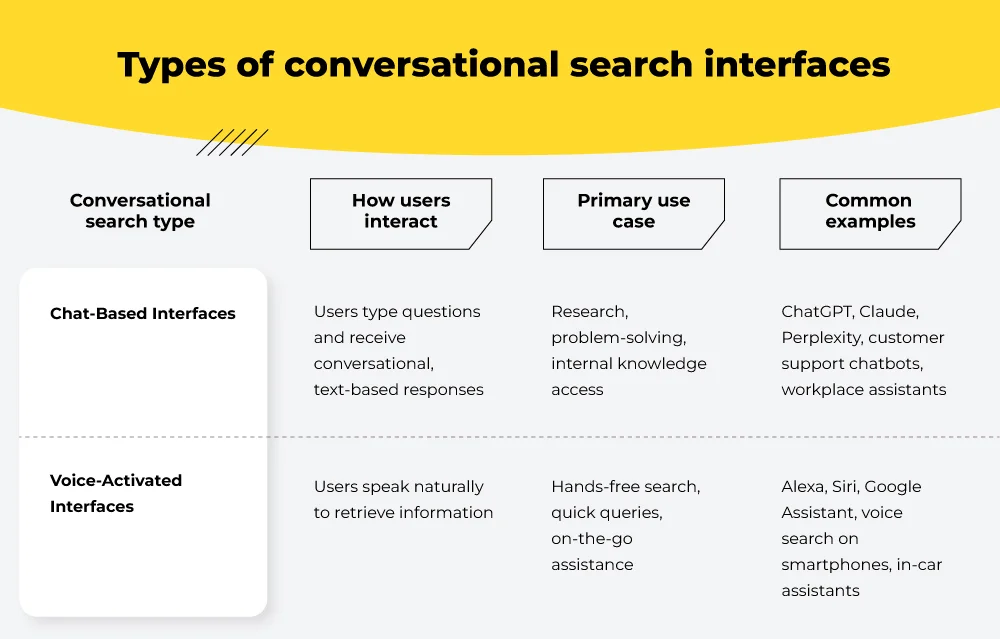
How does NLP help conversational search?
Conversational search excels in presenting you with more context-based search results. That’s because modern search engines use advanced natural language processing to understand searches and match them to relevant content.
NLP-trained models process words not one by one in order, but in relation to other words in the sentence. This is particularly useful in understanding search intent.
Take the search query:
The B2B Example: “Platform migration from AWS to Azure”
In the early days of keyword-based search, an algorithm would see terms: “Migration,” “AWS,” and “Azure.” As a result, a user might be served with generic results or comparisons.
But with NLP, search systems can grasp the nuances of the words “from” and “to” and their relationship with other words in the query. They fully understand the search intent. The results that surface align with the full intent rather than isolated keywords.
One of the biggest shifts driven by NLP is Google’s move from “strings” to “entities.” Entities mean people, places, products, and concepts. Each word in a query is no longer an isolated token – search engines now identify entities and decode their relationship with each other.
The entity-based interpretation makes search intent clearer and allows engines to connect queries to the Knowledge Graph, which powers more accurate responses.
In fact, Google has been investing in NLP for years through models like BERT and MUM.
When Google introduced BERT in 2019, it explained that–
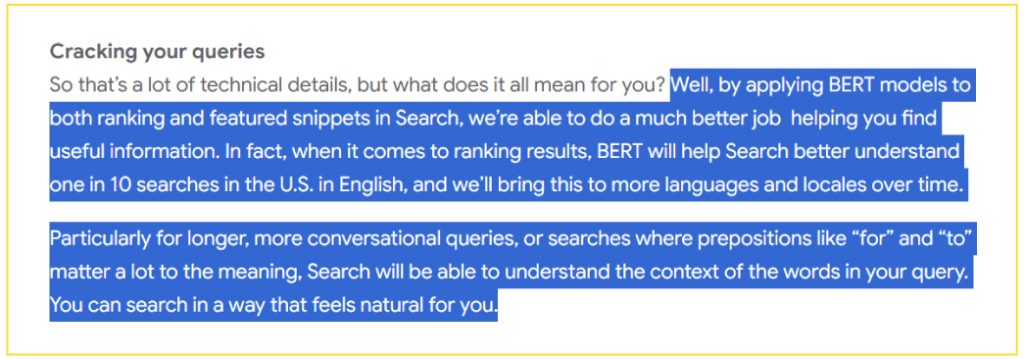
More powerful than BERT is MUM. It’s multilingual and multimodal. It doesn’t just understand text, it processes images, video, and audio and pulls a solution from a document written in different languages.
Here’s a glimpse of how MUM would understand the image to connect it with your question and deliver the answer.

In short, NLP underpins many areas of modern search systems, including:
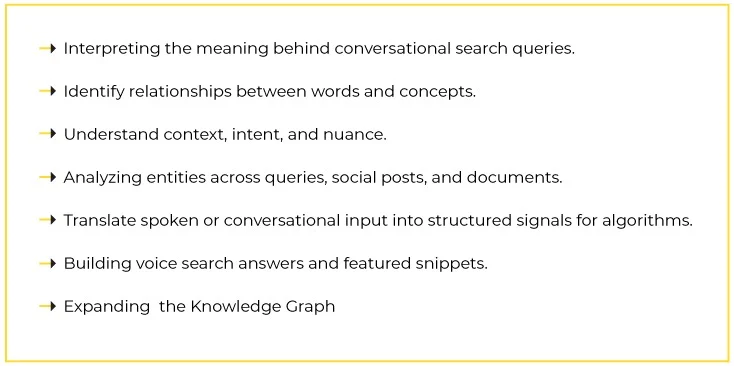
Here’s a simplified version of entity-based SEO and Knowledge Graphs.
Natural language processing techniques that drive conversational search
NLP works through a combination of linguistic analysis and machine learning. The core components for conversational search are:
Syntax analysis (parsing)
Examines sentence structure and grammar. Determine how words relate to one another.
- Semantic analysis
Goes beyond literal definitions. Interprets meaning within context, especially important for understanding complex queries. - Word sense disambiguation
Determines which meaning of a word applies in a specific situation. For example, “apple” the fruit vs. Apple the company. - Lemmatization and stemming
Reduce words to their base or root form so variations don’t mar understanding. - Sentiment and intent analysis
Helps interpret tone, urgency, and purpose in conversational or voice-based queries. - Summarization
Lets search systems condense content into direct answers, which is how featured snippets and AI-generated responses are created.
Further reading:
- SEO vs. AEO: Which Strategy Should You Focus On in 2025?
- Rising beyond the blue links ~ Mastering Google AI overviews for SEO success
Does content that supports NLP techniques perform better in conversational search?
The short answer is yes, absolutely.
If you structure your content to “feed” these specific NLP techniques, you simplify the AI’s task of extracting your information and serving as the definitive answer. Because such content is easier to parse and interpret, it has a better shot at being reused in conversational and zero-click searches.
Put simply, when your content follows the way people think through a problem—how they ask a query, add context, and narrow it down—you’re speaking the same language conversational search systems are built to understand. It stops matching keywords and starts mapping intent.
Here’s more on:
Decoding the rise of AI-trained content: How to stay visible in a zero-click world
Why every SEO should care about brand mentions in the age of ChatGPT and LLMs
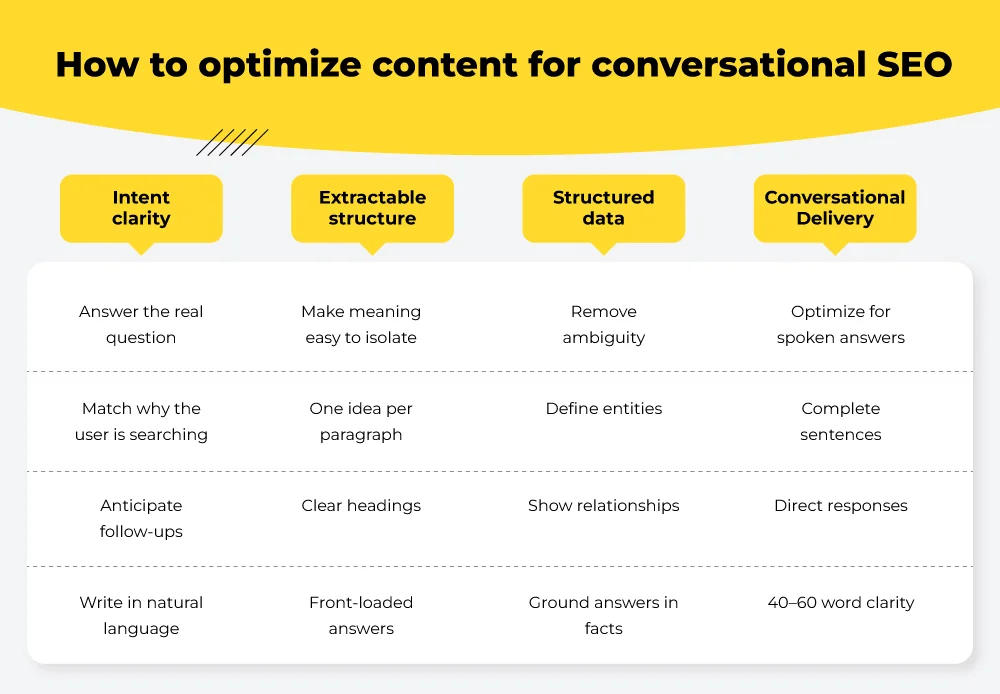
How to optimize content for conversational SEO (Without hiding answers in FAQs)
We have long advocated for the FAQ as a predictable, instructional format for AI-citable content. Our SEO strategy uses FAQs across blogs and service pages whenever they genuinely help readers.
But if your conversational search optimization strategy starts and ends with a Q&A block, you’re treating a sophisticated search engine like a simple filing cabinet.
Conversational search results are not just ranked, they’re synthesized and summarized. Content that’s based on clarity, structure, and credible information is a strong learning signal for the Large Language Models powering these search engines.
LLMs are more likely to parse, extract, and reuse this content, even when it isn’t wrapped in an obvious Q&A block.
In short, optimizing only the FAQ section leaves many conversational SEO opportunities on the table.
Here are key strategies for using Natural Language Processing SEO and creating content for conversational search optimization:
1) Write using search intent optimization
Brands that struggle with natural language search optimization often show content-intent misalignment. When content fails to cover the exact intent, no amount of keyword repetition can salvage it.
Even more so when LLMs are getting much better at understanding why someone is searching, not just what they typed. As Pat Reinhart, VP of Services & Thought Leadership at Conductor, puts it:
“What Gemini is allowing Google to do is what they’ve always talked about wanting to do: correctly matching a user’s query and intent to the most relevant piece of content in their index.”
Because when search results are increasingly generated, not listed, the winning content isn’t the most optimized—it’s the most useful.
Conversational search systems rely on context to decide what to extract and reuse. They look for content that answers the core question, then naturally resolves the follow-ups that come along. Not because you stuffed more keywords. But because you understood the problem well enough to answer what comes next.
That’s why structured data keeps gaining ground—and why loosely written, keyword-driven content keeps falling behind. The clearer your concepts and relationships are, the easier it is for a system to formulate a response from your page.
In practice, that means grounding your content with intent-based search optimization:
- Use natural language and semantic variation instead of forcing exact-match phrasing.
- Structure sections around how people actually ask questions—who, what, why, how.
- Address follow-up questions inline, not buried at the bottom.
- Use internal links with descriptive anchors to reinforce topical authority. For a deep dive, read our detailed guide on How To Strengthen Your Topical Authority With Internal Linking Maps.

2) Optimize for extractability
When we say that LLMs and AI Overviews love content that’s easy to isolate, that usually has less to do with how “well-written” the content is—and more to do with how clearly it’s structured at the paragraph level.
Google embeds passages, not pages. If a section is clear, focused, and tightly aligned to a single intent, it can be selected independently of content around it. That’s why AI Overviews often bring users mid-page, not at the top.
Dense blocks of text don’t fail because they’re long. They fail because ideas get mixed together, the main point is buried, and the system is left to infer what’s the most valuable point.
Content that surfaces consistently in conversational search results shares the following traits:
- Short paragraphs (one idea at a time).
- Clear headings that explain exactly what follows.
- Direct statements that don’t rely on the surrounding context to make sense.
- Avoid dense blocks of text.
In practical terms of conversational search optimization, it looks like this:
- Break text into 1–3 sentence paragraphs.
- Front-load the key point of each paragraph so it’s immediately extractable.
- Prefer active voice and plain language over stylistic complexity.
- Use bullets and numbered lists to summarize or enumerate ideas.
- Explain technical terms when you introduce them, instead of assuming shared context.
- Avoid passive constructions, vague references, and filler phrases that introduce ambiguity and reduce clarity.
- Passages in the 50–150 word range, centered on a single topic, with explicit, unambiguous claims.
3) Use structured data to make meaning explicit
Structured data is standardized, machine-readable code for search engines to understand the meaning and context of content better.
Using semantic standards like Schema.org, you give machines a way to identify entities—people, products, organizations, locations—and understand how those entities relate to one another.
Structured data is important for conversational AI search. Why? While LLMs are trained primarily on unstructured text, their answers become more accurate when grounded in clearly defined entities and relationships. Structured data is that grounding layer.
When you mark up content with schema:
- You clarify what an entity is.
- You define how it connects to other entities.
- You reduce ambiguity that forces systems to guess.
That context helps AI systems determine whether your content is trustworthy, reusable, and safe to cite—especially in environments like AI Overviews, chatbots, and voice assistants.
In a conversational search environment, schema gives retrieval systems and knowledge graphs a reliable way to anchor generated answers to facts—reducing hallucinations.
From a Natural Language Processing SEO standpoint, structured data works best when treated as infrastructure:
- Audit existing markup to identify gaps in entity coverage and missing relationships.
- Define your core entities (products, services, people, topics) and assign each a clear “entity home”.
- Connect related entities to form a lightweight knowledge graph.
- Build repeatable workflows for creating, reviewing, and updating schema at scale.
4) Optimize content for voice search
When people use Siri, Alexa, or Google Assistant, they don’t compress intent into keywords. Instead, they ask full questions. With added context. Expecting to see a single, spoken answer and not a page to browse.
Voice queries are longer, more conversational, and closer to how people actually think. Compare:
- Typed: best Indian restaurant NYC
- Spoken: What’s the best Indian restaurant in New York City?
Optimizing content for voice search means creating content that answers questions in natural language, clearly and directly.
This is why advanced voice SEO has many commonalities with conversational SEO:
- Use conversational phrasing instead of headline-style fragments.
- Address common questions directly, using complete sentences.
- Keep answers concise enough to be spoken aloud.
Also, voice assistants often pull responses from featured snippets or “position zero.” Content that rises to these estates follow a simple pattern: clear question, direct answer, minimal fluff.
To achieve a place in position zero:
- Formatting helps. Short paragraphs. Bullet points where appropriate. Answers that land in 40–60 words instead of trailing off into explanation.
Lastly, local SEO matters too. A large share of voice searches are location-based: near me, closest, open now. That makes local SEO foundational for natural language search optimization with:
- Accurate business information.
- Consistent location signals.
- Real customer reviews.
These all increase the chances your content is trusted enough to be read aloud.
Frequently asked questions about conversational search SEO
Does conversational search optimization replace classic SEO?
No. It evolves how SEO works. Ranking pages still matters, but visibility increasingly depends on whether your content can be extracted, cited, and reused in AI-generated answers. SEO shifts from page-level optimization to passage-level clarity and intent alignment.
Are FAQs still important for conversational SEO?
Yes—but they’re not enough on their own. FAQs work because they’re predictable and easy to extract. However, conversational search also pulls answers from paragraphs, definitions, and explanations embedded throughout the content. Optimizing only the FAQ section leaves many opportunities on the table.
How do AI Overviews choose what content to cite?
AI Overviews use retrieval-augmented generation (RAG). They retrieve relevant documents, break them into tokens or constituent parts, select the most relevant passages, and generate an answer grounded in those sources. For the content to be selected and cited in conversational results, it must be clear, specific, and tightly linked to search intent.
What kind of content performs best in conversational search?
Content that answers a specific question clearly, uses natural language, and stands independently outside the page context. Short paragraphs, explicit statements, descriptive headings, and coverage of follow-up questions all increase the likelihood of reuse in conversational and voice search.
How does voice search relate to conversational search?
Voice search is one interface for conversational search. Both rely on NLP and intent understanding, but conversational search also includes text-based AI systems like Google AI Overviews, ChatGPT, and Perplexity.
How can I optimize content for conversational search without rewriting everything?
Start by making existing content clearer and more extractable. Tighten paragraphs, clarify headings, remove ambiguity, explain terms, and surface key answers earlier.
Will conversational search reduce website traffic?
It can reduce clicks for some queries, especially informational ones. But it increases visibility, brand recall, and authority. Search has always been more than a traffic channel—conversational search simply makes that reality more obvious.
More resources
Be the Answer: AEO Strategies to Dominate Search in 2025
ChatGPT vs Gemini vs DeepSeek: Which AI Chatbot is Best for You in 2025?
Mastering SERP features: How to claim Google’s prime real estate in 2025