 Lifecycle marketing
 Customer data management
 Email campaign production
 Search marketing
 CMS development
 Who we are
 How we work
 Case studies
 Testimonials
 Salesforce Marketing Cloud
 Braze
Braze HubSpot
 Marketo
 Pardot
 DataBricks
 Snowflake
 HighTouch
 RudderStack
 Segment by Twilio
 Videos
SMS is arguably the most powerful marketing channel available. The numbers alone are enough to make any marketer smile; consider this:
- SMS boasts a staggering 98% open rate, compared to email’s average of just 20%.
- 90% of messages are read within three minutes of delivery.
- 75% of consumers prefer receiving promotional content via SMS over other channels.
It’s no surprise, then, that 73% of marketers plan to increase their SMS budgets.
With numbers like these, you’d want to be sending your first SMS right away. However, without a clear, well-structured strategy for a SMS marketing campaign, you won’t see such results.
SMS is powerful, but only when it’s permitted, timely, and customer-centric.
This guide, built from the hard-won insights of practitioners and researchers across the industry, gives you a string of tested SMS marketing strategies. Let’s get started.
Table of Contents
SMS marketing strategies in 2026
Build the right foundation: The POST framework
Grow your list correctly and compliantly
Send messages that actually drive responses
Automate the high-value moments
Segment, test, and optimize relentlessly
SMS metrics you should consider
SMS as a core component of lifecycle marketing
SMS marketing strategies in 2026
Build the right foundation: The POST framework
The POST framework has stood the test of time. Originally developed by Forrester over a decade ago, it has since been applied across a number of marketing channels.
POST stands for People, Objective, Strategy, and Technology. The framework is a simple yet effective way to start thinking about your SMS marketing strategies. It goes like:
- People first: Ask whether your customers actually want SMS. Gen Z consumers, now a dominant purchasing force, overwhelmingly prefer smartphones and messaging interfaces over any other channel. If your audience skews younger or is mobile-native, SMS it is.
- Define your objective: Clarify what business problem SMS will solve. Is it abandoned cart recovery? Customer retention? Flash sale conversions? Nail this before anything else, and then define the specific KPIs you will use to measure success.
- Build your strategy: Determine what content you will deliver, when you will send it, and why customers need to receive it via SMS specifically, not any other channel.
- Choose technology last: Only after people, objective, and strategy are defined should you evaluate platforms. Because technology is the execution layer.
SMS marketing best practice
Create a dedicated SMS landing page (separate from your website popup) for any paid social or organic social campaign pointing people toward your list. Measure traffic and submission rates separately from your site opt-ins so you understand what is working.
Grow your list correctly and compliantly
Marketers often rush to build their lists. After all, it’s the most obvious first step. But compliance is frequently overlooked, or worse, wilfully deprioritized. It happens with email too.
Compliance is the most important aspect of any SMS marketing campaign.
Remember, SMS is federally regulated under the TCPA. You cannot text someone just because you have their phone number. Consent must be obtained, documented, and easy to revoke. Violations carry fines of up to $1,500 per message, and it only takes one complaint to trigger a full-blown litigation against your brand. In addition, keep the following in mind:
- Be transparent at opt-in: Tell subscribers exactly what they are signing up for, how often you will text them and what kind of messages they can expect. Be super-clear.
- Utilize multiple opt-in touchpoints: Popups, embedded forms, text-to-join keywords, QR codes at point of sale, checkout integrations, and tap-to-join links across social media all contribute to list growth. Use as many as are relevant to your audience.
- Make your incentive high-value: People guard their phone numbers more closely than their email addresses. A compelling incentive, whether a discount, exclusive early access, or a genuinely useful resource, can be the single biggest driver of list growth.
- Always automate opt-outs: If someone replies “STOP,” your system must remove them instantly, log the opt-out, and send a confirmation reply.
Unlike email, you cannot bury the terms in a footnote link. Consent disclosures must be visible, readable, and clear.
Send messages that actually drive responses
You want to hear back from your audience. But if your SMS program is stuck in a loop of endless discounts and the occasional seasonal blast, you’ll see mediocre results. If that.
As in email, so in SMS. Personalization and context win every time. To begin with:
- Use the data you already have: Qualifying the info collected from lead forms, purchase history, loyalty tiers, and even in-person conversations is a good starting point.
- Keep messages short and conversational: Get to the point in two or three short lines. If you need to say more, break it up into two separate texts with a delay in between.
- Avoid links unless the urgency is high: Links increase the risk of being flagged as spam. When you do include a link, send the message text first, wait a few seconds, then send the link in a separate message.
- Do not send discounts as a default: Many small businesses cannot afford to discount constantly, and doing so trains customers to wait for a deal. Consider sending tips, recipes, behind-the-scenes content, educational updates, exclusive early access, etc.
- Use MMS selectively: Visual messages tend to outperform plain text, but they cost more per send. Reserve them for product launches, Black Friday campaigns, or moments where a visual genuinely complements the text.
Speaking of driving responses through SMS, check out the table below. It catalogues some of the most successful SMS marketing ideas by brands across various industries. (Source: Various)
| Brand | Industry | SMS tactic | Key insight/result |
| Makers Collective / Indie Craft Parade | Nonprofit / Events | Texted a PDF venue map in exchange for opt-in on event day | Non-discount incentive; 491 subscribers in first 30 days; less than 1% opt-out rate; also ran “artist takeover” flash events where subscribers texted in a photo and received a speed drawing back |
| Bluebell Barn Pet & Hobby Farm | Pet Retail | Customers texted a photo of their pet; AI generated a Dr. Seuss-style poem in return | Simultaneously captured pet-type data for segmentation via ChatGPT image analysis; created user-generated content for their annual pet calendar |
| Divatress | Hair / Beauty E-commerce | Added SMS opt-in field to existing email popup | 70,000 SMS subscribers in 8 months; over $100,000 in incremental sales; 30,000 SMS-only subscribers unreachable by email; SMS now accounts for ~7% of total revenue |
| AX Paris | Fashion E-commerce | Multi-touchpoint opt-in strategy (popups, embedded forms, checkout, keywords) with short-term and long-term subscriber benefits | 100,000 SMS subscribers in one month; 55x ROI on Black Friday/Cyber Monday campaigns; 6.5x higher ROI on SMS than email |
| Dossier | Fragrance / Beauty E-commerce | Migrated SMS platforms to unlock cross-product data (reviews, UGC, loyalty) for targeted flows | 20%+ of revenue from SMS; 151% growth in subscriber collection; 233x ROI on behavior-triggered messages |
| Red Foods | Food Delivery | Texted subscribers every Sunday at noon — one hour before weekly order cutoff | Upfront about send frequency and timing at opt-in; built trust and routine; near-zero opt-outs |
| Princess Polly | Fashion E-commerce (Gen Z) | Combined loyalty program with SMS; higher loyalty tiers had higher SMS opt-in rates | 50%+ of VIP customers subscribed to SMS; at highest loyalty tier, over 90% opted in; 10x higher ROI on SMS sent to loyalty members; 64x ROI overall |
Automate the high-value moments
Automations typically account for a disproportionate share of SMS-driven revenue because they are timely, relevant, and personal by design.
Here are some of the most effective SMS marketing strategies with respect to automation:
- Welcome series: The first 30 days after someone subscribes is the highest-engagement window you will ever have. Use it to introduce your brand, set expectations, answer common objections, and deliver on whatever incentive you promised.
- Abandoned cart: Trigger within 30-60 minutes of cart abandonment. Add an image of the abandoned item and a direct link back to the cart.
- Browse abandonment: If a customer has opted in and browses without buying, a timely nudge referencing what they viewed can be just the thing they need.
- Price drop and back-in-stock alerts: These are high-intent moments. A customer who browsed a product and didn’t buy, then receives a message telling them the price dropped or the item is back — now that’s a message they had been waiting for.
- Post-purchase and review requests: Leverage AI-assisted sentiment analysis in your workflows to send an open-ended question about the experience.
SMS marketing best practice
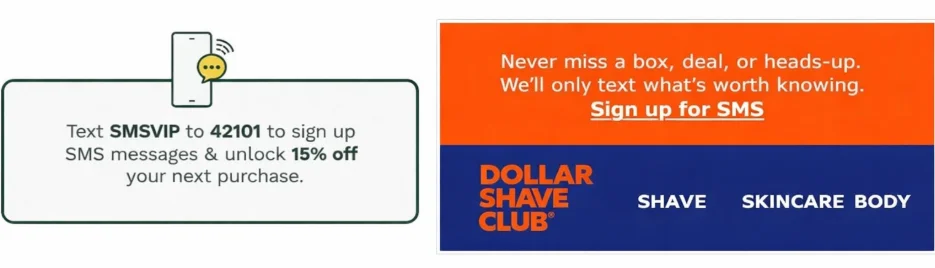
Promote your SMS program inside your email channel.Include a dedicated call-out in your email campaigns, automation flows, and welcome series. Give email subscribers two or three reasons why your SMS list is worth joining. It could be exclusive deals, early access, or last-chance reminders. But do make it feel like an upgrade.
Dollar Shave Club and Cuisine Art include SMS call-outs in their emails as shown below. Cuisine Art pushes a simple opt-in incentive, whereas DSC incentives theirs with more details.
Segment, test, and optimize relentlessly
Sounds obvious, but rarely executed with real discipline. Many marketers get the technical setup right, yet fall short where it matters most, which is consistency. Here are a few practical tips to help you segment smarter, test more effectively, and continuously optimize your SMS campaigns:
- Segment by behavior, not just demographics: Separate VIPs, lapsed customers, recent first-time buyers, and loyalty members.
- Send once a week or less for campaigns: For most service and retail businesses, one well-crafted campaign per week is sufficient.
- Time your SMS sends properly: Lunchtime (12-2pm) and early evening (around 8pm) consistently outperform mid-morning and mid-afternoon sends. Weekends show higher click and conversion rates for many retail brands. But you want to test what works for your specific audience or a segment(s) of your audience.
- AB test one variable at a time: Change only the opening line, or the CTA phrasing, or the offer structure, never multiple elements simultaneously. Run each variant to a minimum of 100 recipients before declaring a winner, then iterate.
- Track what matters: Open rate is nearly meaningless with SMS. Track the response rate (industry average: 20-45%), click-through rate (21-36%), conversion rate, revenue attributed to SMS, and your monthly opt-out rate (anything above 2% is not a good sign.)
SMS marketing best practice
Use SMS to replace unsubscribers from email.When someone leaves your email list, they do not necessarily quit your brand. If they are subscribed to SMS, you still have a direct, first-party channel to reach them, one that costs a fraction of paid retargeting and social advertising.
SMS metrics you should consider
Naturally, you need to track how your SMS campaigns are doing. There are all kinds of KPIs you could track, but here are the five core metrics every SMS marketer should be tracking:
- Revenue per text sent
- Conversion rate
- Month-over-month subscriber growth
- ROI
- Unsubscribe rate
Refer to the table below for more specific KPIs related to SMS marketing.
| Category | Metric | What it measures | Why it matters |
| List growth | Total Active Subscribers | Current reachable audience | Defines revenue potential |
| New Subscribers Added | Acquisition rate | Shows opt-in effectiveness | |
| List Growth Rate | Speed of list expansion | Monitors acquisition + retention health | |
| Opt-in Rate (Desktop vs Mobile) | Channel performance | Helps optimize signup placements | |
| Top Signup Sources | Best-performing acquisition sources | Guides budget allocation | |
| Retention Rate | Subscriber longevity | Ensures sustainable growth | |
| Revenue | Total SMS Revenue | Gross revenue from SMS | Measures channel contribution |
| Incremental Revenue | Revenue directly attributable to SMS | Proves added value | |
| Revenue per Subscriber | Avg. revenue generated per subscriber | Measures audience quality | |
| Attributable Revenue (by campaign) | Revenue by campaign | Evaluates campaign effectiveness | |
| Campaign Revenue Growth | Revenue trend from campaigns | Tracks optimization impact | |
| Triggered/Journey Revenue | Revenue from automated flows | Identifies high-performing automations | |
| Average Order Value (AOV) | Avg. purchase size from SMS | Shows upsell potential | |
| % of Total Revenue from SMS | Channel contribution share | Justifies investment | |
| Engagement | Click-Through Rate (CTR) | % clicking links | Measures message interest |
| Reply Rate | Two-way engagement | Indicates relationship strength | |
| Coupon Redemptions | Offer effectiveness | Tracks promo performance | |
| Abandoned Cart Recovery | Recovered lost revenue | Shows lifecycle impact | |
| Referral Conversions | Word-of-mouth impact | Measures advocacy | |
| Testing & optimization | A/B Test Results by Segment | Variant performance by audience | Improves precision |
| Performance by Cohort | Purchaser vs non-purchaser response | Enables smarter segmentation | |
| Revenue & Conversion by Segment | Segment profitability | Guides personalization | |
| Send Time Performance | Timing effectiveness | Optimizes delivery windows | |
| Drop-off Points in Journey | Funnel friction areas | Improves lifecycle messaging |
SMS as a core component of lifecycle marketing
You now have the fundamentals to launch your SMS program. But remember: SMS isn’t meant to operate in isolation. It delivers its strongest results when integrated with other channels, especially email. If you’re layering SMS into your channel mix, well, more power to you. Together, these channels form a powerful foundation for a high-performing lifecycle strategy.
And if lifecycle marketing is your focus, we’re here to help! Our performance-first framework is built to tackle the challenges of modern lifecycle marketing, with every stage designed to drive measurable, sustainable growth. If you need support with SMS, email, social, or the full customer journey, book a free, no-obligation call with our experts.