 Lifecycle marketing
 Customer data management
 Email campaign production
 Search marketing
 CMS development
 Who we are
 How we work
 Case studies
 Testimonials
 Work samples
 Salesforce Marketing Cloud
 Braze
Braze HubSpot
 Marketo
 Pardot
 DataBricks
 Snowflake
 HighTouch
 RudderStack
 Segment by Twilio
Think about what happens right after someone places an order. They’re excited, curious, and paying close attention to every message you send. Few moments in the customer journey have this level of attention, which is why post-purchase emails often see some of the highest open rates. Customers actually want to hear from you, if only for a short time.
Did you know that 60-80% of first-time customers never return? But the customers who do make a second purchase become dramatically more valuable over time. They’re:
- 2-3× more likely to place a third order
- Up to 5× more valuable over their lifetime
- Less focused on price and feel a stronger emotional connection to your brand
The checkout process plays an important role in building strong relationships with your customers.
So, are you taking full advantage of this moment? If not, this guide can help you get started.
Why are post purchase email flows so valuable?
To understand why the post-purchase window matters so much, you need to understand a psychological shift that happens the moment a customer buys something.
According to Kath Pay, CEO of Holistic Email Marketing, the moment of purchase is driven by what behavioral economists call System 1 thinking. It’s emotional, intuitive, and fast. But the instant the order confirmation arrives, the brain shifts into System 2, which is rational, reflective, and prone to doubt.
This is when customers begin asking questions they rarely voice out loud:
- Did I choose the right brand?
- Will this actually work for me?
- What if I don’t know how to use it properly?
Pay calls this the Post-Purchase Confidence Gap.
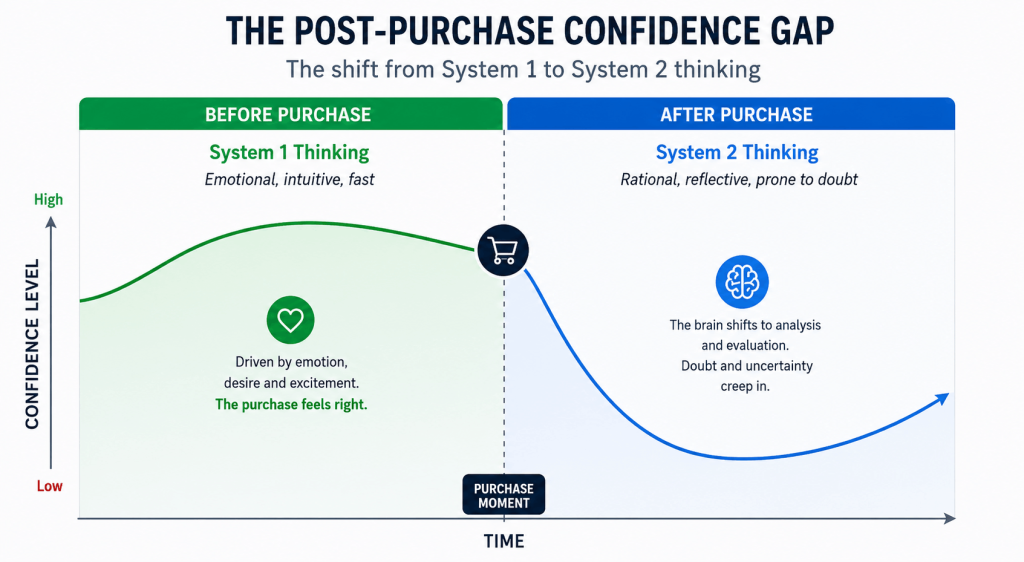
If your brand stops communicating during this stage, they may feel even more uncertain.
When customers don’t get clear updates, they may start to have doubts. But if you can stay in touch in a meaningful way, you can encourage them to buy again, reduce returns, and build long-term loyalty. In fact, according to Bain & Company, increasing customer retention by just 5% can boost profits by 25% to 95%.
The point is that first-time buyers are often not profitable. Profitability comes from repeat purchases. As a result, your post purchase email flow is where the rubber meets the road.
How to create a valuable post purchase email sequence
1. Segment, segment, segment
Before building the post purchase email flow, you must ensure segmentation is in place.
The practical setup for this is either a single flow with conditional splits based on purchase count, or separate flows for each segment. Separate flows make analytics cleaner and let you measure revenue per recipient for each cohort independently. Consider the following segments:
- First-time buyer
- Repeat buyer
- VIP/high-value customer
For many fast fashion brands, the first purchase barely covers acquisition costs. Profitability often depends on getting customers to buy again quickly. That changes the entire post purchase email strategy. The focus shifts from long-term storytelling to driving the next order as fast as you can.
2. Apply flow filters
Flow filters are critical in lifecycle marketing. Getting these wrong creates irrelevant experiences.
Consider a common scenario. A customer places an order and enters your first-purchase flow. Three days in, they place a second order. Without the right filters, they’ll continue to receive first-buyer content on an order they’ve already placed. You’d be rewarding them for a purchase they’ve already made while sending them emails that are now completely irrelevant.
To begin with, here are the essential flow filters to implement:
- Has not placed another order since entering this flow. Once a customer makes their next purchase, they should exit this journey and move into the appropriate repeat-buyer flow instead.
- Has not canceled an order since entering this flow. This prevents customers who have canceled their purchase from receiving irrelevant cross-sell or upsell emails.
- Has not received a refund since entering this flow. Refunded customers are in a very different mindset and require a completely different communication strategy.
- Has not hard-bounced since entering this flow. Removing contacts who can’t receive emails helps protect sender reputation and maintain a healthy deliverability rate.
These filters set your post purchase email strategy on wheels.
3. Create the first-purchase flow
We have already established that the second time’s the charm. Most customers will make another purchase within 30 days of their first order. This gives you a chance to encourage them to buy again. Here are a few ways you can make the most of this opportunity:
- Have the founder or a real team member send a short, personal message after the purchase. It makes customers feel noticed. It also builds confidence in their decision. This is a great moment to recommend a relevant add-on or upgrade while excitement is still high.
- During the first few days, reinforce that they made the right choice. Share reviews, testimonials, or simple reminders of what makes the product valuable.
- If setup is involved, send instructions, tutorials, or app download links before the order arrives. Customers should feel ready to use the product the moment it lands.
- Before asking for a review, send a quick support check-in. Ask how things are going. If there’s a problem, you can solve it before it turns into a public complaint.
Only ask for a review after the customer has received and used the product. Many brands still ask far too early.
4. Create the repeat purchase flow
These customers already trust you. What they want now is to feel like they belong to something.
This is a good opportunity for brand storytelling. Introduce them to the people behind the product. Share your origin story. Talk about your values, community efforts, and environmental commitments.
In addition to these ideas, you can strengthen your post-purchase email strategy by adding:
- User-generated content like testimonials and reviews
- Personalized recommendations based on past purchases
- Loyalty progress updates that show how close they are to their next reward
These are meant to foster emotional attachment. That’s what drives long-term retention in a world where there are now six times as many brands competing in almost every category.
5. Leverage returns
Returns are typically treated as a cost center. But the returns experience can be one of the highest-stakes touchpoints in the entire customer journey. A customer who has a friction-free, respectful return experience is often more loyal afterward than one who never had a problem. The psychology here is that resolving a negative experience creates more trust than providing a seamless experience.
The point is, your returns flow deserves the same attention as your post purchase email flows.
Let customers know what’s happening during each step of the returns process by sending timely updates when you receive the return, process the refund, and issue the refund. After the refund, a follow-up email can help turn a disappointing situation into an opportunity to reconnect.
For example, check out the following email from Huckberry.
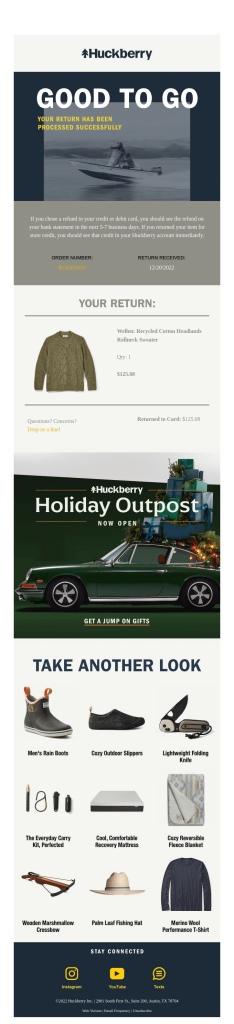
Huckberry’s email actively protects the customer relationship at a moment when disappointment, friction, or churn risk is highest. The email explains when the refund will appear and distinguishes between card refunds and store credit. That cuts down uncertainty and WISMO/WISMR tickets. Most notably, it creates a natural re-engagement moment toward the end. The recommendations are contextually smart.
There’s a high-value touchpoint prior to setting up the post purchase email sequence. It’s your order confirmation page. This is one of the most visited pages in your entire e-commerce stack. Every customer who completes a purchase sees it. Optimize the page to answer common questions, upsell/cross-sell, and create a brand relationship right at the peak of purchase intent.
Customer behavior is inherently unpredictable. A customer might view the same product five times before buying. They might repeatedly browse a category they’ve never purchased from. Or they may order consistently for months, only to suddenly disappear. These can be meaningful signals. You can’t ignore them without ignoring a large group of untapped mid-intent buyers.
Customer confidence and the inverted U
We just talked about the coveted third and fourth purchases.
But interestingly, that’s also where churn often begins.
According to Thomas McKinlay, summarizing research from Northeastern University, the University of Pennsylvania, and Arizona State University, customer confidence doesn’t rise steadily with experience. It follows an inverted-U curve, strengthening at first before eventually tapering off.
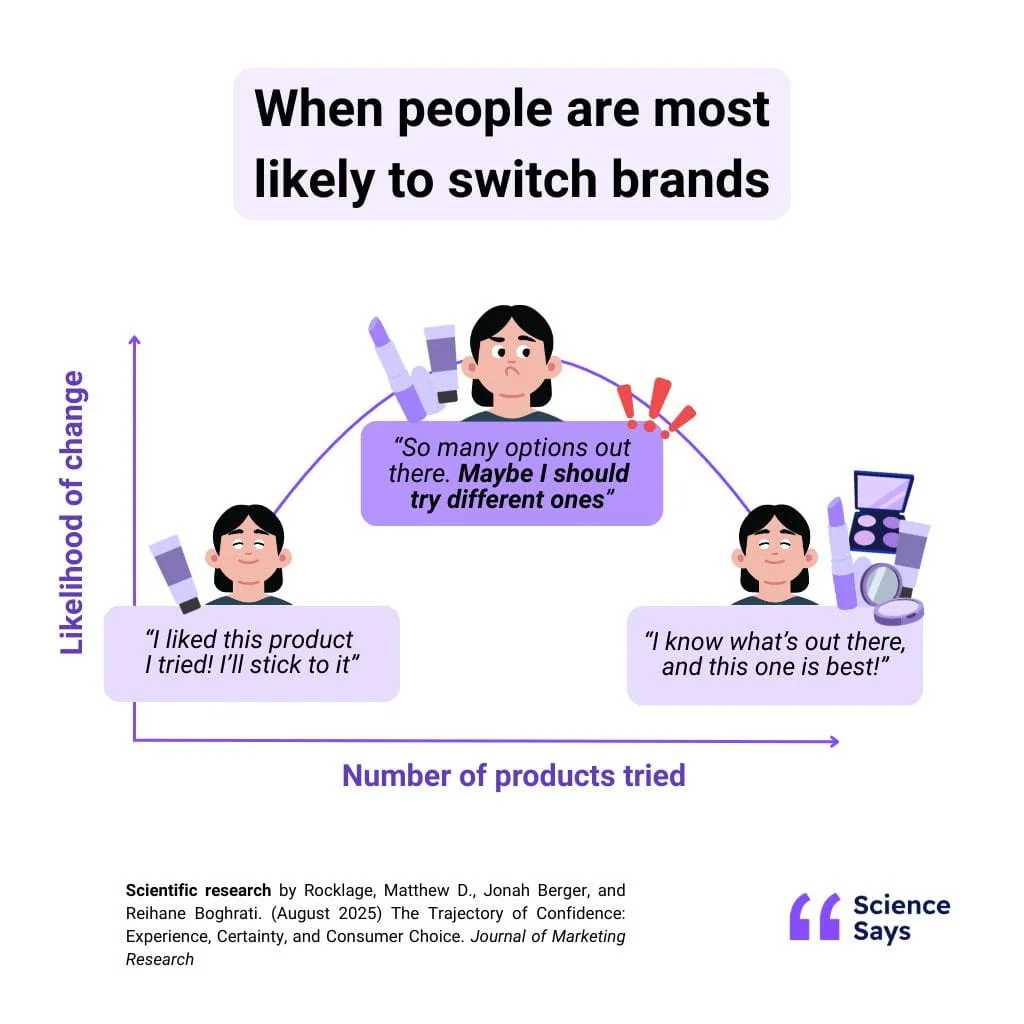
The implication this has for your post purchase email flows is significant. Staying ahead of this requires two specific interventions:
- First, encourage reflection on the quality of their experience. Sending a thoughtful post-purchase survey increases confidence by helping customers verbalize reasons they’re satisfied. This makes them less susceptible to the pull of novelty elsewhere.
- Second, if you carry multiple products, don’t recommend the same thing to a customer who’s already tried your core offering. At the medium-experience stage, customers naturally start looking for something new. If your brand doesn’t create that sense of discovery, they’ll look for it elsewhere. This is the moment to introduce adjacent products, complementary categories, or different formats that expand their relationship with the brand.
McKinlay also points to loyalty mechanics as a way to reduce churn during this vulnerable stage.
Gamified rewards tend to work especially well because the uncertainty of not knowing whether the reward will be a discount, gift, or perk keeps customers engaged.
How to track the success of your post purchase email strategy
According to Eli Weiss, retention marketing expert and author, the most important post-purchase metric is Revenue per Recipient, tracked per person on the list over time. If it’s growing month over month, your program is compounding. Behavioral personalization is doing the heavy lifting. But if it’s flat or declining, something structural is broken.
Along with revenue per recipient, it’s important to watch these other key metrics:
- Repeat purchase rate (RPR): This tells you what percentage of your customers come back to buy again.
- Customer lifetime value (CLV): This measures the total revenue each customer brings in throughout their relationship with your business.
- Returning customer AOV: This shows whether customers who return usually spend more on each order.
- Net promoter score (NPS): This measures how likely your customers are to recommend your brand to others.
- Customer satisfaction score (CSAT): This shows how happy customers are with certain interactions.
- Return-to-origin (RTO) rate: This measures how often deliveries fail or run into fulfillment issues.
- Return rate: This shows how often customers return products.
- WISMO ticket volume: This counts the number of “Where Is My Order?” questions and helps you see if your shipping updates are clear enough.
Audit your current post purchase email sequence
If your post purchase email sequence begins and ends with a receipt, we can start there. Open your order confirmation email and read it like a first-time customer:
- What questions would you immediately have?
- Does the email answer them?
- Does anything in it reassure, excite, or make the customer feel confident about their purchase?
You can make a big difference with a few simple changes. Try making the next steps easy to follow, add a reassuring message, and answer common questions. These steps can reduce support requests and help customers feel more confident. Don’t forget about customers who have already bought from you. Keep them engaged by sharing new products, asking for their feedback, and giving them more reasons to stay connected.
Post-purchase is the most important marketing real estate you own. You’ve already paid to acquire the customer. Now use that moment, and every moment that follows, to retain them.