
 Lifecycle marketing
 Customer data management
 Email campaign production
 Search marketing
 CMS development
 Who we are
 How we work
 Case studies
 Testimonials
 Salesforce Marketing Cloud
 Braze
Braze HubSpot
 Marketo
 Pardot
 DataBricks
 Snowflake
 HighTouch
 RudderStack
 Segment by Twilio
 Videos

The era of monolithic, all-in-one marketing technology suites is ending. According to Gartner, by 2027, organizations that adopt composable architecture will outpace competitors by 80% in the speed of feature implementation, yet 72% of enterprise MarTech implementations still fail to deliver promised ROI—largely due to rigid, inflexible platforms that cannot evolve with business demands. Modern expectations around hyper-personalized customer journeys are accelerating this decline, pushing brands toward scalable, modular alternatives.
Composable MarTech replaces monolithic platforms with modular, API-connected tools, enabling uninterrupted optimization. For technical leaders, it accelerates innovation, improves efficiency, scales personalization, and directly drives revenue and competitive edge. This aligns closely with the benefits of MACH for marketing teams, which emphasizes modularity, agility, and on-demand extensibility that traditional platforms often lack.
As lifecycle marketing leaders with proven MAP expertise, we’re seeing a clear surge in demand for migrations to composable platforms.
The shift is already underway. The question is whether you’ll harness composable architecture as a competitive advantage, or scramble to retrofit it when it becomes table stakes.
So stay with us as we try to unpack the deeper layers of this industry-wide shift.
The shift toward composability
The shift toward composable architecture isn’t just a technology upgrade—it’s a response to mounting pressures across operations, data, governance, and execution. This is where MACH architecture in marketing is emerging as a preferred design approach—headless, cloud-native, and API-first—offering flexibility and continuous innovation.
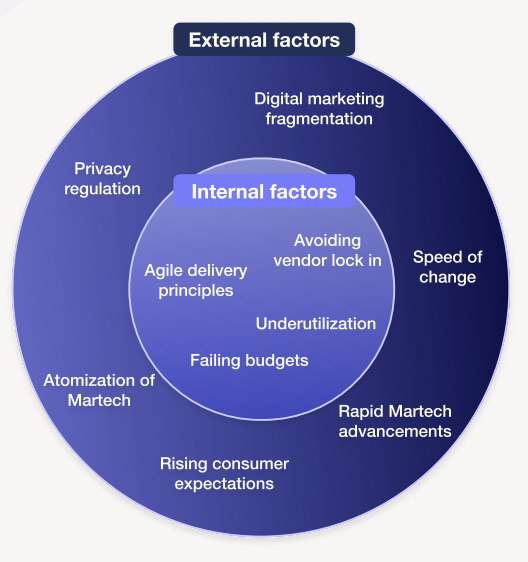
External and internal drivers behind the shift toward composable MarTech. Source: The Martech Weekly
Here’s what’s driving the change:
- Legacy stacks created data friction by requiring brands to copy, map, and maintain customer data across multiple SaaS tools, each with its own schema and update needs.
- Multiple systems holding conflicting “versions of truth” drove up costs, with every new data point requiring expensive mappings, ETLs, and maintenance.
- PII scattered across multiple platforms increased risk exposure, while data leaders now prefer composable models where sensitive data stays protected.
- Traditional CDPs created new data silos, separating customer data from core business, inventory, analytics, and supply chain datasets.
- Modern data clouds replaced brittle legacy systems with elastic, high-performance infrastructure that unlocked new integration possibilities.
- Marketing teams are becoming more technical, and the growing collaboration between marketing and IT makes modular architectures more feasible.
- Privacy regulations, cookie deprecation, and evolving data identity models demand flexibility that packaged platforms can’t deliver.
- Packaged CDPs limit flexibility—you’re stuck waiting for vendor support to add enrichment data or new insight types, or forced to switch platforms entirely.
- The convergence of AdTech and MarTech requires unified, first-party data activation across both owned and paid channels.
Benefits of MACH for marketing teams
Composable martech is an architectural approach that allows businesses to build their tech stack by selecting and integrating “best-of-breed” tools that fit their specific needs, instead of relying on a single, rigid, all-in-one platform.
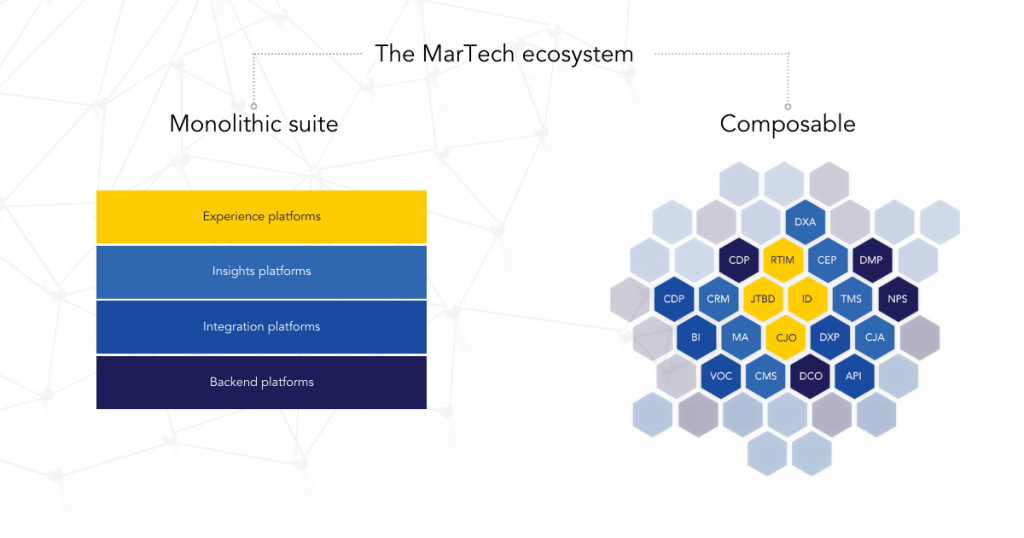
Source: Enterprise Martech
Here are the primary benefits of adopting a composable MarTech stack:
- Fast, Plug-and-Play Deployment: Direct integration with your data cloud eliminates data transformation, mapping, and syncing, speeding up deployments and enabling rapid launch of new use cases.
- Real-Time Agility & Activation: New data can be immediately activated across channels, making the system far more agile than traditional models.
- Cost & Operational Efficiency: Reduces total cost of ownership, lowers operational complexity, and eliminates the expense of maintaining multiple data copies or “versions of truth.”
- Access to Complete & Flexible Data: Native integration provides unlimited access to all customer 360 attributes on demand, rather than being limited to pre-mapped CDP data.
- Scalable Performance: Elastic and high-performance data cloud infrastructure easily supports millions of profiles and large data volumes.
- Richer Analytics & AI/ML Accuracy: Full-scale historical data improves model training, eliminates conflicting attribution, and enables deeper predictive insights.
- Transformational Customer Experience: Delivers hyper-personalized customer journeys that surprise, delight, and drive higher loyalty and share of wallet.
How to build a composable martech stack
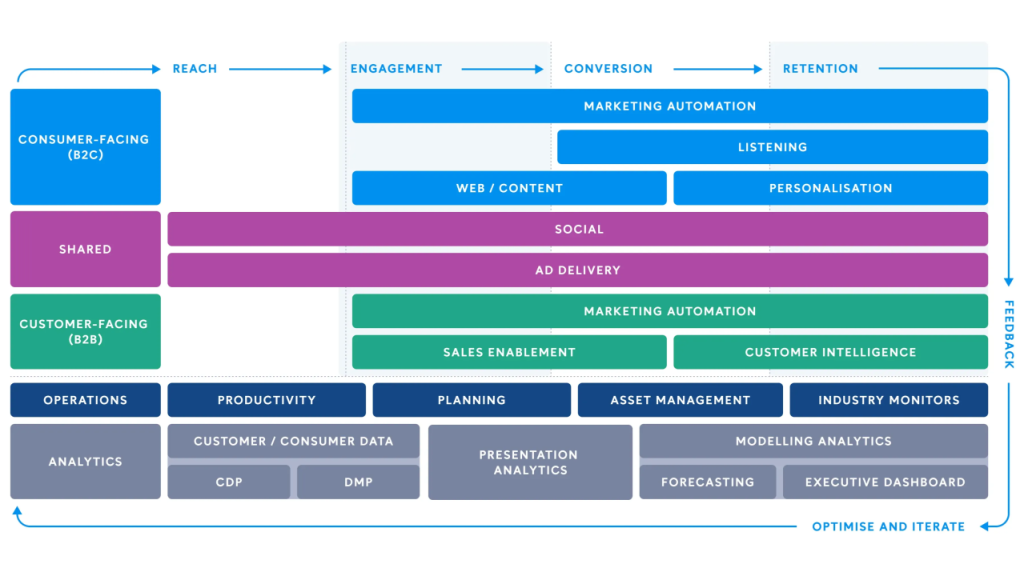
Source: LinkedIn
1. Start with business objectives, not technology
Ground everything in business goals and marketing strategy first. Document specific use cases that map back to these goals – don’t just list features. Define design principles (vendor agnostic, minimize data movement) that will guide architecture decisions.
This prevents building capabilities you won’t actually use.
2. Assess current state honestly
Audit your tech stack, data infrastructure, and CDP gaps to understand what data marketing needs—its format, availability, and cadence (real-time vs. batch). Then assess the maturity of your cloud data platform; if it’s not fully ready, start small by building a basic customer profile table in your warehouse as a foundation.
3. Build around three core principles
Now, to design a truly composable marketing technology architecture, your system should be grounded in these foundational principles, which closely align with how the MACH architecture in marketing is structured:
- Modularity: Independent, swappable components solving specific problems. However, remember picking multiple platforms doesn’t make you composable if you integrate them poorly
- Interoperability: Standard APIs and orchestration systems that maintain clean connections without tight coupling.
- Abstraction: Systems shouldn’t need deep knowledge of each other — just clear API contracts for specific use cases.
4. Establish your data platform as the hub
Make your warehouse (Snowflake, BigQuery, Redshift) the single source of truth. Use event streaming to feed both warehouse and real-time workflows simultaneously. All marketing-relevant data should be accessible here, with proper data quality and governance in place.
5. Choose platforms that write back to your warehouse
Select composable platforms that read data where it lives AND write results back to your data environment. This includes audience definitions, segment metadata, attribution data, AI predictions, identity resolution outputs. Everything should create an audit trail in your warehouse that engineers can review.
6. Build service-oriented workflows
Design narrowly scoped services with well-defined inputs and outputs—such as email validation, lead routing, MQL scoring, or enrichment—and orchestrate them through an integration layer (like an iPaaS or dedicated workflow tool). Adopt a developer mindset: build modular, reusable, and easily modifiable components.
This forms the foundation for automation workflows with MACH, which enable faster execution, better debugging, and reduced platform dependency.
7. Phase your migration strategically
Start by keeping your existing CDP in place, but make customer profiles accessible in your data warehouse. Shift activation capabilities—such as audience building and journey orchestration—to a composable engagement platform, and accept some temporary data duplication as a transition bridge.
Next, migrate all data sources into the warehouse, move core data functions like ingestion and identity resolution, and fully retire the traditional CDP.
This transition can begin even while activation capabilities are being modernized.
8. Solve for identity resolution in your warehouse
Use both probabilistic and deterministic matching to stitch anonymous and known identities and eliminate duplicates, writing golden records back to the warehouse with full auditability. This supports integrating MACH with CDPs & CRMs, ensuring seamless identity resolution and activation.
Start with simple methods like email or key matching, then layer in more advanced techniques. Don’t delay activation while waiting for a perfect identity solution.
9. Build technical skills in-house
This architecture requires operators fluent in APIs, webhooks, data mapping, systems design, and relational data models—skills beyond typical junior roles. You’ll need to upskill or bring in technical marketing operations talent, as owning and maintaining this architecture is a strategic capability, not something you can outsource.
10. Prioritize measurement over observability
Build attribution and campaign measurement into your architecture from day one – don’t bolt it on later. Ensure full visibility into workflow execution with JSON input/output logs, error notifications, and run histories. The ability to trace exactly what happened when for any record is critical for debugging and proving ROI.
5 critical reminders: Mistakes to avoid while integrating MACH with CDPs & CRMs
Before you embark on building a composable architecture, it’s important to recognize some common pitfalls that often derail even well-intentioned initiatives:
- Composability is not achieved by simply buying multiple best-of-breed tools; if you tightly couple systems during implementation or hardcode dependencies, you end up with a brittle monolith that’s harder to maintain.
- Skipping the operating model discussion—ownership, skill sets, and change management—kills adoption; if marketing owns the CDP but data/IT owns the warehouse, alignment must precede architecture.
- Real-time isn’t required for most high-value use cases; suppression, personalization, and attribution work effectively with 15-minute or batch updates, so avoid over-engineering for vanity latency.
- Don’t wait for the perfect data architecture; if customer data is centralized—even imperfectly—you can begin activation using a simple customer profile table while maturing infrastructure.
- Composability shifts ownership of integration, orchestration, and troubleshooting to you; without technical ops talent, custom builds become a liability despite savings on CDP licensing.
Key Insight: Composability is NOT a product feature; it is an implementation discipline.
Even with composable tools, you can still end up with a tightly coupled monolith if you integrate them poorly. True composability is preserved when modular components are orchestrated from an external layer, not embedded within one another, while maintaining modularity, interoperability, and abstraction.

Migrate to a composable stack with the help of Mavlers
Composable MarTech is not just a different way to assemble tools. It is a different way to think about marketing capabilities. It is where architecture becomes strategy, and where data, activation, and experimentation continuously reinforce each other. The brands that succeed in this model are not just deploying technology; they are engineering adaptability, scaling personalization, and building systems that improve rather than decay over time. The competitive edge no longer lies in owning platforms. It lies in mastering how they work together.
If you are ready to shift from platform ownership to capability ownership, we can help you architect, operationalize, and activate it.
Schedule a free, no-obligation call with our lifecycle marketing experts today!