 Lifecycle marketing
 Customer data management
 Email campaign production
 Search marketing
 CMS development
 Who we are
 How we work
 Case studies
 Testimonials
 Salesforce Marketing Cloud
 Braze
Braze HubSpot
 Marketo
 Pardot
 DataBricks
 Snowflake
 HighTouch
 RudderStack
 Segment by Twilio
 Videos
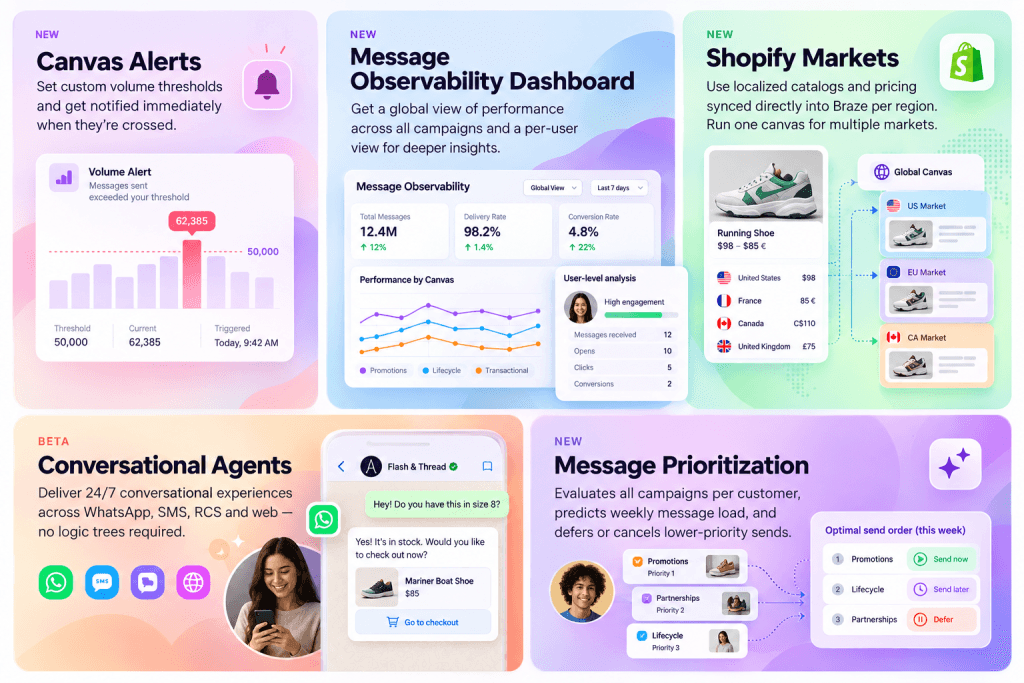
In times of automation, AI, and agentic merchandise, delivering memorable experiences is finally within reach. Marketers have long aspired to sell experiences, yet achieving the near-perfect confluence of timing, channel, and context remained a benchmark few could meet. But what was once the gold standard of personalized marketing is now embedded into the underlying infrastructure. Braze enables such confluence at scale, empowering brands like yours to deliver cohesive, multi-dimensional customer experiences.
Now, that confluence of channel, timing, and context is what we call channel resonance.
Accordingly, in Braze, channel resonance is the process of making three decisions in concert:
- what channel to use
- when exactly to reach someone, and
- in what context
Remove any one leg, and the stool collapses.
When these elements work together, you create the foundation needed to deliver true customer experiences. And in Braze, you have just the infrastructure to pull this off.
Table of Contents
Why most cross-channel efforts tumble downhill
The anatomy of channel resonance
1. Channel fit
2. Timing
3. Contextual relevance
Building the behavioral data foundation
Orchestration
Beyond passive behavioral signals
Measuring channel resonance
Solve your channel challenges in Braze with Mavlers
Why most cross-channel efforts tumble downhill
As a brand, you invest in various channels and, inevitably, run those channels in isolation. Email has its own cadence. Push dances to triggers. They don’t talk to each other.
Such an arrangement disrupts the circadian rhythm, so to speak, of your brand.
More than a technology problem, it’s a data problem compounded by a total lack of strategy.
The underlying customer profile is incomplete or siloed. As a result, the engagement layer cannot make intelligent decisions. You engage alright, but not in a way that makes a difference.
And speaking of making a difference, here’s what it looks like when everything falls into place:
- Coordinated cross-channel marketing can drive engagement up by over 300%.
- 63% of consumers in the US are willing to share more data with brands that deliver strong experiences.
- Brands executing consistent, high-quality multi-channel strategies see customer retention rates that are roughly 91% higher than those that don’t.
The data couldn’t be louder. If you want those gains reflected in your sales report, it’s important to get under the skin of channel resonance.
The anatomy of channel resonance
1. Channel fit
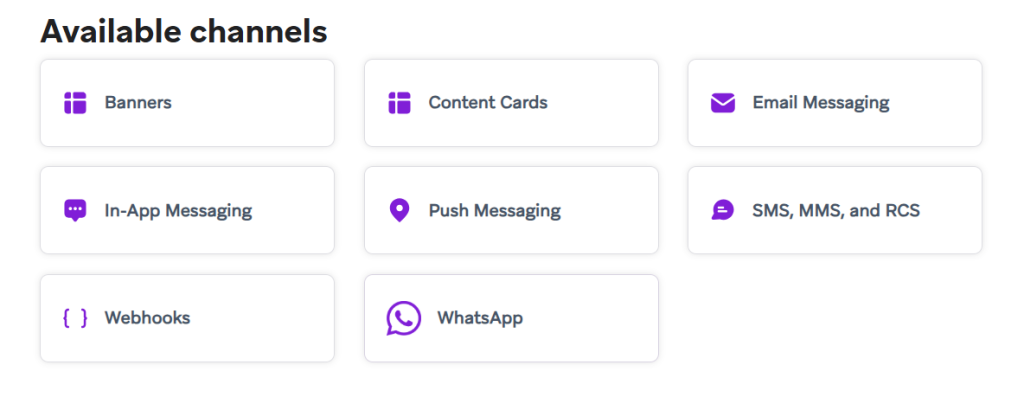
Different customers are fundamentally different in how they engage with your communications.
Source: Braze
For example, one person checks email obsessively first thing in the morning; another treats their inbox as more of a weekly ritual. In fact, certain geographies have historically low email engagement and far higher response to in-app or SMS touchpoints. Some customers have explicitly shown you, through their behavior, that they only engage when you reach them on one specific channel. Resonance begins with acknowledging this reality.
Your goal is to identify the path of least friction into a given customer’s attention, and prioritize it.
2. Timing
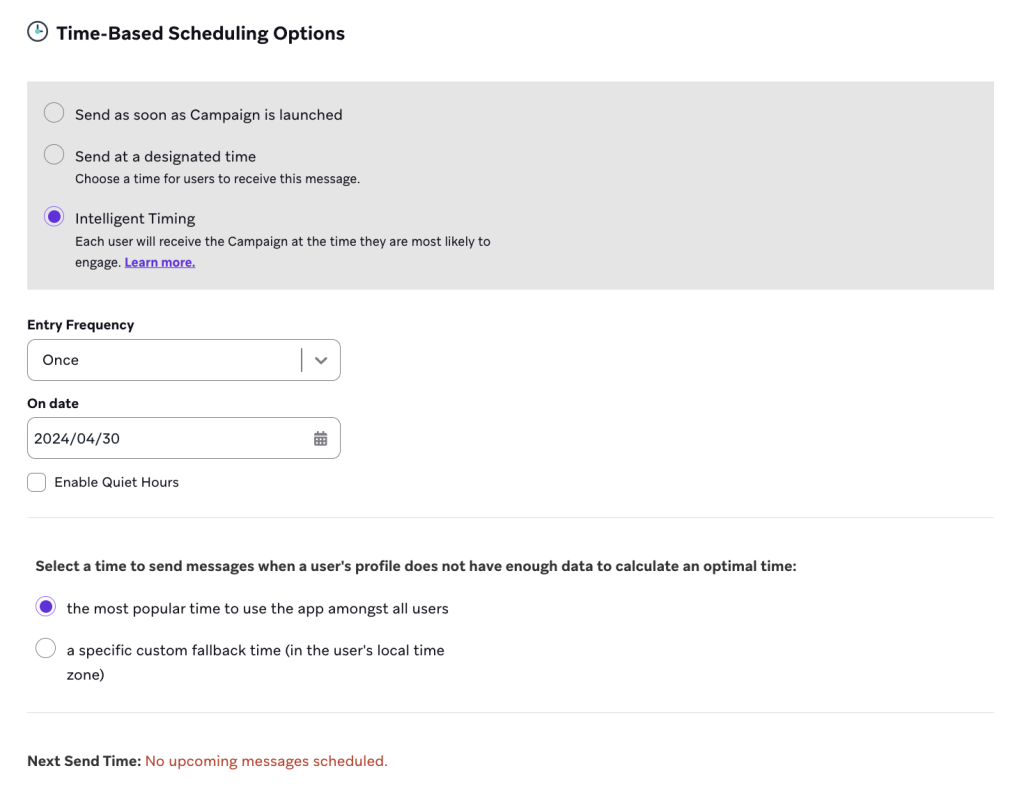
There is an optimal moment to reach every individual customer, and that moment is not the same for any two people. Intelligent timing means analyzing each user’s historical pattern of interaction (when they open, when they tap, when they convert), and targeting those windows statistically.
Source: Braze
This is where automation earns its keep.
Human judgment cannot calculate optimal send times across millions of profiles. But algorithmic timing, fed by behavioral history, can. And the lift it produces is meaningful.
3. Contextual relevance
Timing and channel mean nothing if the message itself does not fit the moment. In fact, it can be as basic as sending an email with an incentive right after a customer has already purchased the same product at a higher price! Some embarrassment for your brand.
Context requires knowing what users have done most recently, what lifecycle stage they occupy, and what signal they last sent. For example:
- Did they abandon a cart?
- Did they just complete an onboarding step?
- Have they gone quiet after a period of heavy engagement?
Each of these stages calls for a fundamentally different message.
For the anatomy of channel resonance to come alive, you need the life-force of data.
Building the behavioral data foundation
Before any strategy can work, you need a unified customer profile that aggregates behavioral signals from every surface where your customer exists i.e. your website, your mobile app, your point-of-sale system, your historical campaign data, your CRM. These signals must be collected, standardized, and made available in real time to your engagement layer.
Below is a five-step process for preparing the data foundation you need to build off of:
- Collect the data: Gather behavioral signals from every owned digital channel in real time.
- Standardize the data: Normalize event schemas so that data from disparate sources can speak the same language.
- Enrich the data: Start to layer on predictive attributes e.g. churn likelihood, engagement propensity, and LTV tier.
- Integrate: Pipe the enriched profiles into your engagement platform as a live, continuously updated source of truth.
- Activate: Trigger journeys based on profile state changes.
Once the data foundation is in place, you start with the orchestration strategy.
Orchestration
In Braze Canvas, you can map the complete arc of a customer relationship as a connected set of decision branches, not isolated campaigns.
From here on, nuance is going to be your best friend.
For instance, consider the structure of an effective onboarding journey. The entry point is almost always a sign-up event, but then the path diverges almost immediately. Users who have downloaded the app and shown in-app activity within the first 48 hours have a different next step than users who signed up via web and haven’t tapped the app at all.
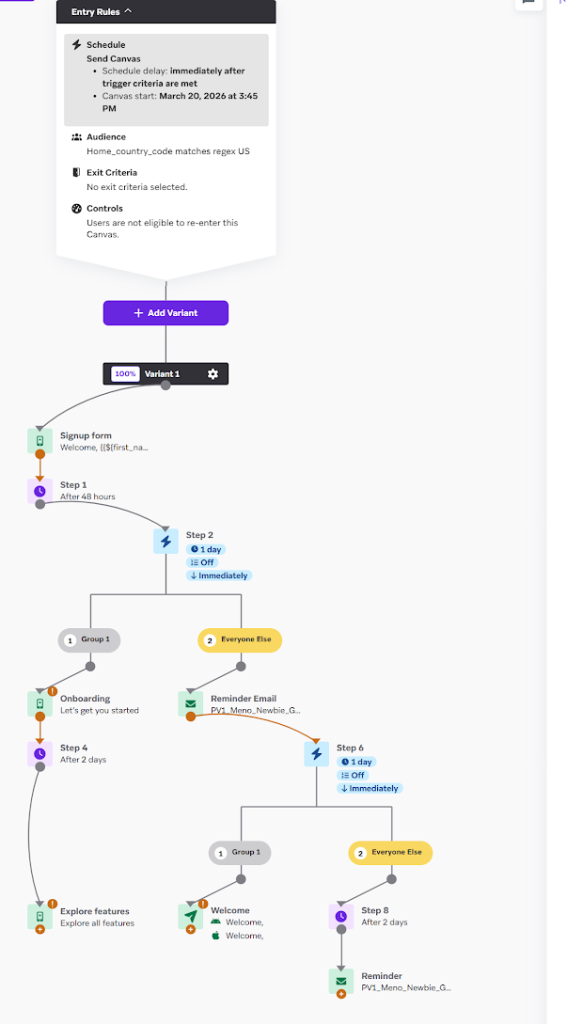
An onboarding journey flow example from our client work
For the latter group, a well-timed email prompting an app download, with messaging that speaks to the specific benefit they signed up for, is more resonant than an in-app ping.
Thus, as users progress, the journey continues to branch in lockstep with their behavior.
Real-time triggers play a big role here.
As you may know, they work by listening for specific state changes. It could be a price drop on a browsed item, a trip date approaching, an offer expiring, a milestone reached, etc. The sophistication is not in the trigger itself but in what happens after: the system must know which channel to use, what content to serve, and, sometimes, whether to send at all.
Channel resonance is also about what you withhold. A user who is highly likely to return on their own does not need an ad retargeting them. A customer who just converted does not need the promotional email that was already queued. Sophisticated orchestration includes suppression logic that reads the profile state before triggering any communication.
Beyond passive behavioral signals
By passive behavior, we mean customer actions that you as a marketer simply react to. However, relying only on this limits how well you understand your audience.
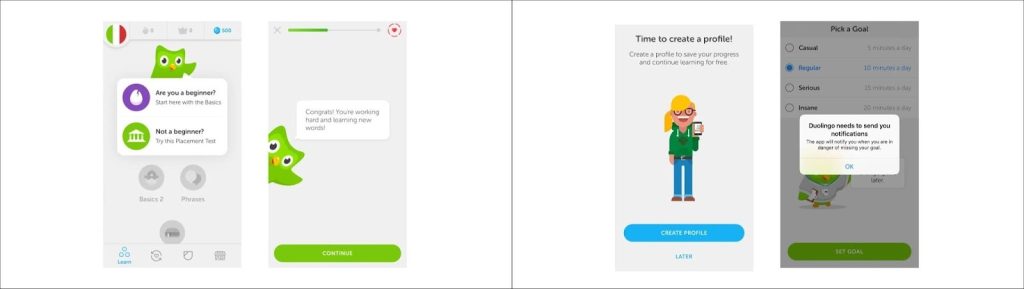
Because even practically, if you want to know another person, you need to take part in the conversation. You don’t just sit and let the other person talk. You make a conscious effort to make them feel comfortable sharing more about themselves, as long as it’s not creepy.
Source: Braze
Similarly, the first few touchpoints after a customer enters your ecosystem are not just onboarding steps. In fact, they are an opportunity to learn what this individual actually needs, how they want to be reached, and what their goals are. Asking customers about their preferences during onboarding, letting them set their own goals or cadences, and then honoring those preferences throughout the journey creates a virtuous cycle. (See how Duolingo does it above)
Over time, this loop compounds into a genuine understanding of each customer, one that no third-party data source can replicate because it is built from the relationship itself.
Measuring channel resonance
Channel resonance is ultimately a measurable outcome. But we’re not talking about open rates and CTR. Here, the metrics that matter are downstream:
- Incremental sessions generated by a re-engagement sequence
- Conversion rate lift from a trigger campaign versus a batch send
- 30-day and 90-day retention differences between users who were engaged multi-channel versus single-channel from the start
- Lifetime value curves segmented by journey type
Each touchpoint that lands well builds a customer’s trust and their propensity to engage the next time. The relationship becomes self-reinforcing.
Solve your channel challenges in Braze with Mavlers
Like we said at the beginning, Braze gives you just the infrastructure required to achieve channel resonance. However, realizing its full potential depends on how you use it.
A lot depends on how you architect within the infrastructure.
If you’ve chosen Braze as your platform and need support in building CX-focused solutions, we can help. Our Braze services cover everything end-to-end:
- Personalized Email, SMS, Push, In-App, Content Cards
- Campaign automation, A/B testing, and optimization
- Seamless migration and real-time reporting
- Deliverability, integrations, and growth-focused strategy
Book a free, 30-min no-obligation call with one of our certified Braze experts when you need.