 Lifecycle marketing
 Customer data management
 Email campaign production
 Search marketing
 CMS development
 Who we are
 How we work
 Case studies
 Testimonials
 Work samples
 Salesforce Marketing Cloud
 Braze
Braze HubSpot
 Marketo
 Pardot
 DataBricks
 Snowflake
 HighTouch
 RudderStack
 Segment by Twilio
The state of martech maturity is dismal. “Martech maturity” itself is an oxymoron.
While the martech landscape has exploded (from just 350 tools in 2012 to nearly 15,000 in 2025), only about a third of organizations have reached a state of maturity. And yet, belief in martech’s potential remains high. 80% of organizations plan to increase their martech spend over the next five years. (It might well be the case that it is more convenient to believe than not to.)
So what’s holding them back?
According to McKinsey, four critical fault lines are limiting martech’s impact:
- Executive buy-in that exists more on paper than in practice
- Platform complexity, traditionally driven by the likes of Salesforce and Dynamics 365
- A lack of clear measurement frameworks to evaluate ROI
- Technology advancing faster than the talent needed to leverage it
Together, these challenges explain why so many organizations struggle to realize the full value of their martech investments.
As we onboard clients, we’re seeing this play out repeatedly, especially with platforms like Braze. As a customer engagement platform, Braze deserves to be squeezed to the seed.
Check out these 7 signs to find out whether you’re only scratching the surface in Braze.
Table of Contents
7 signs your Braze strategy needs an upgrade
1. You’re running campaigns, not lifecycle programs
2. Your Canvas setups are linear
3. You’re not using real-time event data properly
4. You’re not using Catalogs or Connected Content for better personalization
5. Your data model isn’t designed for Braze
6. You’re using BrazeAI tactically, not strategically
7. You’re not using Content Cards
Upgrade to Braze lifecycle marketing with Mavlers!
7 signs your Braze strategy needs an upgrade
1. You’re running campaigns, not lifecycle programs
Braze is designed for event-driven engagement, not batch-and-blast marketing. If your primary lever is campaigns, you’re bypassing the platform’s core strength.
In the majority of instances, here’s how both the approaches stack up against each other.
| Typical setups | Mature setups | |
| Core strategy | Batch-and-blast campaigns | Event-driven, behavior-based engagement |
| Trigger | None (scheduled send) | Product Viewed OR Category Browsed |
| Audience | All active users | Users who viewed but didn’t purchase within 2 hours |
| Execution | One-time campaign | Canvas-based journey |
| Personalization | Minimal or static | Dynamic personalization using Catalogs |
| Promotional content | Generic offers | Product-specific details, pricing, availability |
| Channel strategy | Email only | Multi-channel orchestration |
Lifecycle marketing relies on owned channels where you can engage with customers repeatedly at little to no incremental cost. If you don’t cash in on those channels, you’re losing out.
2. Your Canvas setups are linear
Let’s rehash what Canvas is. It is essentially a customer journey tool in Braze.
If you’re setting up linear Canvases, it could either mean you’re underestimating the significance of what you already know i.e. customer journeys are not linear; or, you’re running into technical friction, hence defaulting to stripped-down setups.
In either case, a linear, stripped-down setup typically looks like the following:
- One entry, one path, and a one-size-fits-all experience for the entire list
- Limited application of decision splits and exit criteria
- Converted users continuing to receive pre-conversion communication
Canvas is built for dynamic decisioning. Here’s what a mature Canvas setup looks like.
| Logic/condition | Action | |
| Entry | User signed up | Enters Canvas |
| Step 1 | — | Send onboarding email |
| Decision splits | If profile completed | Move to activation journey |
| If profile not completed | Send reminder via Push | |
| Step 2 | If purchase made | Exit Canvas immediately |
| If no purchase made | Introduce incentive | |
| Channel optimization | Based on user behavior & preference | Use Intelligent Channel to choose Email vs Push |
3. You’re not using real-time event data properly
Like we explained, Braze is designed for event-driven engagement. That means Braze thrives on real-time streaming data. In spite of that, most setups are guilty of:
- An over-reliance on scheduled data syncs
- Not using custom events for triggers
- Significantly delayed post-behavior communication
Now, why is leveraging real-time data properly absolutely critical?
Once again, it’s customer behavior, that’s why. Take cart abandonments. According to Baymard, here’s why customers abandon carts. This might not even be the full list!
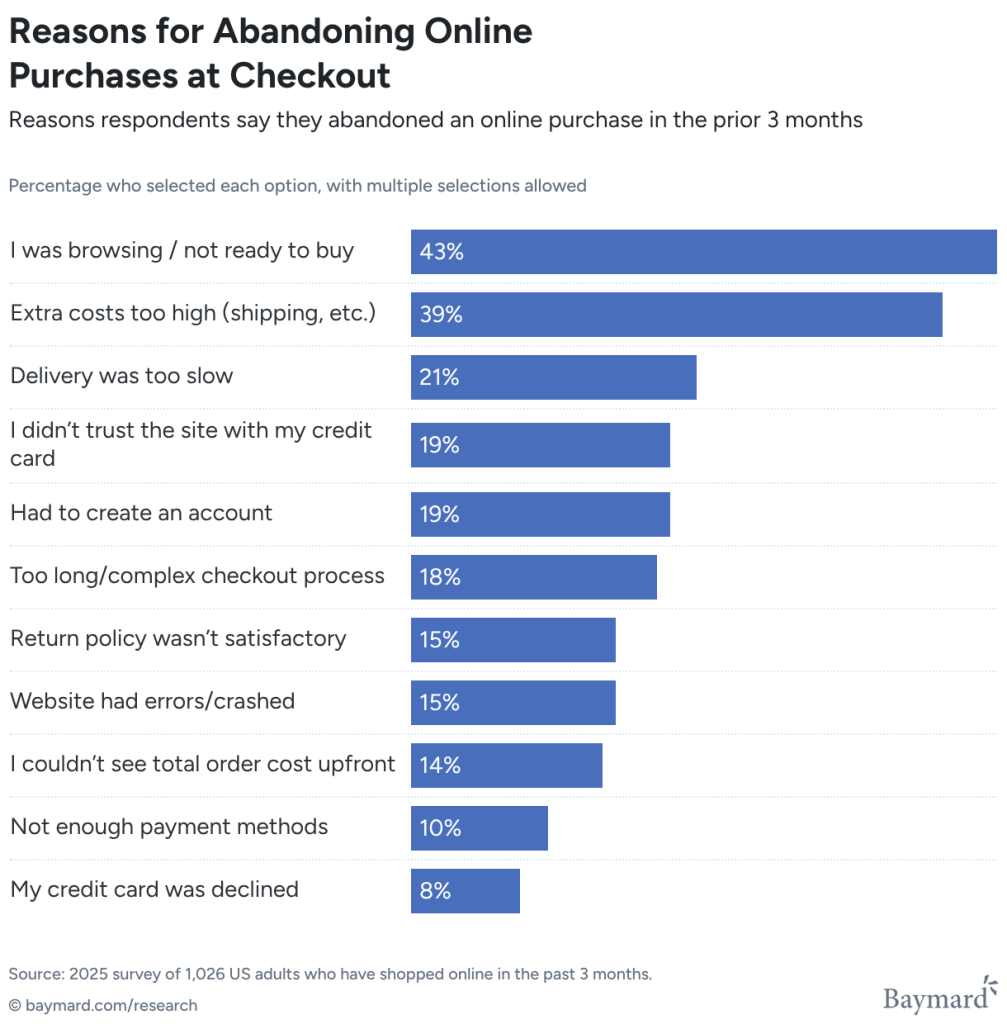
In light of these reasons, you need to think ahead of your customers. And speaking of these cart abandonments, nearly $260 billion worth of lost orders are recoverable.
With that in mind, here’s what a fully optimized cart abandonment execution in Braze looks like.
| Logic/condition | Action | |
| Event | cart_updated with item properties | Captures cart activity with relevant data |
| Trigger timing | Within minutes of event | User enters Canvas quickly |
| Push notification (15 mins) | All users | “You left something behind” |
| Email (2 hrs) | All users | Send dynamic cart items using event properties |
| SMS (next day) | Only if cart value > threshold | Send reminder for high-intent users |
In fact, you can also insert an advanced layer by using Currents to feed abandonment data into Snowflake; building predictive segments; and feeding back into Braze for prioritization.
Here’s how it looks like:
Use Braze Currents to stream real-time user events into Snowflake. In Snowflake, analyze this data to build predictive segments such as “high likelihood to purchase” or “low intent users” based on behavior patterns. Send these scores or segments back into Braze as custom attributes or events, and use them inside Canvas to prioritize messaging; for example, targeting high-intent users faster with no discount, while delaying or incentivizing lower-intent users.
It is particularly helpful when you need to interact with customers across multiple touchpoints. If you do omnichannel or cross-channel marketing, these should be default setups anyway.
4. You’re not using Catalogs or Connected Content for Braze personalization
Personalization in Braze can’t stay limited to basic Liquid usage or static content blocks. Key to advanced personalization is Catalogs and Connected Content.
For example, check out the following setup for personalization in Braze.
| Logic/input | Execution | |
| Data sources | Catalogs | For pulling product recommendations |
| Connected Content | For fetching external data such as pricing, inventory, etc. | |
| Personalization | Last viewed category | Tailor product selection |
| Purchase frequency | Adjust messaging relevance/intensity | |
| Average order value | Influence product range/pricing shown | |
| Dynamic content logic | If user browsed “Running Shoes” | Show top 3 running products |
| Else | Show best sellers |
Within Catalogs, you can try Selections. These are dynamic subsets of a catalog filtered against user attributes. Let’s try to understand this with an example.
If your catalog has 22 products across shoes, t-shirts, and pants, you don’t need three separate selections. You create one Selection that reads the user’s favorite_retail_category attribute and returns only the matching items, randomized, up to a set limit. When the attribute changes from “Shoes” to “Pants,” the Selection then automatically surfaces a different subset.
Braze surfaces the filtered results as a Liquid array, making it simple to loop through items and populate product names, images, and pricing dynamically within a single email template.
5. Your data model isn’t designed for Braze
Flat profiles, overuse of custom attributes, absent event properties — all these are indications of an arrangement where your data is merely synced to Braze.
Braze’s capabilities are directly tied to the quality of the data architecture.
Consider the following setup. This enables better segmentation, dynamic personalization, and multi-product recommendations.
| Event | Event properties |
| product_viewed | product_id; category; price; brand |
| checkout_started | cart_value; currency; item_count; product_ids (array); categories (array); discount_applied (true/false); checkout_step (e.g., shipping, payment) |
| order_completed | order_id; total_amount; currency; product_ids (array); categories (array); purchase_type (first-time / repeat); payment_method; discount_used; shipping_type |
6. You’re using BrazeAI tactically, not strategically
As in all things AI, the urge is to use it without regard for anything else.
If our experience with simple, standalone AI tools has shown us that this approach doesn’t work, how much more of a waste of time is it when it comes to using AI in Braze!
With Braze’s more recent breakthroughs in AI, the temptation is stronger.
So when it comes to BrazeAI, we tell our clients to consider these things before upgrading:
- Start with a single impactful use case. Focus all data, process mapping, and testing on the highest-impact task to limit disrupting your entire stack.
- Document your current process first. Do not hand off decisions you don’t fully understand; mapping reveals where AI fits and where it doesn’t.
- Exhaust your existing stack before buying. Confirm current tools can’t solve the problem to avoid unnecessary complexity and cost.
- Prioritize execution over perfect planning. Work in short sprints and learn through iteration rather than delaying for a static roadmap.
7. You’re not using Content Cards
In our conversation last year with Allan Heo, he highlighted Content Cards as one of the most underutilized features in Braze. Marketing creates the strategy, engineering implements the SDK container, designers ensure brand consistency, and product manages edge cases and default states. Most teams underestimate this cross-functional lift. But once implemented, Content Cards give marketing teams product access; they can optimize creative without engineering tickets.
In light of that, teams need structure and clarity around how they work together:
- Assign a single project owner to coordinate marketing, engineering, design, and product, keeping momentum and preventing handoff gaps.
- Align teams early with a shared spec covering placement, design, logic, and edge cases to avoid mid-build surprises.
- Start small. Launch a basic content card (single placement, simple design, limited logic), and iterate once roles and processes are clear.
- Run a kickoff workshop. Bring teams together to map dependencies, timelines, and blockers, preventing delays caused by scattered communication.
- Start with banners; they’re faster to launch, lighter on design and SDK, and help prove value before scaling to content cards.
Upgrade to Braze lifecycle marketing with Mavlers!
Customer acquisition has become very expensive. Paid channels are increasingly costly. CAC pay back periods are getting longer. As a result, retention matters more.
In addition, customers expect relevant, hyper-personalized experiences.
Lifecycle renews the focus on problem solving, customer success, and end-to-end experiences. Revenue, retention, loyalty, these are your strongest hedges today.
In light of this, it is time to upgrade your Braze usage to lifecycle-level maturity.
We can help you make that transition. Our 20-strong team of Braze experts have so far managed more than 2,000 campaigns/automations in Braze.