 Lifecycle marketing
 Customer data management
 Email campaign production
 Search marketing
 CMS development
 Who we are
 How we work
 Case studies
 Testimonials
 Work samples
 Salesforce Marketing Cloud
 Braze
Braze HubSpot
 Marketo
 Pardot
 DataBricks
 Snowflake
 HighTouch
 RudderStack
 Segment by Twilio
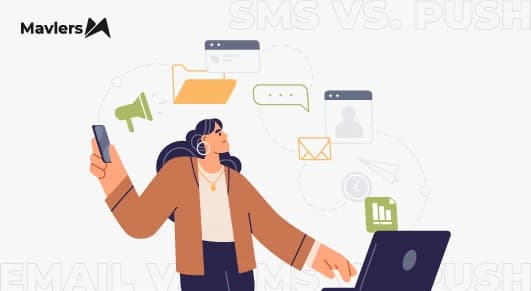
In the course of a Mavlers webinar with marketing coach Sarah Ferraina, the topic of channel selection came up. Sarah shared a practical decision-making tool to help teams evaluate which marketing channel to use for a campaign, the ICE framework:
- Impact: Will this channel reach my ideal customer?
- Confidence: Do we know how to use this channel effectively?
- Ease: Can we get started without a lot of effort or cost?
The ICE method works well as an evergreen framework. But notably, selecting a channel is never the first step. It must be preceded by more fundamental questions, such as:
- Are we capturing existing demand or creating new demand?
- Where does our buyer actually spend time?
- How do they validate purchasing decisions?
- What economics must this channel support?
- How can different channels reinforce one another?
It’s critical to remember: A marketing channel is a delivery method, not a strategy.
And in our experience working with Braze clients, we routinely see teams skip these foundational questions and vault straight to the last one: Which channel should we use?
Getting channel selection right requires a strategic framework. Let’s find out what that is.
Braze channel decision framework: The 3 factors that should drive every channel decision
1. How a user typically engages with you
Historical behavior is the strongest predictor of future behavior. So some customers open every email but never tap push notifications. Others are daily app users who barely glance at their inbox. Still others respond quickly to SMS but treat email as an archive they’ll get to eventually, or maybe never.
Braze provides rich behavioral signals in the form of :
- Email open and click rates
- Push notification open rates
- In-app session activity
- Channel opt-in status
- Recent interaction history
These signals enable you to segment users by demonstrated behavior. Mapping your audience along these behavioral dots is the foundation of channel selection.
But at the same time, even with the data at your disposal and the goldmine of behavioral science, it’s a mistake to treat patterns as gospel. Customers are human, and human beings are not always predictable. So you’ll have to leave that much room for sudden anomalies, and architect fallbacks to account for contingencies across your campaigns.
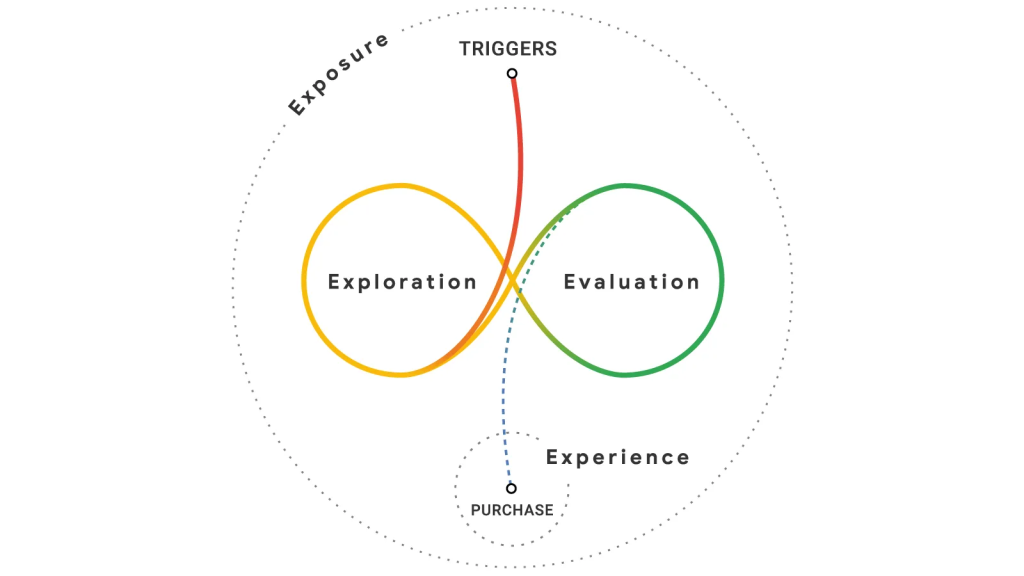
In 2020, Google captured consumer unpredictability in the term “messy middle.”
2. What the message demands
Now, every channel has a native fit, the kind of messages or content it handles well and the kind it doesn’t. Understanding these strengths is crucial. Here’s a top-level distribution:
SMS
SMS is a blunt instrument, powerful if used properly but highly alienating otherwise. It’s best for:
- Time-sensitive alerts
- Urgent calls to action
- Short transactional updates
- Flash sale countdowns
Email is the channel for consideration, supporting rich visuals, extended copy, multiple links, and genuine context. Generally speaking, it’s best for:
- Product announcements
- Educational content
- Receipts and confirmations
- Multi-offer promotions
Push notifications
Push creates interrupt-level attention without demanding much from the customer. It works best inside an established routine for:
- Quick reminders
- Behavioral prompts
- Low-complexity time-sensitive messages
- In-session contextual trigger
But it’s the next and last factor that is arguably the most important.
3. Where the customer is in their relationship with you
The lifecycle stage profoundly shapes how customers perceive your communications.
Yet many brands lose sight of the relationship, even while claiming customer-centricity as their north star. The disconnect becomes especially visible during the holiday season. In Q4, lifetime value initiatives are often sidelined in favor of short-term revenue pushes. Brands want to salvage the year, and therefore maximize volume, run doorbuster promotions, and flood inboxes with discounts. It’s so endemic to marketing that even after the disruptions of COVID, brands reverted to their pre-2019 playbooks.
From the customer’s perspective, this can feel exhausting. If you continue trying to “impress” someone who is already in a mature, established relationship with your brand, you risk coming off as transactional and tone-deaf. When a customer has already chosen you, the goal is stewardship. You need to resist the urge to keep winning over customers you’ve won already.
The decision tree in practice
You want to replace inconsistent, ad-hoc decisions with a repeatable logic that any team member can follow. Ask yourself:
- Can this user actually be reached on this channel?
- Is the message suited to that channel’s format and norms?
- Is this customer likely to be receptive right now?
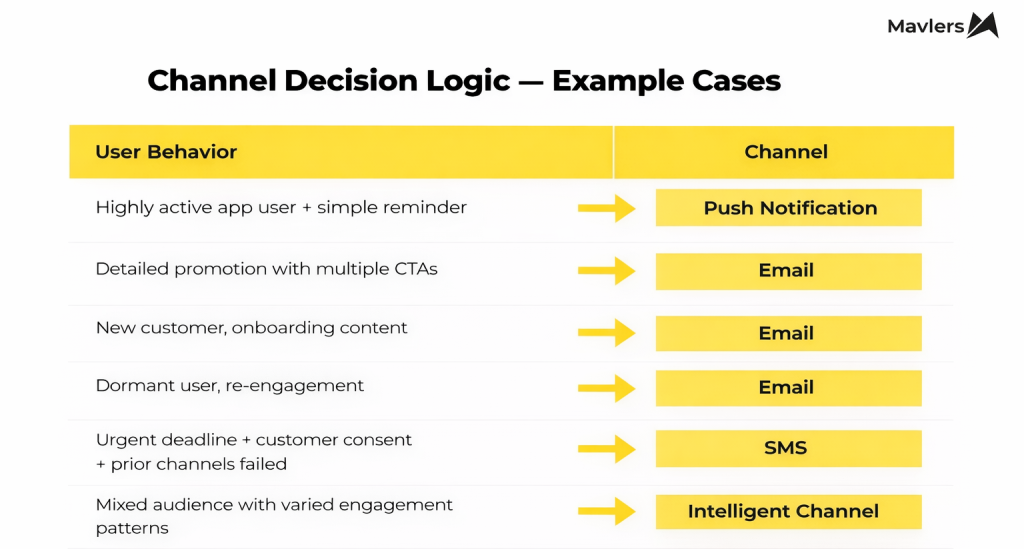
Applied consistently, these questions produce clear, defensible decisions.
In Braze, you can make this logic actionable at scale through Canvas, which lets teams branch users based on engagement signals, behavioral attributes, and lifecycle stage. Intelligent Channel features can automate selection entirely for mixed audiences, using historical data to route each individual to their most responsive channel.
Designing sensible fallback paths
Even a well-chosen channel won’t always produce immediate engagement. A sensible fallback sequence ensures important messages still reach the customer.
So it’s the messy middle again. Customers frequently revisit stages, repeat actions, and change direction based on shifting needs. A customer who doesn’t tap your push notification may be mid-consideration. Thus, fallback timing should account for this, giving customers room to move at their own pace before escalating to a higher-friction channel like SMS.
Speaking of fallback paths, it’s useful to think about customer journeys along the lines of Stephen Anderson’s loops-arcs-terrain model.
Customer journeys are rarely linear. UX and service design have moved beyond the idea of a predictable path to conversion. In reality, customers accumulate dozens of small, independent engagement moments in no fixed order.
Each interaction is less a step in a sequence and more a loop: an action, feedback, and a subtle update to their mental model. Some loops fire instantly. Others take days. Some never happen at all.
As channel designers, you control the terrain i.e. the touchpoints you make available and when. You don’t control the arc, the exact path any individual takes through that terrain. A better approach is to design each touchpoint so well that whenever a customer loops back, the message feels relevant and the channel feels right.
Critically, there’s a data problem lurking here too.
Marketing analytics research shows that customers often interact with a brand dozens of times before converting. Conventional attribution models tend to credit only the final touchpoint. The same distortion gets repeated in the fallback logic: if a customer converts after receiving an SMS, the SMS gets the credit, even if the push notification three days earlier was what actually re-engaged them. Before hopping to the next channel, ask yourself: would this customer have converted anyway, given more time?
Measuring whether your framework is working
You need to measure, test, and refine the channel decision framework. The metrics that matter fall into two categories:
- Effectiveness: Conversion rate by channel; time to conversion; engagement depth; and long-term engagement trends.
- Efficiency: Cost per engagement; cost per conversion; SMS utilization vs outcomes; and channel-specific opt-out rates.
Channel-specific opt-out rates are a particularly useful early-warning signal: when they spike, it indicates your channel selection is misaligned with what customers actually want to receive on that channel. Long-term engagement trends tell you whether your framework is building the kind of sustainable relationship that drives lifetime value, or eroding it.
Need help with intelligent channel orchestration in Braze?
The most immediate benefit of a channel decision framework is consistency. It gives you a certain degree of control over outcomes by making them predictable.
That predictability compounds over time. Teams move faster because they’re not relitigating the same questions. Customers receive more appropriate communications because channel selection reflects their actual preferences and context. Attribution becomes cleaner because you’re not muddying the signal with redundant multi-channel sends. And finally, costs come down because you’re using each channel where it genuinely earns its place.
So, start with the three questions. Build your decision tree.Apply it consistently. Measure, iterate, and improve. That’s the whole playbook.
If you need help operationalizing it in Braze, book a no-obligation call with one of our experts.