 Lifecycle marketing
 Customer data management
 Email campaign production
 Search marketing
 CMS development
 Who we are
 How we work
 Case studies
 Testimonials
 Salesforce Marketing Cloud
 Braze
Braze HubSpot
 Marketo
 Pardot
 DataBricks
 Snowflake
 HighTouch
 RudderStack
 Segment by Twilio
 Videos
According to Inside Sales’ 2021 Lead Response Research, the odds of converting a lead drop more than eightfold when the first response comes after the five-minute mark.
This spotlights, among other things, the fleeting nature of customer intent. However, speed in marketing isn’t about being the fastest. Customers don’t experience speed as an absolute metric; they experience it as a gap between what they expect to happen and what actually happens.
When you close that gap, you build trust, confidence, and momentum. (Remember, for 66% of customers, speed carries the same weight as price in buying decisions.)
Crucially, speed is not universally positive. Too slow might suggest indifference; too fast can trigger suspicion, erode trust, and make experiences feel automated. This creates a “Goldilocks zone” of responsiveness: you want to be fast enough to reassure customers you’re operationally sound, but not so fast that the interaction feels canned.
So you want the right amount of speed, responding to customer intent at just the right moment, while knowing that “right” isn’t universal. It varies by customer, context, and industry. This balance is exactly where low latency marketing automation becomes a competitive advantage.
But how do you know what the right time or speed actually is? The answer is, through data.
However, when event data arrives late, it robs you of context and direction. Without real-time data streaming, hitting the Goldilocks window can be very hard. And that’s what real-time data streaming in Braze enables you to do.
How does Braze help you capture intent?
Unlike legacy marketing clouds that rely on batch-and-blast (i.e. processing data in chunks every few hours), Braze is built as a real-time event-driven engine.
Here is how the architecture leverages streaming data to minimize latency.
1. The ingestion layer (Braze Cloud Data Ingestion)
Braze uses SDKs and APIs to ingest data the millisecond it happens:
- SDKs: When a user clicks “Add to Cart” on a mobile app, the Braze SDK sends that event directly to Braze’s servers.
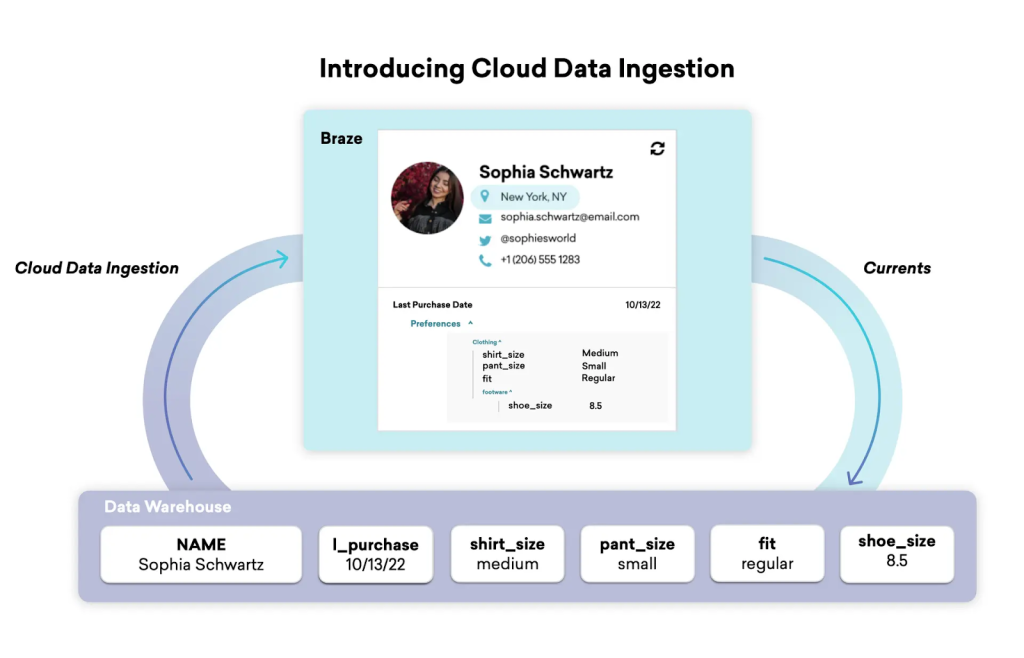
- Cloud Data Ingestion (CDI): For data living in warehouses, Braze uses CDI to “stream” updates. In 2024-2025, they heavily optimized this for “zero-copy” syncs, meaning Braze can trigger actions based on warehouse changes without having to fully “copy” and store the data first, significantly reducing the time-to-action. This approach is foundational to zero-copy data activation Braze enables at scale.
Source: Braze
A case in point would be Dyn Media. By connecting Snowflake directly to Braze via Cloud Data Ingestion, Dyn Media activated real-time behavioral and subscription data—such as viewing habits, preferred sports, and subscription status—inside Braze. This allowed them to identify why a customer joined, what they cared about, and when intent was most likely to decay.
2. The processing layer
Braze uses a high-performance stack to ensure data doesn’t sit in a queue:
- Apache Kafka: Kafka acts as the central nervous system in Braze. Every event (like a click, a purchase, a location change) is a “message” in a Kafka stream.
- Redis: Redis is used as a lightning-fast cache to store user profile “shards,” which allows Braze to check a user’s eligibility for a campaign.
- MongoDB: MongoDM stores the deeper, persistent user profiles in a flexible document format that can be updated on the fly without rigid schema constraints.
3. The activation layer
Braze enables you to create action-based triggers.
Consider a typical cart abandonment scenario.
Let’s say you decide to trigger a follow-up email 30 minutes after a customer leaves their cart. Because the data is streaming, the “30-minute” clock starts the exact second the cart is abandoned. Without real-time streaming, the system wouldn’t know the cart was abandoned until the next batch sync, causing the message to arrive way outside the Goldilocks zone.
In Braze, Kafka acts as the real-time backbone of the engagement stack. Inventory updates and customer interest events flow into Kafka the moment they happen, preserving freshness and eliminating the need for polling or scheduled checks. This is where real-time data streaming in Braze ensures marketing actions stay aligned with live customer intent.
Streaming keeps intent fresh
For example, any application that needs to respond in real time is constantly at risk of acting on information that’s already out of date. Streaming solves this by:
- Treating data as an immutable, ordered event log
- Allowing multiple services to consume the same events simultaneously
- Avoiding polling, delays, and chained API calls
Because events are flowing continuously, the system doesn’t wait for a dashboard refresh or an overnight job. Intent is processed while it’s still valid.
How does Braze help you leverage intent?
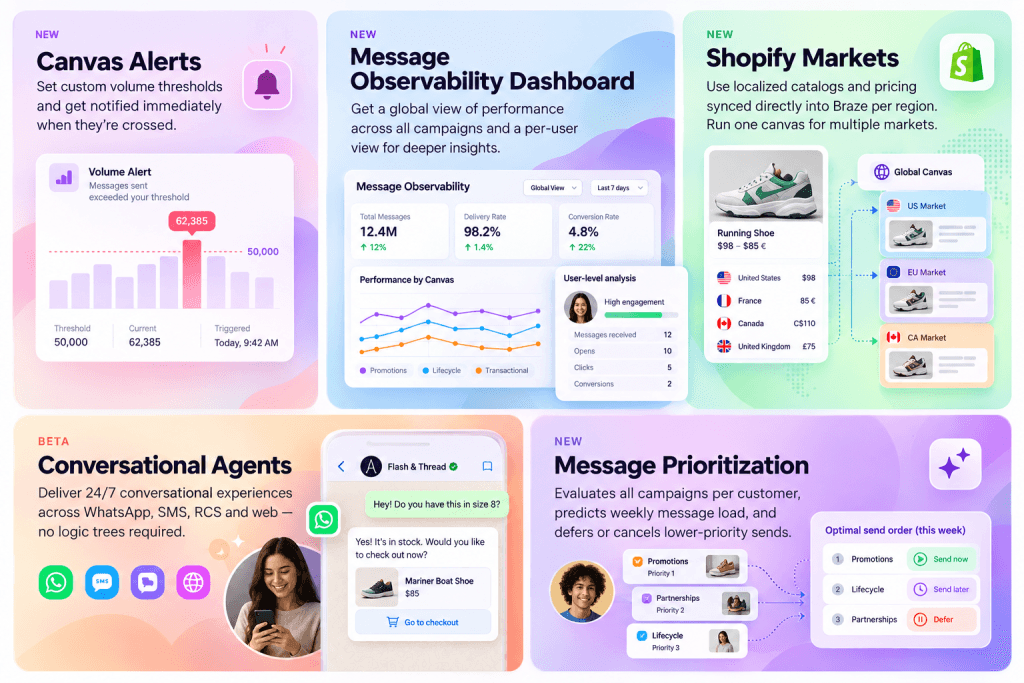
Braze offers a powerful suite of capabilities that enable marketers to capture and act on customer intent while it’s still fresh. Below is a list of features that support real-time engagement:
- Zero Copy Canvas Triggers
- Intelligent Channel Selection
- Intelligent Timing
- Connected Content
- Catalogs
- BrazeAI Decisioning Studio
Take Connected Content, for example.
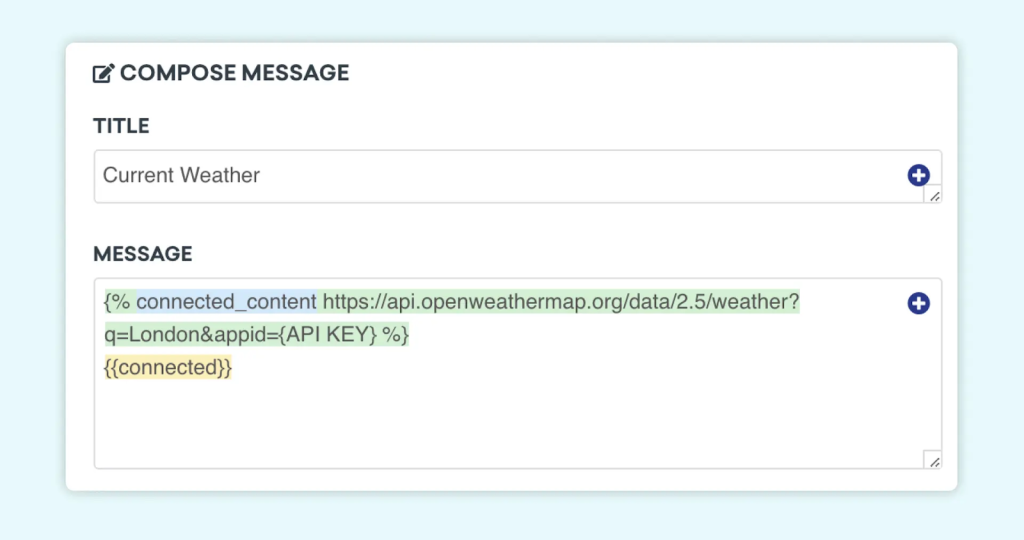
It allows brands to dynamically pull in real-time data at the moment of message send, ensuring each interaction reflects the customer’s latest context, behavior, and needs.
Source: Braze
Using Braze-specific Liquid syntax, marketers can make an API call from within an email, push notification, or in-app message and dynamically insert the response into the message body. This data can come from a company’s own web server or any publicly accessible API, and can be used for personalization, conditional logic, and dynamic content at scale. The result is a highly dynamic, context-aware messaging that reflects the most up-to-date information available at the exact moment a customer engages.
Similarly, BrazeAI Decisioning Studio brings autonomous agents directly into campaign workflows. Using gradient boosted decision trees, these models continuously learn from every customer interaction. The system identifies patterns and adapts in real-time.
Zero-Copy Canvas Triggers allow you to access and act on warehouse data directly, initiating a Canvas journey the moment a high-value event fires in your Snowflake, Redshift, BigQuery, or Databricks instance. For example, when a customer makes their first subscription payment, the warehouse recognizes the event, and Braze immediately triggers an onboarding journey.
How to architect for moment-of-intent personalization?
Moment-of-intent personalization is achieved by designing a system that can detect intent as it forms, interpret it accurately using live context, and act before that intent decays. This requires a deliberately constructed architecture built on an event-driven marketing architecture rather than scheduled or batch-based systems.
A complete moment-of-intent system is composed of three tightly integrated layers:
- A real-time data foundation that ensures signals and context are available when decisions are made.
- Dynamic personalization and decision logic that adapts messaging at the moment of delivery.
- Instant activation and orchestration that executes decisions within seconds or minutes.
Remember, each layer is necessary on its own, but none is sufficient in isolation. Let’s take a look at each of these layers.
1. Real-time data foundation
This layer ensures your system always knows what just happened and what’s true right now. That means:
- Event tracking focused on decisions, not data collection.
- Zero-copy data activation so you can query your warehouse at trigger time instead of relying on synced snapshots that are already outdated.
- Connected Content for live external data that pulls current inventory levels, pricing, or availability at send time.
2. Dynamic personalization
Real-time data alone doesn’t create relevance. The system also needs to decide how to respond based on live conditions. The right architecture involves utilizing:
- Liquid templating with conditional logic that adapts content at send time based on trial status, cart value, or engagement history.
- Catalogs for centralized product data that updates continuously.
- AI-based decisioning that selects the next best message, offer, or channel.
3. Instant activation & orchestration
The final layer ensures decisions are executed before intent decays. High-intent moments require response times measured in seconds or minutes:
- API-triggered campaigns that fire immediately when backend events occur.
- Canvas Flow orchestration with event-driven paths, unlimited entry points, and adaptive branching based on real-time actions.
- Intelligent Timing and Channel Selection that predicts optimal send times and chooses the best channel per user.
What this looks like in practice
The full implementation requires a phased rollout. You’ll need event instrumentation, warehouse connectivity decisions, governance controls, and cross-functional alignment.
But the payoff is substantial: Organizations typically see 20–50% conversion lifts on high-intent journeys, with response latency dropping from hours to minutes through.
Leverage intent in Braze with the help of Mavlers
What makes speed especially dangerous is its invisibility.
When a deal is lost due to slow responses, it doesn’t show up in dashboards or post-mortems. The loss is often misattributed to price, pushing teams into margin-destroying discount spirals—lower prices without solving the real problem: latency. Meanwhile, faster competitors win not because they’re cheaper, but because they preserve momentum.
The real challenge for modern marketers is that customer expectations around speed are rising faster than most organizations’ ability to adapt.
Braze’s event-streaming architecture and real-time capabilities let you act on intent while it’s still valid, helping you understand and operationalize the dynamics of speed.
Ready to build the complete system? The Moment-of-Intent Playbook gives you the full framework: conceptual foundations for understanding intent decay, technical specifications for all three architectural layers, week-by-week implementation timelines, measurement standards with control group design, and organizational principles that sustain speed at scale.
Download the ebook here.