 Lifecycle marketing
 Customer data management
 Email campaign production
 Search marketing
 CMS development
 Who we are
 How we work
 Case studies
 Testimonials
 Salesforce Marketing Cloud
 Braze
Braze HubSpot
 Marketo
 Pardot
 DataBricks
 Snowflake
 HighTouch
 RudderStack
 Segment by Twilio
 Videos
For Braze, AI didn’t come on as a sudden lightning bolt exposing an ageing marketing landscape. Quite the opposite. Long before AI became a buzzword (and, for many, a cuss-word), Braze’s founders were already building what would become an AI-powered customer engagement platform. (Today, that platform processes more than 10 trillion data points annually, orchestrating personalized experiences for 6 billion monthly active users.)
As their CEO and co-founder Bill Magnuson has said, the company has been applying machine learning for optimization since 2015, built its core architecture on real-time stream processing as early as 2011, and incorporated generative AI much later.
Because Braze’s work with AI long predates today’s hype cycle, understanding its philosophy and application of AI is essential to making sense of where marketing automation is headed.
Viewed through the lens of Braze’s AI strategy and the evolution of the martech-scape, the future of AI-driven marketing automation revolves primarily around:
- Event-streaming architecture (EDA)
- Composability
- Human creativity over AI slop
- First-party intelligence
- AI decisioning/reinforcement learning
As marketers and Braze practitioners, it’s essential to understand how these shifts will shape not only how you work within Braze, but how you approach AI-powered marketing automation.
Braze AI marketing automation: Steps to the future
1. Event-streaming the new default
The technical foundation underlying Braze’s AI capabilities represents a decade-long bet that has only recently proven its value. While competitors built clouds by acquiring email platforms and stitching together disparate tools, Braze made a contrarian choice in 2011 to architect everything around event-driven stream processing:
- Stream processing enables AI decisions in milliseconds, allowing personalization during live product experiences.
- The vertically integrated stack processes real-time behavioral data, external context, and AI recommendations through a single coherent system.
- The abstraction layer treats channels as implementation details, allowing AI to optimize the delivery methods rather than forcing marketers to think channel-first.
- This allows Braze to maintain feature parity across all channels, unlike legacy platforms requiring ETL transfers between siloed tools.
This architectural coherence matters more in the AI era than before. ML models need consistent, real-time data flows. Generative AI must integrate seamlessly into production systems. The “frankenstack” approach of bolting AI onto legacy platforms creates latency, data inconsistency, and cognitive overhead that undermines the promise of intelligent automation.
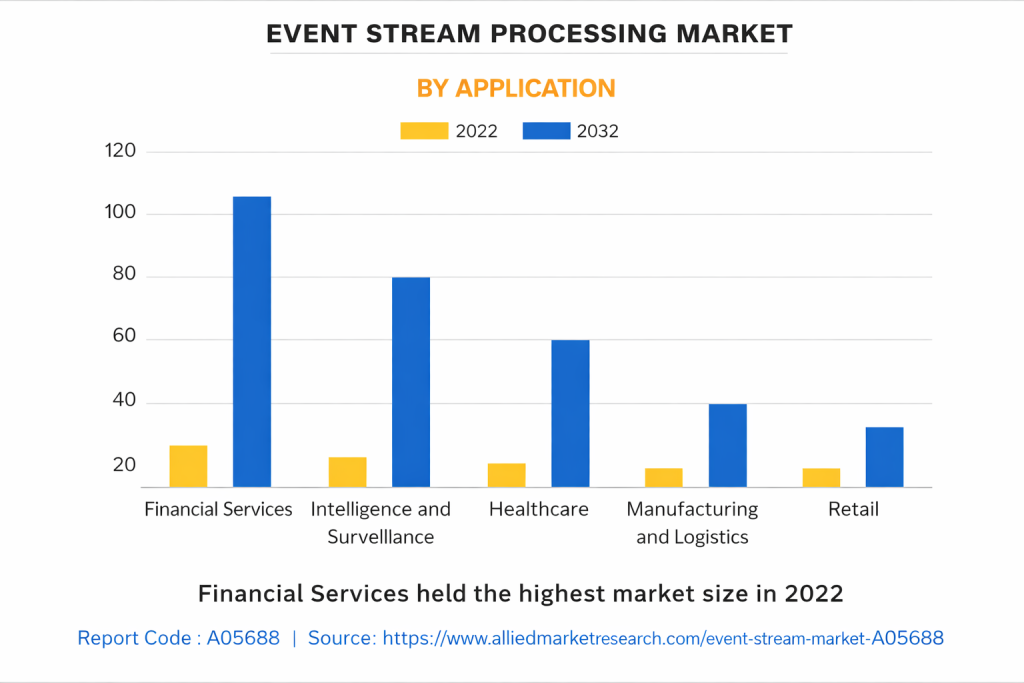
The future is “eventful”
Event-driven architecture is now utilized by over 72% of global organizations to enable real-time, responsive, and scalable applications, with 71% reporting that the benefits, such as improved agility and system resilience, outweigh the costs. However, adoption is still maturing, with only 13% of organizations reaching the “gold standard” of organization-wide maturity. [Source: Solace]
2. Unified architecture, not a pastiche of tools
The technical debt from acquisition-driven growth undermines effective AI deployment. Here are a few ways it plays out:
- Feature inconsistency across channels forces marketers to learn different interfaces and capabilities depending on whether they’re working with email, mobile, or web.
- Each acquired platform brings its own data models, APIs, and operational assumptions, creating cognitive overhead that curbs deployment even when AI features abound.
- The “tech debt tax” from maintaining multiple incompatible codebases diverts engineering resources from innovation to integration, slowing AI capability development.
Braze’s architecture makes it composable-ready by design, acting as a real-time engagement layer over your existing data infrastructure.
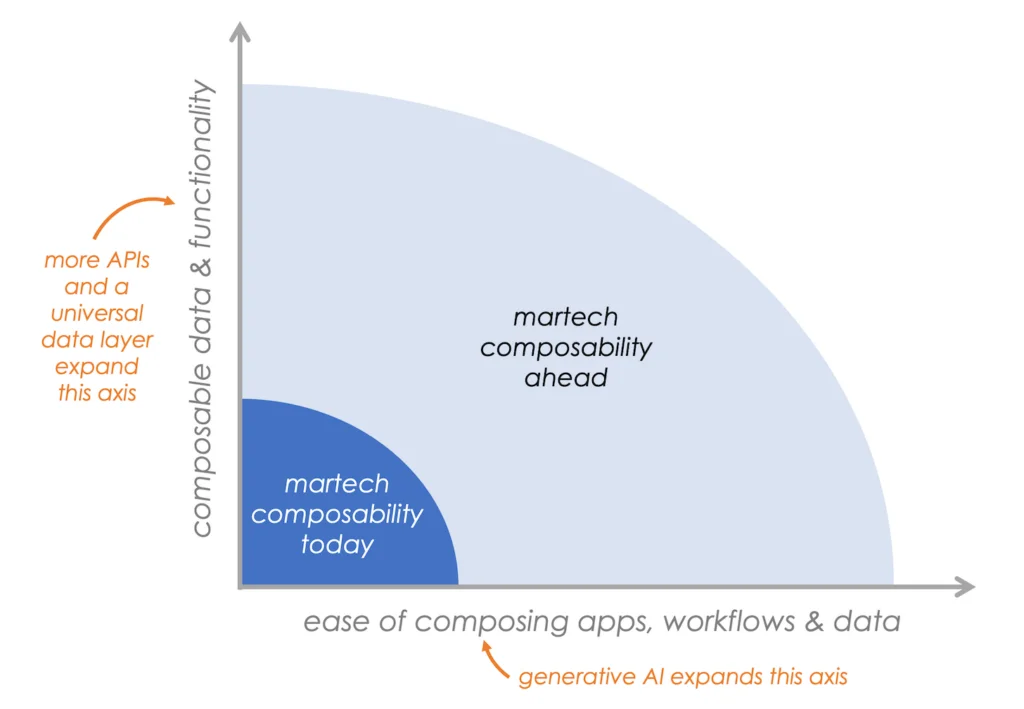
The future is composable
Composability is a shift away from monolithic architectures toward best-of-breed, modular systems. By connecting specialized tools through APIs, organizations gain greater agility, reduce vendor lock-in, and can seamlessly replace or upgrade components as technology evolves.
Source: Chief Martech
Scott Brinker, one of the most widely recognized experts on martech, explains, “As applications expose more of their functionality via APIs — driven by the market demand for integration between apps — those APIs can be used to programmatically “compose” workflows and customer experiences that span multiple applications behind-the-scenes. As applications pipe more data into CDWs, it’s all stored in one universal and professionally governed location, where it can more easily be “composed” into context-specific datasets.”
And that pretty well sums up the Braze infrastructure.
In fact, by becoming a MACH-certified member, Braze has solidified its position as a platform that is intentionally built to be swappable, scalable, and specialized.
3. Gen AI as a creative sidekick
Unlike many AI-focused companies, Braze’s leadership has expressed notable skepticism about the limitations of artificial intelligence. Their CEO expects LLMs to “logarithmically approach a ceiling” rather than exponentially improve, requiring breakthroughs beyond current transformer architectures to reach human-level reasoning. Here’s what Braze gets right:
- Current large language models excel at pattern matching and mimicry but lack capabilities that appear fundamental to human cognition.
- The “mixture of experts” approach may extend current architectures but might not achieve qualitative breakthroughs in reasoning or creativity without novel approaches.
- Hallucination is still being studied and may remain inherent to most models.
- The deterministic aspects of marketing (compliance, budget constraints, brand guidelines) still require rule-based systems rather than probabilistic AI.
The future is human
Audiences are increasingly fatigued by AI slop. In response, marketers are swinging back toward content experts and skilled copywriters. According to eMarketer, consumer enthusiasm for AI-generated content fell from 60% in 2023 to just 26% in 2025. Platforms are now adding new AI buttons while preserving the space for authenticity.
It is reassuring to note that Braze employs AI as a sidekick, not a replacement. In fact, it’s totally outside the machine-replaces-man debate. Crucially, they understand that AI is better at generation options rather than evaluating them. That philosophy is evident in how AI features are implemented across the platform, from tone controls and brand voice selection to image generation (via DALL-E), and LLMs trained on global language patterns to support localization.
4. First-party intel over cookie forensics
Cookies may be taking longer than expected to crumble, but their future remains highly uncertain. What’s reassuring is that Braze understands this reality better than most. Regardless of when or if third-party data is ultimately phased out, Braze’s leadership recognizes the deeper implications of personalization. Braze’s approach to data and AI centers on a principle their CEO calls being a “good listener versus a creepy detective.” This plays out in the following manner:
- AI should respond to revealed preferences through actual behavior, not deduce identities from third-party data sources and make inferences about private attributes.
- Actions signal intent. Understanding what customers do in your product provides richer signals than knowing demographic details purchased from data brokers.
- First-party behavioral data creates a strong reciprocal value. Intelligent personalization improves customer experience, making the data collection feel fair.
- Since platforms controlling deliverability now care more about user experience than legal compliance, AI that creates genuine value survives radical platform changes.
- Finally, by avoiding dependency on fragile identity chains across devices and platforms, the AI remains effective even as cookies disappear and tracking is contained.
The future is intent-driven
Intent is the new currency of marketing, and first-party data is the only way to read it. Anything else is guesswork stitched together from piecemeal signals. This shift affects industries differently, especially those where relevance can take precedence over personalization, as with air travel, for example. (See below)
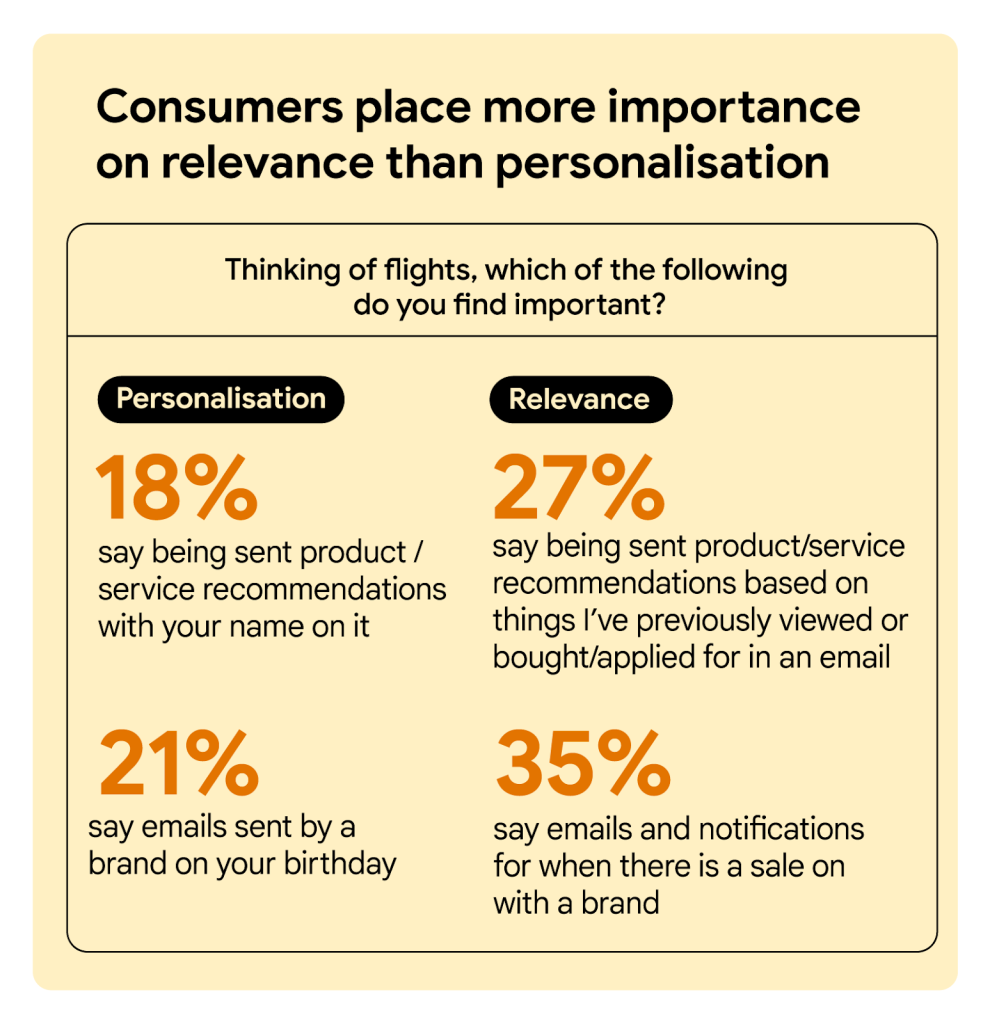
Source: Think with Google
(The line between relevance and personalization is thin. Relevance seems like personalization without redundancy. But that’s a conversation for another time.)
Braze functions primarily as a first-party data engine, capturing rich behavioral data through its web and mobile SDKs. This is complemented by Cloud Data Ingestion, which enables warehouse-native syncing, while native Form Blocks and in-app surveys help collect zero-party data at the point of engagement. Together with a robust REST API and integrations with CDPs such as Segment, Braze enables the creation of privacy-forward user profiles.
5. AI decisioning in customer engagement
Bill Magnuson touches on AI decisioning as part of a broader discussion, and it’s instructive to hear directly from the founder how Braze approaches it.
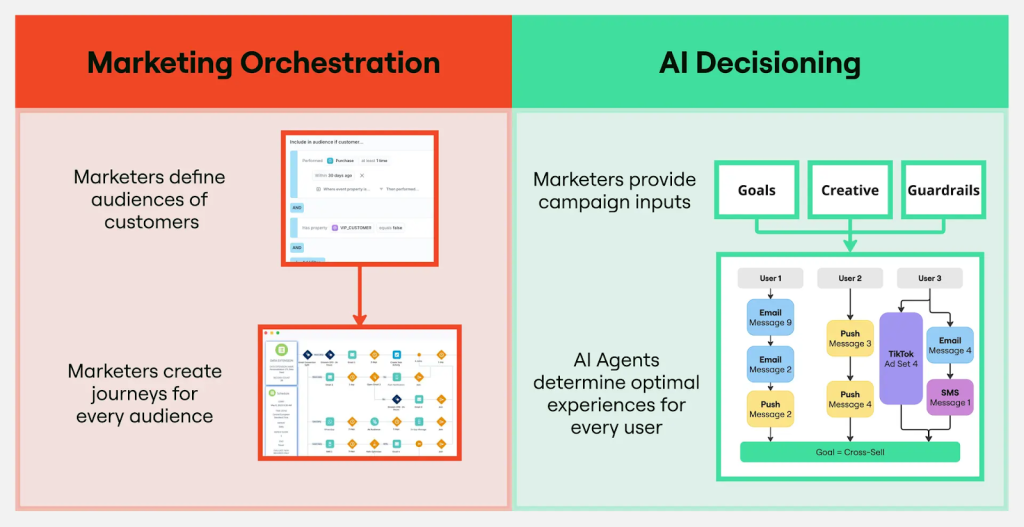
He addresses AI decisioning in the context of A/B testing. Traditional marketing automation, he notes, relies heavily on A/B testing: define a set of variants, test them, select a winner, and deploy it universally. This model optimizes for the “average customer” and quickly buckles under real-world complexity.
With the acquisition of OfferFit, Braze moves beyond testing into continuous, individualized decisioning. OfferFit applies advanced reinforcement learning to optimize decisions for each customer in real time, without ever “locking in” a single winner.
This applies across the full decision surface:
- Content and offers
- Timing
- Channels
- Sequencing across lifecycle stages
Humans define the guardrails, which includes brand guidelines, budget constraints, compliance infrastructure, etc. The machine handles the combinatorial complexity that humans cannot.
This is especially powerful in “high-leverage moments” such as onboarding, lifecycle transitions, cross-sell and upsell, and financial services use cases.
The future is real-time, hyper-personalized
Craig Dennis of Hightouch has labelled AI decisioning the “next major wave in martech.”
Echoing this view, Stephanie Miller writes, “The AI decisioning revolution is as significant as the shift from mass email to real-time personalization.”
Fundamentally, there are two ways in which AI decisioning is going to alter marketing:
- AI decisioning replaces static if–then rules with models that learn from patterns, behaviors, and outcomes over time. Campaign logic becomes probabilistic, not deterministic.
- Effective AI decisioning requires breaking decisions into very small, discrete steps rather than handing over large, abstract tasks. Complex actions (like “run a campaign” or “write a report”) must be decomposed into atomic decisions the system can reliably execute.
Source: Hightouch
There’s a certain irony in hearing martech commentators predict that, in 2026 and beyond, CDPs will begin rolling out decisioning capabilities—when Braze is already operating at that frontier.
It reflects Braze’s historically sober, understated approach to AI. Rather than chasing headlines, the company has focused on building durable capabilities that compound over time.
This mindset is also evident in Braze’s decision to pursue a two-year path to profitability while competitors raced to break even quarter by quarter. That long-term orientation extends directly to its AI investments. Braze has resisted the temptation to brand itself as an “AI company,” despite possessing substantive AI capabilities, focusing instead on customer engagement.
What this means for you, the marketer
Now that we’ve explored what AI-driven marketing automation will look like, the question is: What does it mean for you as a marketer, and what should you be doing right now?
Drawing from the discussion so far, here are the most immediate actions to consider:
- Move to zero-latency streaming. If the data takes time to move between your warehouse and your engagement platform, your AI is making decisions based on the past.
- Stop exporting data into siloed clouds. In a composable world, the data warehouse is the single source of truth. Every tool should function as an interoperable layer on top of it.
- Use AI decisioning where uncertainty and optimization matter most. Turn to deterministic, rule-based systems for compliance, security, permissions, and execution steps.
- Incentivize zero- and first-party data. Elicit intent from customers to feed higher-quality inputs to AI and create a fair value exchange.
- Audit your current stack for composability. Any tool that isn’t API-first and swappable is taxing your ability to innovate.
The transition to the new era won’t be smooth.
Marketers who built careers on channel-specific expertise face obsolescence as AI handles those details. Meanwhile, strategists who understand customer psychology, brand positioning, and business objectives become more valuable as AI handles more execution. So, the future favors T-shaped marketers: highly strategic thinkers who also boast broad technical fluency.
Get started in AI and lifecycle engagement with Mavlers
In an increasingly competitive landscape, growth depends on more than isolated campaigns.
Mavlers takes a lifecycle-first approach, thoughtfully orchestrating email, SMS, and in-app messaging into a cohesive, data-informed strategy that helps brands retain customers, improve conversion at key moments, and drive ROI across the entire customer journey.
Book a free, no-obligation call with one of our platform-specific, lifecycle marketing experts!