 Lifecycle marketing
 Customer data management
 Email campaign production
 Search marketing
 CMS development
 Who we are
 How we work
 Case studies
 Testimonials
 Salesforce Marketing Cloud
 Braze
Braze HubSpot
 Marketo
 Pardot
 DataBricks
 Snowflake
 HighTouch
 RudderStack
 Segment by Twilio
 Videos

Creating content around a niche topic and linking them all together will crown you the topical authority in Google’s eyes.
Nope.
Consistently creating high-quality content focused on a niche topic and then organizing it so easy so human, Googlebot, and now even AI systems acknowledge you as authoritative in that niche.
Read it again. Slower this time. That topical authority isn’t about writing more, gets clearer the more you linger.
You don’t earn authority by mass-producing 50 loosely connected articles. You earn it by building a structure—a clear, connected nexus that turns sporadic content into a topic ecosystem and makes you a credible expert on subjects that matter the most to your brand.
And that structure has a name:
An internal linking map.
In this post, we’ll dig into everything you should know about creating internal linking maps in order to establish authority, niche relevance, and trust. And that trust leads to stronger search visibility and greater traffic.
How the internal linking structure of a website reinforces its topical authority
What is topical authority in the first place?
Topical authority is a classic SEO concept where your website ranks for every single keyword related to its niche. That happens when the website becomes the go-to-resource and perceived authority for your nuanced understanding of an entire subject.
Picture two websites.
The first has a lone article on internal linking. One quick read. Helpful? Sure. But no deeper layers to peel. No trail of answers leading you forward. You get what you came for, and then you leave.
Now consider the second website. This one is a full repository.
Content clusters on SEO, guides on keyword research, breakdowns of content architecture, internal linking blueprints, and the whole bummock that lies beneath the iceberg tip.
You click one article, and get pulled into another. And another. And another.
Which one feels like the industry expert? Which one makes users and crawlers take notes?
That—right there—is topical authority, the sum total of depth + breadth + structure, woven together (like those on Mavlers) so both humans and algorithms can explore your command over the subject.
Clear? Great! Now the next question–
So what does internal linking have to do with topical authority?
In a monosyllable: lot.
You can build exceptional content. You can target keywords with surgical precision and align every page to search intent. And even optimize for AI visibility with TL;DR summaries and structured responses.
But without a strong internal linking framework, you don’t do much good for Google’s web crawlers to go deeper into your site within the available crawl budget. Not to mention, users and LLMs miss the full picture of what your content is meant to communicate.
Internal links serve as the connective tissue with the hold of which you can organize and interconnect the content depth. So that search engines can recognize thematic structure and expertise.
The broader and more connected your topic coverage, the stronger the signals you send to both users and algorithms.
To put it in brief, beyond being just a navigation feature, internal linking for topical authority helps search engines:
- Discover and crawl pages deeper in the architecture.
- Understand relationships between concepts and topics.
- Evaluate which pages are most important.
- Build a semantic understanding of your website’s subject focus.
Guiding search engines this way is crucial for a couple of reasons:
- Google’s shift toward entity-based understanding through the Knowledge Graph means rankings aren’t determined solely by keyword matching. They’re shaped by context, relationships, and meaning.
- When content references related topics, tools, frameworks, and concepts — and links to them — Google is better able to understand what your site is authoritative about.
This is why Google’s John Mueller describes internal links as one of the strongest signals available to SEOs:
“Strategic internal linking is one of the most important things you can do on your website.”
A strategic internal linking architecture strengthens topical authority because it:
- Surfaces important pages and prevents them from being buried.
- Distributes link equity to newer or lower-visibility pages.
- Reinforces a clear topic hierarchy through pillar-cluster relationships.
- Supports AI models trying to map domain expertise across pages.
When pillar pages link to supporting cluster pages — and those cluster pages link back — search engines repeatedly encounter signals pointing to the pillar as a primary resource.
The result: faster crawling, stronger indexation, and better rankings across entire topic sets rather than single URLs.
Google formalized this perspective in its May 2023 blog post on News Topic Authority, reinforcing that comprehensive, structured topical coverage directly contributes to perceived expertise and search performance.
In practice, this means a strong internal linking strategy improves:
- Visibility for clusters of related keywords, not just one.
- Placement in SERP features such as Featured Snippets, People Also Ask, and AI overviews.
- Overall organic growth rather than page-level wins.
This is the same structure we use at Mavlers. We build pillar pages that introduce broad topics, then support them with cluster posts that explore subtopics in depth — all interconnected through a deliberate linking strategy.
The result: a clear, navigable topic map and a stronger pathway for both users and search engines.
Building internal linking maps: a practitioner’s framework
Internal linking for topical authority is one of those things that looks simple on the surface—but done with a strategy, it’s an art.
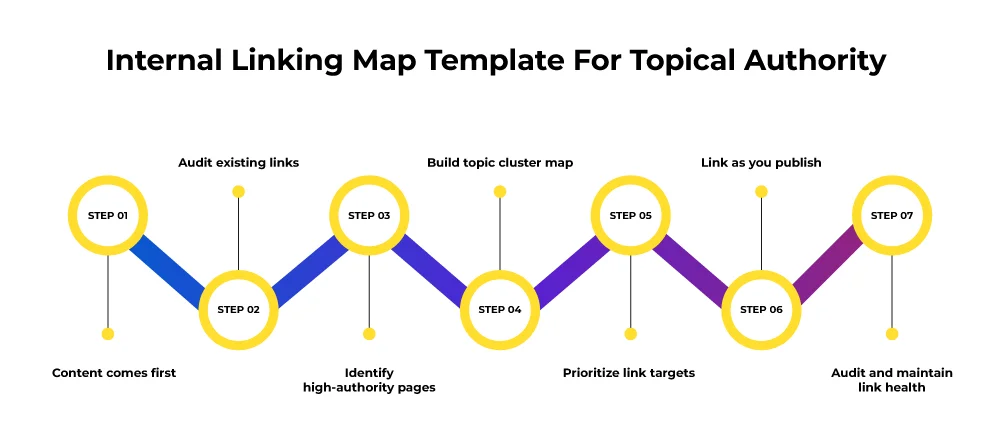
Here’s how we create an SEO internal linking strategy at Mavlers.
Step 1: Content comes first
It’s our empirical experience that effective internal linking starts long before a single link is placed. It starts with the content itself.
The brands known for their topical authority are the ones that put original research, unique insights, and useful multimedia before content volume.
They understand their domain, know what questions their audience is asking, and create content that answers them.
Naturally, those pages include related keywords and concepts — not because they’re stuffed in, but because real expertise brings them forward.
Hence, before any links get dropped, you need content that deserves to be linked.
We tell clients this all the time: if your pages don’t naturally flow from one topic to the next, your linking will feel forced, and it perhaps won’t help SEO.
If we were you, creating internal linking structures, we would:
- Build substantial pillar pages that introduce broad themes.
- Then create focused cluster pages that dive deep into subtopics, solving specific problems and search intents.
- Go past inserting keywords onto pages. Show your expertise. Build E-E-A-T into every piece.
Step 2: Audit internal links to see what you’ve got and what’s missing
Next, we crawl. We use internal link mapping tools like Screaming Frog, Ahrefs to have a complete list of URLs on the site. From there–
- We sort pages by topic.
- Flag orphan pages with no inbound links.
- Discover where you might have content gaps.
The reports for each page provide a solid foundation for the next steps, as they yield valuable data on linking opportunities and crawl depth.
Step 3: Identify high-authority pages
Authority flows within your website. And this step is to find where.
Some pages on your website are powerhouses of authority. Getting backlinks, attracting traffic, earning engagement, and holding strong positions in search.
Those are your most valuable assets for internal linking because authority flows across your site based on how pages are connected.
When you direct internal links from your strongest pages to a target page, you’re concentrating force and effectively heating that page up, telling Google, “This matters. Pay attention.”
Do the opposite — leave important pages buried three folders deep, with no internal links pointing to them, and they refuse to rank. They don’t get crawled and die quietly.
How to spot your high-authority pages?
To identify pages that already demonstrate strength, open your analytics and look for pages with at least one of the following:
- High organic traffic — consistently bringing search visitors.
- External backlinks — earning authority from other sites.
- Strong engagement signals — time on page, scroll depth, clicks.
- Existing page-one rankings — pages Google already trusts.
What to do next?
Choose one target page you want to heat up — a new article, a product page, a key conversion driver — and send internal links from your strongest pages toward it using intentional, descriptive anchor text. That’s how authority flows.
And one more thing people forget:
None of this matters if users never click the links. So be strategic with link placement and relevance. Don’t stuff links where they don’t belong. Guide readers like you’re designing a path, not decorating a page.
Step 4: Build the topic cluster map
With content in place and linking recommendations discovered, it’s time to build the internal linking structure that organizes internal links logically.
When we audit sites without a map, we often see cluster pages with no links pointing to them, orphan pages buried six clicks deep, and missed opportunities to pass authority.
A map prevents messy linking, ensures every page serves a purpose, and shows Google that your content is comprehensive and connected.
Here’s what a pillar-cluster map looks like–
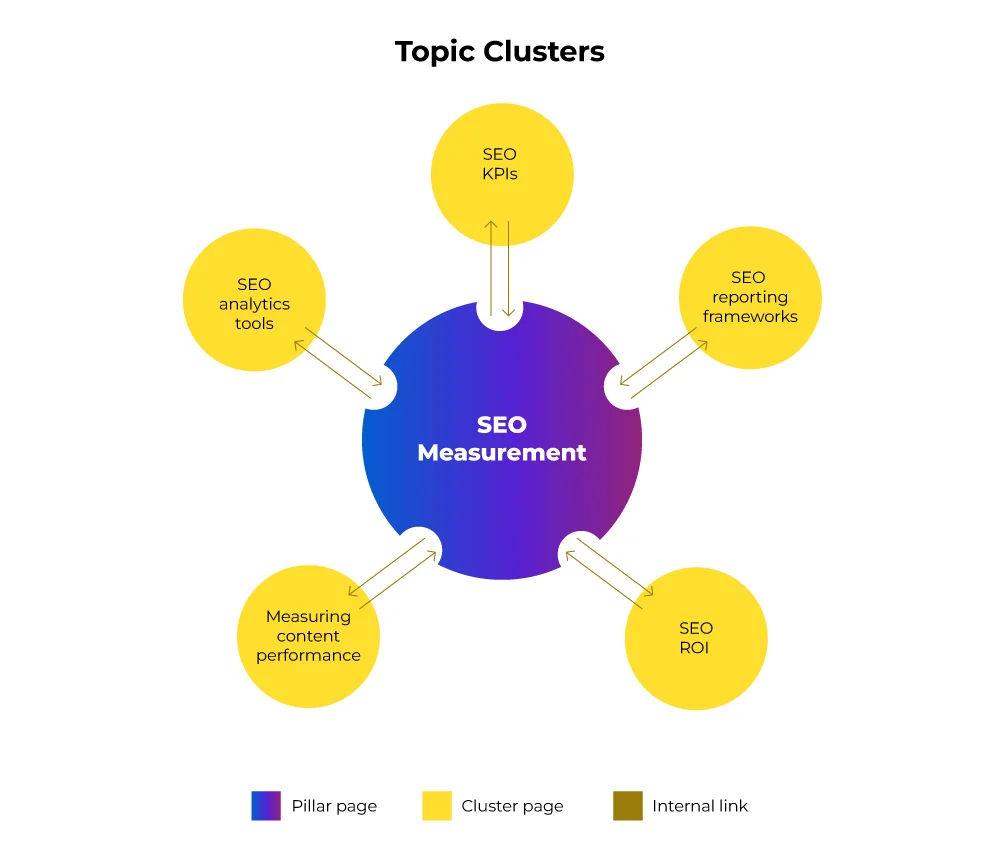
- Pillar pages as the command center. It’s the broad overview page about your main subject.
- Cluster pages organized logically around them. They branch out with detailed content that all link back to the pillar and, when relevant, to each other.
- Contextual cross-links between related clusters.
This map isn’t static. It should reveal where you need new content, how subtopics relate, and which pieces will geek out on certain angles.
We sketch this visually (hello, Miro!) and keep it practical, marking both existing content that ties in and holes to fill.
Step 5: Prioritize which pages get linked where
Our internal linking maps prioritize the pages that matter most — big-money pages, high-traffic pieces, or cornerstone content. We directly link equity from these “laser pages” to the clusters that need a boost, often new or underperforming pages.
Plus, there’s a cap: too many links per page and you water down their impact; too few, and crawl pathways get choked off.
Step 6: Link as you publish
A good map includes how you add links when new content goes live. Link new posts back to their pillars or related clusters immediately!
This phase also involves working closely with writers and SEOs. Writers know the map shapes their briefs. SEOs ensure every publish fuels the network, maintaining internal coherence and maximizing SEO impact without overlinking.
Here are some of our link placement must-follow rules:
- Use descriptive anchor text. Mixing descriptive, natural phrases with branded ones gives clear signals to users and search engines.
For example:
If you’re unsure whether to prioritize relevance or authority in your link strategy, check out Niche Relevance vs. Authority in Link Building: What Really Moves the SEO Needle?”
- Using generic phrases like “click here.” isn’t a good user experience, especially when trying to scan the page quickly to find the right link.
- Nothing wrong with using keyword-rich anchor text. But if it feels artificial or forced into the sentence, users are far less likely to click on it. So use keyword variation that makes sense in the sentence and feels like a helpful pointer without interrupting the flow.
Google guides clearly on this:

- Link new pages to authoritative pages immediately. This jumpstarts visibility and indexing.
- Cross-link clusters only when contextually relevant.
More on Google indexing issue in our blog: How to Fix and Prevent Indexing Issues to Ensure Your Content is Found by Google
Step 7: Audit and maintain link health
Internal linking is never “done.” We audit regularly to
- Crawl the site with Screaming Frog or Sitebulb to find 404s and redirects.
- Check anchor text for clarity, relevance, and variety.
- Identify orphan pages and integrate them into clusters.
Tools like Rank Math‘s Link Suggestions or Broken Link Checker help automate these checks.
The road ahead
If your site doesn’t yet have authority, the best move is to focus on your own expertise and go deep. There’s an entire layer of content waiting for you to explore, packed with opportunities to demonstrate real knowledge.
The black box has opened and what it revealed confirms what seasoned SEOs have long known: Quality is the only sustainable strategy for building topical authority.
Yes, it takes time. Creating a genuinely effective authority strategy is a slow-burn romance. But invest in internal linking, depth, and relevance, and the payoff is long-lasting rankings and credibility.
Curious to go even further? Check out: Why SEOs Are Betting Big on Brand Authority in the Age of AI.
More resources: