 Lifecycle marketing
 Customer data management
 Email campaign production
 Search marketing
 CMS development
 Who we are
 How we work
 Case studies
 Testimonials
 Work samples
 Salesforce Marketing Cloud
 Braze
Braze HubSpot
 Marketo
 Pardot
 DataBricks
 Snowflake
 HighTouch
 RudderStack
 Segment by Twilio
You’ve got a campaign ready to go. It’s timely, it’s personal, it’s exactly what a customer needs to hear right now. You write the brief, hand it to IT, and wait.
Three days later, it’s live. But the moment’s already gone. The customer checked out, churned, or simply moved on to whatever landed in their inbox first.
Sound familiar?
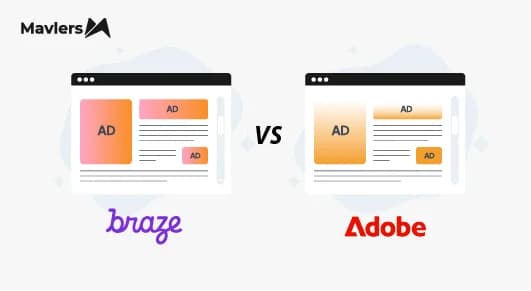
That’s daily life for a lot of marketing teams still running on suite-based platforms built for a different era of engagement, and it’s exactly what a Braze vs Adobe Campaign comparison needs to get at. Because the real question isn’t which platform has more features. It’s about whether the platform beneath your strategy is enabling it or quietly capping it. It’s Adobe Campaign against the Braze CDP integration mechanisms.
This isn’t a “Braze is better” piece. Think of it as a diagnostic. The global customer engagement solutions market is projected to grow from $26.67 billion in 2026 to $57.45 billion by 2034, suggesting buyer expectations are outpacing many legacy engagement platforms.
Let’s cut to the chase and find out which is best for your business.
What Adobe Campaign represents in enterprise marketing
Adobe Campaign, Classic or Standard, is the traditional enterprise campaign management archetype. It lives inside a broader suite, and it’s built around structured workflows, IT-managed data models, and scheduled, batch-based campaign delivery rather than messages triggered by what a customer is doing right now.
That’s not an accident. It reflects an era when “campaign management” meant centralized control, layered approval chains, and heavy customization for large, complex organizations. For enterprises with mature IT teams and multiple departments that all need a say, those were real strengths.
And Adobe Campaign still earns its keep in certain places. It has genuine strength in direct mail and strong batch export and print workflows for offline partners, but a lot of “modern” platforms simply aren’t built to handle.
But here’s the tension the rest of this piece is built around: Adobe Campaign’s batch-based model often means slower reactions to what a customer is actually doing in the moment. Worth noting, Adobe’s own newer product, Adobe Journey Optimizer, is Adobe’s answer to real-time engagement. We’re using Campaign here because it’s still the platform representing the classic legacy workflow a lot of teams are stuck on, not because Adobe hasn’t tried to solve for this.
The everyday friction: Where legacy stacks slow marketing teams down
This is where it actually hurts. Not in a boardroom slide about “platform capabilities”, in the day-to-day work of trying to get a campaign out the door.
- Slow campaign launches. Multi-step approval and build cycles turn what should take hours into weeks. By the time a campaign goes live, the moment it was built for has usually passed.
- Heavy technical dependencies. Marketers routinely need IT, dev, or a dedicated campaign ops team just to make basic changes. That’s not a training gap. That’s a structural bottleneck baked into the platform.
- Complex, rigid workflows. Suite-based tools are built to optimize for control and governance. That’s useful for compliance. It’s tough on a marketer trying to iterate quickly on their own.
- Fragmented customer data. When data lives across a CRM, a campaign tool, and half a dozen other suite modules, building one real-time view of a customer becomes a project of its own, not a quick query.
- Difficulty reacting to behavior in real time. Braze processes data instantly to build automated campaigns based on user behavior, while Adobe Campaign’s traditional infrastructure struggles to match that speed and flexibility.
Picture a cart-abandonment moment. It should trigger a push notification within seconds. Instead, it waits for the next scheduled batch job, and by then, the customer’s already moved on. Multiply that across every channel and every trigger, and you can see how these gaps compound.
How Braze changes the game: The modern CEP approach
Braze was built from a different starting point altogether, as what’s often called a customer engagement platform (CEP), designed around real-time interaction rather than scheduled batches.
- Event-driven by design. Braze’s core value is real-time triggers, product events, app usage, and behavioral targeting acting within seconds, not the next scheduled batch window. That’s what a real-time engagement platform is all about.
- Cross-channel from one canvas. Push, in-app messages, email, SMS, WhatsApp, all planned and launched from a single place, working off first-party signals like product activity, content engagement, purchases, and subscriptions.
- Marketer-operable, not IT-dependent. Braze’s Canvas is built so marketers can design and launch branching, complex journeys without pulling in a developer for every small iteration, directly addressing the technical-dependency friction we just walked through.
And the market backs this up. Braze holds a 4.5 out of 5 rating on G2 across 1,685 reviews, compared to 4.1 out of 5 for Adobe Campaign across 347 reviews. Braze also rates notably higher on ease of use (8.3 vs. 7.4) and ease of setup (7.6 vs. 6.8).
Think about a retention journey that adapts as it happens, sending a push, waiting to see if it’s opened, and automatically falling back to email if it isn’t. That’s one connected journey. Not three disconnected campaigns bolted together and hoped to work.
Not “Braze is better”, it’s about strategic fit
Let’s be clear about something: modern doesn’t automatically mean right for every organization. This is the part of the conversation that actually earns credibility rather than reading like a sales pitch.
Large enterprises with heavy print or direct-mail workflows, complex multi-brand governance, or deep existing investment in a suite’s other modules may have real switching costs. Those costs can genuinely outweigh near-term gains.
And Braze isn’t without its own gaps. It lacks a true built-in customer data platform (CDP) and leans heavily on integrations with third-party CDPs, including Adobe’s own, to centralize customer data. A Braze CDP integration by itself isn’t a zero-effort fix for fragmented data.
The real evaluation lens, according to Braze’s own guidance on choosing a CEP, is to weigh integration capabilities, data architecture, AI features, and scalability against your organization’s specific needs. Not a feature-list shootout.
Here is another interesting read, about Braze vs MoEngage.
Five signs your engagement stack no longer matches your ambition
Use this as a quick self-check for where your Braze team actually stands.
- Every campaign launch requires an IT or dev ticket.
- Campaigns are still batch-scheduled, even though the moment they’re addressing is behavioral, not calendar-based.
- Customer data lives in silos that need manual work to reconcile before a campaign can go out.
- Your team has quietly stopped trying certain journeys because “it’s too hard to build” in the current tool.
- Personalization stalls at the segment level and never reaches individual behavior.
If two or more of these sound like your Tuesday, the stack isn’t a theoretical problem anymore; it’s a practical one. And it’s showing up with customers too: 66% of customers expect companies to understand their personal needs and expectations, but only 34% say companies actually deliver on that.
The question marketing leaders should be asking
Here’s the reframe worth sitting with: Is your current platform enabling your marketing strategy, or limiting it?
The real cost of a legacy stack rarely shows up on a feature-comparison spreadsheet. It shows up in missed moments, slow time-to-market, and the journeys your team has quietly stopped attempting.
Even Adobe’s own research backs this up. 61% of senior executives believe delivering personalized experiences and fostering deeper engagement will be critical for growth. That’s notable and credible precisely because it’s Adobe making the case for real-time personalization.
Wrapping up
That brings us to the business end of this article, where it’s fair to say that this was never about declaring a winner. It’s about recognizing whether your platform’s architecture matches the ambition of the strategy you’re running on top of it.
Legacy platforms built for control and governance aren’t wrong. They were built for a different customer-engagement era. The real question is whether that era still matches how your customers behave today.
If you’re not sure, that’s a good place to start. We help brands audit their current CEP setup, pinpoint exactly where it’s creating friction, technical dependency, fragmented data, slow launches, and map out an evaluation or migration path to a platform like Braze if that’s genuinely the right fit. Assessment first, always. Never a sales pitch first.
If any of this sounds like your team’s Tuesday, let’s talk.