 Lifecycle marketing
 Customer data management
 Email campaign production
 Search marketing
 CMS development
 Who we are
 How we work
 Case studies
 Testimonials
 Salesforce Marketing Cloud
 Braze
Braze HubSpot
 Marketo
 Pardot
 DataBricks
 Snowflake
 HighTouch
 RudderStack
 Segment by Twilio
 Videos
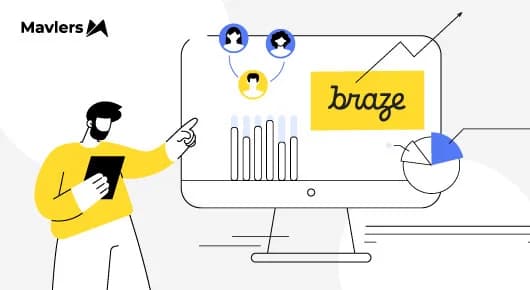
A browser tab hums with images. A user scrolls, lingers, and closes a few tabs.
For an hour, this is casual browsing. Then a signal appears: three product views, a pricing page visit, a wishlist add, and something changes. Intent spikes.
In that moment, the probability of conversion jumps.
One well-timed, precisely rendered message meets the user at the peak. The sale follows. Or a trial turns into a demo. Or a churned customer reengages.
That near-instant is the moment of maximum intent (MMI). It is not a marketing stunt. It is a convergence: behavior, context, and readiness align for a short window of outsized influence.
Why MMI matters for lifecycle marketing:
- Higher efficiency: budget focused on moments that actually convert.
- Better UX: messages arrive when they help, not interrupt.
- Lower cost per acquisition: less wasted spend.
- Stronger LTV: relevant timing increases retention and repeat purchase.
This article walks you through data to design, Braze implementation, measurement, governance, and scale.
If you want fewer campaigns but better outcomes, you want MMI journeys.
Let’s cut to the chase.
Core concepts of intent, propensity, and lifecycle journeys
Words often blur. We need clarity. And moreover, customers need clarity too.
Let’s differentiate the blurred lines.
Intent vs interest vs engagement
- Interest is a mild signal, a click, a page view.
- Engagement is repeated actions over time.
- Intent is the pattern and context that says, “I’m ready to act now.” Think about frequency, depth, and recency in alignment with a buying cue.
Propensity vs probability
- Propensity is the relative likelihood derived from features and behavior.
- Probability is the calibrated numeric chance that a defined event occurs in a time window.
Lifecycle vs funnel
Traditional funnels are stages. Lifecycles are repeating relationships.
Typical stages include: awareness → consideration → intent → conversion → retention.
MMI sits in the fleeting intent stage. It is transient. If you miss it, the signal decays.
Why single-channel triggers miss MMI?
A single email open or one cart add rarely captures the full context. MMI often needs cross-signal inference: web behavior, app activity, email responsiveness, and product context. Orchestrate across signals, not channels.
Also, here are a few design principles.
- Optimize for the peak.
- Orchestrate around the peak.
- Measure lift at the moment.
Now, let’s discuss what your intent journeys in Braze are made up of.
Braze architecture you’ll use in lifecycle journeys
Here is a small set of tools that, used together, get you real-time intent journeys.
- Canvas – Journey orchestration. Entry nodes, conditional branches, message nodes, goal logic, suppression. Canvas is the runtime where MMI plays out.
- Segments – Real-time cohorts. Define eligibility and persist audiences for scoring thresholds and suppression.
- Currents – Streaming events export. Use Currents to feed behavioral streams to your warehouse or model host.
- Liquid & Connected Content – Runtime personalization inside templates. Liquid handles conditional rendering; Connected Content pulls server assets at send time.
- REST API & Webhooks – Two-way integration. Push scores and attributes into Braze; call out to scoring services; listen for conversion events to close the loop.
But then again, in the end, it’s all about the real-time data.
Signal engineering: The data that reveals intent
Not all signals are equal. Build a ranked inventory and capture them consistently.
Here are a few high-value signals.
- Conversion-intent events – add-to-cart, checkout-initiate, pricing page view. (Very high predictive quality)
- Behavioral velocity – session frequency, session recency, page depth. (High)
- Deep content engagement – time on product pages, video watch, feature demos. (Mid-high)
- Product signals – wishlist, comparisons, saved items. (Mid)
- Transactional & account signals – recent purchases, subscription status, payment failures. (Mid-high)
- Support signals – returns, complaints, negative CSAT, often negative intent, or churn warning.
- Channel responsiveness – recent opens, push interactions, SMS replies (contextual).
How to capture them in Braze
- Client SDK events for web and mobile for low-latency interactions.
- Server-side events for purchases, sensitive actions, and guaranteed delivery.
- Consistent naming: event_name, product_id, price, category, timestamp, session_id.
- Stream everything to the warehouse via Currents for modeling and enrichment.
Signal quality checklist
- Deterministic IDs (SubscriberKey or person_id).
- Timestamp normalization (UTC and event time).
- Deduplication keys (event_id) and idempotency.
- Event enrichment (attach product metadata).
- TTL and freshness rules.
Operational caution
Avoid acting on single noisy events. Prefer patterns aggregated by short windows (e.g., 3 product views in 30 minutes) rather than “one view = action.” Patterns reduce false positives.
The basics have been covered. Now comes the building stage.
Building an intent score model (probabilistic approach)
You need a single, actionable metric: an intent score. It collapses signals into a decisionable value.
Why an intent score? Many signals are noisy. A score summarizes and thresholds action. It’s your canvas gatekeeper.
Simple, fast approach, weighted rule score: Assign weights, apply decay, sum. Example weights:
- add_to_cart = 8
- view_pricing = 10
- product_view = 2
- wishlist_add = 4
Decay function: Recent events matter more. Use exponential decay: weight × e^(−λ·age_hours). Choose λ so that a day-old signal is significantly reduced.
Advanced approach
Train a model (logistic regression or gradient boosting) in your warehouse. Features: counts, recency, velocity, channel responses, lifetime value, product affinity. Historically, label with true conversions within your MMI window.
Where to host?
Train in Snowflake/BigQuery or your ML stack. Store predictions in a scored table and push them back to Braze as a custom attribute (intent_score). Alternatively, call a scoring API at send time for tight latency.
Cadence: Near-real-time: minutes for high-value SKUs. Hourly for broad segments. Choose based on volume and cost.
Designing Canvases for MMI: patterns and templates
MMI canvases must be lean, fast, and focused on the window.
Core canvas patterns
- Immediate micro-action canvas (reactive)
- Trigger: high intent event + score threshold.
- Action: one immediate, high-salience touch (in-app or push).
- Goal: micro conversion (complete checkout, schedule demo).
- Urgency orchestration canvas (escalating)
- Sequence: in-app → push → email → SMS (respecting suppression).
- Escalation windows tuned to the product buying cycle.
- Recovery canvas (support-driven)
- Trigger: checkout failure, payment declined, or negative CSAT.
- Action: reassurance, help link, support contact, targeted incentive.
- Predictive outreach canvas (proactive)
- Trigger: rising propensity before explicit cart actions.
- Action: preemptive offer or assistance to convert sooner.
Here are a few canvas node design principles.
- Entry criteria: score threshold + recent signal pattern.
- Wait steps: prefer signal-driven waits (e.g., wait until score drops below X or conversion event).
- Decision splits: channel_score, excluded flags, geo/time constraints.
- Actions: use the highest immediate-impact channel available.
- Goals: align goal windows to buying cycles (e.g., 6–72 hours). Goals prevent over-messaging once conversion occurs.
Now, let’s summon the personalization strategies and customization of templates.
Runtime personalization: Liquid, Connected Content, and templates
MMI succeeds when the content matches the immediate intent. Here are a few areas of our interests.
Liquid for modular content
- Use Liquid to render product cards, conditional blocks, and language variants inside templates.
- Keep snippets short, readable, and testable.
Connected Content & APIs
- Pull live inventory, dynamic coupons, or live pricing at render time to keep CTAs up to date.
- Always provide safe fallbacks to avoid blank areas when external calls fail.
Personalization rules
- Surface the single most relevant variable prominently: product image, price, or stock level.
- Use behavioral snippets (e.g., “You viewed X 3 times”) to create context, but avoid creepy phrasing.
- Keep CTAs direct and friction-free (one click where possible).
Always validate the latency of connected content and set timeouts.

Channel strategy and intelligent arbitration (email, push, SMS, in-app)
MMI is not a channel problem; it is a timing and context problem. Here are three key channel strategies.
Channel characteristics
- Push / In-app: immediate, short window, high conversion potential when the app is active.
- SMS: very immediate, high response, higher cost, and consent sensitivity.
- Email: richer, better for receipts, and longer deliberation windows.
- In-site banners / Live chat: immediate on web sessions.
Arbitration policy
- Prioritize the channel with the highest recent responsiveness for the user (channel_affinity).
- Escalate only when the initial channel fails, within suppression windows.
- Respect cross-channel suppression to avoid collisions.
Braze implementation
- Use Canvas decision splits to route based on the channel_score attribute.
- Send_time settings should respect local time zones and quiet hours.
- Example priority for checkout MMI:
- In-app (if app_open_in_last_30min)
- Push (if push_enabled and not recently sent)
- Email (rich content)
- SMS (if opted in and other channels exhausted)
Now, let’s discuss the ways to understand your campaigns beyond vanity metrics.
Measurement: metrics, dashboards, and attribution
Measure the moment, not just the send. Here are a few classifications of metrics that will help you better understand your efforts and resources.
1. Primary MMI KPIs
- Conversion rate within MMI window (e.g., conversion within 6 hours of the triggering event).
- Incremental lift vs holdout, causal lift measured from randomized holdouts.
- Revenue per treated user in the MMI window.
2. Secondary KPIs
- Open/click rates, time-to-conversion, suppression and opt-out rates, cost per conversion (esp. SMS).
3. Attribution approach
- Use short-window attribution for immediate visibility (credit conversions within your MMI window).
- For causal proof, run randomized holdouts, e.g., 10% control per segment, and measure lift.
4. Dashboards
- Real-time MMI widget: volume of MMI events, treatment rate, conversion rate.
- Cohort analysis: conversion by score bucket, channel, and canvas variant.
- Experiment view: treated vs holdout conversion rates, incremental revenue, confidence intervals.
5. Experiment guidance
- Randomize holdouts per segment (avoid systemic bias).
- Minimum sample sizes depend on baseline conversion rates; power calculations are essential.
- Avoid peeking. Use pre-defined run times or sequential testing with proper statistical controls.
But what if you wish to scale these operations? Let’s find out.
Operationalizing at scale: Templates, content ops, and runbooks
MMI at scale needs systems. Here are five crucial components needed to build a solid system.
1. Content and component library
- Standard hero, product card, CTA, and footer blocks as Braze content blocks.
- Centralized content DEs that drive copy and asset URLs.
2. Naming and conventions
- Event names, Canvas names, segment keys, and attributes follow a strict taxonomy. Example: mmi_checkout_v1, mmi_score_15_plus.
3. Runbooks
- Incident playbook for message failures (fallback to email, notify ops).
- Model drift playbook: alert thresholds, retrain cadence, rollback criteria.
4. Roles & responsibilities
- Data science builds and maintains models.
- Martech handles Braze orchestration and Currents.
- Content ops manages templates and copy.
- Growth owns experiments and KPIs.
- Customer ops coordinates support touchpoints triggered during MMI.
5. Automated health checks
- Monitor enrollment anomalies, conversion deviations, and suppression misfires with alerts.
Now, let’s get ahead to the testing phase.
Testing matrix and QA checklist to build high-converting journeys
MMI demands exhaustive but efficient testing.
Test matrix
- Data scenarios: rich profile, sparse, and anonymous.
- Devices & clients: mobile OSes, browsers, email clients.
- Channels: in-app, push, email, SMS.
- Locales & time zones.
QA checklist
- Event mapping correctness and deduplication.
- Liquid logic for conditional blocks.
- Connected content fallbacks and timeouts.
- CTA/Deep link tracking and RedirectTo validation.
- Suppression and opt-out behavior.
- GDPR/consent flags honored in all branches.
Staging
- Use seed/test users and synthetic events to simulate high intent. Inspect Currents logs and API responses before go-live.
But the grass won’t always be greener. You may face some challenges as well.
Common pitfalls and how to avoid them
Here are a few common issues you may encounter while implementing real-time lifecycle journeys.
- Actioning noisy single events → use short-window patterns and thresholds.
- Over-messaging during the window → enforce suppression and cooling periods.
- Fragile fallbacks → design robust templates with safe defaults.
- Short-term click chasing → measure retention and long-term effects.
- Siloed handoffs → align sales/support to expected MMI outreach and timing.
Tooling checklist and resources appendix
Here is a tabular representation of the checklists you need to keep a tab on.
Here is a tabular representation of the checklists you need to keep a tab on.
| Tech Checklist | Template Checklist |
| Braze SDK (web & mobile) integrated | Content blocks library |
| Currents to the data warehouse | Liquid snippets repository |
| Model hosting (warehouse or ML infrastructure) | Connected Content endpoints with fallbacks |
| API keys for third-party services | Suppression and preference lists |
| Alerting and logging for health checks |
Wrapping up
With that, we reach the business end of this article, where it’s fair to say that the best place to meet your customers is at the moment. Not at the start. Not at the end. But exactly where they are in a particular lifecycle journey.
Start small. Pilot a single MMI canvas for checkout or trial conversion. Run randomized holdouts. Measure incremental lift. If lift is real and sustainable, scale with guardrails.
Meet customers where they are most ready. Design for the moment. Measure the impact. And let your journeys earn every message they send.