Lifecycle marketing
 Customer data management
 Email campaign production
 Search marketing
 CMS development
 Who we are
 How we work
 Case studies
 Testimonials

 Salesforce Marketing Cloud
 Braze
 HubSpot
 Marketo
 Pardot
 DataBricks
 Snowflake
 HighTouch
 RudderStack
 Segment by Twilio
 Videos
Customers rarely notice a good message. They notice the one built on yesterday’s data: the reminder to buy something they picked up last night, or the winback offer that arrives a week after they returned on their own. Nobody on the receiving end thinks about pipelines. They conclude the brand isn’t paying attention.
That conclusion has a cost. In Optimizely’s Marketer’s Survival Guide, 75% of 1,000 UK consumers said they often receive irrelevant marketing, 42% said they disengage when content feels that way, and 35% said they are more likely to unsubscribe after a poor experience. It is a UK study run by a software vendor, and it measures perception, so treat it as a signal rather than a benchmark.
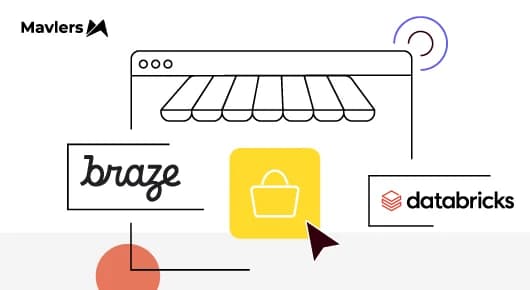
The Braze Databricks integration has to be judged against that signal. Our view is that its value lies less in connecting two systems than in shortening the distance between what a brand knows about a customer and what that customer receives. That only helps if identity, governance, and campaign strategy are ready for it. Otherwise, it delivers weak decisions faster.
How do Braze and Databricks work together now that data moves both ways?
For years, the handoff between warehouse and engagement platform was batch by design. The warehouse held the version of the customer everyone trusted; the engagement platform needed a copy, and exports, custom pipelines, reverse ETL tools, or a CDP carried it across. That model solved a real problem, and plenty of lifecycle programs still run well on it.
Databricks is the lakehouse platform where customer data is unified, governed, and modeled into scores and segments. Braze turns that intelligence into messages and journeys.
What has changed is the route between them. Braze Cloud Data Ingestion (CDI) has synced Databricks data into Braze since 2023. In June 2026, Braze announced a broader integration: governed audiences from Databricks CustomerLake into Braze for segmentation, Databricks Model Serving for agentic workflows, and Delta Sharing to return delivery and engagement events to Databricks.
Status matters. CustomerLake launched in Private Preview, Braze labeled Delta Sharing beta at launch, and its current documentation limits Delta Sharing to customers on US clusters. Confirm availability for your own account before either enters a production plan.
In our view, the genuinely new part is the return path. Getting Databricks data into Braze was already possible. Getting engagement back without a separate pipeline turns a one-way sync into a loop. For setup details, see our guide to connecting Snowflake, Databricks, and BigQuery to Braze.
Does your Braze and Databricks data need to be real-time?
Batch marketing sends on the last known state of a customer, and the customer has usually moved on by the time the message lands. That argues for faster data, not for making everything as fast as possible.
The mechanics are more graded than the phrase real time suggests. Braze’s documentation says CDI scheduled syncs can run as often as every 5 minutes, by request, with 15 minutes as the dashboard default. Syncs can also be triggered by API when a warehouse job finishes, and zero copy options let Braze query the warehouse without duplicating data. The same documentation notes that standard CDI syncs are not real-time and points to REST API ingestion where that is needed. Braze calls the Databricks loop real-time; read that as direction of travel, and check the cadence your own setup actually runs on.
The useful question is what each decision needs. In our work, a cart abandonment message cares about minutes, while a churn score or lifetime value tier is fine refreshed daily. Teams that put everything on the fastest cadence add cost and failure points without changing what customers see.
Our posts on real-time segmentation setup and zero-copy integration in Braze go deeper.
One customer’s journey across Braze and Databricks
It helps to describe this integration less as pipes and more as a sequence of decisions a customer experiences. Each decision needs a fresh signal, governed context, and a record of what happened last time. That is our framing, not a product feature.
Here is a walkthrough of the data flow for one ecommerce customer, an illustration of the mechanics and not a client story. The customer leaves a cart behind, and Braze acts on that fresh signal with a reminder while intent is still warm, which is what better-timed messages come down to. The customer buys. The order reaches Databricks and Braze, so the reminder is suppressed, and recommendations move from the item bought toward what tends to go with it, the mechanism behind fewer irrelevant communications and more accurate recommendations. Over the following weeks, opens, clicks, and ignored messages return to Databricks and join order data, and a later score decides which offer the customer gets, so offers reflect what has worked for similar customers rather than a fixed rule. Strung together, those decisions are what a smarter shopping journey looks like from the outside. The return leg depends on the Delta Sharing status above.
Braze’s launch article sketches the same shape for travel: engagement updates feed a Databricks model, the refined segment goes back to Braze, and a CDI SQL Editor example, currently in Early Access, joins bookings and preferences. Braze presents these as what a brand can do, not as reported results. Applying them before, during, and after a trip is our reading.
A closed data loop in a D2C churn program
A global D2C retail brand with more than 4 million customers ran its churn model in ad hoc Python notebooks, with a 24-hour refresh lag and marketing dependent on engineering for audience updates. Mavlers moved the modeling to Databricks AutoML with scheduled retraining in Workflows, synced churn scores to Braze, and triggered personalized winback journeys. As reported by Mavlers, model AUC moved from 61% to 78%, winback revenue rose 22% in 90 days, and segment refresh dropped to 45 minutes.
That engagement moved scores through Hightouch, not the native flow described above. We include it because the pattern, warehouse intelligence turned into current customer messages, predates the integration, and it shows what changes for the customer: winback messages driven by a current score rather than a stale rule. The integration changes how data moves and what can return. We would also not credit the AUC gain for the revenue lift, since AUC measures how well a model ranks churn risk and the 22% is a business outcome over 90 days.
What returns is where the value compounds. Send, open, click, and bounce events joined to orders in Databricks show which winback offers were ignored and which led to a purchase, so a team can retrain on outcomes and stop messaging customers who have already come back. Before anyone writes a join, note that shared data is read-only in Databricks, and Braze IDs map to USER_ID and EXTERNAL_USER_ID.
RaceTrac’s Director of Loyalty and Digital Marketing makes a related point in Braze’s launch article: returning engagement data to Databricks lets the team combine it with the wider business picture. It is a vendor-published testimonial, so weigh it accordingly.
Is better data plumbing the same as better personalization?
The case worked because several unglamorous things were already in place. The integration supplies none of them.
Identity comes first. Every score lands on a profile through an identifier. CDI matches on external ID, alias, email, or phone, and can update existing profiles by Braze ID but cannot create new users with one. If the lakehouse identity graph and Braze external IDs disagree, a score lands on the wrong profile or on none, and anonymous-to-known users need an explicit plan.
Data quality follows: a sync moves what the table contains, so a stale table produces wrong messages faster. Consent needs the same care. Unity Catalog governs the Databricks side, Braze subscription groups govern the send, and forget requests must reach both.
Campaign strategy still decides whether a message helped. Frequency caps, holdout groups, and clear measurement matter as much as before, and a faster loop without a control group cannot show impact. Someone also has to own it: the model, the audience approval, and the sync.
Braze and Databricks lower the effort of connecting data, which is a real gain. What remains is largely organizational. Teams running a CDP or a reverse ETL tool chose them for reasons that may well still apply, and different stacks suit different routes. This is one more route, not the end of the others.
What this means for lifecycle teams
Mavlers works on both sides of this handoff, on Braze CRM programs and on Databricks data work, so we see it from both directions. If you are working out where your own gaps sit, we are happy to talk through your Braze data and CRM setup.
The value was never the integration itself. It is turning customer data into more relevant experiences, faster. So for each message your brand sends, how old is the signal behind it, and would the customer notice if it were older?