
 Lifecycle marketing
 Customer data management
 Email campaign production
 Search marketing
 CMS development
 Who we are
 How we work
 Case studies
 Testimonials
 Salesforce Marketing Cloud
 Braze
Braze HubSpot
 Marketo
 Pardot
 DataBricks
 Snowflake
 HighTouch
 RudderStack
 Segment by Twilio
 Videos
As a customer engagement platform, Braze is second to none. More and more people are choosing it over established options like Salesforce and HubSpot.
However, Braze, as much as any other platform, relies on skilled people. Data shows that having the right talent, training, and enough team members is key to marketing success:
- 48.6% of marketing professionals cite a lack of expertise and know-how as their primary challenge when using marketing automation.
- 56% of marketers say the martech industry is evolving faster than their internal teams can use the technology effectively.
Conversely, marketing teams trained in automation are 30% more effective than untrained teams.
If you want to get the most out of Braze, you need a strong team of experts. Without one, your investment in Braze may not pay off. Let’s explore this further.
Why Braze programs tank
It may seem counterintuitive at first, but the lack of a properly-structured team is one of the reasons why Braze programs plateau over time. The root causes are structural, not technical:
- Skills are concentrated in one or two individuals. When the person who knows Liquid or owns the data connection is unavailable, the program comes to a halt.
- Ownership is undefined. Nobody has a mandate over campaign quality, technical debt, or platform governance.
- Workflows were designed for batch email platforms. Braze is an event-driven, real-time system. Managing it with weekly planning cycles and manual QA processes creates bottlenecks.
- Data is handled only when something comes up. Each new event, attribute, or integration needs an engineering ticket, which leads to queues and delays.
As Vladimir Cleric, marketing consultant, puts it:
“No level of technological sophistication can compensate for a lack of internal adoption. If teams are not prepared to use the platform effectively, the investment will fail to deliver value.”
It’s no different in the case of Braze. Technology alone doesn’t make up the charter of Braze best practices. Understanding these structural issues is the first step. The next question is how to scale a Braze program without creating bottlenecks, technical debt, or over-dependence on a handful of specialists.
The answer lies in team structure, role ownership, certification pathways, and operational workflows.
Braze team structure: The 4 core roles you need
High-performing Braze programs need four capabilities covered at all times, whether through dedicated headcount, shared responsibilities, or an external partner. Here is a sneak-peek into a standard Braze team structure.
| Role | Focus | Required & recommended credentials |
| Braze Strategist | Lifecycle strategy, commercial outcomes, and program roadmap. | * Braze Certified Marketing Strategy Expert (L3) * Braze Certified Marketing Specialist (L2) |
| Braze Builder | Cross-channel execution, Liquid personalization, and Canvas architecture. | * Braze Certified Marketing Specialist (L2) * Liquid Essentials Skills Badge |
| Braze Data Strategist | Data layer ownership, SDK instrumentation, and ingestion pipelines. | * Braze Certified Technical Marketing Expert (L3) * Braze Certified Developer (L2) * Data Essentials Skills Badge |
| Analytics & Optimization Lead | Experimentation rigor, data exports, and incrementality frameworks. | * Braze Certified Marketing Strategy Expert (L3) * BrazeAI™ Skills Badge |
Now, let’s explore each of these roles in more detail.
1. Braze Strategist – Program owner
The Braze Strategist:
- Lays out the lifecycle strategy
- Owns the measurement framework, and
- Maintains the program roadmap
This person thinks in terms of customer journeys, not individual campaigns or sends. They connect CRM activity to commercial outcomes, and maintain strategic coherence across the Canvas library. Teams usually have people who can execute tasks, but no one to guide the big-picture strategy. As a result, they send lots of individual campaigns that naturally fail to create a cohesive customer experience.
2. Braze Builder – Campaign & Canvas specialist
A Braze Builder designs and builds Canvas flows, campaigns, Content Cards, and templates across push, email, in-app, SMS, and WhatsApp. They own day-to-day execution with fluency in Liquid personalization, Canvas Flow architecture, Action-Based vs Scheduled delivery, audience filters, Segment Extensions, and A/B test configuration using Braze’s built-in multivariate testing.
3. Braze Data Strategist – Integration & Data Lead
The Data Strategist serves as the critical bridge between engineering and marketing, owning the data architecture required to give marketing complete campaign autonomy.
- Data ownership: Manages the data layer, including event taxonomy, custom attribute schemas, and SDK instrumentation.
- Data ingestion & APIs: Leads Cloud Data Ingestion (CDI) from Snowflake, BigQuery, or Databricks, and oversees REST API usage.
- Quality & automation: Monitors data quality and builds self-sustaining Catalog sync models to eliminate the team’s dependencies on ongoing engineering support.
This is the most commonly absent role in mid-sized Braze programs. Without it, the data layer accrues technical debt silently. The cost surfaces later as a re-platforming exercise.
4. Analytics & Optimization Lead
The Analytics & Optimization Lead owns the measurement framework, testing rigor, and data-driven insights for the CRM program. This role is responsible for shifting the organization away from surface-level vanity metrics toward true incrementality. Key responsibilities include:
- Measurement & reporting: Own the Braze data ecosystem, including the Analytics Dashboard, Query Builder reporting, and Currents data exports.
- Experimentation rigor: Design and execute robust A/B testing frameworks and holdout group strategies to isolate campaign lift.
- Predictive optimization: Intelligently deploy BrazeAI™ capabilities to automate and scale performance.
- Actionable insights: Define and track meaningful business outcomes beyond proxy metrics (like open and click rates) to deliver actionable data that leadership can act on.
The full certification map with role-based exams
Braze Learning offers a structured, three-level certification program administered through Certiverse with proctored online exams. Certifications are valid for three years and carry recognised industry credibility. Here is the complete current role-based certification stack.
| Level | Certification | Focus | Price · Time |
| L1 | Braze Certified Practitioner | Dashboard basics: campaigns, Canvas, segments, reporting | $50 · 60 min |
| L1 | Braze Certified AI Fundamentals | AI/ML concepts and BrazeAI™ customer engagement applications | $50 · 60 min |
| L1 | Braze Certified Retail Marketing Specialist | Customer-centric retail strategies and cross-channel journeys | $50 · 60 min |
| L1 | Braze Certified Financial Services Marketing Specialist | Personalization and engagement for finserv brands | $50 · 60 min |
| L2 | Braze Certified Marketing Specialist | Channel mastery and experience orchestration in Braze | $100 · 90 min |
| L2 | Braze Certified Developer | Technical integration, SDK, and Braze API implementation | $100 · 90 min |
| L3 | Braze Certified Marketing Strategy Expert | Campaign planning, optimization, and data-driven strategy | $150 · 90 min |
| L3 | Braze Certified Technical Marketing Expert | Designing and implementing Braze integration plans | $150 · 90 min |
Skills badges: Topic-specific certification
Skills Badges are shorter, topic-focused assessments that complement the role-based certifications. They are not replacements for the full certification exams but are highly practical for validating specific platform skills. Particularly valuable for builders and data practitioners are these.
| Skills Badge | What it validates | Price · Time |
| Email Deliverability Skills Badge | Email deliverability best practices in Braze | $25 · 30 min |
| Customer Engagement Skills Badge | Customer-centric journeys that foster loyalty | $25 · 30 min |
| BrazeAI™ Skills Badge | Advanced BrazeAI™ tools and optimization | $25 · 30 min |
| Liquid Essentials Skills Badge | Liquid personalization and dynamic messaging | $25 · 30 min |
| Data Essentials Skills Badge | Data strategy for campaigns and analysis | $25 · 30 min |
| Web SDK Skills Badge | Web SDK integration and Braze Developer Docs | $25 · 30 min |
| iOS SDK Skills Badge | iOS SDK integration and Braze Developer Docs | $25 · 30 min |
| Android SDK Skills Badge | Android SDK integration and Braze Developer Docs | $25 · 30 min |
When supporting teams with Braze certification, we recommend that all platform users, including strategists and analysts, begin with the Practitioner exam. To address the most common technical skill gaps in CRM teams, we also advise earning the Liquid Essentials and Data Essentials Skills Badges.
What each role needs to know – in Braze terms
Beyond certifications, each role requires fluency in specific Braze capabilities. The following maps Braze’s platform terminology to the skills each function should own.
Braze Strategist
- Canvas Flow: Entry conditions, audience re-evaluation, exit criteria, exception events
- Lifecycle stage design: Onboarding, Activation, Retention, Win-back, Sunset flows
- Frequency Capping and Global Control Groups
- Conversion Tracking and Revenue attribution in Braze campaigns
- Campaign and Canvas analytics: Unique Recipients, Conversion Rate, Revenue metrics
- Braze’s Currents and Query Builder for program-level reporting
Braze Builder
- Canvas Flow: Message Steps, Delay Steps, Decision Splits, Audience Paths, Action Paths, Experiment Paths, User Update Steps
- Liquid: conditionals, loops, filters, abort_message, catalog_items, catalog_selection_items
- Connected Content: API calls, caching, :rerender, fallback logic
- Catalogs and Catalog Selections for dynamic message personalization
- Segment Filters vs Segment Extensions — when to use each
- Multivariate and A/B testing using Braze’s built-in testing tools
- Channel-specific mechanics: push tokens, email deliverability, in-app message triggers, Content Cards, SMS subscription groups, WhatsApp opt-in flows
Braze Data Strategist
- Custom Events vs Custom Attributes vs Purchase Events — correct usage for each
- Event Properties and Nested Object support
- Cloud Data Ingestion (CDI): sync configuration from Snowflake, BigQuery, Databricks, Redshift
- Braze REST API: /users/track, /users/alias/new, /campaigns/trigger/send, /messages/send
- SDK instrumentation review: Web SDK, iOS SDK, Android SDK
- Braze Data Categories: Automatically Collected, Standard vs Custom, nested objects
- Feature Flags: configuration, rollout, and Canvas integration
- Currents: event schema, data exports, downstream data pipeline setup
Analytics & Optimization Lead
- Braze Analytics Dashboard: Campaign Analytics, Canvas Analytics, Segment Insights
- Report Builder and Query Builder for custom analysis
- Holdout Groups and Global Control Groups — design and interpretation
- Predictive Suite: Predictive Churn and Predictive Events configuration and use
- BrazeAI™ features: Winning Variant, Personalized Paths, Intelligent Timing, Intelligent Channel
- Braze Currents integration with data warehouses for cohort and incrementality analysis
How to manage Braze effectively: The workflow architecture
Team structure and certifications show what we can handle. Good workflow design helps us turn that capacity into real results. In Braze teams, the main workflow issues are starting development before the brief is clear and launching without a proper QA stage.
No Canvas or campaign should be built without a documented brief that specifies:
- Strategic objective: Activation, Retention, Win-back, Monetization, or Cross-sell
- Trigger or entry condition: The specific Custom Event, segment membership change, or schedule that initiates the journey
- Audience definition: Segment filters or Segment Extension, estimated size, suppression rules, Frequency Capping exemptions if applicable
- Channels in scope and delivery method: Action-Based, Scheduled, or API-Triggered
- Personalization strategy: Which Liquid variables, Catalog lookups, or Connected Content calls are required
- Success metric: Primary conversion event, measurement window, holdout group configuration
Teams that skip the brief pay for it in QA and in rebuilds. Brief quality is correlated with Canvas quality.
| The 4-stage launch process | ||
|---|---|---|
| Stage | Phase | Details |
| 01 | Design | Canvas architecture mapped before any build. Entry condition, step logic, and audience re-evaluation points defined. Data requirements validated against existing events and attributes. |
| 02 | Build | Canvas construction in Braze dashboard. Liquid logic and Connected Content or Catalog calls implemented. Copy written and approved. A/B or multivariate test configured if applicable. |
| 03 | QA | Seed address testing across all message variants and Canvas paths. Edge case validation: null attribute handling, missing Catalog rows, entry-condition edge cases. Email rendering across clients. Holdout group confirmed. Sign-off from Strategist and Data Lead. |
| 04 | Launch & Monitor | Staged rollout using Braze’s percentage-based audience controls where appropriate. Active monitoring for the first 48 hours. Canvas Analytics check at day 7. Post-launch review at the end of the measurement window. |
When to reach out to an external partner
This is a very important question. The right answer changes as your program matures. Here are situations where a specialist Braze partner adds value:
- Specialist project work: Advanced Liquid development, CDI architecture from a specific warehouse, complex Braze API work, or setting up a Currents pipeline all take years to master and are often only needed now and then.
- Independent program audits: Outsiders can spot patterns that your team might overlook. A structured review of your Canvas library, event taxonomy, Segment setup, and measurement framework will show you where your program is strong and where there may be hidden risks.
- Accelerated certification and skill-building: Bringing in a specialist partner for 3 to 6 months to work with your team on campaigns helps your team’s Braze skills improve quickly, leaving members better prepared for certification exams.
- Strategic turning points: Entering a new market, launching a major product change, migrating platforms, or changing your commercial model often needs more CRM capacity and strategic expertise than most in-house teams have. External support can help fill these gaps.
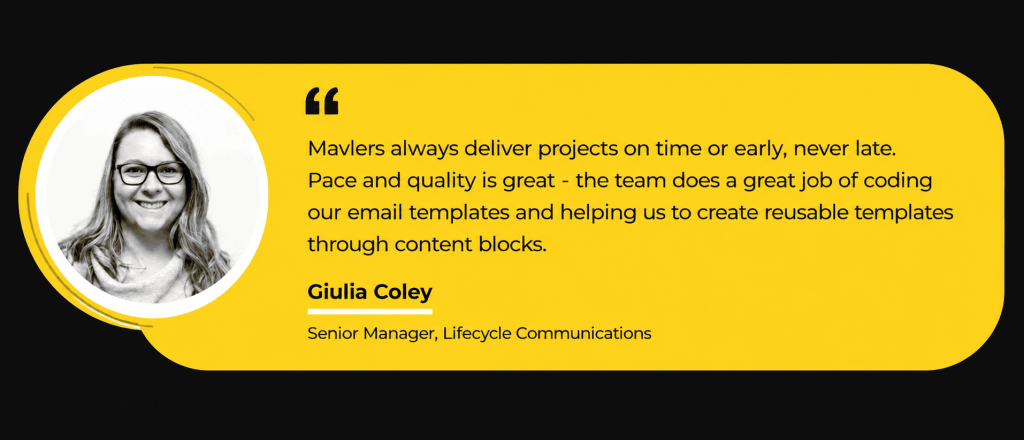
Source: Prodigy x Mavlers case study (Braze)
4 questions to ask while assessing your Braze program
If you want to assess your Braze program, start with an audit across four dimensions:
- Data layer: Is your event taxonomy consistent and documented? Are the Custom Events that drive your most important Canvas triggers firing reliably? Do you know the latency from user action to Braze profile update for your critical events?
- Team coverage: Are the four core roles covered? Is there a single point of failure in your Liquid or data knowledge? Do all active team members hold at least the Braze Certified Practitioner credential?
- Workflow discipline: Does every Canvas start with a documented brief? Is there a structured QA stage before every launch? When did you last run a technical debt sprint against your Canvas library and Segment Extensions?
- Measurement rigor: Can you distinguish between campaigns that drive incremental retention and those that claim credit for organic behavior? Are your holdout groups configured correctly in Braze’s Global Control Group settings?
Adding new features alone usually isn’t enough for most Braze programs to reach their full potential. Success comes from focusing on Braze best practices, like having good data, building an effective team, getting the right certifications, and following disciplined workflows.
These are what help you get the most out of the platform.