 Lifecycle marketing
 Customer data management
 Email campaign production
 Search marketing
 CMS development
 Who we are
 How we work
 Case studies
 Testimonials
 Salesforce Marketing Cloud
 Braze
Braze HubSpot
 Marketo
 Pardot
 DataBricks
 Snowflake
 HighTouch
 RudderStack
 Segment by Twilio
 Videos
Let’s say one of your high-value customers has just advanced to a higher loyalty tier after a major in-store purchase. Now, you want to trigger a personalized reward email.
Traditional methods require moving massive amounts of data, leading to:
- High costs: Storage and processing of duplicate data in Braze.
- Latency: Delays in getting the latest data from your warehouse to Braze.
- Maintenance: Complex ETL pipelines for data movement.
Now, this is where Braze’s zero-copy CDP integration architecture changes the equation entirely.
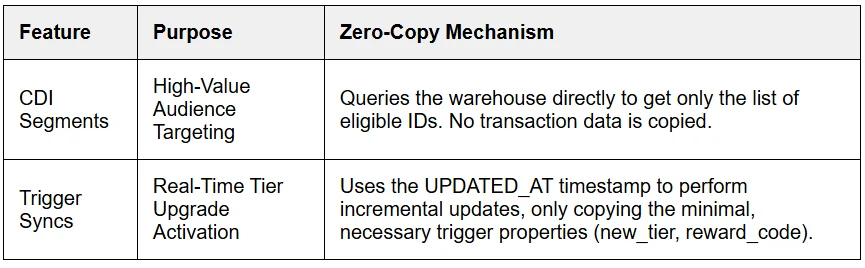
Using Braze’s Cloud Data Ingestion (CDI) Segments combined with incremental syncs via the Braze Data Partner platform allows you to use the data in place (zero-copy for segmentation) and only ingest minimal, necessary data for triggers—that’s Braze CDP integration in action.
We saw Braze’s zero-copy segmentation capabilities firsthand during their demo at Braze Forge, where our dedicated team was onsite in October.
Incidentally, zero-copy architecture in marketing is rapidly becoming a core industry standard.
But coming back to Braze, here’s how to send that reward email, minus the headaches.
How to implement zero-copy CDP in Braze
1. Set up a secure connection
First, you must establish a secure connection between Braze and your data warehouse to allow Braze to query your data securely.
Configure the secure connection to allow Braze read access to specific loyalty tables/views.
2. Implement Zero-Copy segmentation
To target the initial high-value customer audience (e.g., users who qualify for the highest tiers) without moving their entire transaction history, use CDI Segments:
- Create a view in your warehouse: Define a SQL view that identifies all active high-value customers.
- Define the CDI segment in Braze: Create a new segment in Braze based on the CDI source, mapping it to the view created in step 1.
When a Canvas evaluates segment membership, Braze does not independently query your warehouse. Instead, CDI Segments are pre-evaluated during audience qualification, and Canvas uses those qualified audiences at runtime.
Related: How Braze’s Canvas Flow Simplifies Complex Customer Journeys
3. Implement the incremental tier upgrade
For the immediate, real-time trigger and personalization data, use a minimal, incremental sync:
- Create a Trigger View in your warehouse that captures only loyalty tier upgrades, including external_id, new_tier_name, reward_code, in_store_purchase_location, and an UPDATED_AT timestamp marking when the upgrade occurred.
- Your data partner or CDI ingestion job must use UPDATED_AT as the incremental key to ensure that only new or changed rows are sent to Braze, since Braze ingests exactly what it receives and does not determine incrementality on its own.
- Configure your Braze CDI source to sync incrementally based on UPDATED_AT, pulling in only rows newer than the last sync.
- Finally, set up your Braze Canvas to use this synced view as the “Loyalty Tier Upgraded” entry event and personalize the reward email using the Canvas Entry Properties.
The system avoids duplication when handling the loyalty upgrade trigger by treating data in two ways:
This process ensures that your personalized reward email is immediately triggered by the most current loyalty status with minimal data duplication.
Minimal is the operative word. A literal “zero-data-copy” model is neither practical nor useful for an engagement platform. “Unfortunately, warehouse-native CDPs’ apparent fit-for-purpose of ‘zero-copy’ data strategies was embellished, via product marketing, into a narrative that alternative solutions are inherently antagonistic to data quality and governance efforts,” the authors of this mParticle post rightly maintain.
Back-in-stock notifications
For back-in-stock notifications, zero-copy segmentation identifies users who showed interest, while your incremental stock-update ingestion triggers the alert when the stock is replenished. This approach demonstrates the practical use of a Zero-copy CDP for retail.
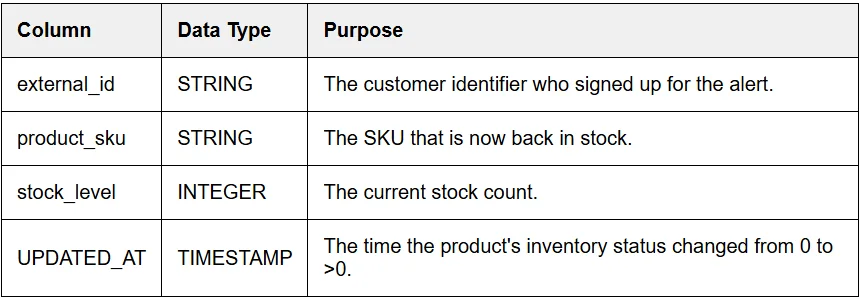
You need a view that joins user interest data with product inventory data, as shown below.
Trigger logic
- The view only surfaces users who previously showed interest in a product_sku and whose corresponding stock_level has just increased from zero.
- Braze performs an incremental sync using the UPDATED_AT column, pulling records only for the products whose stock status was just updated to available.
- The sync acts as the Canvas Entry Event. The product_sku and stock_level are used for personalization.
Data point usage optimization: The cost multiplier
Braze’s data point pricing makes efficient ingestion non-negotiable—and zero-copy architecture directly unlocks those efficiencies. Traditional full-record syncs are costly because Braze charges for every attribute included in the payload, even when only a few fields actually changed.
At scale, this creates substantial and often unnecessary data point consumption.
Zero-copy workflows address this by using Reverse-ETL tools to compute field-level diffs inside your warehouse, sending only the attributes that have been modified rather than entire records. This targeted approach typically reduces data point usage by 60–70% compared to unoptimized full-record syncs. For example, for a customer record with 50 attributes:
- Traditional CDI sync every 15 minutes: 50 data points × 96 syncs/day = 4,800 daily data points.
- Zero-copy sync (only changed attributes): average 5 changed attributes × 96 syncs/day = 480 daily data points.
For a retail org with 5M customers, that’s a swing from 24 billion monthly data points to 2.4 billion.
Data unification in Braze through multi-warehouse orchestration
Enterprise retailers often tend to maintain multiple, separate data warehouses. With zero-copy architecture, however, Braze can connect to multiple CDI sources:
- Transaction warehouse: Syncs purchase history, order status, refund data, loyalty tiers.
- Behavioral warehouse: Streams browsing activity, cart abandonment signals, and predictive churn scores.
- ML warehouse: Surfaces real-time next-best-action outputs and propensity models.
Each CDI Segment queries a single warehouse source, and you can combine those segments within Braze using segment logic to build unified audiences.
This multi-warehouse approach eliminates the need for intermediate data lakes or expensive CDP—your existing warehouse investments become the customer data foundation.
“As the debate continues over the eventual sunsetting of third-party data collection (cookies), companies are investing more and more into zero-party and first-party data collection and intelligence. Further, with brick-and-mortar shopping continuing to dominate the retail space with mobile shopping increasing, businesses will need something to unify their customer data if they hope to make it actionable.” — CMSWire researchers
Related: The Marketer’s Playbook for Braze Segmentation
Overcoming common challenges while implementing zero-copy integration in Braze
1. Latency and race conditions
Warehouse sync intervals (typically 15-60 minutes) introduce slight delays.
Now, to avoid race conditions where messages send before attributes update, implement Canvas Delay steps (5-minute buffer minimum) as the first step in journeys. This ensures profile attributes, email addresses, and push tokens process fully before downstream steps execute.
2. Governance and compliance
Zero-copy segmentation keeps full customer datasets in your warehouse, while only the minimal fields needed for triggers or personalization are ingested into Braze. PII masking, encryption, and role-based access controls remain entirely within your infrastructure, simplifying GDPR and CCPA compliance. Braze accesses only the specific columns required for segmentation and personalization.
3. API rate limits
Warehouse syncs count toward Braze API rate limits. If you sync frequently (say, every 15 minutes) across millions of customers, coordinate with your Braze CSM to establish appropriate limits or consider using REST API calls for truly real-time requirements.
Related: How to leverage privacy-enhancing technologies (PETs) for GDPR-proof marketing
Getting started with Braze zero-copy integration
By keeping data inside your warehouse, querying it on demand, and ingesting only what’s truly necessary, retail brands can finally break down the silos that have long slowed down personalization. The result: faster activation, dramatically lower data costs, stronger governance, and a unified customer profile built on the most accurate and current data available.
If you’re ready to modernize your Braze data architecture and unlock warehouse-native personalization, let’s talk about how we can help.
We’re a Braze Alloys–certified partner with a dedicated 20-member Braze team, and we have managed more than 2,000 campaigns for clients to date. Book a no-obligation call!