 Lifecycle marketing
 Customer data management
 Email campaign production
 Search marketing
 CMS development
 Who we are
 How we work
 Case studies
 Testimonials
 Work samples
 Salesforce Marketing Cloud
 Braze
Braze HubSpot
 Marketo
 Pardot
 DataBricks
 Snowflake
 HighTouch
 RudderStack
 Segment by Twilio
The data landscape is becoming increasingly unreliable.
Third-party cookies are declining. Firefox and Safari block them by default. And Google Chrome continues to tighten privacy controls around cross-site tracking
As a result,the most valuable data now comes directly from customers themselves.
According to recent Harvard Business School research, over 80% of consumers will share data for a clear value exchange, even as 75% worry about how it is used.
And that is where email stands out. Unlike other channels, email gives brands an ongoing, direct line to their audience. It gives you natural moments to ask subscribers about their interests, preferences, and goals. If you want to create personalized, memorable customer experiences in a privacy-first world, get better at earning information from your subscribers.
But how do you collect it in ways subscribers actually want to engage with? And how do you turn it into better customer experiences? Let’s find out.
Zero-party data collection: 8 ways to do it through email
1. The welcome sequence
The welcome email is the highest-engagement moment in most programs. Open rates often run two to three times higher than standard campaigns. Keeping that in mind, you could do more than devote it entirely to discounts and brand education, though they’re not useless. To start with, you could ask one well-considered question.
Not a long, multi-field form, just a single prompt with a few clickable answers. For example:
- “What brings you here today?”
- “What’s your biggest challenge right now?”
Then offer three simple response options, perhaps. It takes less than two seconds for the new subscriber, but it can open the door to a meaningful relationship.
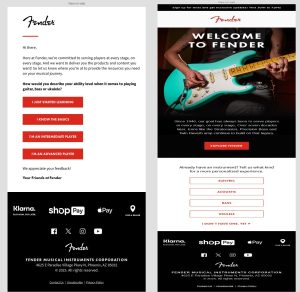
Check out how Fender uses welcome emails to learn more about subscribers.
Here are some other ways you can use the welcome sequence to know your subscribers:
- If you have a VIP group or specific community space, invite them to share their preferred social platform or handle in exchange for community perks.
- Ask a conversational question. Encourage them to hit reply.
- Include a toggable option for viewing the email in Dark Mode. Going forward, it will help you send emails that are accessible to all kinds of people.
- Use an interactive carousel inside the email that showcases products with vastly different price points or use-cases.
Don’t ask for everything upfront. Collect zero-party data gradually, and always give something useful in return. Guidance, recommendations, or better experiences earn trust far more than a generic discount ever will — Chase & Jimmy
2. Embedded polls
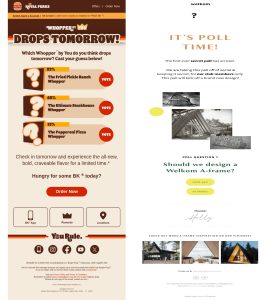
The strategic use of polls goes beyond simple curiosity. Consider these applications:
- Content strategy polls: Ask subscribers what they want to hear about next. Their responses can shape your editorial calendar. You also learn about individual interests based on the options each subscriber chooses
- Product development polls: Use simple polls to test interest in new products, features, or ideas before launch. This gives you lightweight market research. It also builds anticipation among subscribers who express early interest.
- Segmentation polls: A single question about experience level, goals, or familiarity with a category can place subscribers into different content and recommendation tracks.
- Satisfaction checkpoints: Send a quick sentiment poll after a purchase or key interaction. Negative or uncertain responses can automatically trigger customer support, success, or retention workflows.
Check out how Burger King and Welkom make use of polls in their promotional emails.
3. Preference centers
A well-designed preference center gives subscribers explicit control over their experience and, in doing so, generates a detailed profile of what they want from your program.
A preference center is really a system for effective subscriber preference management.
But what should a good preference center actually collect? Here are a few examples:
- Do they prefer long-form educational content or quick product updates?
- Are they only interested in promotions and deals?
- Which channel do they prefer? Email, SMS, or push notifications?
- When do they want to hear from you — mornings, evenings, weekdays, or weekends?
You can also collect contextual information. A baby products brand might ask about the age of a subscriber’s child. A financial services company might ask about career stage or financial goals. Don’t treat the preference center like a hidden settings page. Promote it throughout the customer lifecycle. Link to it in welcome emails, re-engagement campaigns, and account settings.
You can even position it as an alternative to unsubscribing.
Instead of asking people to leave, give them options. Let them change topics, frequency, or channels. Often, a little more control is enough to keep subscribers engaged.
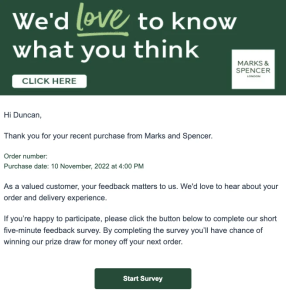
4. Post-purchase surveys
Email surveys enjoy a 15-25% response rate. Since transactional emails have high open rates, they’re a good place to gather information about your customers.
For example, a question appended to a delivery confirmation email can yield contextual data that behavioral signals can’t provide. Knowing that someone bought your protein powder for marathon training is fundamentally different from knowing someone else bought it while recovering from an illness. Those customers need totally different follow-up emails. But without asking, you have no way to tell them apart.
Here’s an example of a simple post-purchase survey.
Post-purchase surveys also serve a diagnostic function.
For instance, you can ask “Is there anything about your experience that could have been better?” 30 days after purchase. This creates a feedback loop between your customer service and marketing data. When you can connect negative experiences to specific products or customer segments, you can refine both your communication strategy and product positioning.
5. Progressive profiling
Progressive profiling in email marketing means collecting small amounts of information over time, instead of trying to build a complete customer profile upfront. Small asks feel low-stakes. A profile built incrementally is more accurate because each data point is collected in a relevant context.
A practical progressive profiling sequence for an e-commerce brand might look like this:
- Sign-up: Email address + primary product interest (one click)
- Welcome email 3: Preferred content type (educational vs. promotional)
- Post-first-purchase: How they plan to use the product
- 60-day check-in: Whether their needs have changed; invite profile update
- Anniversary email: Birthday or key date collection for event-based personalization
Each ask is small and contextually relevant. Over time, those responses build a richer customer profile. This allows you to personalize your future outreach better. For more on this, read our post on progressive profiling in email marketing.
6. Quiz flows
For brands where fit-matching is core to the value proposition, a quiz at the acquisition stage can be helpful. Here are a few tips when it comes to creating quizzes:
- Keep the quiz short: Three to five questions is usually the sweet spot. Just enough to generate meaningful personalization without reducing completion rates.
- Frame questions around the subscriber, not the product: Ask about the subscriber’s situation, habits, goals, or challenges instead of your product categories. The experience should feel relevant and conversational, not like market research.
- Use visual answer options where possible: Visual responses make the experience feel more like a conversation. They might also improve completion rates.
Consider these emails for inspiration.
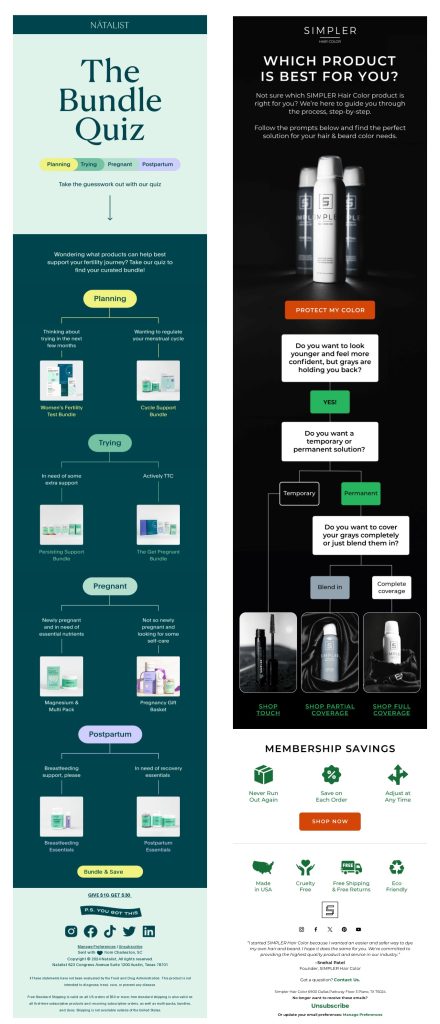
When you use the results in your post-quiz email sequence, make the subscriber’s result clearly visible in the email. Seeing that their responses were received and used helps build trust.
7. Loyalty programs
Loyalty program members are the most valuable zero-party data contributors in your subscriber base. Why? Because they have the highest stake in the accuracy of their profile. So you want to leverage this by building preference collection directly into the loyalty program experience. Use key moments in the customer journey to gather information:
- When a subscriber joins the program, ask how they want to be rewarded.
- When they reach a milestone, ask what kind of exclusive content or access would be most valuable to them.
- When they make a high-value purchase, ask what prompted it. Was it a specific occasion? A need they’ve been building toward? Or a spontaneous decision?
This data will inform the communication strategy for your highest-value customer segment.
8. Interactive/gamified content
Gamification often generates much higher response rates than regular surveys. That’s because the experience feels fun, useful, or rewarding to the subscriber. Research cited by Marigold suggests gamified collection can deliver up to 48% higher click-through rates and a 3.2x lift in conversions with optimized timing.
Coming up with an interesting game is not simple. But if you know the anatomy of a good game, you will find it easier to produce one.
We have identified four non-negotiable elements of a good game:
- A storyline: Any good game has an interesting storyline. “Interesting” doesn’t, however, mean it can’t be simple. In fact, you want to make these emails simple and achievable.
- A goal: Your game must have a “non-stupid” goal to motivate the viewer to play.
- A character: Include a character whom the player can relate to. This is another way of letting the player immerse themselves in the story.
- Rules: Make sure the rules of your game are easy to follow. Don’t include too many rules.
How to use your zero-party data
Much of effective personalization comes down to good subscriber preference management. Now that you have the data, how can you use it? Instead of personalizing a few products or subject lines, you can use customers’ preferences to shape journeys, suppress irrelevant campaigns, improve predictive models, and determine the next best action in real time.
Here are some of the most effective ways to activate the zero-party data you already have.
| Activation of zero-party data | How it works | Use case |
| Journey branching | Subscribers enter entirely different lifecycle flows based on stated preferences | “Dry skin” vs. “oily skin” subscribers enter different welcome, product, and post-purchase journeys |
| Dynamic content blocks | One template dynamically changes key sections based on profile properties | Different hero images, recommendations, and copy render per subscriber |
| Real-time journey routing | New signals instantly update subscriber paths | “Ready to buy” clicks trigger purchase-intent sequences immediately |
| Intent qualification | In-email questions identify buying readiness | “Planning to buy in the next six months?” routes subscribers into different tracks |
| Predictive enrichment | Declared preferences strengthen predictive models | Predicted CLV combined with stated goals or interests |
| Churn-risk contextualization | Preferences explain otherwise misleading inactivity | Seasonal gifting customers suppressed from win-back campaigns |
| Purchase timing optimization | Declared occasions refine purchase predictions | Anniversary shoppers targeted weeks before expected purchase dates |
| Suppression logic | Irrelevant campaigns are intentionally excluded | Educational-content subscribers removed from promotional sends |
| Offer personalization | Discounts and offers adapt to stated preferences | Budget-sensitive subscribers receive value-focused bundles |
| Revenue attribution loops | Preference data is tied to downstream revenue | Travel quizzes connected to personalized destination offers |
The goal is not to replace behavioral data entirely. Practically, personalization doesn’t rely on either side of the first party vs zero party data tussle alone. It includes both.
Is your zero-party data strategy working?
You can only find out by measuring the impact. The following 3 metrics determine whether your zero-party data strategies are working:
- Profile completion rate. What % of your subscriber base has at least one zero-party data point beyond name and email? This is your baseline measure of program penetration.
- Personalization lift. Compare open rates, click rates, and conversion rates between subscribers who received personalized content based on zero-party data and those who received standard campaigns.
- Data decay rate. Zero-party data has a shelf life. Life circumstances change, preferences evolve, so the data collected at signup is no longer reliable. Track what percentage of your zero-party data is more than 12 months old. Then run re-profiling campaigns to refresh outdated information.
In addition to the above, filter revenue analytics by profile property and compare email-attributed revenue across segments defined by zero-party inputs.
Getting started with zero-party data
If you follow these approaches, you’ll likely end up with more zero-party data than you expected. Here’s how you can get started:
- Start by mapping the data you already collect. Identify where information is being captured but not activated. Then prioritize the easiest gaps to close first.
- Keep the first implementation simple. A single successful use case creates the proof needed to justify broader investment and expansion.
- Once the model is validated, replicate it across additional segments and touchpoints.
Whatever tool you currently use for email, on-site personalization, or surveys can almost certainly capture and act on a single preference data point. You don’t need a massive CDP implementation or an enterprise AI stack to begin. A single welcome question, a well-placed poll, or a smarter preference center can turn around your email program.