 Lifecycle marketing
 Customer data management
 Email campaign production
 Search marketing
 CMS development
 Who we are
 How we work
 Case studies
 Testimonials
 Salesforce Marketing Cloud
 Braze
Braze HubSpot
 Marketo
 Pardot
 DataBricks
 Snowflake
 HighTouch
 RudderStack
 Segment by Twilio
 Videos
Across dozens of Salesforce Marketing Cloud implementations, a consistent pattern emerges: programs that prioritize send volume over engagement discipline end up with worse deliverability, lower revenue per subscriber, and higher customer acquisition costs. This is not just a performance issue but a structural risk to long-term Salesforce Marketing Cloud engagement, where inbox providers increasingly reward reasoned restraint over raw volume.
You can make a strong case for sending more emails to stay top of mind, strengthen customer relationships, and drive more traffic to your website.
But when those well-intentioned emails are sent to unengaged contacts, they deliver little to no value. That is where the “send more” mindset falls apart. It fails to account for a fundamental shift in how email performance is judged today. While send volume and list size still matter, ISPs increasingly judge email programs based on how recipients interact with messages at scale. And when messages consistently go to unengaged contacts, ISPs take notice.
But the impact is not limited to ISPs. It can also create problems for your engaged subscribers.
As Craig Smith, Chief Strategy Officer at OuterBox, points out, “Email burnout is a very real problem that your brand faces. Your customers will start to ignore your emails, become annoyed by their frequency, and eventually unsubscribe.”
Kath Pay, a seasoned email veteran with over 27 years of industry experience, also takes a dig at the volume-only mindset in one of her LinkedIn posts.
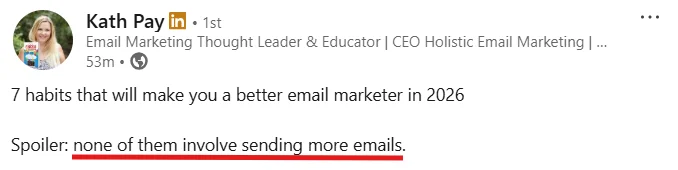
To steer clear of the negative consequences flagged by Craig, we recommend a disciplined sending framework, grounded in Salesforce Marketing Cloud best practices.
Crossing the ‘bulk sender’ threshold
Most Marketing Cloud teams don’t deliberately choose to become bulk senders. They drift into it through accumulation, and the consequences are immediate.
Here’s how the threshold works:
- Send approximately 5,000 emails in a single day to Gmail or Yahoo addresses → you’re now classified as a bulk sender. Why? Because both Google and Yahoo strictly enforced this beginning in 2024, followed by Microsoft in 2025.
- The count is cumulative: promotional campaigns + journey automation + transactional messages + sales emails from the same domain.
- Once you cross the threshold, the designation is permanent.
- From then on, spam complaint rates must stay below 0.3%.
Here’s where the volume-first approach becomes dangerous: In SFMC, programs tend to grow by default. Journeys remain active indefinitely. Entry criteria rarely get re-evaluated. Legacy automations persist without clear ownership. Each program appears controlled in isolation, but in combination, they push the domain into bulk sender territory without anyone making a deliberate decision to scale that way. This is how over-sending emails in SFMC becomes an operational reality rather than an intentional strategy.
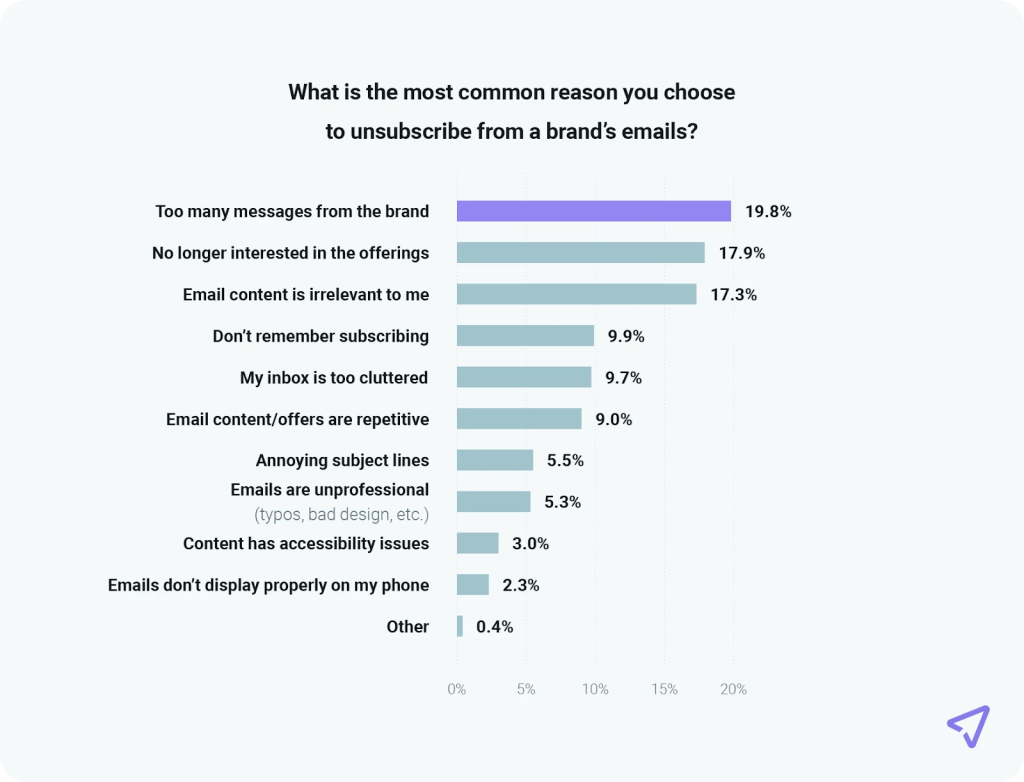
Source: Mailjet
And when complaint rates or engagement signals deteriorate, inbox placement declines across all message types. Marketing campaigns suffer alongside transactional emails. Executive communications get filtered the same way promotional blasts do. The entire organization absorbs the cost, regardless of which team caused the decline.
Disengagement accumulates silently
Spam complaints trigger alerts. They show up in dashboards. They demand attention. However, disengagement does more cumulative damage, and it happens quietly.
How silent disengagement compounds:
- When relevance drops, most subscribers don’t unsubscribe, they just stop opening.
- Mailbox providers interpret declining engagement as a negative signal.
- As engagement weakens relative to volume, sender reputation erodes.
- Inbox placement becomes unpredictable, even for messages that would have performed well.
- Teams instinctively compensate by sending more email to offset declining opens.
This response typically worsens the outcome. Additional volume amplifies the same signals that caused the decline in the first place. Over time, each incremental send reduces future delivery efficiency rather than improving it. But more worryingly, responding to declining engagement with increased volume is a failure of strategic governance that prioritizes short-term recovery over long-term asset viability. It reveals a fundamental misunderstanding of the email channel as a free utility rather than a reputation-based asset; by forcing teams to “burn the furniture to keep the house warm,” executives trade future market reach for immediate, marginal gains.
The irony is that Marketing Cloud captures engagement data continuously. What’s historically been missing is a mechanism to operationalize that data before performance declines. Teams review open rates after campaigns deploy, analyze click-through rates in retrospective dashboards, and react to deliverability issues only after inbox placement has already dropped.
By the time the problem becomes visible, the reputation damage is already embedded.
How does Einstein Engagement Scoring enable smarter sending decisions?
Engagement discipline starts with predictive restraint. And this is where Einstein Engagement Scoring fundamentally changes the operating model.
Instead of analyzing what happens after a campaign completes, Einstein predicts what’s likely to happen next—and allows you to constrain sending decisions accordingly.
Einstein evaluates subscriber behavior and forecasts likelihood over the next 14 days: likelihood to open, likelihood to click, likelihood to unsubscribe, and overall retention probability. These predictions aren’t campaign-specific; they’re modeled at the business unit level, reflecting the cumulative inbox pressure subscribers experience across all message types.
This predictive layer directly supports healthier Salesforce Marketing Cloud engagement by preventing saturation before it compounds.
What makes this operationally powerful is that Einstein automatically segments subscribers into engagement personas based on predicted behavior:
- Loyalists are likely to open and click frequently
- Window Shoppers open often but click infrequently
- Selective Subscribers click selectively and open less frequently
- Win Back and Dormant show low engagement across both dimensions
These personas are activation primitives that can be used directly in segmentation, journeys, and suppression logic.
Instead of treating all contacts as a monolith, you can optimize deliverability and engagement by tailoring frequency and intent to specific lifecycle segments.
For instance, you can reward Loyalists with exclusive access and high-frequency updates, while leveraging Window Shoppers for aggressive incentive testing and conversion-focused calls to action. Selective Subscribers benefit from high-relevance, behavior-triggered content, whereas At-Risk or Dormant segments should be shifted to low-frequency re-engagement paths or even preference centers to protect your sender reputation and minimize unsubscribes.
And if re-engagement fails, suppression or exit messaging becomes a strategic call.
If you’ve been suppressing subscribers based on inactivity and want to reintroduce them to your program, treat it like IP warming, according to Dela Quist in our hour-long chat with him on Marketing Insider.
Start with subscribers inactive for 120 days or less, gradually expand the window, and monitor engagement signals closely. Don’t immediately mail everyone who hasn’t opened in 18 months. Take the same gradual approach you would when warming a new IP—because from a deliverability perspective, you’re essentially introducing yourself to these subscribers again. Watch the full Q&A with Dela Quist on email frequency, and more.
How to control send frequency in Journey Builder?
In Salesforce Marketing Cloud, send frequency within Journey Builder is best controlled using Einstein Engagement Frequency and Engagement Scoring,
By leveraging Einstein Engagement Frequency, marketers can evaluate how close a subscriber is to email fatigue based on their historical send and engagement patterns. This allows journeys to dynamically adapt frequency without applying the same pressure to every contact, reducing the risk of over-sending emails in SFMC at scale.
For example, subscribers identified as Undersaturated or On Target can continue receiving regular journey communications, while those classified as Almost Saturated or Saturated can be slowed down, suppressed, or diverted to lower-frequency or alternative channels. This ensures engagement is preserved while protecting sender reputation.
SFMC supports two primary Einstein-driven approaches for frequency and engagement control:
- Einstein Engagement Frequency: Engagement Frequency classifies subscribers into categories such as Saturated, Almost Saturated, On Target, Undersaturated, based on how frequently they receive messages relative to their predicted engagement tolerance. These categories can be used within Journey Builder decision logic to throttle, pause, or redirect messaging paths.
- Einstein Engagement Scoring: Engagement Scoring assigns subscribers an engagement score or segment based on predicted likelihood to open, click, or engage. These scores can be used to prioritize high-engagement subscribers for premium content while placing low-engagement or dormant subscribers into re-engagement or reduced-frequency tracks.
Each journey path can contain single or multi-step experiences across email, SMS, push, or other channels, allowing marketers to align message volume with predicted engagement capacity. Rather than increasing send volume to offset declining opens, SFMC enables teams to allocate frequency strategically, protecting deliverability while maximizing long-term engagement.
What infrastructure underpins deliverability in SFMC?
Engagement strategy only matters if messages reach the inbox in the first place. Authentication failures, IP reputation issues, and compliance violations block delivery before engagement signals are even evaluated.
This is why the Sender Authentication Package (SAP) is foundational to deliverability infrastructure in Salesforce Marketing Cloud. While SAP establishes the required authentication framework, inbox placement is ultimately determined by mailbox providers based on sending behavior and engagement signals.
Mailbox providers increasingly expect DMARC to be in place for bulk senders.
Domains without DMARC—or with long-term monitoring-only policies—are increasingly viewed as higher risk, even when engagement metrics appear healthy.
As a general guideline (not a strict rule), IP strategy typically aligns with sustained monthly send volume as follows:
- Below ~100,000 emails/month: Shared IPs typically provide greater stability, as volume is often insufficient to maintain consistent sender reputation on a dedicated IP
- ~100,000–2,000,000 emails/month: A single dedicated IP can become appropriate when volume and cadence are consistent.
- Above ~2,000,000 emails/month: Multiple dedicated IPs are often required to distribute volume and manage reputation effectively.
Volume should start with highly engaged subscribers and increase gradually—often over a 30–45 day period—scaling only when engagement and complaint signals remain stable.
Contact hygiene: The cost of ignoring engagement discipline at the contact level
Salesforce Marketing Cloud pricing is typically based on the number of billable contacts in the Contact Builder model—not on active reach.
Categories of contacts inflating your license count:
- Dormant subscribers who haven’t opened in 6+ months
- Bounced addresses that failed delivery permanently
- Unsubscribed contacts still counting toward billing
- Contacts without email addresses or mobile numbers
The extreme case: contacts without channel addresses
These records sit in your database, inflate billing, and provide no operational value.
They cannot be messaged via email or SMS, yet they count against license limits in the same way as active, engaged subscribers. Most enter the system through imports or integrations or legacy migrations without proper validation. At scale, this can translate into tens of thousands of dollars each year in wasted license capacity.
How to identify and delete unreachable contacts in Marketing Cloud?
Cleaning up these records requires a deliberate, repeatable process using native Marketing Cloud capabilities:
- Use Marketing Cloud’s built-in Data Extract Activity in Automation Studio
- Select “Contacts Without Channel Addresses” as the extract type
- Schedule the automation to run and automatically create a Data Extension
- Back up the data for compliance purposes
- Delete the contacts permanently through Contact Builder
- Billing adjustments reflect reduced contact count in subsequent cycles
How can you prevent invalid contacts from entering SFMC?
Long-term control depends on enforcing guardrails across data ingestion, Contact Builder modeling, and upstream systems to prevent invalid records from becoming billable contacts in Salesforce Marketing Cloud. Here are a few tips to that end, aligned with proven Salesforce Marketing Cloud best practices:
- Implement import validation that rejects rows lacking email or mobile before they load.
- Enforce upstream API integration controls that validate the presence of required communication channels before records are passed into Salesforce Marketing Cloud as contacts.
- Configure Salesforce Connector to exclude Leads/Contacts without email addresses from synchronization.
- Schedule recurring monitoring using Automation Studio queries or reports (monthly or quarterly) to detect the accumulation of non-marketable or invalid contacts early.
Final thoughts
To be clear, the argument here is not that you should send less email. It’s that volume must be allocated based on engagement capacity, not campaign objectives.
Marketing Cloud can still send millions of emails. What’s changed is that unconstrained volume now guarantees failure. The 0.3% complaint threshold isn’t negotiable. Authentication failures don’t get second chances. Disengagement compounds silently until inbox placement collapses.
But every constraint is equally enforceable too. Einstein prevents saturation before it becomes reputation damage. Bounce management removes invalid addresses before they trigger blocks. Contact deletion eliminates phantom records before they inflate costs. Authentication protocols establish trust before a single message deploys.
The organizations that thrive in this environment aren’t the ones sending the most email. They’re the ones who realized that deliverability is infrastructure, not optimization.
Want the full technical playbook? Our new ebook, Driving Higher & Meaningful Engagement in SFMC: The Science of the Send, covers Einstein implementation, IP warming protocols, authentication configuration, bounce management workflows, and contact deletion automation in depth. It’s built for Marketing Cloud operators who need to shift from volume-driven execution to engagement-constrained discipline—without sacrificing scale.
Download the ebook here and get the complete operational framework.