
 Lifecycle marketing
 Customer data management
 Email campaign production
 Search marketing
 CMS development
 Who we are
 How we work
 Case studies
 Testimonials
 Salesforce Marketing Cloud
 Braze
Braze HubSpot
 Marketo
 Pardot
 DataBricks
 Snowflake
 HighTouch
 RudderStack
 Segment by Twilio
 Videos

The creative is clever.
A campaign looks beautiful in isolation.
It opens a spike, and the deck gets applause.
Then the pipeline spreadsheet tells a different story. Because the reds are too loud to ignore.
You’ve seen it a hundred times already:
- An email that lights up vanity metrics but leaves revenue flat.
- A month of “engagement” that fails to translate into a pipeline.
- Dashboards that argue with each other.
- Meetings where people defend impressions like sacred cows.
The problem is not dashboards. The problem is the appetite for noise.
Marketing has always promised causality. We spend. We hope. We attribute.
But do we change?
And as channels multiply, privacy bites, and decision windows shrink, the old ways break down.
Clicks and opens stop being reliable proxies. Spreadsheets proliferate. And ownership…it blurs in oblivion.
CMOs need a single, honest measurement system: one that cleanly and audibly ties marketing activity to business outcomes, pipeline, revenue, and retention.
Marketo can be that hub, but only when you treat it as part of an engineered measurement architecture.
Because…let’s be honest about it:
“Reporting and attribution are a CMO’s North Star.”
Let’s cut to the chase and play the endgame.
To build this single, honest system, we must first clearly define the essential capabilities that drive modern marketing measurement.
What modern CMOs actually need from reporting and attribution
CMOs need reporting and attribution to do five things well.
- Truth about contribution
Not “what got the click,” but “what moved the pipeline.” Channels contribute differently at lead creation, pipeline acceleration, and revenue conversion. Reporting must map: activity → pipeline → revenue → LTV.
- Speed
Tactical teams need near-real-time signals (hours, not weeks) to pull or push spend. Strategic teams need robust historical data for seasonality and cohort analysis. Measurement must serve both cadences.
- Actionability
Every report must link to a decision. If a channel shows declining conversion probability, what do you do? Pause, reallocate, change creative? Reports must prescribe action, budget moves, creative swaps, and suppression rules.
- Trust and auditability
Lineage matters. Every number must be reproducible from canonical sources: event → Marketo activity → CRM record → warehouse model → BI dashboard. Ownership, change logs, and model versions must exist.
- Flexibility
Support multi-touch, account-based, and cohort views. CMOs need both person-level funnels and account-level influence for enterprise deals.
And most importantly, you need to stop asking for:
- Open and click improvement as proof of value. They’re proxies, useful, but not outcomes.
- One-off spreadsheets that cannot be audited or rerun. They die as soon as someone leaves.
Now, let’s see what goes into building the system that will deliver this trustworthy, end-to-end measurement.
Measurement architecture every CMO should demand
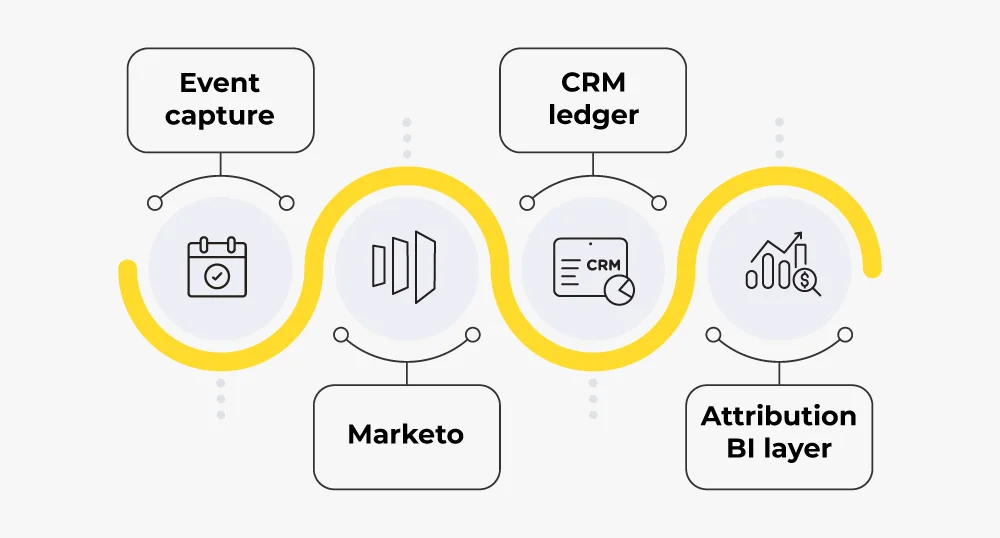
Think of measurement as a pipeline distinct from marketing execution. The canonical flow should be:
Event capture → Marketo activities → Marketo → CRM (lead/account) → Data warehouse (event and profile store) → BI/attribution layer → Dashboards and activation.
Let’s check each one of them.
- Event capture
All interactions (web, app, email, ads, offline) should be captured with canonical schemas. Engineers own tagging and server-side events. Client-side events are fragile; server-side tagging, where possible, is more reliable.
- Marketo activities
Marketo records sends, opens, clicks, fills, program memberships, and scoring changes. These activities must carry canonical IDs (contact_id, session_id) and UTM/campaign metadata for later joins.
- CRM linkage
Lead → Contact → Account mapping is critical. CRM becomes the revenue ledger; link Marketo contacts to CRM leads/accounts deterministically and track lifecycle transitions (MQL→SQL→Opportunity→Close).
- Warehouse
Centralize events and profiles in a canonical model. This is your single source of truth for joins and models. Store raw events, normalized sessions, identity tables, program metadata, and CRM outcomes.
- BI/Attribution layer
Run deterministic and probabilistic attribution models here. Keep model code in the warehouse (dbt/SQL) with version control. Produce channel-level outputs, experiment metrics, and exposure cohorts.
- Dashboards and activation
Push model outputs into BI and into Marketo/activation systems for suppression, re-targeting, and budget signals.
Design the architecture to guarantee lineage: any dashboard metric must be traceable to raw events, Marketo activities, and CRM outcomes.
With the architectural foundation clearly defined, it is time to move from theory to a precise, practical implementation.
Marketo-specific instrumentation checklist (practical)
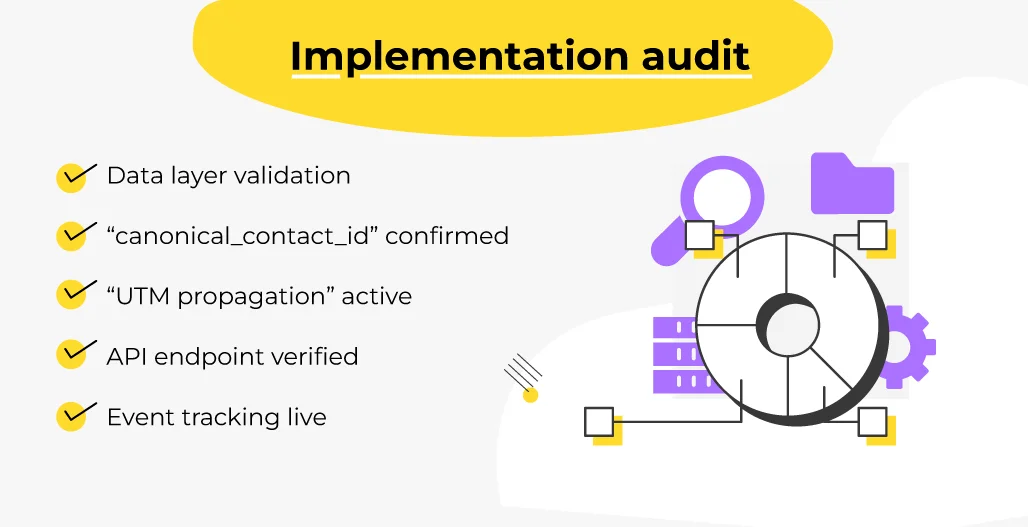
Here are the practical checklists you need to tick to ensure everything goes as planned.
Required fields on every Marketo lead/contact:
- canonical_contact_id (UUID)
- person_id (if using identity stitching)
- first_touch_utm_source, first_touch_utm_medium, first_touch_utm_campaign
- last_touch_utm_source, last_touch_utm_medium, last_touch_utm_campaign
- acquisition_channel (normalized taxonomy)
- source_system (e.g., web, ad_platform, partner)
- created_by_campaign (program ID where applicable)
Recommended Marketo activities to capture:
- email_send (program_id, email_id)
- email_open (email_id, timestamp)
- email_click (link_id, url)
- form_fill (form_id, page_url)
- landing_page_view (page_id, utm
- webinar_registration, webinar_attendance (event IDs)
- cta_click (button_id)
- conversation (chat/CS engagement IDs)
- offline_conversion (sales-reported outcomes)
Naming conventions (sample):
- Campaign: campaign.type_channel_offer_locale_YYYYMMDD e.g., promo.email_summerlaunch_us_20260601
- Email: email.template_offer_shortdesc_v1 e.g., email.hero_discount_abandon_v2
UTM and tracking rules:
- Mandatory UTM fields: utm_source, utm_medium, utm_campaign, utm_content (optional utm_term).
- Enforce normalized utm_source taxonomy (e.g., Google, Facebook, newsletter).
- Propagate campaign_id in query strings and link shorteners.
Webhooks and server-side events into Marketo:
- Purchase events: include order_id, amount, items, and currency.
- Demo booked: appointment_id, datetime, sales_owner.
- MQL/SQL transitions: lifecycle_stage, score_delta, trigger_reason.
QA checklist:
- Create synthetic leads and simulate flows.
- Verify activity timestamps and CRM sync within SLA.
- Run sample queries to confirm canonical IDs join across Marketo → CRM → warehouse.
- Validate UTM propagation end-to-end.
Once the data is strictly captured and structured, the next crucial step is selecting the right model to accurately assign credit for business outcomes.
Attribution models decoded: Strengths, limits, and when to use each
Different channels play different roles. Attribution must show which part of the buyer journey a channel influenced, lead creation, pipeline acceleration, or revenue recognition, not just “percent of credit.
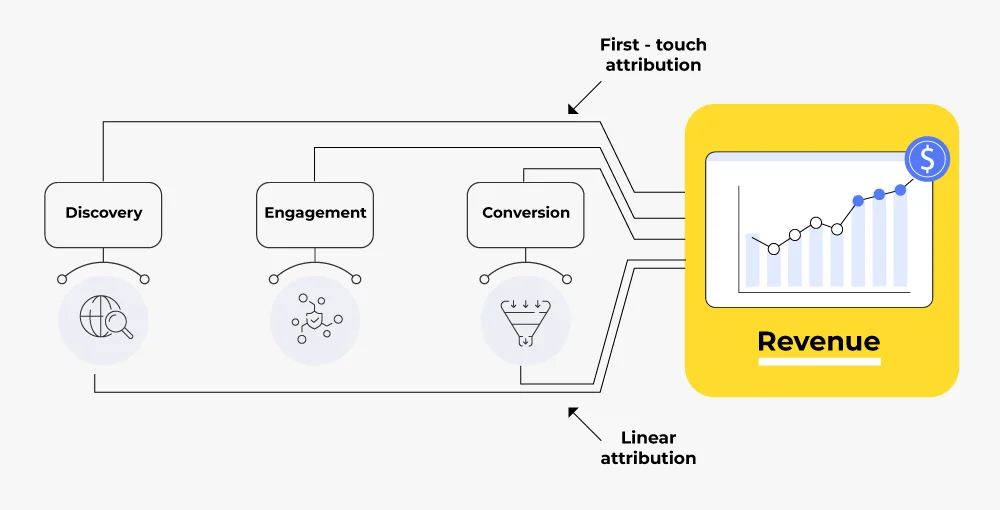
Here is a tabular representation for the same.
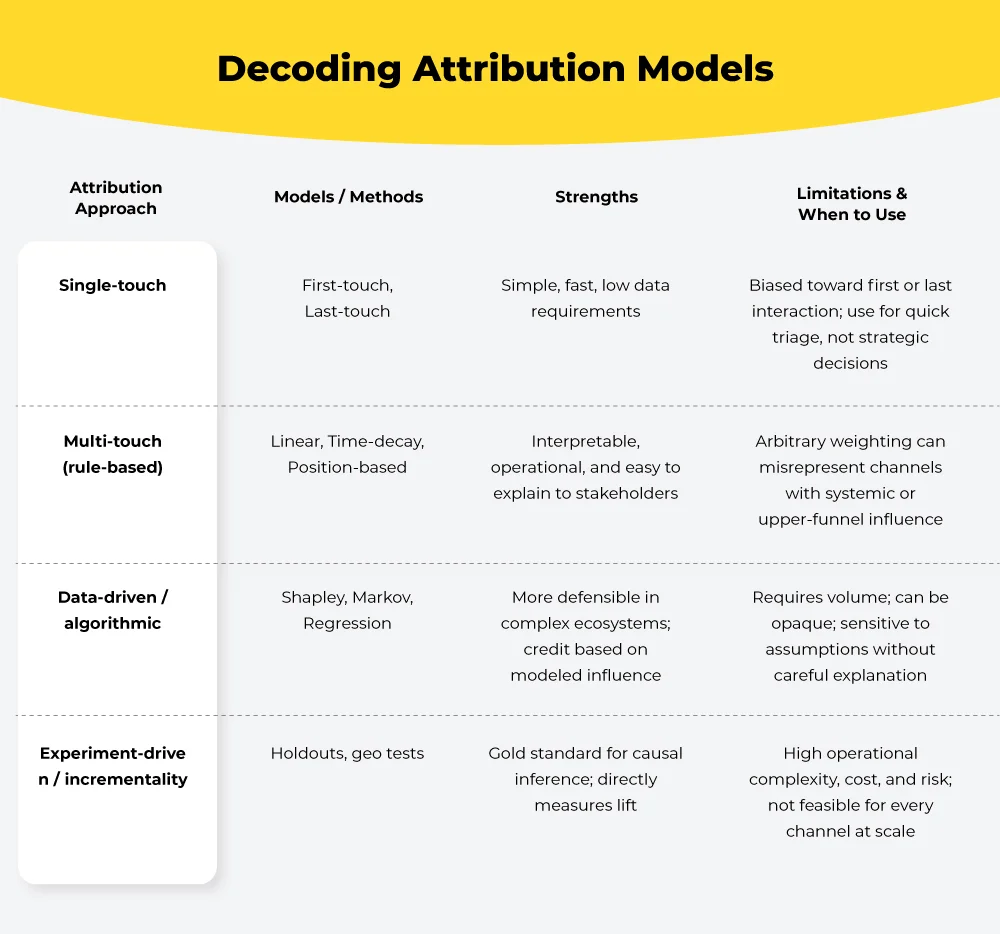
Combining the right models is the key to actionable attribution. So, let’s see how you can leverage your Marketo customers’ data to build a robust, hybrid approach.
Building a hybrid attribution playbook for Marketo customers (practical steps)
Here are five steps that will help you build a hybrid system of measurement that includes both reporting and attribution in Marketo.
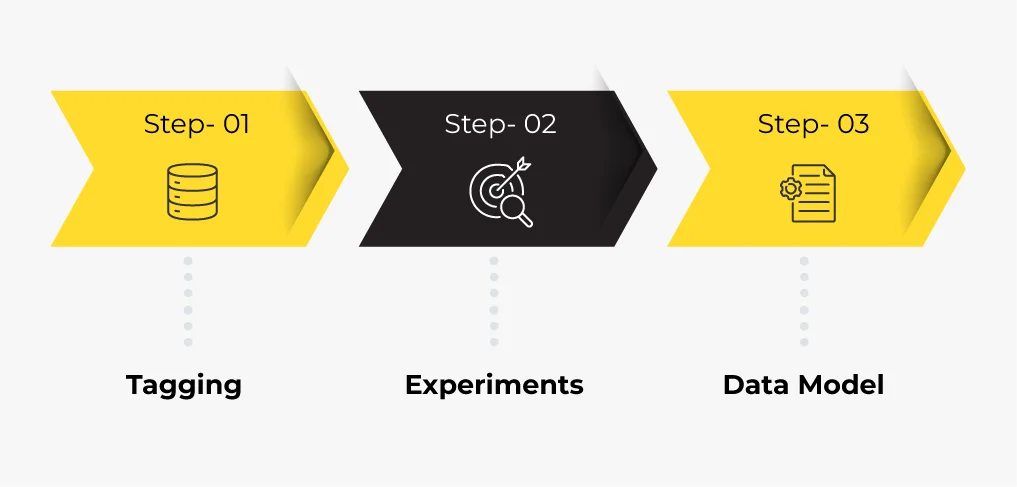
Step 1: Strict tagging + baseline rule-based attribution.
Enforce naming and UTM rules. Implement program- and campaign-level IDs. Run last-touch and position-based models (e.g., 40/40/20 split for first/mid/last or customized position rules) as operational defaults.
Step 2: Instrument experiments (holdouts) for expensive channels.
Pick the top two spend channels. Run 5–15% holdouts, excluding users from the channel, and measure incremental conversion and revenue over 60–90 days.
Step 3: Build a lightweight data-driven model in the warehouse.
Run a Markov chain or Shapley model at channel granularity. Keep code in DBT and versioned. This model gives fairer credit distribution but uses it as advisory, not a sole decision.
Step 4: Reconcile models with experiments.
If algorithmic outputs diverge from experimental results, investigate the signals and adjust model inputs. Convene a monthly attribution governance meeting to tune weightings and decide actions.
Step 5: Map outputs to budget runbooks.
Define thresholds: e.g., if incremental lift < X% in an experiment, scale back spend; if the model shows sustained high contribution and experiments validate it, increase the budget. Make decisions operational: automation triggers to reallocate small budgets; human-reviewed reallocations for large shifts.
With the architecture and models in place, the final step is creating dashboards that distill data into clear, immediate, and actionable insights for every level of the organization.
Sample dashboards and report templates CMOs actually need (with wireframe ideas)
You need dashboards that answer three questions quickly:
- Are we generating a quality pipeline?
- Are channels moving revenue efficiently?
- Where should I reallocate the budget now?
So, here are some significant dashboards that will help your cause.
Executive KPI dashboard (single page)
- Headline metrics: MQLs, SQLs, Pipeline created (rolling 90 days), Pipeline influenced, Revenue (ARR/MRR), CAC, LTV:CAC, Marketing-influenced ARR.
- Trend line: Pipeline created vs target (rolling 90 days).
- Attribution snapshot: Top 5 channels by influenced pipeline and data-driven credit.
- Alert widget: Budget at-risk signals (declines in conversion probability or sudden drop in influenced pipeline).
- Quick actions: Buttons/links to run or schedule holdout tests or pause programs.
Tactical channel performance dashboard (multi-tab)
- Channel summary: cost, spend, influenced pipeline, CPA, conversion probability.
- Creative and asset performance: templates, subject-line clusters, send-time effects, open-to-opportunity rates.
- Cohort funnel: time-to-MQL, time-to-SQL, conversion curves by acquisition month.
Sales-marketing alignment dashboard
- Lead velocity and L2O conversion by cohort.
- SAL trends and handback reasons.
- Top accounts influenced and contact touch coverage.
Attribution diagnostic dashboard
- Model vs experiment comparison: show discrepancy and confidence intervals.
- Channel incremental lift over holdout.
- Exposure frequency and saturation alerts.
Visualizations and cadence
- Tactical: near-real-time (hourly/daily) for send and paid teams.
- Operational: daily/weekly for channel managers.
- Strategic: monthly for C-suite review. Use sparklines, distribution charts (e.g., exposure vs. conversion), and small multiples to compare cohorts.
Now that CMOs have built exclusive dashboards, how can they ensure everything runs smoothly? Let’s find out.
Data governance, lineage, and trust: Rules every CMO must enforce
CMOs need to avoid doing everything on their own and start offloading their roles to their subordinates.
Here is an effective strategy to do exactly that.
Owner roles:
- Naming and UTM ownership: Marketing ops.
- Data quality: Analytics engineering.
- Schema changes: Change-control via ticketing with approvals (martech + analytics).
- Model ownership: Attribution lead/data science.
Version control and models:
- All model code in Git/dbt with version IDs.
- Dashboards must show the model version and date used for calculations.
- Keep change logs and rollback ability.
Data lineage requirements:
- Each dashboard metric must link back to raw events and Marketo activity IDs.
- Record transformation logic as SQL/DBT so any metric can be rebuilt.
Periodic audits:
- Run synthetic records monthly to validate pipeline counts.
- Reconciliation scripts: Marketo → CRM → Warehouse totals should match (allow <1% variance).
- Anomaly detectors to flag sudden drops/spikes.
Privacy and compliance:
- PII rules, retention policies, and consent propagation are documented.
- Propagate consent state from Marketo to the warehouse; block data uses when consent is revoked.
SLA and freshness:
- Define SLAs. For example, event ingestion within 1 hour; nightly reconciliation; critical dashboards updated hourly/daily depending on use.
Trust is procedural. If your org can’t explain how a number was made, you can’t act on it with confidence.
But life won’t always offer you cherries. You will be tested with challenges.
Even the most rigorous architecture will encounter turbulence. So, anticipating and actively mitigating common pitfalls is crucial to maintaining data integrity and trust.
Pitfalls, common failures, and how to avoid them

Here are some common challenges you may encounter while implementing Marketo reporting and attribution, along with effective ways to topple them.
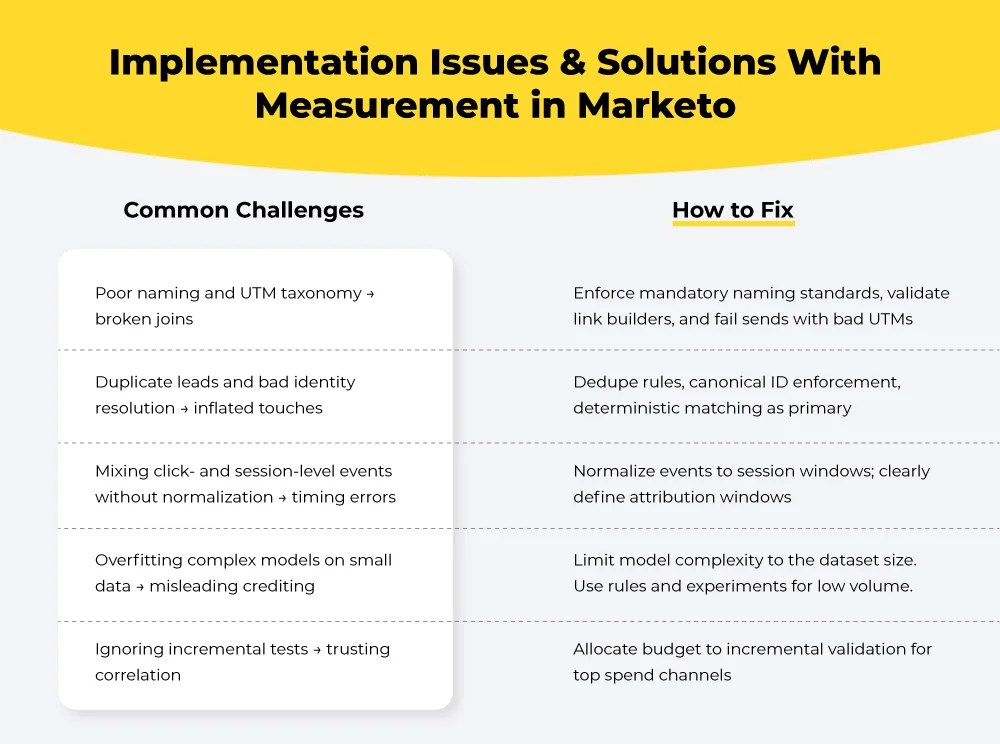
Wondering where to start fixing? Here are a few quick tips.
- Naming governance in place.
- Deduplication rules implemented.
- Time-window normalization enforced.
- Minimum sample sizes for models.
- Holdout schedule for experiments.
Need more help? Here comes the trump card.
Modern CMO’s 90-day playbook: Prioritize, deliver, and measure at leisure
Here is a structured 90-day plan to give you a head start.
Week 0–2: Audit and stabilize.
- Run a tracking audit. Fix broken UTMs and implement mandatory fields. Create synthetic leads to verify flows.
- Deliverable: Tracking issues log, remediation plan.
Week 3–6: Build the minimal operational dashboard.
- Dashboard: MQL → SQL → pipeline; last-touch and influenced pipeline. Operational alerts for declines in conversion probability.
- Deliverable: Live dashboard with daily refresh.
Week 7–10: Deploy first experiment.
- Holdout on one high-cost channel (10% segment). Instrument outcome window.
- Deliverable: Experiment plan and executed holdout cohort.
Week 11–13: Iterate with a data-driven model.
- Implement the Markov/Shapley model in the warehouse. Reconcile with the holdout results.
- Deliverable: Model outputs and comparison report.
Week 14: Governance cadence and roadmap.
- Define owners, meeting cadence, SLA, and prioritized experiment calendar.
- Deliverable: One-page measurement runbook to present to the CFO.
Wrapping up
That brings us to the business end of this article, where it’s fair to say that measurement is a habit, not a report.
Accurate, auditable, and actionable attribution turns Marketo activity into predictable business outcomes.
Measurement isn’t a dashboard you check weekly. It’s a muscle you build: enforce naming, instrument canonical events, run experiments, and govern models.
The modern CMO invests in systems, not spreadsheets; in experiments, not opinions; in governance, not handoffs.
If you make measurement habitual, reproducible, owned, and quick, marketing stops being a cost center and becomes a reliable growth engine.
Here are some more relatable reads if you’d like to consider.
How Marketo’s new global tokens save you hours and boost consistency
Marketo data hygiene: How to prevent bad data at the source
Scaling audience targeting & lead qualification with Marketo Smart Lists