 Lifecycle marketing
 Customer data management
 Email campaign production
 Search marketing
 CMS development
 Who we are
 How we work
 Case studies
 Testimonials
 Work samples
 Salesforce Marketing Cloud
 Braze
Braze HubSpot
 Marketo
 Pardot
 DataBricks
 Snowflake
 HighTouch
 RudderStack
 Segment by Twilio
Have you ever looked at your marketing funnel and realized you are treating every single prospect exactly the same way?
Traditional B2B marketing relies heavily on generic, top-of-funnel email campaigns. We blast the same whitepaper to the CEO, the IT Director, and the end-user, hoping something sticks.
But here is the reality. Today’s modern B2B buyers expect personalized, real-time, and value-driven interactions tailored to their specific role. Attempting to deliver these hyper-personalized conversations manually leads to extreme marketer burnout and severely bottlenecks your pipeline growth.
So, how can enterprise marketing teams scale one-to-one conversations across complex buying committees without drastically increasing their headcount?
By 2026, the solution will have officially shifted to AI-powered Salesforce Marketing Cloud Account Engagement. Utilizing autonomous agentic systems, intent data, and predictive modeling, businesses can now orchestrate real-time, multi-stage conversations.
AI Pardot B2B marketing actively drives revenue while completely eliminating the burden of manual execution.
Let’s cut to the chase.
To understand how this works, we first need a clear definition of AI-powered account engagement.
What is AI-powered account engagement in 2026?
Formerly Salesforce Pardot, now Salesforce Marketing Cloud Account Engagement.
It is an AI-powered account engagement that replaces rigid automation with autonomous agentic AI that analyzes real-time buyer signals to orchestrate highly personalized, multi-stage conversations across the entire B2B buying committee.
Let’s look at the end of “if-then” automation.
Traditional tools and basic AI assistants follow static, predefined rules that demand constant human oversight and regular re-briefing. If a prospect clicks a specific link, they get an automated email.
Agentic AI operates entirely differently. It is dynamic, using live context, predictive models, and goal-based logic to decide the next best action without manual intervention.
This completely shifts how we approach the buying committee.
In 2026, you cannot assume you see every interaction, as much of your buying committee evaluates vendors anonymously in dark social channels.
Marketing to the committee simplifies your strategy by ensuring your message reaches the entire decision-making ecosystem rather than betting everything on a single, isolated decision-maker. That’s what dynamic content brings to the table.
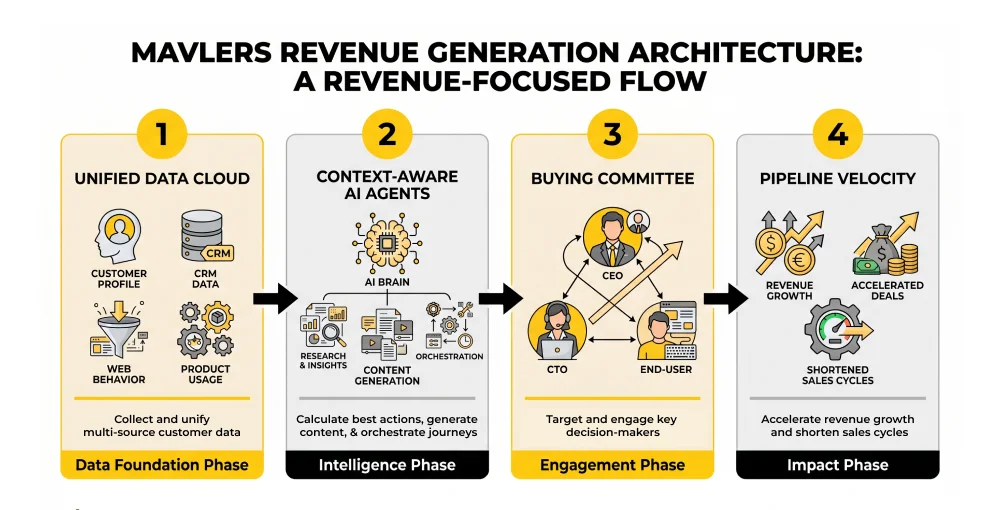
Salesforce Pardot Einstein AI allows marketers to simultaneously orchestrate unique, highly relevant messaging tailored specifically for the CEO’s financial concerns and the CTO’s technical requirements.
However, unifying the revenue engine is a strict prerequisite for this success. This shift requires Revenue Operations (B2B RevOps) to completely tear down marketing and sales data silos. When data is centralized, the entire company stops operating as fractured departments and begins functioning as a single, intelligent revenue engine.
Now that we’ve defined the technology, let’s explore the practical ways agentic AI redefines campaign orchestration.
How does agentic AI transform B2B campaign orchestration?
Agentic AI transforms B2B marketing by dynamically customizing content for specific buying committee members, predicting pipeline velocity, and intelligently timing delivery to maximize engagement and reduce manual workloads.
The transition to agentic AI Pardot B2B marketing is a fundamental paradigm shift.
Here are the Pardot AI features in 2026, which autonomous systems (like Salesforce Marketing Cloud Account Engagement) are redefining campaign execution.
1. Autonomous campaign orchestration
AI agents do not just follow rigid instructions. They analyze live buying signals to make and adapt strategies on the fly. They actively monitor the digital body language of your target accounts in real-time.
2. Hyper-personalized engagement
We are moving far away from generic outreach. AI dynamically customizes messaging, channels, and content for specific members of a buying committee based on their current intent. Think about the financial impact.
3. Predictive lead scoring & revenue modeling
Advanced predictive models analyze behavioral signals and complex social interactions to accurately forecast pipeline velocity.
Industry frameworks, such as the Cyfuture B2B revenue modeling strategy, show that modern enterprise systems must seamlessly integrate to maximize customer lifetime value. AI connects these dots, turning scattered data points into reliable predictive lead scoring 2026 metrics.
4. Intelligent content creation & delivery
Creating bespoke content for every persona used to take weeks. Now, AI tools generate tailored content based on specific personas and their unique pain points instantly.
Furthermore, the AI optimizes the exact delivery time for maximum engagement. It knows that the CFO opens emails on Tuesday mornings, while the lead engineer browses LinkedIn on Thursday nights.
5. Deepened data analytics
Finally, AI consolidates buyer intent, competitor moves, and historical engagement data to eliminate tactical guesswork. Marketers can now focus exclusively on high-priority accounts showing active buying signals.
“The current marketing department looks fundamentally different from 2024. Teams have shifted from tactical execution to strategic oversight.”
Business leaders need to see tangible results, so let’s look at the quantifiable impact of adopting an AI-driven approach.
What are the quantifiable benefits of AI in Account Engagement?
Implementing AI-driven Marketing Cloud Account Engagement drastically reduces administrative overhead, saving teams an average of 20 hours per week while improving high-intent identification accuracy of over 78% respondents.
Business leadership needs concrete data to justify the transition from legacy marketing tools to a fully autonomous platform. You cannot secure a budget based on industry buzzwords alone.
You need to prove that autonomous campaign orchestration actually impacts the bottom line.
The data is incredibly clear. When executed correctly, AI agents do not just save time; they fundamentally improve the accuracy and speed of your entire sales cycle.
Here are the quantifiable benefits of Salesforce Account Engagement AI you can expect when migrating to an AI-powered revenue engine:
| Feature | Impact on B2B Marketing |
| Agentic Workflows | Saves teams an average of 20 hours per week on routine, repetitive tasks. |
| Predictive Analytics | Delivers up to 73% higher accuracy in identifying high-intent accounts. |
| Chatbots & Virtual Assistants | Seamlessly handles initial qualification and meeting scheduling 24/7. |
| Revenue Operations (RevOps) | Unifies historically siloed data into a single “revenue engine” for the entire company. |
These metrics prove that AI is no longer an experimental toy. It is a highly reliable, revenue-generating team member that works around the clock without ever experiencing burnout.
That’s exactly what AI Pardot B2B marketing helps you with.

The transition requires a methodical approach. Here is the blueprint for successfully implementing your autonomous B2B revenue engine.
How do you implement an autonomous B2B revenue engine?
Building an autonomous B2B revenue engine requires establishing a foundation of clean, unified data, aligning sales and marketing goals, and deploying AI agents through a phased, ROI-driven rollout.
You cannot just flip a switch and expect your marketing stack to become autonomous overnight. Implementation requires strict, methodical discipline.
Here is the blueprint for Marketing Cloud Account Engagement for rolling out buying committee AI personalization across your enterprise.
Step 1: Data infrastructure first
AI agents cannot succeed without unified, clean data. You must start with a structured assessment of your data, processes, and governance. That’s where Pardot Einstein AI helps.
The outdated “more leads” mindset must be actively replaced by a strict focus on data quality and consistency at scale. If you feed the AI garbage, it will execute garbage at a terrifying speed.
Step 2: Start with clear ROI use cases
Do not attempt to deploy AI everywhere at once. Teams should focus on specific, measurable pain points, such as automating initial meeting qualifications or streamlining predictive lead scoring.
This caution is critical. Gartner predicts that over 40% of agentic AI projects will be canceled by the end of 2027 due to escalating costs, unclear business value, or inadequate risk controls. Start small, prove the ROI, and then scale.
Step 3: Establish continuous human oversight
AI removes humans from the execution bottleneck, but not from the overarching strategy. Marketers must continue to define the messaging and brand narrative.
This transformation is inevitable. By 2029, at least 50% of knowledge workers will be expected to develop the skills necessary to work with, govern, or create AI agents on demand for complex tasks. Your team must evolve from tactical operators into strategic orchestrators.
Wrapping up
That brings us to the business end of this article, where it’s fair to say that in 2026, AI is the baseline, not the differentiator.
The B2B organizations that ultimately win will be the ones utilizing agentic workflows to build deeper, more meaningful conversations with their buyers.
Stop letting your team drown in manual campaign execution. It is time to let the machines handle the tasks so your humans can handle the relationships.
Ready to upgrade your revenue engine? Book an “AI Account Engagement Audit” with our agency today.
Connect with our Marketing Cloud Account Engagement experts to learn how to leverage AI.