 Lifecycle marketing
 Customer data management
 Email campaign production
 Search marketing
 CMS development
 Who we are
 How we work
 Case studies
 Testimonials
 Work samples
 Salesforce Marketing Cloud
 Braze
Braze HubSpot
 Marketo
 Pardot
 DataBricks
 Snowflake
 HighTouch
 RudderStack
 Segment by Twilio
Marketing has always been part art, part logistics. The art is where marketers worth their salt want to spend their time. The logistics have a way of consuming most of it. Agentforce shifts that balance. It acts as a layer that connects strategy, content, lead management, and optimization inside the systems most enterprise marketing teams already use.
Today, we walk through what that looks like in practice across the four pillars of agentic marketing in Salesforce Marketing Cloud Next. Let’s get started.
The 4 pillars of agentic marketing
1. Create
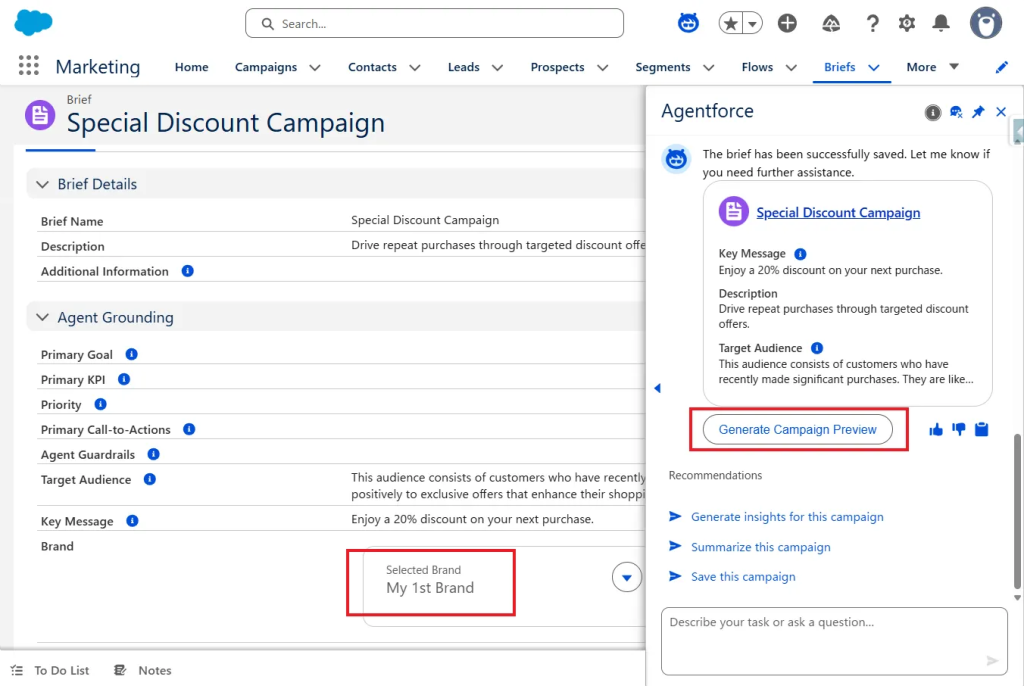
Traditionally, in enterprise marketing teams, creating a campaign is a long, multi-step process, starting with a creative brief, then going through several rounds of copy and design reviews, followed by HTML coding by a developer and journey setup by a MarTech specialist. Altogether, it can take anywhere from two to four weeks to get everything ready.
With Agentforce Campaign Creation, you describe your goal in natural language. The agent:
- Generates a full campaign brief
- Creates the audience segment using Data Cloud in real time
- Drafts email and SMS content aligned to your brand voice and guidelines
- Sets up the customer journey in Flow
- Surfaces everything for your review before activation
The Campaign Designer adds a wizard-style interface to this workflow, allowing for seamless progression from brief to content creation without a conversational interface.
A note on how content generation works
The agent fills predefined HTML template shells that your team creates and maintains. It means brand guidelines, layout standards, and legal disclaimers are baked into the template before the agent ever touches it. Personalization tokens, preheader character limits, and tone guidelines are all defined in the agent’s topic instructions upfront, so the output is brand-compliant.
It’s also worth noting that journey settings are hard-coded within the underlying Apex logic, not inferred by the language model. This eliminates the risk of hallucinated configuration and gives teams confidence that what the agent builds matches exactly what they specified.
2. Engage
The ‘engage’ pillar is where Salesforce Marketing Cloud Next fundamentally changes what email can be. When a customer replies to a Marketing Cloud-powered email, Agentforce reads the reply, interprets the intent, and responds with a relevant, contextual answer. This is a big win in terms of conversational email marketing, which is the basis of relational marketing.
3. Qualify
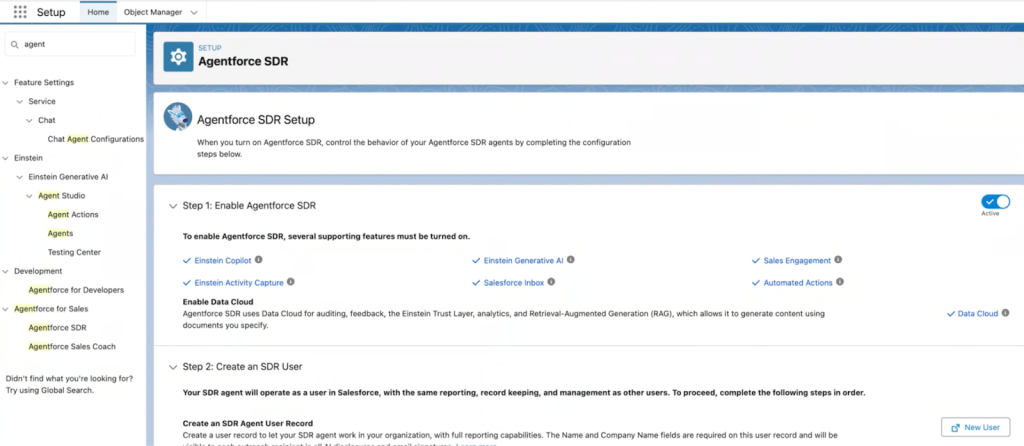
Agentforce Lead Management is the agentic pillar with perhaps the most immediate commercial impact. It deploys an AI agent that functions like a Business Development Representative, except it works 24 hours a day, seven days a week, and in multiple languages. The agent can:
- Retrieve lead scores from Salesforce
- Engage leads with personalized multi-turn email conversations
- Answer product questions using your knowledge base
- Schedule meetings directly in calendars,
- Hand off qualified leads to human sales reps at the optimal moment
The handoff logic is configurable; you define what ‘qualified’ means.
For B2B organizations especially, this collapses the gap between marketing and sales that has historically been a source of friction and lost revenue.
A design lesson from the field
Teams implementing agentic lead qualification often start by replicating the data requirements of their existing manual process. But that creates unnecessary friction. The agent can gather information progressively across multiple turns, qualifying iteratively rather than front-loading the conversation. Starting lighter and letting the agent work through the exchange produces better engagement and, ultimately, more complete data.
One further point: because every interaction is logged and structured in Salesforce, the ‘qualify’ pillar generates a new category of intelligence beyond individual lead outcomes. Teams gain visibility into which inbound channels are delivering quality, which segments are expressing demand you hadn’t anticipated, and where pipeline is being lost. In many early implementations, organizations discovered meaningful demand signals in channels they had previously dismissed as low-value, because the data had never been captured consistently enough to analyze.
4. Optimize
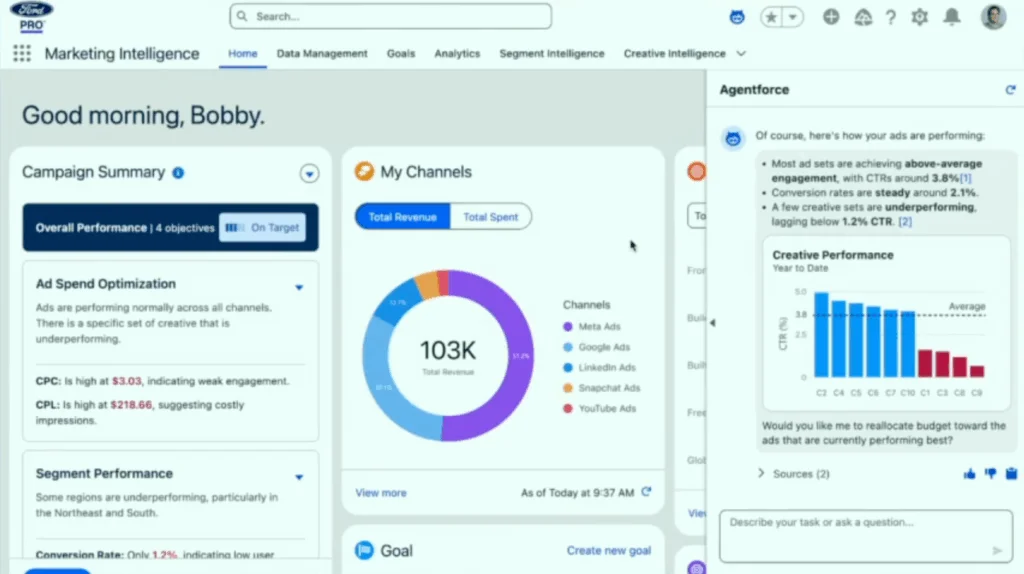
Agentforce Paid Media Optimization and Segment Intelligence represent the fourth pillar: the continuous, autonomous improvement of marketing performance. Segment Intelligence surfaces insights about which audiences are responding, how, and why. Paid Media Optimization applies those learnings to budget allocation and targeting.
There is an underlying benefit here that tends to emerge once the other pillars come together.
When agentic systems consistently capture and structure previously untracked data, this pillar is strengthened with more complete inputs. Many organizations have been limited by data gaps, demand from unmeasured channels simply wasn’t visible. Agentforce closes those gaps, making optimization significantly more effective.
What you can build from here
The architecture underlying these 4 pillars means the surface area for customization is far wider than any single implementation. Here are a few directions worth noting:
- Multichannel journeys: Everything described above applies equally to SMS, WhatsApp, and push notifications. Agentforce can build journeys that span all these channels from a single conversational prompt.
- Dynamic content: Email templates can be configured with variable image sources and content blocks, making agent-generated emails dynamic in a real sense.
- Test send automation: An action(s) can be created to trigger a test send to a specified inbox before any campaign goes live.
- Advanced journey logic: Decision splits, personalization paths, and custom activities (including third-party integrations) can all be defined within an agent’s action set, provided the corresponding Apex and Flow logic is built to support them.
- Data extension management: Agents can create and populate data extensions directly from CRM or Data Cloud.
- Multilingual deployment: The agent framework supports multiple languages natively. In this way, a global rollout of a single workflow is made possible.
A word on compliance and privacy
Agentforce operates within established guardrails for data handling. PII is masked within the agent environment and not retained across sessions. At the campaign execution level, send classifications can be stored in the relevant custom object, ensuring that consent rules defined within Marketing Cloud are honored automatically. GDPR compliance at the consent management level remains a marketing strategy responsibility, but the infrastructure supports it.
As far as email rendering is concerned, this is not something Agentforce handles natively. Preview testing and multi-device rendering remain within Marketing Cloud’s own toolset, including the native Litmus integration.
On change management
Agentic marketing implementations can stumble from the operational perspective if the human dimension is underestimated. A few principles worth carrying into any rollout:
- Start small: It’s always better to pilot on a channel where you have existing trust with the stakeholders involved, where you can iterate quickly, and where the consequences of early imperfection are contained. In short, you want to build confidence first, then scale.
- Expect resistance: External partners or prospects interacting with an agent for the first time may actively try to route around it to reach a human. This is normal and manageable. What changes the dynamic is having data to show those partners that make the case for the new process better. The agent builds its own credibility over time, but you need to be patient through the early period.
- Sales teams need to trust the output: Sellers will engage with agent-qualified leads if they believe the qualification is sound. That belief is earned through consistent performance, clear handoff criteria, and transparency about how the agent works. Involve sales early in defining what qualified means, and the adoption curve will shorten.

Conclusion
None of this requires a leap of faith. We saw that the APIs are documented, the integration path is established, and teams have already built and shipped working implementations. The right starting point is usually the same: find where the manual work is heaviest, where data is falling through the cracks, and where speed of response actually affects outcomes.