 Lifecycle marketing
 Customer data management
 Email campaign production
 Search marketing
 CMS development
 Who we are
 How we work
 Case studies
 Testimonials
 Work samples
 Salesforce Marketing Cloud
 Braze
Braze HubSpot
 Marketo
 Pardot
 DataBricks
 Snowflake
 HighTouch
 RudderStack
 Segment by Twilio

The email open has had a remarkably long career for a metric that tells marketers so little about what a person actually did.
Email opens are now largely driven by background tech and privacy scripts. The email industry has spent years dealing with privacy protections, image caching, and other mailbox behavior that makes an open increasingly difficult to interpret.
The metric became useful because it was easy to capture. Email tracking pixels record when an email was opened, allowing this single data point to drive campaigns and related processes.
Now, the open rate has once again suffered a major blow.
As you may have heard, France has begun enforcing consent requirements for marketing uses of tracking pixels, with Italy following a similar path.
The result is an uncomfortable situation for email teams: one of their most established measures of engagement is becoming both less available and less informative. Those are related problems, though not the same. Regulation can limit whether an open is captured at all; mailbox and privacy behavior can limit what a captured open tells you.
So the question is: how much weight should the open rate still carry in email marketing?
The evidence is stacked against email open rates
The appeal of the open was never particularly complicated. It was available at scale and could be captured without requiring the recipient to do a lot.
Once that infrastructure existed, its role expanded.
Open data could trigger another message, influence segmentation, contribute to send-time decisions, or help determine when a contact should be removed from a campaign. The tracking pixel effectively became part of the decision-making layer of an email program.
That made some sense when the email open rate was treated as a proxy for attention.
The problem is that the proxy has been getting weaker for some time. Traditional open data is no longer as useful or as expressive as it once was. With Apple Mail accounting for more than 50% of the market share, open rates can be inflated by 18-35%.
As we explored in another post, open rates, high or low, have little bearing on your business. In one example from our own client work, a strong average open rate coexisted with much weaker CTR and conversion rates. It’s a pattern we’ve seen recur often enough to distrust open rate as a standalone signal, though results will vary by list and industry.
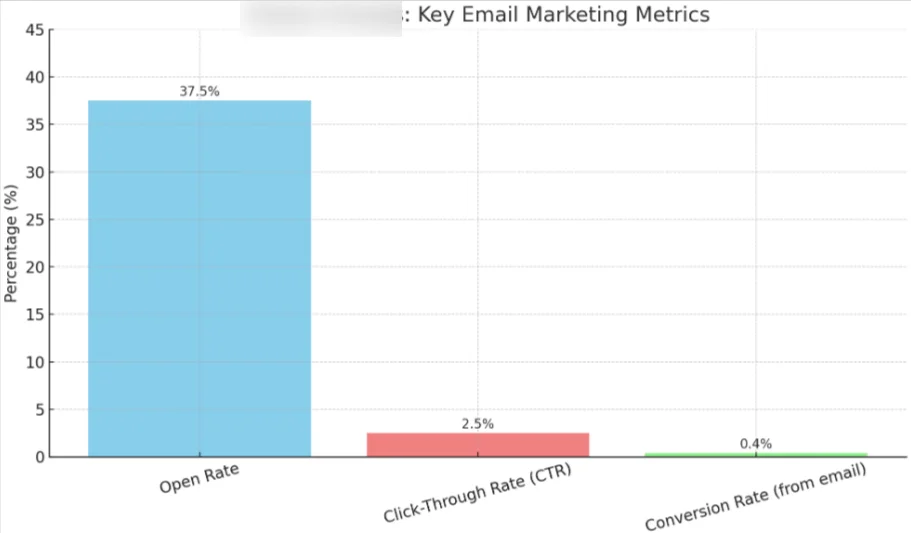
In addition, an open event doesn’t necessarily represent a conscious action by the recipient. A tracking pixel can fire because an email client, privacy system or security service requests the image. That makes the open fundamentally different from a click. A click requires the recipient to take an action. An open can be recorded without the recipient deliberately doing anything.
That does not make every click a meaningful engagement signal, but it does mean the evidence behind a click is different from the evidence behind an open.
France and Italy are turning a measurement problem into an operational problem
The regulatory changes make this harder to ignore because they reach into the systems built around the pixel.
The French guidance requires prior consent for marketing uses of tracking pixels, including open analytics, automation triggers and personalization, subject to narrow exemptions. New subscribers need compliant consent from the outset, while existing subscribers had a July 14, 2026 deadline for being informed and given the opportunity to object.
Italy’s Provision No. 284 takes a similar approach for pixels used to measure opens or conduct behavioral analysis in promotional campaigns. Its framework also allows consent to be incorporated into the broader marketing opt-in when appropriately disclosed, while requiring recipients to be able to withdraw tracking. (Pixels used exclusively for security validations, in transactional/service-related emails, or to manage delivery hygiene do not require consent.)
The important thing is what happens downstream.
If a French or Italian recipient has not consented to tracking, opens are not available. That can affect open-based journeys and engagement-based suppression. Contacts may need to be segmented by consent status and tracking configured accordingly.
Plus, the open rate may be supporting several unrelated decisions across email programs.
Removing that signal can create gaps in automation, reporting and audience management that were never obvious when tracking was enabled by default.
The old measurement model is harder to defend
In light of that, email teams need better reasons for the metrics they use.
If an open is being used to decide whether a subscriber is engaged, there should be a stronger behavioral signal available wherever possible. Open rate alternatives have emerged. For example, a click can tell you that someone took an action. A conversion can connect email activity to a business outcome. A reply can show deliberate engagement and, in some cases, create a direct sales opportunity.
Replies are a potentially stronger replacement for an open because the recipient has chosen to respond rather than merely load an image; though a reply is less structured and less comparable across contacts than a response to a formal survey.
That does not make replies a universal replacement.
A retail newsletter, a SaaS lifecycle email and a B2B sales campaign have different customer behaviors and different definitions of success. The better approach is to work backward from the decision the measurement is supposed to support. For example:
- If the objective is suppression, purchase behavior may be more useful than an open.
- If the objective is understanding customer sentiment, a reply or direct feedback may tell you considerably more.
NPS, for example, illustrates a broader principle: when inference becomes unreliable, it can be better to ask customers directly. The team is no longer relying entirely on passive signals to infer what customers think. It is creating a mechanism for customers to tell the business directly, then connecting that information to an operating process.
Measurement does not have to be limited to tracking what happened inside a message.
It can also help the organization understand how customers experience the program and what should change as a result.
The mailbox may eventually tell senders more
The emerging IETF work around Aggregate Performance Reporting proposes an aggregated way for senders to receive information about how their mail performs at a mailbox provider. The discussion includes metrics and signals related to areas such as inbox or unwanted placement and sender reputation.
That could eventually change how much email teams have to infer from their own tracking.
Instead of trying to reconstruct mailbox behavior from opens, clicks and other sender-side data, more aggregated feedback from mailbox providers could give teams a clearer view of how their mail is being handled. Currently, the APR draft proposes:
- Daily reporting, with data covering a single UTC day
- Message placement data, such as inbox, unwanted, promotional, or forwarded
- Engagement data showing what happens after a message is delivered
- Positive, neutral, and negative engagement categories
- Privacy safeguards, including thresholds where small datasets could reveal information about individual recipients
Before APRF, mailbox providers (like Gmail, Yahoo, or Microsoft) had completely different, proprietary ways of handling sender data, if they shared any at all. APRF establishes a unified, open standard through the IETF.
There is an important caveat here. Aggregate Performance Reporting remains an emerging IETF discussion. It is something to monitor, not a capability that enterprise teams should build their current measurement strategy around.
Still, the direction is revealing. The emergence of APR points to a broader interest in richer evidence about email performance at the same time that the traditional open signal is becoming harder to interpret and, in some markets, harder to collect.
What enterprise email teams should do now
In light of France and Italy’s email tracking consent rules, here’s what you need to do:
- Audit tracking dependencies: Document where open events are being used across campaigns, journeys, segments, scoring models, and suppression logic.
- Map consent to those dependencies: For affected markets, understand which recipients have consented to tracking and how that consent is stored, passed between systems, and withdrawn.
- Separate delivery permission from tracking permission: A subscriber’s decision to receive email should not automatically be treated as permission for every form of measurement.
- Review the metrics that drive decisions: Keep useful signals, but stop giving weak signals more authority than they deserve. If an open rate can’t reliably support a decision, reconsider the decision.
- Build measurement around outcomes: Connect email activity to clicks, conversions, revenue, retention, replies, and other behaviors that matter to the business.
Exclude email open rates in MCAE’s scoring model
If you’re using Marketing Cloud Account Engagement (MCAE, formerly Pardot), make sure open rate is not included in your baseline scoring model. You may have already downgraded the metric following Apple’s Mail Privacy Protection (MPP), but it’s worth revisiting your model to make sure.
As you may know, since MPP was introduced, open rates in Pardot email reports have become increasingly unreliable, with results ranging from inflated figures to zero. The France and Italy rules add a second layer. Open data for those markets now splits in two: consented recipients who are tracked normally, and non-consented recipients who register as permanently unengaged regardless of what they do. Any scoring model built on opens will read that second group as cold.
Parting thoughts
France and Italy may have forced the issue earlier than other markets, but the underlying problem is much broader. For international senders, changes in one market can still have consequences beyond that market, particularly when measurement systems and consent frameworks are shared across regions
For email teams, that makes this a useful moment to examine the assumptions built into their measurement systems. If the open disappeared tomorrow:
- Could the organization explain which decisions would break?
- Could it identify which journeys depend on it?
- Could it separate the programs where an open is still useful from those where it is being treated as evidence of intent?
- Could it replace the signal without accidentally changing how customers are suppressed, segmented or contacted?
These questions pertain to your programs’ underlying architecture as well as measurement.
Right now, organizations may be approaching the change as a legal problem, a tooling problem, or an architecture problem.
The open rate may still have a place on the dashboard. Its place in the decision-making process should depend on how much the evidence behind it is worth.