 Lifecycle marketing
 Customer data management
 Email campaign production
 Search marketing
 CMS development
 Who we are
 How we work
 Case studies
 Testimonials
 Work samples
 Salesforce Marketing Cloud
 Braze
Braze HubSpot
 Marketo
 Pardot
 DataBricks
 Snowflake
 HighTouch
 RudderStack
 Segment by Twilio
You’ve heard the number a hundred times: email marketing returns $36 to $42 for every dollar spent, the highest ROI of any digital channel, according to Litmus and Omnisend’s 2026 benchmarks. It’s the stat every pitch deck opens with.
But that number rests on one quiet assumption: a person opens your email and reads it. That assumption is now the variable in question.
Gmail’s Gemini and Outlook’s Copilot are already summarizing, prioritizing, and in limited cases acting on emails before a subscriber ever opens them. You see, email deliverability isn’t a once in a blue moon kinda activity.
That’s the real AI inbox email marketing impact worth paying attention to this year, not punchier subject lines. Let your email campaign strategist bear that harsh truth.
Email marketing now has two audiences. And most brands are still only writing for one of them.
Let’s cut to the chase.
What are AI Inbox Agents, really?
Let’s break it down, because “AI inbox agents” gets thrown around a lot right now, and most of it is hype.
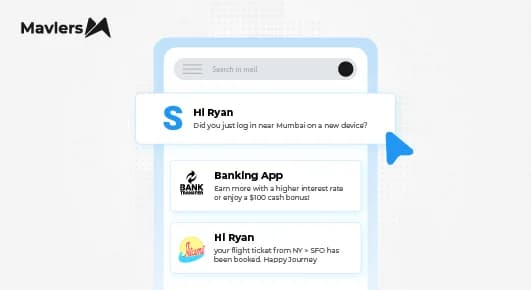
Gmail’s Gemini-powered inbox already summarizes long threads into a few key points, turns emails into reminders, and lets you search your inbox in plain language, something like “what was the quote from that plumber last year?”
Outlook Copilot does something similar. It summarizes threads, drafts replies, and now prioritizes what lands in front of you first.
Here’s the distinction that actually matters for marketers: assistive AI summarizes for a human who still makes the call. Agentic AI goes further: it replies, books, or acts, sometimes without the email ever being opened. Agentic behavior is still early. But it’s directionally clear, and it’s a discipline worth building now, not a fire to fight later.
The sending side already shows where this is headed. Marketing professionals now use generative AI to brainstorm content at least once a week, according to ProGEO.ai’s AI Marketing Maturity Index, and email copy is consistently the most common place they start. If AI is already this embedded on the sending side, the receiving side catching up isn’t a surprise. It’s overdue.
Why your open rate doesn’t mean what you think anymore
Here’s the thing about open rate: it’s been shaky for years, thanks to Apple’s Mail Privacy Protection. AI summaries are finishing the job.
When Gemini or Copilot generates a preview summary, the tracking pixel in your email can still fire, even though nobody actually read the message. Your open rate can hold steady while real engagement, clicks, replies, and actual attention quietly drops. The number stays flattering. The truth doesn’t.
Subject lines and preview text lose their gatekeeping power too. Inbox AI decides what surfaces based on relevance, sender reputation, and behavioral history, not how clever your copywriting is.
So think about it. If your subscriber never truly “opens” the email in any way your ESP can measure, what does your open rate even tell you anymore? Not much.
And here’s the pivot line worth sitting with: if you can no longer out-write the algorithm standing between you and your subscriber, the only lever left is being legible to it.
Email now has two audiences, and one of them reads code, not copy
Most 2026 articles on this topic stop at the same advice: front-load your value proposition so the AI summarizes you correctly. That treats the AI like a lazy human skimmer.
It isn’t one. It’s a parser executing against structured signals. And almost nobody in email marketing is talking about the structural layer sitting underneath the copy.
There’s already a name for this in other corners of tech: Agent Experience, or AX. Forbes describes it as designing your digital presence so an autonomous agent can discover, evaluate, and act on it, such as user experience, but for algorithms instead of humans. AX has mostly lived on websites and in commerce so far. Almost nobody applies it inside the inbox itself. That’s exactly the gap.
Here’s how it works in practice: schema.org markup, embedded directly in your email’s HTML. This isn’t new technology. Gmail and Outlook have used it for years to pull flight confirmations, hotel bookings, and receipts straight into Calendar and quick-action cards. Microsoft’s own developer blog reports that partners who adopted structured email markup saw up to 30% higher engagement. This isn’t a theoretical, SEO-flavored exercise. It already moves a real number.
And the 2026 stakes are getting sharper. The same markup that made a receipt “actionable” now decides whether an AI agent accurately pulls out your promotional offer, price, or deadline, or summarizes it as generic noise, or drops it entirely.
Picture two identical-looking promotional emails. One has clear Offer schema behind it, and an AI agent summarizes it accurately: “20% off, ends Friday.” The other carries the same deal but as a hero banner image with zero underlying markup. It risks getting summarized as vague promotional clutter, or skipped altogether.
Sound familiar? It should. This is the same shift SEO went through with schema markup and rich snippets about a decade ago. Except this time, it’s happening inside a private, opt-in channel that marketers assumed was fully theirs to control.
That’s the tension nobody’s naming out loud. Most brands still build templates for human visual appeal, image-heavy hero banners, tracking-pixel-first construction, minimal semantic HTML, not machine parsing. Those two goals don’t automatically line up. And that’s the design problem the rest of 2026 is going to force marketers to solve.
None of this matters if you never reach the inbox
Before you get excited about markup and AX, here’s a reality check: none of it matters if your email never reaches the inbox in the first place.
Gmail’s 0.3% spam-complaint ceiling went live as a hard rejection threshold, not a friendly suggestion, in November 2025. Outlook, Hotmail, and Live followed with comparable bulk-sender rules back in May 2025, proper authentication, low complaint rates, and one-click unsubscribe.
Here’s how to think about authentication (SPF, DKIM, DMARC, BIMI) going forward: it’s AI-trust infrastructure now, not just spam-filter hygiene. An under-authenticated sender isn’t likely to be trusted enough by an inbox AI to get summarized favorably at all. That’s a new kind of cost for cutting corners.
There’s a second-order effect worth flagging too. As AI agents increasingly manage inbox hygiene on a subscriber’s behalf, poor list quality and irrelevant sends could get filtered out faster, and more permanently, than a human would ever bother to do by hand.
Here is what to actually do about it
You don’t need to overhaul your entire program overnight. A few moves now will put you ahead of most of your competitors, who are still polishing subject lines.
- Audit your templates for schema.org markup. Most brands have none beyond transactional receipts. Extend it deliberately into promotional and event-style sends where it fits.
- Rewrite your preheaders and opening lines to be extracted accurately, not just to charm a human. Assume a summarizer will lift your first two lines, word for word, into someone’s daily digest.
- Cut back on image-only hero banners for anything critical, price, deadline, call to action. Make sure that same information also exists as machine-readable text in the email body.
- Treat sender reputation and authentication as a growth driver, not a one-time IT checklist item. It’s doing more work than it used to.
- Start watching new performance signals as your ESP exposes them: click-to-summary correlation, post-summary conversion, actions taken directly from an AI-agent surface. Don’t anchor solely on open rate anymore. Take your email marketing strategies to the next stage.
- Keep a human in the loop on segmentation, offer strategy, and brand voice, even as tools like Klaviyo and HubSpot Breeze take on more autonomous execution. Match the task to the tool, and don’t automate everything by default just because you can.
Wrapping up
That brings us to the business end of this article, where it’s fair to say that AI inbox agents aren’t killing email. They’re inserting a second, non-human reader between your send and your subscriber, one that decides whether the human ever sees your message at all.
Brands that treat this as a copywriting problem will keep polishing subject lines and wonder why performance is flattening. Brands that treat it as an infrastructure problem, such as markup, authentication, and machine-legible content, will be the ones an AI agent actually trusts enough to surface accurately. Email marketing patterns will keep on shifting.
So ask yourself: is your email program ready for the human inbox and the agentic one?
If you’re not sure, that’s exactly the kind of gap we like digging into. At Mavlers, we help teams audit their email program for readiness on both fronts. Let’s talk.