 Lifecycle marketing
 Customer data management
 Email campaign production
 Search marketing
 CMS development
 Who we are
 How we work
 Case studies
 Testimonials
 Work samples
 Salesforce Marketing Cloud
 Braze
Braze HubSpot
 Marketo
 Pardot
 DataBricks
 Snowflake
 HighTouch
 RudderStack
 Segment by Twilio
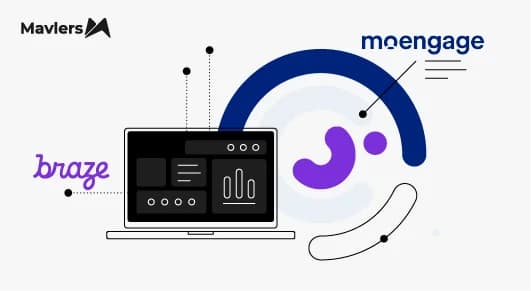
Most CEP decisions start the same way: two or three logos on a shortlist, a comparison spreadsheet, and a quiet pull toward whichever platform is cheaper and faster to get live.
It’s no surprise that Braze vs MoEngage is one of the most-searched CEP comparisons in India and Southeast Asia. Asia-Pacific is the fastest-growing region for customer engagement platforms, with Mordor Intelligence putting regional growth at roughly 11% CAGR through 2031, driven largely by mobile-first buying behavior and more teams evaluating a CEP for the first time.
Pricing and ease of use are reasonable first filters. They just answer the wrong question. They tell you which platform you can start with, not which one you can grow with.
That’s the trap worth naming upfront: the easiest CEP to adopt isn’t always the easiest one to scale. This piece compares Braze and MoEngage across real-time segmentation usability, campaign execution, scalable personalization, data activation, and the operational effort each demands at real volume, not just the sticker price.
Let’s cut to the chase.
Why pricing wins the first round
Most CEP evaluations are marketing-led, not IT-led, especially at mid-market and D2C brands without a dedicated martech engineering team. Price and ease of use become the default filters by necessity; they’re what a marketing lead can judge without pulling in engineering. So, let’s discuss Braze vs MoEngage pricing first.
The numbers make MoEngage look like the obvious starting point. It publishes a free tier for up to 10,000 monthly tracked users and a Standard plan priced around $999/month for the same volume.
Braze publishes no pricing at all. Every quote is custom, and third-party estimates place enterprise contracts anywhere from $60,000 to $200,000+ a year. Treat that range as a directional estimate, not Braze’s actual price list.
G2’s own ratings echo the gap: Braze scores 8.3/10 on Ease of Use against MoEngage’s 9.0, and 7.6 against 8.8 on Ease of Setup. Add MoEngage’s stronger support reputation and deeper regional footprint across India, Southeast Asia, and the Middle East, and it’s easy to see why this comparison over-indexes so heavily in these markets.
Marketer usability and time-to-launch
MoEngage’s reputation is built on getting non-technical marketers live fast, a drag-and-drop journey builder that needs comparatively little engineering support to stand up a first campaign. Braze’s reputation runs the other way.
“Learning Curve” is Braze’s single most-cited complaint on G2, showing up in 159 reviews against just 14 for MoEngage, a real signal about the onboarding curve, not a one-off gripe.
Support quality follows the same pattern: G2 puts MoEngage at 9.0/10 for Quality of Support versus Braze’s 8.5. Both are solid scores, but the gap keeps surfacing across reviews as something users notice day-to-day.
Two teams feel this differently. A 15-person D2C brand launching its first lifecycle email and push program wants a tool that gets out of the way, MoEngage’s pitch. A 200-person enterprise martech team standing up governed, multi-brand campaign operations across regions is optimizing for something else: control and depth, even if it costs a few extra weeks upfront.
Here is another interesting read, about Braze vs Adobe Campaign.
Campaign execution and journey complexity at scale
Braze’s Canvas and MoEngage’s journey builder solve the same problem differently. Canvas is flexible and powerful, but reviewers consistently flag that it gets harder to manage once multiple people are building on the same canvas for a complex journey. MoEngage’s builder leans the other way: segments and journeys map directly to event triggers already sitting in the company database, which keeps things simpler but more prescriptive.
That difference barely matters when a brand is running one welcome flow. It matters enormously once a brand is running forty. G2’s Customer Journey Analytics category makes the scale-up story explicit: MoEngage scores 8.8/10 across 203 reviews against Braze’s 7.4/10 across 120, with Journey Mapping (8.9 vs 7.7) and Journey Reporting (8.8 vs 7.6) telling the same story from different angles.
Picture a regional retail brand running a single welcome journey today. Three years later, if it grows the way it hopes to, that’s the same brand governing 40+ overlapping journeys across five markets and eight channels. “Easy to build one flow” and “easy to govern fifty flows” are not the same claim, and this is where that distinction shows up first.
Personalization and AI: Both platforms are moving fast
Both vendors have poured real investment into AI over the past year, and it’s worth pinning down where each actually stands. MoEngage folded its two AI layers, Sherpa AI for send-time and channel optimization, Merlin AI for content generation, into a single unified Merlin AI suite in late 2025, now covering copywriting, image generation, and natural-language segment building.
Braze has been shipping its own agentic AI stack through BrazeAI, including Decisioning Studio, AI Operator, and Agent Console, aimed at bringing real-time decisioning and content generation directly into a marketer’s workflow.
Let’s discuss some numbers in the Braze vs MoEngage personalization scheme of things.
On usability, G2’s numbers still favor MoEngage: 8.9/10 on Personalization Engines against Braze’s 7.7, with the gap widest on Recommendation Engine (8.6 vs 7.4) and Personalized Discounts (8.7 vs 7.1).
MoEngage’s own published case studies back this up in places; one payments app reported a 21% lift in engagement using Merlin AI’s content optimization, though that’s a single vendor case study, not an independent benchmark. The honest read: MoEngage’s tools tend to work well out of the box, while Braze’s personalization depth, Connected Content, and Catalogs are real but usually need more technical setup before it pays off.
Data activation, integrations, and real-time streaming
This is the section that matters most once a brand has multiple data sources, real-time behavioral triggers like cart abandonment, and an actual data or engineering team to lean on.
Braze’s architecture is built for that world: a streaming backbone using Kafka, Snowflake, MongoDB, and Redis, with Braze Currents and Cloud Data Ingestion enabling near real-time, zero-copy data activation straight from the warehouse. It’s genuinely engineered infrastructure, which is also why it demands more setup.
MoEngage’s pitch is breadth over depth. Its own comparison page claims unified performance dashboards across 10+ channels, against what it describes as Braze’s dashboards being limited largely to email and SMS; worth noting that’s MoEngage’s framing, and it should be weighed alongside Braze’s own architecture documentation. MoEngage also points to native integrations with Shopify, Segment, Twilio, and more than 5,000 Zapier-connected apps.
G2’s integration scores land in MoEngage’s favor again, 8.6 vs 8.1 on Integration APIs, 8.7 vs 7.9 on Data Import & Export Tools, though the gap here is narrower than in journey analytics or personalization, and both platforms clearly treat integrations as core, not an afterthought.
Operational effort and total cost of ownership at scale
Here’s the reframe that matters most: cost isn’t the number on the invoice. It’s the headcount, the engineering hours, and the time-to-launch every new campaign, channel, or market demands.
G2’s reviewer demographics quietly make this point. Braze skews more enterprise, 27.4% of its reviewers versus MoEngage’s 20.6%, while MoEngage over-indexes small business, 23.6% versus Braze’s 16.8%. Source
Each platform’s real-world user base has already self-selected by company scale, long before either vendor says a word about positioning.
Neither platform is standing still. Braze’s “Missing Features” complaint shows up in 149 G2 reviews, but it sits next to a strong Product Direction score of 9.2 (MoEngage: 9.6), both companies are actively closing gaps, and this comparison will look different again in another year.
Picture two brands, three years out. One outgrows MoEngage’s simpler journey builder as it expands from 3 markets to 12. The other never needs Braze’s deeper data architecture, because its complexity ceiling turns out lower than the team expected when they signed the contract.
Matching the platform to your engagement maturity
MoEngage isn’t a lesser Braze. It’s a different fit for a different stage, and plenty of high-growth brands are correctly served by it indefinitely, not as a stepping stone toward something else.
Instead of asking which platform is cheaper, three questions get closer to the real decision: How many concurrent, cross-channel journeys will we realistically be running in 18 months? How much engineering time can we actually dedicate to CEP maintenance and data integration? And how real-time does our data need to be: periodic reporting, or live, event-driven decisioning?
The honest fork: MoEngage suits teams prioritizing speed and marketer autonomy. Braze suits teams anticipating high journey complexity and genuine real-time data needs. Neither answer is wrong; they’re answers to different questions.
Evaluate for where you’re going, not just where you are
Pricing and ease of use are legitimate starting filters; they’re just not finishing ones. Usability, execution, personalization, data activation, and operational effort are what determine whether the platform you pick still works in year three, not just in month three. Braze has its own advantages, and MoEngage has its own.
The real cost of a CEP was never the contract value. It’s what your team spends, in time, in engineering hours, in workarounds, to run customer engagement at scale inside it.
To make an informed decision, you should start with learning if your team really needs support from an expert Braze consultant.
Wrapping up
That brings us to the business end of this article, where it’s fair to say that if you’re weighing this decision, Mavlers works as a Braze partner, helping brands stress-test their CEP choice against their actual growth trajectory, implement Braze the right way the first time, and manage the ongoing campaign operations most teams underestimate.
Talk to us before you sign a multi-year contract with either platform.