Lifecycle marketing
 Customer data management
 Email campaign production
 Search marketing
 CMS development
 Who we are
 How we work
 Case studies
 Testimonials

 Salesforce Marketing Cloud
 Braze
 HubSpot
 Marketo
 Pardot
 DataBricks
 Snowflake
 HighTouch
 RudderStack
 Segment by Twilio
 Videos

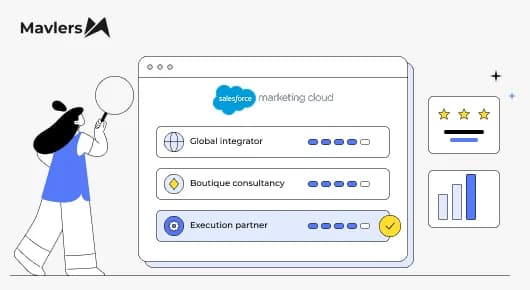
The best Salesforce Marketing Cloud (SFMC) agency for your business depends on what you need help with: strategy, implementation, ongoing execution, or migration.
Global integrators are typically suited to complex, multi-cloud enterprise programs. Boutique consultancies often focus on specialized expertise and strategy-led engagements. Execution partners handle implementation, optimization, and ongoing platform management.
This guide examines what each type of partner brings to the table, which businesses they’re best suited for, and how to evaluate them against a consistent set of criteria.
Mavlers, the publisher of this guide, is one of the options in it.
We’re an SFMC execution and migration partner that builds and runs journeys inside your own Marketing Cloud, with a dedicated team working in your time zone. The Where Mavlers Fits section sets out our evidence against the same scorecard. Let’s get started.
Quick answer: which type of SFMC partner fits you?
Start with the work you’ll hand over most often. The table compares the three options on what each is best for, how it usually engages, and the trade-off to check first.
| Partner type | Best for | Typical engagement | Watch-out |
| Global integrator | Multi-cloud programs across business units and regions | Large, phased program with discovery, architecture and a long delivery roadmap | Small SFMC scopes can get deprioritized inside a larger program |
| Boutique or specialist consultancy | Plans, audits and specialist problems | Fixed-scope project or advisory retainer led by a small senior team | Limited capacity for high-volume ongoing production, so you may still need a build team |
| Execution partner (build and run) | Weekly production, peak capacity and migrations | Retainer or dedicated team inside your own tools | Less suited to enterprise-wide transformation |
What a Salesforce Marketing Cloud agency does
A Salesforce Marketing Cloud agency is a partner that plans, builds, runs or migrates your marketing programs on SFMC. Most agencies are strongest at a couple of these four jobs, so start by working out which one you need.
The four jobs: strategy, build, run, migrate
- Strategy: The agency audits how you use SFMC, maps the customer lifecycle and designs the data model and journeys you should have.
- Build: The agency implements the platform, from account setup, sender authentication, Data Extensions to integrations with your CRM, and the first set of journeys and templates.
- Run: The agency operates the platform week to week: campaign production, journey updates, segmentation, testing, reporting and admin.
- Migrate: The agency moves you onto SFMC from another platform, off SFMC to another platform, or between Salesforce products, without losing data, consent or sending reputation.
See Marketing Cloud migration for details on how we do migration.
Marketing Cloud partner or Sales Cloud partner?
Choose a partner on its Marketing Cloud delivery evidence, not just its overall Salesforce partner status. A firm can be strong in Sales Cloud and still have a thin Marketing Cloud bench, because the two products need different skills. Ask for SFMC-specific proof before you sign, whatever the firm’s tier or size.
Sales Cloud work is mostly CRM configuration involving objects, fields, page layouts, sales processes, approval flows and Apex.
Marketing Cloud work is different. It involves building journeys in Journey Builder, writing AMPscript for dynamic content, querying data with SQL in Automation Studio, structuring Data Extensions, and managing deliverability and sender reputation.
A certified Sales Cloud consultant may never have done any of these.
The gap matters at the handoff between the two clouds: syncing leads, contacts and events from your CRM into Marketing Cloud, and back again. A partner who knows only one side tends to treat the other side as out of scope.
Three checks to run on any partner
- SFMC-specific experience: Is Marketing Cloud, not Sales Cloud, at the center of the work they show you?
- Certified SFMC people on your actual team: Do the people assigned to you hold current Marketing Cloud credentials?
- A named delivery team: Will the same people do the work after you sign, or will it go to a shared pool?
The three types of SFMC partners
SFMC partners fall into three types: global integrators, boutique and specialist consultancies, and execution partners. They differ in what they do best, how they engage and who they suit.
1. Global integrators
What they do best: Global integrators run large transformation programs where Marketing Cloud is one workstream among several: Sales Cloud, Service Cloud, data platforms, ERP and wider IT. They bring program management, security reviews, change management and the ability to staff many workstreams at once.
How they usually engage: Work runs through steering committees, statements of work and formal change control, so decisions take longer.
Who they suit: Enterprises whose Marketing Cloud decisions depend on other Salesforce clouds or IT systems.
Watch-out: Once the program launches, day-to-day SFMC work can be left with nobody clearly owning it.
2. Boutique and specialist consultancies
What they do best: Boutiques bring deep, senior expertise in a narrow area: lifecycle strategy, data and journey architecture, platform audits, or a specialism such as loyalty programs or B2B nurture.
How they usually engage: The senior consultants who scope the work usually stay on it to the end, which is much of the value.
Who they suit: Brands that know SFMC is underused and want a clear plan, or that have a specific problem their own team can’t solve.
Watch-out: A short engagement can end before results show. Agree up front what success looks like and when you’ll measure it.
3. Execution partners (build and run)
What they do best: Execution partners handle the production work such as campaign and journey production, AMPscript and SQL work, template builds, testing, admin and migrations. They act as an extension of your marketing team.
How they usually engage: They join your ticketing tools and communication channels, with working hours that overlap yours.
Who they suit: Brands with a steady flow of campaigns, a journey backlog or seasonal peaks.
Watch-out: Not every execution partner brings strategy. Check whether you’ll get proactive recommendations or just tickets closed, and whether the team is SFMC-specific or a general email production shop.
Decide whether you want knowledge transfer. Some teams want the partner to own the platform. Others want their own staff to run it eventually. Say which one you want at the start, because it changes how the partner documents its work and how much your team is involved along the way.
Who fits whom: SFMC partner by industry
Your industry shapes who you should hire and what to weigh when you score them. Find your row before you score your shortlist; company size is covered next.
| Industry | Typical need | Best fit | Weight most on the scorecard | Watch-out |
| Retail and ecommerce | High-volume promotions, abandonment and browse journeys, product-data personalization, peak-season capacity | Execution partner, with specialist input on loyalty and data design | SFMC-specific experience; engagement models (scale for peaks); time-zone coverage | Agencies that can’t build product-driven dynamic content in AMPscript or SQL |
| B2B | Lead nurture and scoring, sales handoff, SFMC or Account Engagement alongside a CRM | Boutique or specialist consultancy; a global integrator if it’s tied to a larger CRM rollout; or an execution partner for ongoing nurture builds | Platform-agnostic advice; SFMC-specific experience that includes CRM integration | Partners that can’t explain how scores and sales handoff will sync with your CRM |
| Financial services | Onboarding and cross-sell journeys, renewal reminders, regulated copy approvals, consent and data security | Execution partner with a documented approval process; a global integrator if it’s part of a wider Financial Services Cloud program | SFMC-specific experience; certified bench | Partners with no written review and sign-off step for regulated content |
Want a second opinion on your row? Book an SFMC audit or specialist call, and we’ll tell you what kind of help your setup needs.
Enterprise vs mid-market: how the choice changes
Company size influences the kind of Salesforce Marketing Cloud partner you need. The differences come down to four areas: governance, speed, in-house capabilities, and the complexity of your Salesforce ecosystem.
Enterprise: Look for scale and specialist depth
- Governance: Multiple brands, business units, and regions may involve formal procurement, security reviews, and change-control processes.
- Speed and budget: Longer implementation timelines are acceptable when the architecture supports long-term growth. Budgets are typically allocated per program.
- In-house team: A dedicated platform owner, admins, and developers may already be in place. The partner should bring additional capacity and specialist expertise.
- Salesforce ecosystem: Marketing Cloud often connects with CRM, Service Cloud, and enterprise data platforms.
- Best-fit partner: A global integrator for architecture and program management, supported by an execution partner for ongoing delivery.
- What to prioritize: Certified bench and SFMC-specific experience at comparable scale.
- Watch out for: Regional consent and data-governance requirements that aren’t accounted for in journey design.
Mid-market: Look for speed and hands-on execution
- Governance: Usually one brand or a handful of business units, with fewer approval layers and faster decisions.
- Speed and budget: Results are expected within a quarter. Extended discovery phases can consume budgets without delivering tangible outcomes.
- In-house team: Often one or two marketers managing SFMC alongside other channels. The partner needs to provide hands-on support.
- Salesforce ecosystem: Typically one CRM and a smaller number of data sources, with less complex integrations.
- Best-fit partner: An execution partner or boutique that can work as an extension of the internal team.
- What to prioritize: Engagement models, certified bench and time-zone coverage.
- Watch out for: Overly elaborate discovery and consulting engagements that delay implementation.
How to evaluate any SFMC agency: the scorecard
Score each partner from 1 to 5 on the six criteria below.
| Criterion | What to ask for | Strong signal | Red flag |
| SFMC-specific experience | Two or three clients where SFMC was the main platform, with scope and duration | Named or described programs of similar size to yours, running for a year or more | References that are really Sales Cloud or general Salesforce work |
| Certified bench | Names and current Marketing Cloud credentials of the people who would work on your account | Certified admins, developers and consultants on the actual team, with a count you can verify | A firm-wide certification total with no names |
| Platform-agnostic advice | A scenario where they advised against SFMC, or for a different tool | They discuss SFMC next to Braze, Marketo, HubSpot or Klaviyo and explain when each fits | Every question ends in “buy more Salesforce” |
| Time-zone coverage | Support hours, overlap with your team, and who covers leave | Defined overlap hours and a named backup | A single offshore time slot and no coverage plan |
| Engagement models | Project, retainer and dedicated-team options, with notice periods | Flexible scale up or down without a long lock-in | Only one model, or a multi-year minimum |
| Marketing Cloud Next readiness | How they’d assess a move from Marketing Cloud Engagement to Marketing Cloud Next, what carries over and what gets rebuilt, and what Agentforce would change for your team | A specific readiness view of your setup: what carries over, what changes with Data 360, which agents your edition includes, and a recommended timing, including “not yet” if that’s the honest answer. | A push to move now with no look at your setup, or vague answers on what changes and which editions or add-ons you’d need |
How to score it
- Score each criterion from 1 (red flag) to 5 (strong signal).
- Double the scores for the criteria listed for your industry and company size.
- Add the scores. Anything that scored 1 on any criterion is a reason to ask more questions before you go further, whatever the total.
Engagement models: project, retainer or dedicated team
SFMC agencies usually work on one of three models:
- Project: A fixed scope, timeline and deliverable: an implementation, a migration, an audit or a journey build. It fits when you know exactly what you need. Watch for change requests: anything outside the agreed scope is usually billed on top, so cost rises with every addition.
- Retainer: A set number of hours or deliverables each month for ongoing production, admin and optimization. It fits regular campaign work. Watch for unused hours that don’t roll over, and for retainers that quietly turn into a ticket queue with no proactive input.
- Dedicated team: One or more dedicated SFMC specialists assigned to your account full-time or part-time, working in your tools and hours. It fits high volumes or a long backlog. Watch notice periods and how quickly you can scale the team down.
Consider a separate fixed-price or capped discovery engagement that ends in written requirements. You’ll find out how the partner thinks before committing to a build, and you can use the document to compare quotes. Be wary of a fixed build price offered after a short call. It often means the gaps get billed later as change requests.
Where Mavlers fits
Here’s how Mavlers measures up against the key criteria for choosing an SFMC partner.
1. SFMC-specific experience
SFMC is a core practice at Mavlers, backed by 15 years of client relationships and hands-on platform experience:
- Our experience: 100+ Salesforce Marketing Cloud projects delivered.
- Clients: Acima, Staypineapple, Wests Group, Innovative Capital, Wisdom Tree, DodgeMiami, and Palmerbet. Explore our SFMC case studies.
- Integration: We connect Marketing Cloud with CRM and other data sources to support reliable data flows and coordinated customer communications.
- Quality checks: SPF, DKIM and DMARC configuration, seed-list testing and campaign QA, and client sign-off before deployment.
2. Certified bench
We maintain a dedicated bench of SFMC specialists who can join projects without lengthy ramp-up periods.
- Our capacity: 70+ SFMC specialists.
- Typical onboarding: Around five days to onboard a team to a new account.
3. Platform-agnostic advice
We work across marketing automation platforms and recommend the technology that best fits a client’s requirements, even when that means moving away from SFMC.
- Our experience: Support across 50+ platforms.
- Client: Migrated Weight Watchers from SFMC to Braze.
4. Time-zone coverage
Our delivery model accommodates clients across different regions, with support aligned to their working hours.
- Coverage: 24×5 support.
- Delivery model: Teams based in India and the US, with client-facing contacts across the US, UK, and Australia. We work in your time zone.
5. Engagement models
Clients can choose an engagement structure based on their delivery requirements and scale the team as those needs change:
- Available models: Project-based delivery, retainers, or dedicated teams.
- Flexibility: No long-term contracts, with the option to resize teams as requirements evolve. View our engagement models here.
6. Marketing Cloud Next readiness
With certified Marketing Cloud Next consultants on our team, we will help you decide whether and when a move to Marketing Cloud Next makes sense, what carries over from Marketing Cloud Engagement, and what Agentforce would change for their team.
Mavlers is ISO 27001 certified, so the client data we work with is handled under an independently audited information security management system.
Who Mavlers is best suited for
- Retail and ecommerce brands with high email volumes
- B2B teams connecting SFMC with their CRM and sales processes
- Mid-market businesses looking for hands-on implementation and ongoing support
- Enterprise teams that need additional SFMC execution capacity alongside a global integrator
For more information, go to our listing on AgentExchange.
Where Mavlers may not be the right fit
Mavlers is not positioned to lead large-scale, multi-cloud transformation programs spanning ERP, cloud infrastructure, and wider enterprise IT. These initiatives are better led by a global integrator, with an execution partner brought in for marketing-specific implementation and execution.
Find the right SFMC partner for your setup
If you’d like an outside view of your Marketing Cloud setup before you shortlist, book an SFMC audit or specialist call. We’ll look at how your Marketing Cloud is set up today, where the gaps are, etc. You’ll come away with a clear view of the partner type that fits, and you can take that view to any partner on your list.
If a global integrator or a boutique would serve you better, we’ll say so and explain why. If the honest answer is that your team can handle it in-house, we’ll tell you that too.