Lifecycle marketing
 Customer data management
 Email campaign production
 Search marketing
 CMS development
 Who we are
 How we work
 Case studies
 Testimonials

 Salesforce Marketing Cloud
 Braze
 HubSpot
 Marketo
 Pardot
 DataBricks
 Snowflake
 HighTouch
 RudderStack
 Segment by Twilio
 Videos
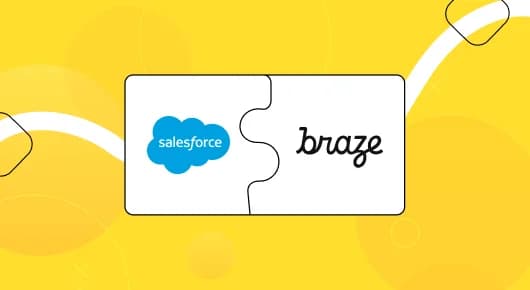
In June 2013, Salesforce agreed to pay about $2.5 billion for ExactTarget, a platform used by more than 6,000 companies at the time, whose flagship product was later renamed Salesforce Marketing Cloud. On October 20, 2026, it agreed to acquire Braze for approximately $5.66 billion in enterprise value. Braze serves approximately 2,770 customers.
In headline terms, that’s more than twice the price for fewer than half the customers. The dollars sit 13 years apart, and the two companies count customers differently, so this isn’t a precise comparison. But the gap is wide enough to tell you something. This is not a price for reach.
The deal is still pending. Braze shareholders will receive $47.50 in cash per share, and the transaction is expected to close in Salesforce’s and Braze’s fiscal year 2028 (beginning February 1, 2027), subject to approval by Braze shareholders and required regulatory approvals. And the stock prices have more than doubled since the announcement.
Most of the early conversation around the Salesforce Braze acquisition has focused on Salesforce’s side of the table: Marketing Cloud overlap, roadmap, pricing. If you run Braze, there’s a more useful question to ask.
Our view is this. Salesforce is paying for the ability to make decisions on live customer behavior in real time. And Braze customers already own the most important piece of that: the decision layer they built themselves.
What the price tag is actually pricing in
In the ExactTarget era, the hard problem was delivery. Getting personalized messages out at volume across email, then mobile and social, was what enterprise marketing needed, and value tracked closely with the scale of sending. That model made complete sense for its time, and it’s a big part of why so many enterprises still build on Marketing Cloud today.
Salesforce’s own announcement describes a different problem. It says AI is raising the bar for marketers, who now need agentic solutions that can understand customers, make decisions, and act in real time. It then points to Braze’s event streaming architecture, which turns live customer signals and warehouse data into personalized messages and coordinated journeys, and its AI decisioning, which helps marketers optimize content, offers, channels, and timing.
The timing of Braze’s own launches makes the point sharper. At Forge in late September, Braze announced Decisioning Studio Go, a self-service offering that gives marketers access to AI decisioning agents. Braze says a single agent can test more than one billion combinations simultaneously, and general availability was expected on October 14, 2026, less than a week before the deal. At the same event, Braze introduced Operator Connect (still in beta), which puts Braze intelligence inside Claude, ChatGPT, and Microsoft Copilot. (If you’re still sorting out how these tools fit together, we broke it down in Operator vs Agent Console vs Decisioning Studio.)
The scale underneath is real too. According to cofounder and CTO Jon Hyman, Braze engages 9 billion monthly active users across its customers, and last year the platform sent about 4.5 trillion messages and other actions.
Put those together, and the shift becomes clear, at least to us. Value has moved from “can we send it” to “should we send this, to this person, right now.”
Why “wait and see” is the wrong instinct
The uncertainty is real, and Braze hasn’t pretended otherwise. Its letter to customers says existing contracts continue as is and account teams stay the same (until the deal closes). On how Braze will fit into Salesforce’s architecture, Braze describes these as possibilities, with no decisions made yet.
So the natural reflex for a lifecycle team is to wait. And here’s what waiting usually looks like inside a business. Budget owners defer anything platform-related. The decisioning pilot that was due this quarter gets parked “until we know more.” Documentation slides further down the backlog. And somewhere along the way, the one person who knows why a Canvas branches the way it does moves to another team or another company.
The window isn’t short, either. Close is expected sometime between February 2027 and January 2028. That’s potentially more than a year of decisioning maturity on hold, and that maturity is valuable under any roadmap.
The stakes are going up as well. On the day of the announcement, Braze CEO Bill Magnuson wrote that customer engagement keeps expanding, drawing in more teams and commanding increased strategic importance inside every business. The more teams that touch your journeys, the riskier undocumented decision logic becomes.
To be fair, some caution is sensible. A long renewal or a big new module purchase deserves a pause until things are clearer. The argument here isn’t against prudence. It’s against freezing the work that pays off whatever happens next.
Your decision layer is the asset
Magnuson framed the announcement around a belief Braze has held since the beginning: that “marketers and their creativity are a brand’s ultimate competitive advantage.” We agree, and it’s worth following that idea to its practical end. If the advantage is what marketers create, then the asset isn’t just the platform. It’s the decision logic marketers have built on top of it.
In Braze terms, that decision layer is very specific. It’s your event taxonomy and custom attributes. It’s the entry, exit, and branching logic inside your Canvases. It’s your frequency caps and suppression rules, the objectives and guardrails you give a decisioning agent, and the data moving out through Currents and in through Cloud Data Ingestion. Braze provides the engine. Your team builds how that engine decides for your business.
That holds under every scenario. Whether Braze keeps running as it does today, sits alongside Marketing Cloud, or connects more deeply into Data 360 and Agentforce, someone will need to understand and connect this logic. Logic that lives only in people’s heads is the hardest thing to carry into any next step.
The partners have made this easier to plan for. Salesforce and Braze say they share a commitment to an open, composable approach that gives customers flexibility across the data, tools, and partners they rely on. Magnuson repeated it directly to customers: Braze remains committed to that approach so customers can keep building on the data, tools, and partners they use today. Braze brings the real-time architecture Salesforce valued; Salesforce brings CRM context, Data 360, and reach. Customers get the most from that commitment when their own architecture is designed for it.
We’ve made a similar point before about decisioning itself. In our guide on how to kick off with BrazeAI Decisioning Studio, we noted that Decisioning Studio doesn’t work out of the box; it works best with a well-defined objective, and ongoing stewardship is key. The same is true of real-time intent journeys in Braze, where predictions are stored and pushed back into Braze as a custom attribute to drive Canvas decisions. In both cases, the platform does the work, but the judgment built into the setup is yours.
What lifecycle leaders should do before close
None of this needs a new budget line. It needs focus. Here’s where we’d start.
- Write it down. Inventory your live Canvases: what triggers each one, what every branch decides, and why. Begin with the journeys that drive the most revenue. One lifecycle ops owner working over a few weeks can cover a lot of ground.
- Keep behavioral data portable. Where practical, make sure key behavioral data also lives in your warehouse, for example by using Braze Currents to stream real-time user events into Snowflake. How far you take this depends on your data maturity and whether a warehouse is already in place. If you’re not sure where you stand, these 7 signs your Braze strategy needs an upgrade are a good gut check.
- Keep piloting decisioning. Run one pilot with a clear objective, such as Decisioning Studio Go on a single email program. What you learn about objectives, guardrails, and measurement compounds, regardless of what sits above Braze later.
- If you run both platforms, map overlap by use case and channel, not by product name. That way, you can judge any combined offer against what your teams actually need.
Looking further out, we expect buyers may increasingly judge engagement platforms on the quality of their decisions and the portability of their data, rather than on channel count. That may take a while to show up in RFPs, but this deal points in that direction.
At Mavlers, we work inside both the Braze and Salesforce partner ecosystems, and much of our work is helping teams audit and document exactly this decision layer so they get more from both. If that’s useful, our Braze team is happy to take a look.
The price of a decision
Salesforce has now put a public price on real-time decisioning. Every Braze team already has a version of that capability running today, in its Canvases, its attributes, and its decisioning objectives.
The deal put a price on real-time decisions. The question for every Braze team is simpler: could you explain yours?