 Lifecycle marketing
 Customer data management
 Email campaign production
 Search marketing
 CMS development
 Who we are
 How we work
 Case studies
 Testimonials
 Salesforce Marketing Cloud
 Braze
Braze HubSpot
 Marketo
 Pardot
 DataBricks
 Snowflake
 HighTouch
 RudderStack
 Segment by Twilio
 Videos
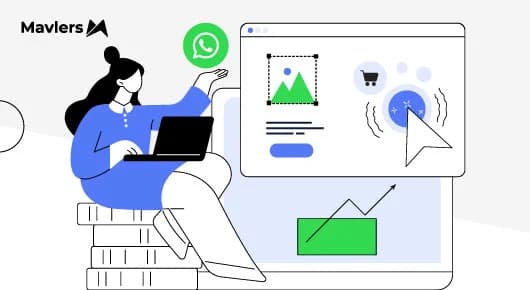
Fellow marketers and e-commerce enthusiasts, pause everything that you are doing and put yourself in the shoes of a shopaholic scroller casually bingeing on their feed, and they suddenly pause on your ad.
They like the product and are curious.
But they’re not quite ready to buy at the moment.
So they do what most online shoppers instinctively do before making a purchase, which is to ask a question. A few probable ones off the bat could be;
“Is this available in size 9?”
“How long does delivery take?”
“Do you ship internationally?”
“Is this authentic?”
If your ad sends them to a website, the experience might end up becoming friction-heavy.
They might scroll through product pages, search for answers, hesitate, and, more often than not, they tend to leave.
But if that same ad opens a WhatsApp conversation with your brand, something fundamentally different happens.
Instead of navigating a website, the shopper simply asks their question.
A conversation begins.
That conversation can quickly build trust, and trust is what ultimately converts curiosity into a purchase.
For many DTC brands, Shopify store owners, and e-commerce marketing managers, rising acquisition costs have made this approach increasingly attractive.
This is why WhatsApp ads for ecommerce are becoming an important tool in the modern marketing stack.
In this guide, with our 14+ years of experience and expertise in the paid search sphere, we’ll talk about:
How WhatsApp ads work
How to create a WhatsApp ads conversion strategy
When conversational commerce works best
and what marketers are really saying about using WhatsApp as a sales channel.
Understanding why e-commerce is moving toward conversations
Over the past few years, there have been certain changes in the undercurrents of online shopping.
Consumers or prospective browsers usually don’t make the decision to trust a new brand instantly, and rightly so.
Now this is exactly where click-to-WhatsApp ads e-commerce strategies pose a meaningful alternative to the lack of a personal touch on websites.
Instead of pushing customers down into a checkout funnel, brands instead invite them into an open one-on-one conversation.
And conversations are known to naturally build trust.
But first, what are WhatsApp Ads?!
When marketers quote WhatsApp ads, more often than not, they are usually referring to Click-to-WhatsApp Ads (CTWA).
Now, these ads are created inside Meta Ads Manager and may appear across several Meta platforms. This may include Facebook, Instagram feed, Instagram Stories, Facebook Marketplace, and other supported Meta placements.
The key difference here to be noted is the call-to-action.
Instead of sending users over to your website, the ad opens up a WhatsApp chat with your business.
Some CTAs could be “Chat with us,” “Message us,” or “Ask about this product.”
Now, this introduces a change in the traditional e-commerce funnel, which earlier resembled something like Ad → Website → Product Page → Checkout.
On the other hand, a conversational funnel on this platform looks like Ad → Chat → Questions → Trust → Purchase.
And that very shift forms the foundation of a modern WhatsApp ads conversion strategy. On that note, we recommend reading ~ 7 Platforms for SMS+WhatsApp+InApp Messaging for E-Commerce Brands.
What do WhatsApp ads look like?
From the customer’s perspective, these ads look pretty similar to regular Facebook or Instagram ads. As reiterated earlier, the only visible difference is the CTA button.
For instance, in a standard e-commerce ad, the CTA might look like “Shop Now,” whereas in a Click-to-WhatsApp ad (CTWA), it might be “Chat on WhatsApp.”
When clicked, WhatsApp opens with a pre-filled greeting.
This small design change lowers friction and encourages interaction.
Understanding how WhatsApp ads work (The 72-hour conversation window)
One of the most important mechanics behind Click-to-WhatsApp ads is the Free Entry Point conversation window.
Let’s understand how that works.
When a user clicks a Click-to-WhatsApp ad and sends the first message, the business must respond within a span of 24 hours.
Once the business replies, a 72-hour Free Entry Point conversation window begins, during which WhatsApp conversation charges are waived (although the ad click itself still costs money through Meta).
An important caveat is that during this 72-hour Free Entry Point window, template messages can be sent without messaging charges.
Also, at the same time, free-form replies are still subject to the 24-hour customer service messaging rule.
Why e-commerce brands are resorting to deploying WhatsApp ads
Nowadays, many brands are experimenting with WhatsApp ads for store growth and for several practical reasons.
1. “Talk to buy” builds trust faster
When brands replace “Buy Now” with “Chat with us,” the experience feels less transactional, as customers feel comfortable asking questions before committing to a purchase.
This works particularly well for higher-priced products, fashion items with sizing concerns, and new brands still building trust.
Instead of forcing a purchase decision immediately, the brand opens a conversation, and conversations often lead to better-informed buyers.
2. Conversations can reduce acquisition costs
Many advertisers observe that conversation-based campaigns often generate a lower cost-per-lead compared to direct purchase campaigns.
Now this happens because the campaign objective focuses on starting conversations rather than completing purchases.
However, the actual sale still depends on how effectively the brand manages the chat interaction.
3. Customers already spend time in messaging apps
Messaging apps are among the most frequently used applications on mobile devices.
WhatsApp alone has well over three billion users globally, and that makes it one of the largest messaging platforms in the world.
Because people check messaging apps regularly throughout the day, messages sent through WhatsApp often receive faster responses than emails or contact forms.
4. Instant answers reduce buying friction
So, many e-commerce questions can be repetitive, such as “Is this in stock?” “Do you ship internationally?” or “How long does delivery take?”
Now, automated responses or chatbots can answer these questions instantly.
This allows businesses to offer 24/7 support, even with limited customer service resources.
5. Product catalogs can be shared inside WhatsApp
Another useful feature for e-commerce brands is product catalog sharing.
WhatsApp Business (both the app and the Business Platform/API) allows businesses to create product catalogs that one can share directly inside chats.
Customers may then browse product images, view pricing, explore different items, and ask questions about specific products.
For many shoppers, this might come across as being similar to browsing with the help of a personal shopping assistant.
Insight into a practical WhatsApp ads conversion strategy
So, executing WhatsApp ads effectively requires more than simply launching a campaign.
Below is a practical workflow many e-commerce teams use.
Step 1: Launch Click-to-WhatsApp ads
Start with audiences such as website visitors, product viewers, engaged social followers, and returning customers.
Here’s an example of ad copy that you might want to use ~ “Not sure about sizing? Chat with us before ordering.”
Step 2: Use automated greeting messages
An automated greeting may help start the conversation. For example, “Hi! Thanks for messaging us. How may we help you today?”
You can proceed to guide customers with options like product questions, delivery information, or order tracking.
This helps move conversations quickly toward the right outcome
Step 3: Share product recommendations
If a customer asks about a category, you can share relevant products.
For example, “Here are our best-selling running shoes. Let us know if you’d like help choosing the right size.”
This keeps the shopping experience a lot more conversational rather than merely transactional.
Step 4: Follow up within the conversation window
If a customer shows interest but doesn’t make the purchase immediately, a gentle nudge or follow-up message may help.
For instance, “Just checking if you had any questions about the shoes we shared earlier. We are happy to help.”
Follow-ups are most effective when they remain helpful rather than promotional.
Step 5: Recover abandoned carts
Some e-commerce brands use WhatsApp to recover abandoned carts; however, this must be done carefully.
Businesses may send abandoned cart reminders through WhatsApp if customers have explicitly opted in to receive messages and the communication stays true to WhatsApp Business messaging policies.
Respecting and complying with these rules is important to avoid account restrictions.
Unveiling real marketer sentiments about WhatsApp ads
So, many marketers discussing WhatsApp advertising online tend to express both a mix of excitement and caution.
Many appreciate the direct interaction with customers that WhatsApp enables.
They report benefits such as:
~ quicker responses to customer questions
~ higher engagement compared to forms
~ better insight into buyer objections.
However, some advertisers also highlight some challenges.
In online marketing communities, some marketers mention that Meta sometimes includes messaging placements automatically in campaign setups, which can send traffic to chats instead of websites.
Others note that WhatsApp Business accounts may face restrictions if they violate messaging policies.
These experiences reinforce a simple lesson that WhatsApp works best when used for genuine customer conversations, not mass promotional messaging.
Delving into privacy considerations
Privacy is a super important part of WhatsApp’s platform design.
Personal messages on WhatsApp remain end-to-end encrypted, meaning their contents cannot be viewed by Meta or advertisers.
Also, advertising does not rely on the content of private messages; instead, targeting uses broader signals such as engagement behavior, location, or language settings.
Meta has introduced advertising in WhatsApp’s Updates tab, specifically within Status and Channels, while personal chats, messages, and calls remain end-to-end encrypted and ad-free.
For businesses, consistently maintaining user trust remains essential when using messaging as a sales channel.
Deciphering when WhatsApp works best for e-commerce and when it might not be the right fit
So, these campaigns may turn out to be quite effective for fashion and apparel brands, electronics or technical products, luxury or high-consideration items, customized or made-to-order products, as well as new brands building trust.
In these cases, shoppers often need reassurance before purchasing.
However, they might be less effective when products are low-cost impulse purchases, your website checkout already converts extremely well, and your team cannot respond to conversations quickly.
Conversations require timely replies.
Without responses, leads may lose interest.
The road ahead
Wondering how to optimize your AI search ad campaigns? We recommend reading ~ Why AI Search Ads require PPC advertisers to bid on long-tail, question-based phrases.