 Lifecycle marketing
 Customer data management
 Email campaign production
 Search marketing
 CMS development
 Who we are
 How we work
 Case studies
 Testimonials
 Salesforce Marketing Cloud
 Braze
Braze HubSpot
 Marketo
 Pardot
 DataBricks
 Snowflake
 HighTouch
 RudderStack
 Segment by Twilio
 Videos
AI search ads mark a fundamental restructuring in the PPC funnel. Sign that paid ads are becoming part of a conversation, not just a list of links. Indication that there is a pivot from keyword-centric search to intent-driven “answer engines”.
AI is also expanding what search can do. For instance, AI Overviews and Google’s AI-led campaign types, such as Performance Max, have started showing Search and Shopping ads.
That’s great news for advertisers. They now have more surface and opportunities to get in front of their customers.
However, AI search ads systems are meant to capture more searches and even stronger signals of intent that Google uses to connect highly qualified users with the most helpful ads. Instead of relying solely on keyword triggers, these systems analyse user behaviour, context, and conversational queries to place Search and Shopping ads directly within AI-generated responses.
So when a user searches, “How do I manage inventory for a small retail store without hiring more staff?”, they might see a quick AI-generated workflow guide alongside an ad for an inventory management platform that fits that exact use case.
In such discovery-led moments, broad match keywords and Google’s AI-powered targeting solutions, Smart Bidding helps. They connect ad campaigns to long-tail, natural language searches that reflect underlying goals rather than isolated terms. This is beneficial for your ad relevance and click-through rates, as searchers are likelier to click on ads that are most relevant to their search intent.
As a result, when ads begin appearing within AI-guided responses to complex queries, advertisers can engage users earlier in their decision journeys with the most relevant solutions they’re seeking.
Moreover, targeting long-tail keywords also gives advertisers ample opportunity to optimize for local and voice search, wherein the search queries are significantly longer than text search.
If you’re the kind of PPC advertiser who relies only on tightly controlled manual keyword match campaigns, you’re bound to miss out on a lot of exposure in AI search ads.
This blog explores how bidding on long-tail, question-based phrases can help PPC advertisers tap into these high-intent moments and drive stronger returns from AI search ads.
Dig deeper: Optimizing ads for voice search: Unveiling the future of PPC in a voice-driven world
Why long-tail, conversational phrases that mimic human dialogue are a staple for AI search ads
People often misunderstand long-tail keywords for queries that are longer in word count. That’s not true.
In reality, what defines long-tail keyphrases is specificity and niche intent.
Case in point: a search term like “email marketing platform”. Short? Yes. But it’s broad and exploratory, too.
Now have a look at this search term—“What’s the best email platform for sending interactive newsletters without coding?” This one reflects a clearly defined search requirement, even if it’s phrased conversationally. In short, it’s a specific, long-tail, conversational keyword with high-intent.
But why are “long-tail keywords” named that way?
It’s their position on the search demand curve, as shown below, that gives them that name.
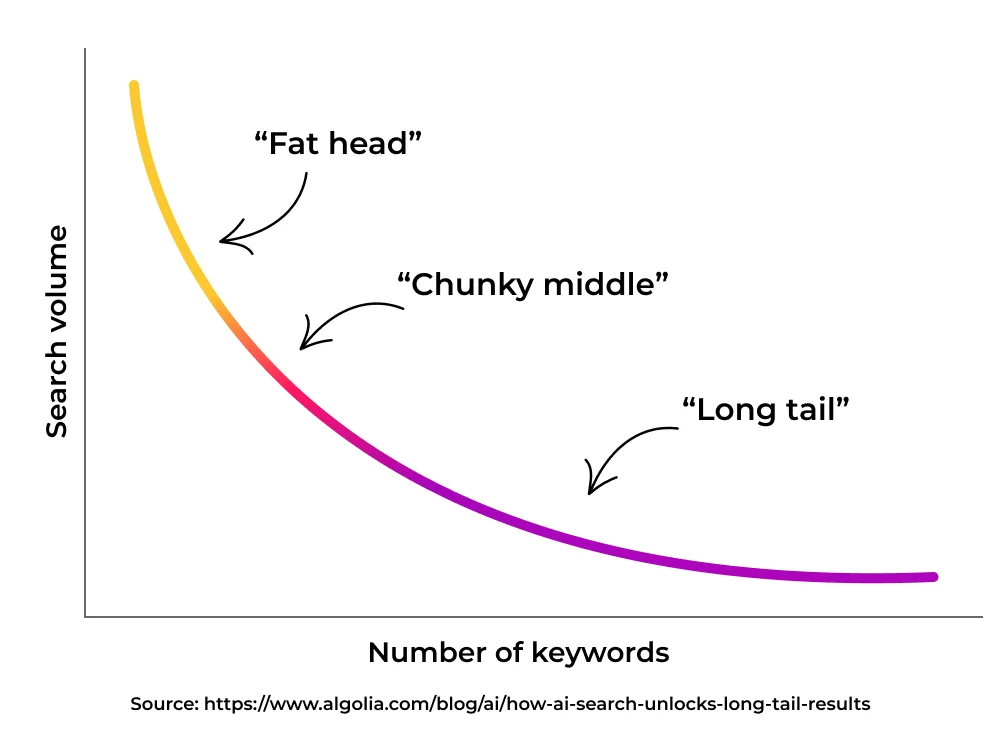
The search demand curve visually represents how search volume decreases as search queries become more specific. Which means, a small cluster of high-volume keywords sits at the “head”. And millions of low-volume, highly specific queries form the “tail.”
Historically, advertisers ignored long-tail keywords in PPC because ROI was difficult to track and search volume seemed negligible.
However, the rise of conversational search advertising has inverted this logic. That’s because:
- Generative AI search ad systems are built to interpret prompts and accommodate evolving conversational search behaviour.
- AI searches mostly type or speak full questions in ways that reflect their goals, constraints, or use cases. For instance, now it’s often “How can I prioritise inbound leads automatically without hiring more SDRs?” instead of “lead scoring tool”.
- These conversational queries carry layered intent, which also leads to follow-up questions. AI search ads systems can interpret and translate them into structured searches to surface relevant responses—and ads.
That’s the reason long-tail, natural language phrases become indispensable for intent-based PPC targeting.
Unlike head terms that dominate impression volume but carry mixed intent, long-tail queries represent users who are already problem-aware and actively evaluating solutions.
For instance, a SaaS company bidding on “workflow automation software” is competing in a crowded, expensive space. But a query like “How to automate invoice approvals for a remote finance team?” signals a far more immediate and actionable need. An ad copy that delivers an answer in that context earns engagement because it mirrors the user’s immediate objective behind the search and guides them through their journey.
In short, long-tail phrases are the staple of 2026 PPC management because they mirror how humans actually communicate. By capturing the “untapped intent” within these conversational queries, advertisers can design AI search ad messaging with real-world queries that signal readiness to act.
What Dr. Pete Meyers, a Marketing Scientist at Moz, says is even more relevant here. He argues that the most profitable queries are too unique to be tracked consistently, but they have high intent to take action.
AI-driven search systems excel at answering these questions, making it urgent to create ads that solve specific user problems rather than just targeting high-volume “trophy” keywords.
Also read:
How to mine long-tail conversational phrases for AI search ads
Finding long-tail keywords for conversational search advertising doesn’t start with a keyword tool. It starts with language.
More specifically, the natural language your users use when they’re describing a problem, not when they’re trying to search efficiently.
In AI-driven environments, users no longer compress their thoughts into one- or two-word queries. They explain. Qualify. Ask. And those full-sentence prompts become the basis for how AI systems retrieve and match ads to intent.
So, we would suggest that advertisers step up their keyword research approach and, instead of looking for keywords in isolation, observe where these natural-language problem statements surface across the user journey.
What are your sources for long-tail, conversational queries
1) Search query reports (Google Ads / Microsoft Advertising)
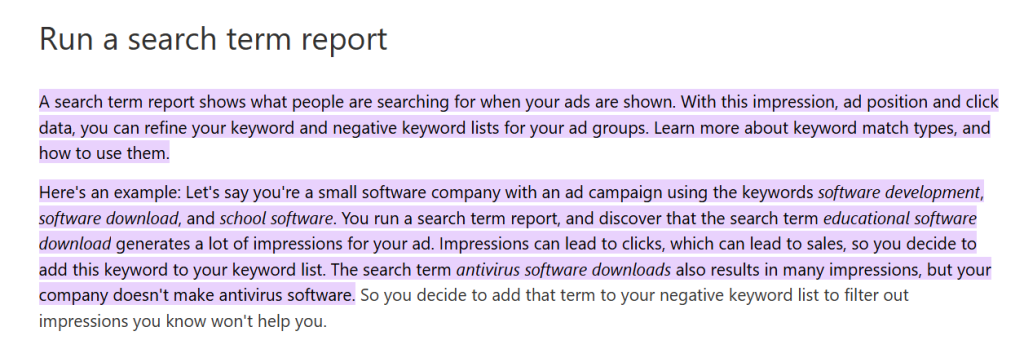
Your own paid search data is a good starting point. Search term reports give you search terms that have had a significant number of clicks in the specified time period.
Oftentimes, these are longer, question-based variations that your existing keywords are already triggering. These are useful indicators of how users interpret your offer in real-world contexts.
2) Google Search Console (GSC)
GSC performance reports surface organic queries that brought users to your site. Filter the queries with solid impressions, say hundreds monthly, but mid-tier rankings where you’re visible but not dominating. These are your PPC targets. Bid there to capture traffic your SEO hasn’t locked down, often at lower CPCs since competition thins out past page one.
3) Autocomplete, People Also Ask & Related searches
Google’s native SERP features have long been used to extract search terms straight from the horse’s mouth. They reveal how users expand or refine their initial searches. Autocomplete suggestions and related searches at the bottom of the page are reliable sources of follow-up queries that mirror evaluation-stage thinking.
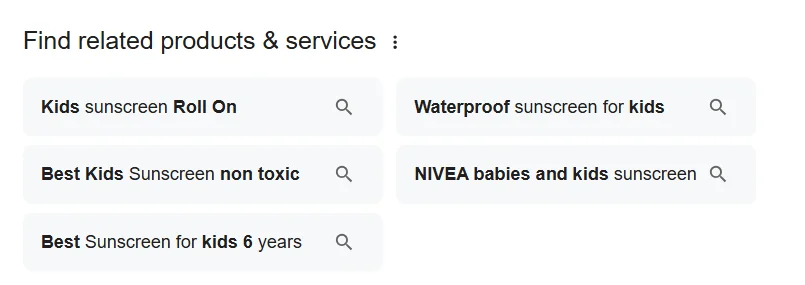
In the example above, I was searching for dermat-approved sunscreen for my son and came across some excellent search term suggestions. If I were managing a paid search account focused on these categories, these terms would be a fantastic addition to enhance the account’s effectiveness.
4) Competitor websites & campaigns
Keep review product pages, comparison guides, FAQs, and landing pages on competitor sites under surveillance. SEMrush has some really cool advertising research to help you peek into paid keywords competitors are testing.
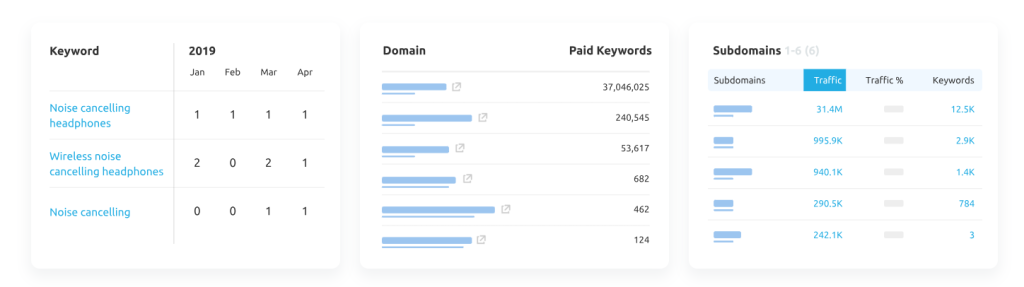
Of course, the search intent of these keywords and your budget should be evaluated before using these keywords in your search ads.
5) Social listening & community platforms
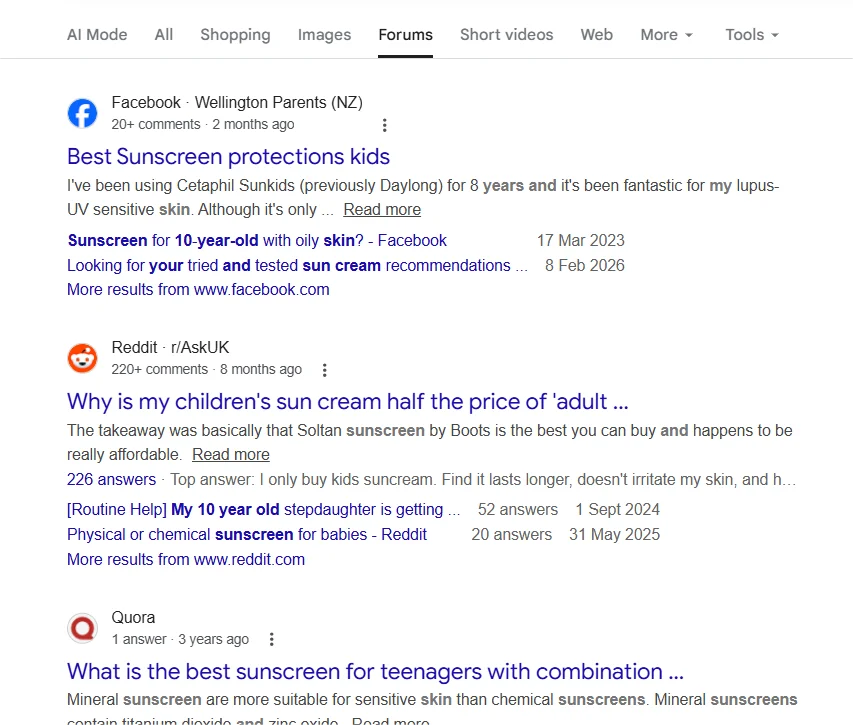
Comments on LinkedIn posts, Reddit threads, YouTube videos, or niche forums are rich in problem statements in unfiltered language. These discussions reflect how users describe needs outside of search-engine constraints.
6) Customer conversations
Sales calls, onboarding chats, and support tickets brim with raw, conversational phrases that don’t show up in sanitized results from keyword tools. Like buyers asking for “wireless earbuds that stay in during runs” when your team notes it as “sports headphones.” Record or transcribe 10-20 recent interactions, pull phrases verbatim, then test them in Google Ads or SEMrush.
Our team shifted a SaaS client from “CRM software” to “CRM for real estate teams with deal tracking,” spiking conversions 2x by matching buyer speak exactly.
7) On-Site surveys & reviews
Open-ended responses from customer surveys and user reviews can surface recurring phrases that can help you uncover expectations, objections, or use cases.
8) AI-assisted discovery
Prompt-based AI tools like ChatGPT can spit out dozens of long-tail ideas when given a seed topic and buying-intent context. We gave ChatGPT a simple prompt:
“Act as a PPC expert targeting performance marketers. From the seed ‘CRM software,’ generate 20 long-tail keywords (4+ words) for high-intent AI search ads. Focus on MOFU needs like pipeline tracking or team collaboration. Group by funnel stage and estimate CPC ranges.”
Here’s what we got back—
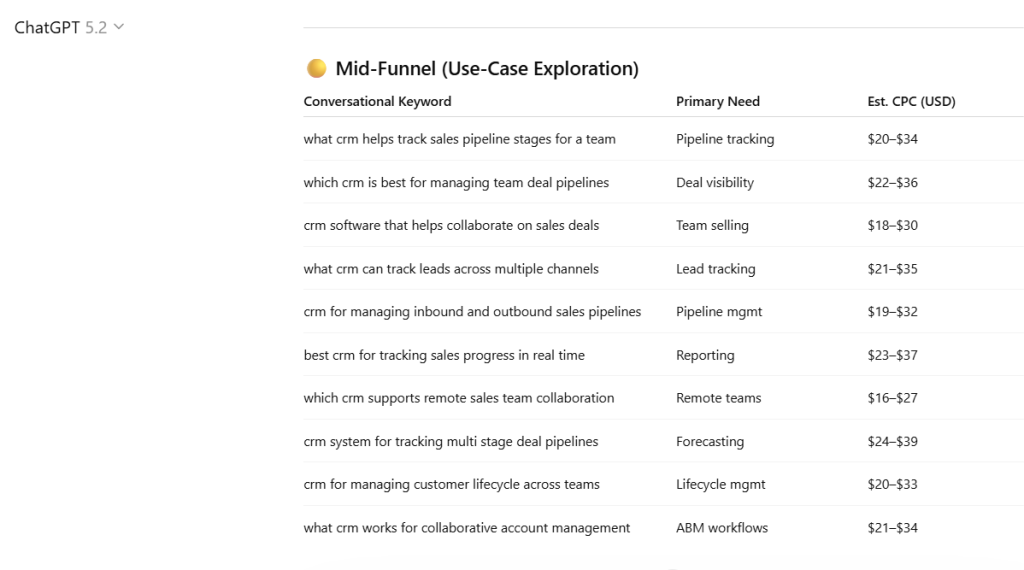
Always QA the results. Make sure to validate these suggestions after that. Feed the winners into traditional keyword research platforms to check their volume, low competition, and CPC.
How to deploy long-tail keywords for PPC in AI search
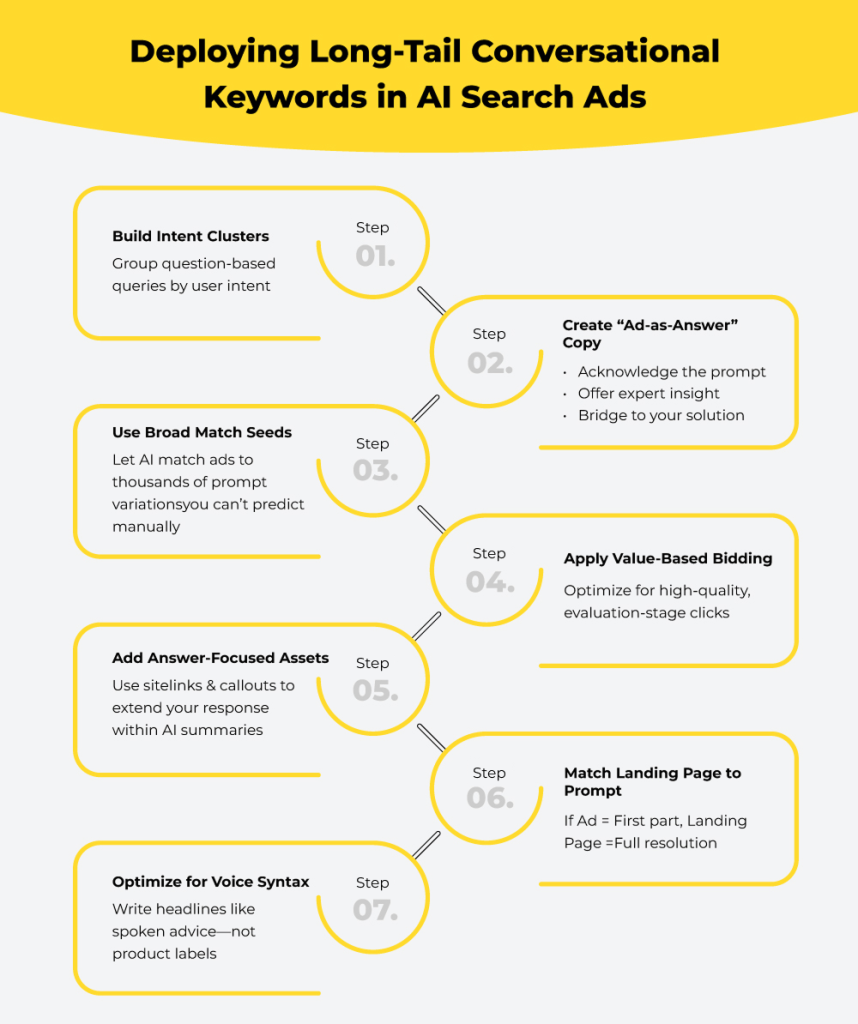
For a Performance Lead, the challenge doesn’t stop at finding keywords for contextual PPC targeting. In fact, that’s the groundwork. The next big step is to ensure the ad copy serves as the first logical step of the AI’s response. Think of it like this—if the shopper is treating the search bar like a consultant, your ad must act like the expert’s advice.
Below is the step-by-step breakdown of how to take those long-tail, conversational phrases and weave them into a high-converting intent-based PPC targeting strategy.
1) Question-based ad groups
It’s not uncommon for traditional account structures to group keywords by product category. E.g., “Running Shoes”. In the era of generative AI search ads, it’s advisable to structure your account by “Intent Clusters”. So that each ad group delivers “Ad-as-an-Answer” copy to the specific context of the prompt. This structure feeds Performance Max assets by intent, letting Google’s AI serve the right ad to conversational triggers.
- The troubleshooting cluster: Keywords like “why is my lawn turning brown in patches” or “how to fix a leaky faucet without a plumber.”
- The comparison cluster: Keywords like “should I get a Mac or PC for video editing in 2026” or “CRM vs. Spreadsheet for 5-person teams.”
- The niche constraint Cluster: Keywords like “best carbon-plated shoes for humid marathons” or “vegan protein powder that doesn’t cause bloating.”
2) The copywriting framework
In conversational search advertising, a “Buy Now” headline is a non-sequitur. It interrupts the user’s train of thought. Instead, your ad copy should lead with a helpful solution that bridges to the product. Here’s the anatomy of AI search ad copy:
- Headline 1 (The acknowledgement): Address the specific nuance of the question.
- Headline 2 (The expert advice): Provide a “bite-sized” tip or data point.
- Headline 3 (The logical bridge): Introduce your product as the tool to execute the advice.
- Description: Use natural language to explain why this solution fits the user’s specific “prompt” parameters.
3) Broad Match + Smart Bidding
To make natural language query targeting work at scale, you have to let the AI do the heavy lifting of “listening.”
- Use Broad Match on your long-tail “seed” phrases. This lets LLMs match your ads to thousands of variations of the same intent that you couldn’t possibly predict manually.
- Pair this with value-based bidding. Since you are targeting MOFU (Middle of Funnel) questions, you want the AI to optimize for “High-Quality Clicks”—users who spend more time on your “answer” pages—rather than just raw volume.
- Use “Assets” (formerly Extensions) to provide further answers. If someone asks about “How to fix slow WordPress sites,” use sitelinks to offer “Top 5 Speed Plugins” or “Free Audit Tool.”
4) Landing page optimization
The biggest mistake in PPC for AI search is sending a user from a highly specific question to a generic home page. If the ad promises the “first part of the answer,” the landing page must be the “full resolution.”
If the user asked “how do I protect my patio furniture in a coastal climate,” the landing page showing just a catalog of covers doesn’t quite hit the spot.
It would lead with a 200-word expert breakdown on salt-air corrosion, if it were our ad. Followed by “Marine-Grade Covers” as the recommended solution. Such a smooth “Answer-to-Commerce” pipeline builds massive trust.
5) Voice and AI search advertising
As we said earlier, many of these natural language queries are spoken. Voice and AI search advertising queries are typically longer and more “rambling” than typed ones. Hence, ensure your ad headlines use “vocal” syntax. Instead of “Waterproof Gear,” use “Keep Your Gear Dry in Heavy Rain.” This small shift in tone makes your ad feel more relevant when the AI reads it back to a user or displays it within a synthesized summary.
The road ahead
The new PPC playbook for AI Search may feel unfamiliar. But look closely and you’ll see it’s built on principles performance marketers already understand.
For years, paid search has been shaped by the constraints of the search box. Campaigns revolved around short queries, tightly matched head terms, and predictable intent signals. Long-tail keywords were often treated as cost-saving add-ons, not primary acquisition levers.
AI-led search is causing it to evolve.
When users interact with AI interfaces, they don’t force their needs into two or three words. They express it, explain it. The detailed prompts still trigger ads. But now more opportunities exist in decision-stage questions, not just product-category searches.
This transforms PPC’s role. From bidding on a fixed keyword set to aligning campaigns with evaluation-driven queries that reflect how buyers assess tools, workflows, or trade-offs in real time.
The paid advertisers who adapt will:
- Invest in understanding decision-stage user intent.
- Structure campaigns around prompt-level needs, not just product types.
- Use ad copy and landing pages to resolve specific questions—not redirect to generic offers
As with SEO, there will be a temptation to overengineer for the AI layer itself. But AI systems aren’t the ones converting. They’re surfacing responses on behalf of users who are trying to understand, compare, or decide.
If your campaigns are built to address those moments of evaluation, rather than just capture category demand, you’re already moving in the right direction for AI Search ads.
You might as well read this next–The performance marketer’s guide to AI Max ~ Unveiling hidden challenges & tricks