 Lifecycle marketing
 Customer data management
 Email campaign production
 Search marketing
 CMS development
 Who we are
 How we work
 Case studies
 Testimonials
 Salesforce Marketing Cloud
 Braze
Braze HubSpot
 Marketo
 Pardot
 DataBricks
 Snowflake
 HighTouch
 RudderStack
 Segment by Twilio
 Videos

So, suppose you and I are sitting across a table right now with our laptops closed, caffeine kicking in, you’d probably lean in and ask me something like this:
“Everyone’s talking about AI in e-commerce. I get the hype. But before I invest time, money, and sanity, should I build on Shopify or WooCommerce?”
And I’d smile. Because that question tells me that as a business/brand owner, you’re already ahead of the curve and also standing at one of the most consequential crossroads you’ll hit as a modern store owner.
This isn’t about themes; it’s also not about which dashboard looks cleaner.
And it’s definitely not about which platform has better marketing.
This is about how smart your store can realistically become, how much control you want over that intelligence, and how much complexity you’re willing to live with once the honeymoon phase is over.
AI has changed the stakes. Completely.
Understanding why AI isn’t a feature anymore (and why your platform choice matters)
So, in the current year and in the near future, your customers already expect your store to remember them, recommend products that make sense, answer questions instantly, and not show them irrelevant junk.
Behind the scenes, you’re expected to forecast inventory better, spot trends earlier, and create content faster than a human team reasonably can.
That’s what AI is doing quietly across modern stores. It’s personalizing storefronts for thousands of users at once, powering chatbots that actually resolve queries, predicting demand, and pricing more accurately.
The part that most blogs gloss over is that AI doesn’t live in isolation. It feeds on your platform’s architecture, your data access, and your ability to integrate and experiment.
That’s why Shopify vs WooCommerce for AI-powered stores is a very different conversation from “Shopify vs WooCommerce for e-commerce” circa 2018.
The philosophical fork in the road (and this matters more than the features!)
Before we touch tools, pricing, or performance, you need to understand the mindset baked into each platform.
Simply said, WooCommerce and Shopify are not competing to solve the same problem.
WooCommerce is built for control.
It runs on WordPress, which means open-source DNA through and through. You may touch and change everything. Break things if you’re careless, and build extraordinary things if you’re not.
Shopify is built for certainty.
It’s managed, opinionated, and intentionally constrained.
With this platform, you don’t worry about servers, updates, or scaling. However, in exchange, you accept guardrails, especially once you move into advanced AI territory.
It’s important to note that neither approach is “better.” But one of them will feel right, and the other will eventually frustrate you.
AI flexibility and customization: freedom vs finesse
Now, let’s take a deep dive into what AI actually looks like on each platform.
To begin with, if you have specific AI ambitions that go beyond “install an app and hope,” WooCommerce shines.
Because it’s open-source, you can wire your store directly into AI services like OpenAI, Google AI, or enterprise platforms. You can process raw customer behavior data, transaction history, and browsing patterns without platform-level restrictions.
This is where things get interesting.
We’ve seen WooCommerce stores:
~ Run GPT-powered conversational commerce tuned to brand voice
~ Use proprietary recommendation logic trained on years of sales data
~ Implement visual search using computer vision
~ Build predictive dashboards that merchandising teams actually trust
But, and this is a big one, you earn this flexibility. Hosting, security, performance, compliance, and optimization are your responsibility. WooCommerce gives you the keys, not the chauffeur.
On the other hand, Shopify takes the opposite approach and does it exceptionally well.
Instead of asking you what you want to build, Shopify asks: “What do most businesses need right now?” Then it builds AI features directly into the platform.
By 2025, Shopify’s AI features like Shopify Magic are doing a lot of heavy lifting, such as generating product descriptions, marketing copy, FAQs, and more. AI-powered search improves discovery. Smart recommendations handle upsells without configuration. Admin-side AI surfaces insights you’d otherwise need analysts for.
On top of that, Shopify’s app ecosystem has exploded with AI tools, chatbots, personalization engines, quizzes, and merchandising tools, which are all vetted, documented, and supported.
Here’s the trade-off, and it’s an important one; you’re mainly working within Shopify’s vision of AI. You can extend it via APIs and apps, but you’re not rewriting the rules.
For many businesses, that’s perfect. For others, it eventually feels, well, boxed in.
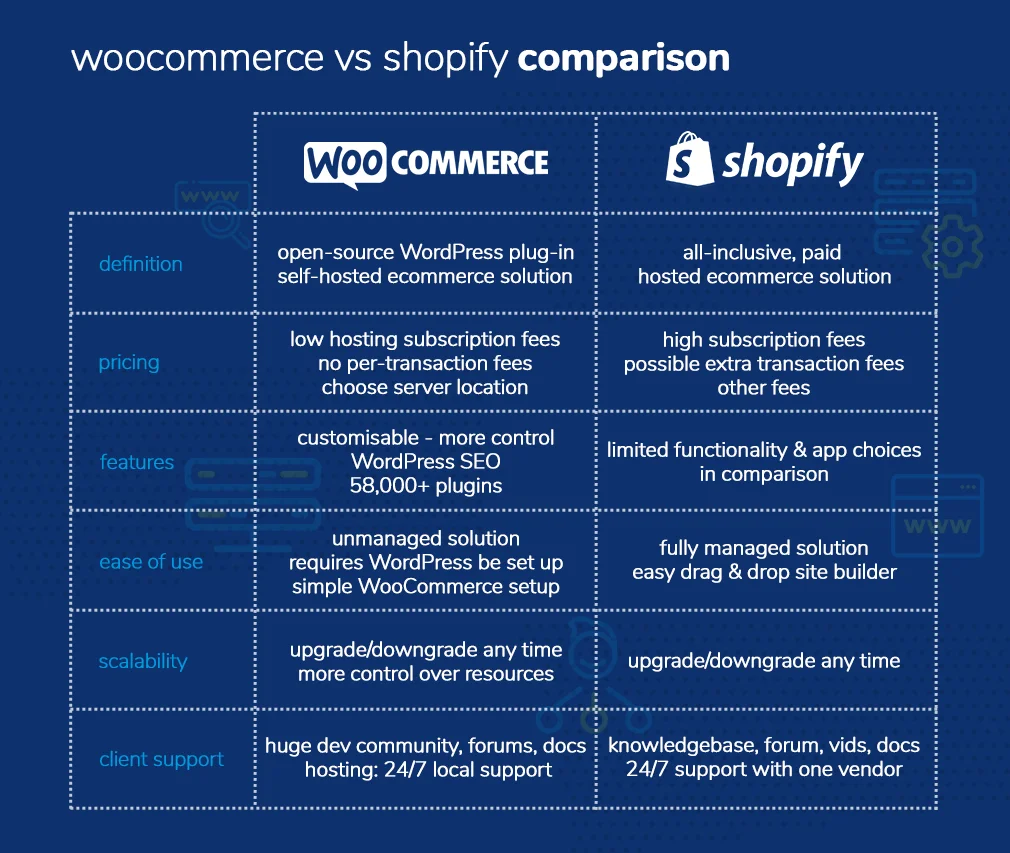
As we delve deeper into a feature-based comparison of Shopify vs. WooCommerce, here’s a bird’s-eye view to help you decide faster.
Performance
This comes up in every Shopify vs WooCommerce performance debate, so let’s settle it properly, once and for all.
Shopify is fast by default. Period.
You get a globally distributed CDN, automatic scaling, high uptime, and zero stress during traffic spikes. If your store suddenly goes viral, Shopify will handle it quietly in the background.
WooCommerce can absolutely match that performance, but only if it is built correctly.
Hosting quality, caching layers, database optimization, CDN setup, and code discipline all matter. When done right, WooCommerce stores can fly. On the contrary, if you don’t hit the nail’s head, they crawl.
So here’s the fundamental distinction: while Shopify gives you guaranteed consistency, WooCommerce gives you a higher performance ceiling, but only if you earn it.
Let’s talk money (because vague pricing helps no one)
This is where we see the most regret after launch.
To begin with, WooCommerce costs are flexible but real.
WooCommerce itself is free. Everything else depends on your choices.
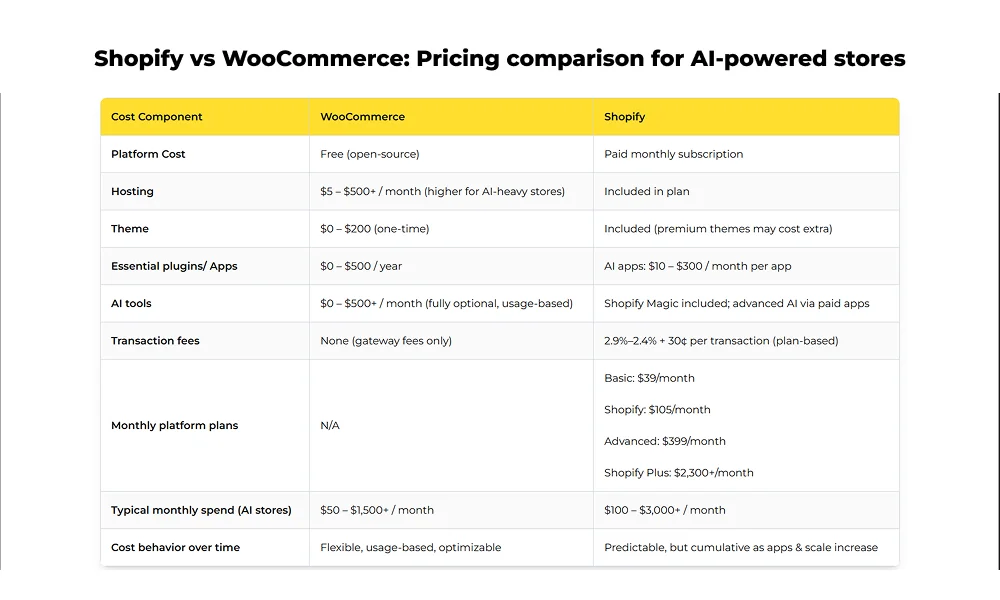
Typical cost ranges look like this,
~ Hosting: $5 to $500+ per month (AI-heavy stores skew higher)
~ Themes: $0 to $200 one-time
~ Essential plugins: $0 to $500 per year
~ AI tools: $0 to $500+ per month
Most stores land somewhere between $50 and $1,500+ per month, scaling as traffic and AI usage grow.
The upside is that you don’t have to pay any platform transaction fees. You pay for what you use and can optimize infrastructure as your AI needs evolve.
Proceeding towards Shopify costs, they can be predictable, but cumulative.
Shopify’s pricing is refreshingly clear:
~ Shopify Basic: $39/month + 2.9% + 30¢ per transaction
~ Shopify: $105/month + 2.7% + 30¢ per transaction
~ Advanced Shopify: $399/month + 2.4% + 30¢ per transaction
~ Shopify Plus: $2,300+/month (enterprise)
Shopify Magic is included in all plans. AI apps typically add $10 to $300 per month each.
Over time, many AI-powered Shopify stores land in the $100 to $3,000+ per month range, which is predictable, but not always affordable as you scale.
Data ownership
It’s a known fact that AI runs on data.
While WooCommerce gives you complete data sovereignty, with every click, purchase, and interaction is yours to store, analyze, and train models on. You get to control compliance, geography, and security.
On the other hand, Shopify takes a more managed approach. Your data is secure and compliant, but raw access is limited. External model training comes with restrictions, and you’re tied to Shopify’s roadmap.
For some brands, that’s comforting, while for others, it comes across as a ceiling.
Support & day-to-day reality
If you were to go with Shopify, you would enjoy its excellent managed support, including 24/7 availability, extensive documentation, regular updates, and dedicated account management at higher tiers. You get to focus on growth while Shopify handles the plumbing.
On the other hand, WooCommerce support is decentralized. Community forums are strong, hosting providers offer varying levels of help, and agencies fill the gaps. So here, while you gain flexibility, you also take on more responsibility.
This is why WooCommerce works best when there’s technical maturity, either internally or through a trusted partner.
So, which would be the right fit platform for your AI-powered store, Shopify or WooCommerce?
Well, here’s the honest answer we give clients when the laptops stay closed.
If your goal is to launch quickly, leverage proven AI tools, and avoid technical overhead, Shopify is a fantastic choice. You’ll be selling and learning fast.
However, if your goal is to build something genuinely differentiated, train AI on your own data, and control how intelligence evolves in your business, WooCommerce provides the runway.
This is why asking “Which is better, WooCommerce or Shopify?” misses the point. The better question is: how ambitious is your AI vision, and how hands-on are you willing to be?
Interestingly, many successful brands start their journey on Shopify, validate ideas, and then migrate to WooCommerce as AI becomes strategic rather than tactical. While others stay on Shopify forever and win because focus beats flexibility.
The road ahead
You may now want to read our detailed guide on ~ Migrating to WordPress in 2026: The ultimate guide for teams managing multiple CMS.