 Lifecycle marketing
 Customer data management
 Email campaign production
 Search marketing
 CMS development
 Who we are
 How we work
 Case studies
 Testimonials
 Salesforce Marketing Cloud
 Braze
Braze HubSpot
 Marketo
 Pardot
 DataBricks
 Snowflake
 HighTouch
 RudderStack
 Segment by Twilio
 Videos
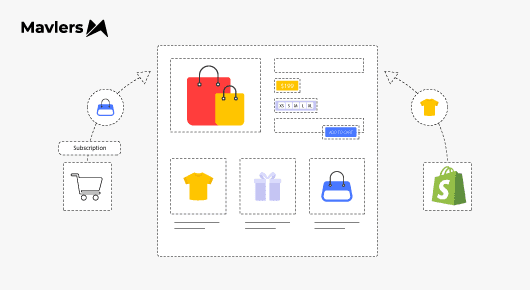
Subscription eCommerce is the fastest-growing way to buy products online. The market for it was at $326.44 billion in 2024. By 2029, it is estimated to be worth more than tenfold.
The trajectory of subscription-based models in eCommerce tells a story of shifts in how consumers prefer to buy and how brands aim to grow.
This strong growth has attracted start-ups to established retailers in space.
From essentials like contact lenses, cosmetics, and pet food to categories once considered immune to repeat models—wine, apparel, even gaming—different subscriptions model examples are reshaping the path to higher LTV and more reliable revenue.
What’s powering this momentum is not just habit or convenience. It’s a convergence of forces: consumers expecting more predictability, brands under pressure to build sustainable margins, and a fierce landscape where ongoing engagement matters as much as product quality.
For Shopify merchants, that combination has catalyzed in making Shopify subscription model as a new, quintessential strategy of the sales mix, loyalty, and customer retention. And technological enhancements only enhanced this model’s appeal.
When integrated with a powerful platform like this, Shopify subscription services unlock recurring revenue, foster long-term customer relationships, and streamline operational workflows.
In the sections ahead, we break down why subscription eCommerce growth is accelerating across Shopify, why brands are adopting Shopify subscription model at record speed, the strategies that set top performers apart from the rest, and where this model is headed next.
What is a subscription business model?
A subscription model in eCommerce charges shoppers recurring fees for continuous delivery of a product or service over a period of time.
Instead of asking customers to return for the same product every few weeks, the brand sets up a system in which refills, restocks, or curated shipments occur on a schedule the customer chooses.
If you’ve ever used a streaming platform that quietly renews each month, the logic is similar. The difference is that in eCommerce, a subscription can remove a weekly chore or introduce customers to products they wouldn’t have chosen on their own. For brands, it creates a more stable revenue rhythm. For customers, it removes friction from everyday routines.
Types of eCommerce subscriptions
- Replenishment
Recurring orders for consumable products—coffee, skincare, pet food, razors. Customers choose the frequency, and the brand automates the rest. - Curation
A rotating selection of products based on customer preferences. Common in beauty, snacks, apparel, books, and hobby categories. - Access
A recurring fee for exclusive perks—member pricing, early access, gated products, or premium services.
Many Shopify brands combine these models or use tiers, supported by apps like Recharge, Skio, and Bold Subscriptions.
Why Shopify subscription models are taking off
Ecommerce subscription models are carving out a dominant space on Shopify. Not through hype, but because they fundamentally reshape the economics of online retail.
The allure is both operational and strategic, benefiting merchants and consumers alike.
1. Predictable, actionable revenue
The value of a subscriber model is in recurring billing cycles. For brands, it transforms revenue forecasting from guesswork into a structured approach.
This lets businesses:
- Anticipate cash flow.
- Plan inventory.
- Make strategic investments with far greater confidence.
Subscriptions shift the focus from one-off transactions to predictable income streams, which is particularly valuable for scaling operations efficiently.
2. Capital efficiency and cash flow visibility
Many eCommerce subscription plans require upfront payments or long-term commitments, providing immediate cash reserves.
This reduces the pressure on short-term financing and allows start-ups to launch with minimal upfront capital. Discounted annual or multi-month plans further encourage early adoption, balancing customer acquisition with liquidity.
3. Higher lifetime value and lower acquisition pressure
Subscriptions convert first-time buyers into ongoing relationships. With a predictable revenue stream per customer, brands don’t have to acquire new customers constantly.
Retaining subscribers becomes more valuable than acquiring new ones. And when that happens, overall marketing costs lower and lifetime value increases.
4. Operational simplicity and cross-selling opportunities
Breaking larger costs into smaller, recurring payments makes Shopify products more accessible and reduces friction at checkout.
At the same time, a subscription framework creates a built-in channel for cross-selling, upselling, and personalized offerings, without adding extra marketing overhead.

Why Shopify is the right platform for selling subscription boxes
- Native recurring billing
Automate recurring payments directly through Shopify’s checkout. No third-party systems required, reducing friction for your team and customers.
- Flexible Subscription Models
Offer weekly, monthly, or custom plans to match customer needs. Third-party apps like Recharge and Appstle expand functionality for account management and personalized experiences.
- Scalability with Shopify Plus
High-volume merchants benefit from direct checkout integration, robust APIs for custom apps, and reliable payment processing—ensuring subscriptions are seamless and secure.
- Operational insights
Forecast revenue, manage inventory, and optimize cash flow. Shopify’s analytics make scaling subscription businesses more predictable and efficient.
Steps to set up a subscription business on Shopify
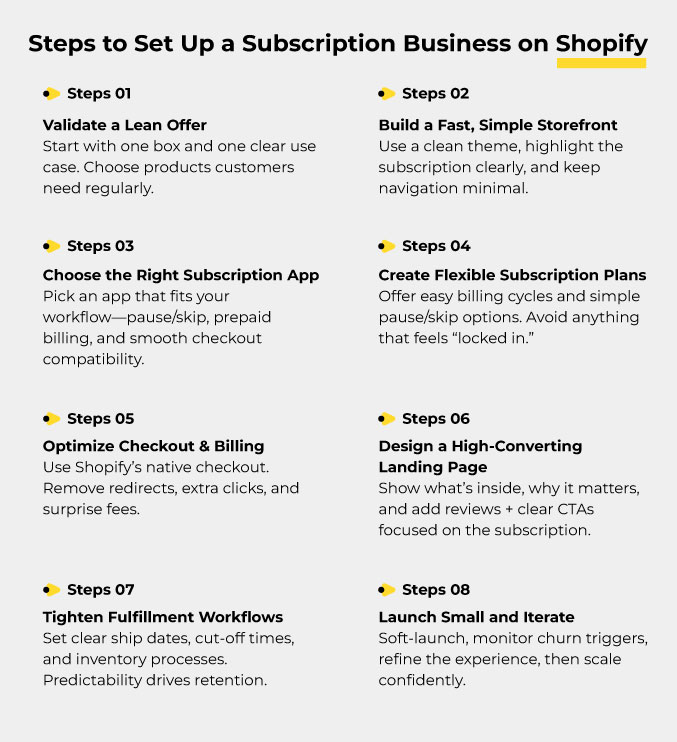
1. Start with a lean, validated offer
Jumping into subscriptions without validation is how brands end up with shelves full of “why did we order this?” inventory.
So, start with understanding to start small. Test one subscription box. One promise. One predictable use case.
Consumables, refills, anything your audience runs out of—these win because customers don’t have to justify the purchase every month.
2. Build a lean Shopify storefront
Choose a fast, conversion-focused theme and highlight your subscription offering with crisp copy and uncluttered navigation. And set up clear policies and taxes to ensure a smooth launch.
3. Choose a subscription app that doesn’t fight you
Shopify has options—Appstle, Recharge, Shopify Subscriptions. But the trick isn’t picking the “best.”It’s picking the one that plays nicely with your tech stack, checkout flow, and team.
If your customer support team needs pause/skip features or you want prepaid billing, filter apps by the problems you actually have—not the features that sound cool.
4. Build plans that feel flexible, not forever
Customers love subscriptions… until they feel trapped. Offer clear billing cycles (weekly, monthly, quarterly), easy skip/pause options, and no-surprise pricing. Think of it as reducing “buyer anxiety per click.”
5. Nail the checkout and billing setup
Your checkout decides whether shoppers commit or bounce. Keep everything inside Shopify’s native checkout—no redirects, no “open a new tab,” no mystery fees. If people have to do mental math to understand what they’ll be charged, you’ve already lost them.
6. Build a high-converting landing page
Your subscription box needs more than a pretty page. It needs a story: what’s inside, why it matters, how it makes life easier. Add trust markers (reviews, UGC), clear CTAs, and one job for the page—push the subscription, not your entire catalog.
7. Tighten fulfillment before you scale
Subscriptions aren’t like one-off orders. You’re promising rhythm. Predictability. That means cut-off dates, batch fulfilment, inventory planning, and “we ship on the 1st and 15th” clarity. Operations is the part no one flexes on Instagram—but it’s where you win or lose retention.
8. Launch small. Listen hard. Iterate fast
Your first subscribers are not just customers—they’re your R&D department. Soft launch to a small group, watch the churn triggers, fix the friction, and refine your offer. Once the experience feels smooth end-to-end, then scale.
The hidden playbook behind subscription brands that win
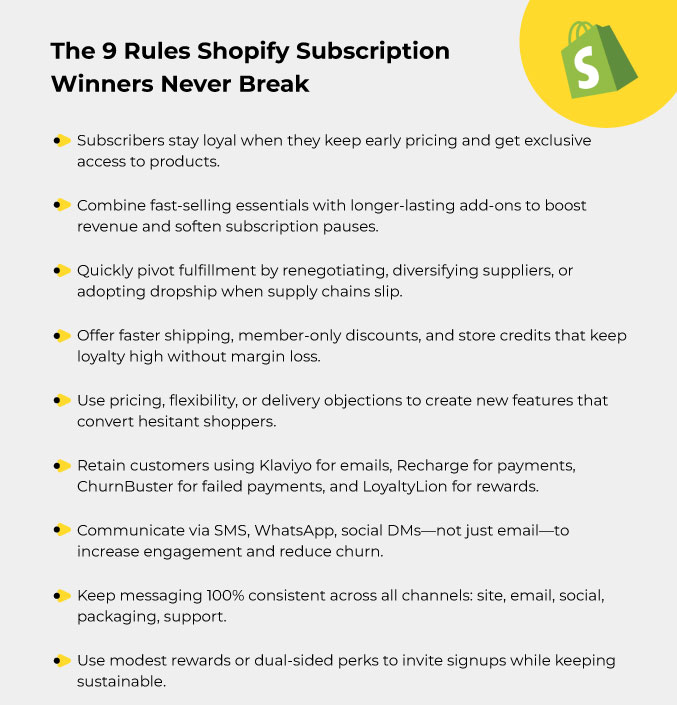
1. Make subscribers feel like insiders
High-retention brands understand the real currency of subscriptions: status. Grandfathered pricing, exclusive access, guaranteed availability—these small privileges create a “members get more” effect that keeps churn low.
2. Build an ecosystem, not a box
Winning brands rarely stay boxed into one SKU. They introduce smart add-ons—fast movers and slow burners—that increase AOV without complicating the subscription. A replenishable essential plus a longer-use complementary product? That’s how they grow revenue even when someone pauses a subscription.
This is the difference between a box business and a commerce ecosystem.
3. Stay operationally adaptable
Supply chain disruption exposes the fragile operators. The resilient ones adapt: renegotiate fulfillment, diversify suppliers, shift to dropship partners, or rebuild the backend when needed. Subscription revenue is predictable—until your operations aren’t. Agility becomes a retention strategy.
4. Add perks that reinforce value, not margins
Prime trained consumers to expect fringe benefits. Smart subscription brands lean into that: faster shipping, member-only discounts, store credit loops, or early product access. These perks don’t erode margins when structured well—they strengthen emotional loyalty while anchoring perceived value.
5. Use objections as product intelligence
Top brands obsess over the reasons people don’t subscribe. Every objection—price, flexibility, delivery windows, product mix—becomes a roadmap for new membership features. Customer service queries aren’t a cost center; they’re a conversion engine.
6. Invest in a retention-centric tech stack
High-growth subscription brands invest in:
- Klaviyo for lifecycle flows that trigger at the right moments.
- Recharge for reliable recurring billing at scale.
- Littledata for visitor behavior insights.
- ChurnBuster for failed-payment recovery.
- LoyaltyLion for data-driven reward programs.
7. Communicate where your customers already live
Email is great—but it’s not the only line of communication anymore.
Top subscription brands use SMS, WhatsApp, Messenger, and social DMs to deliver updates, reduce uncertainty, and increase touchpoints.
8. Keep your brand message consistent everywhere
The strongest brands feel coherent across every touchpoint—website, email, social, packaging, support scripts.
9. Incentivize with intent, not discounts
Deep discounts rarely build sustainable subscription businesses. The top performers know that 10–15% is enough to tip a decision without gutting margins. What works even better? Dual-sided rewards—small perks for the subscriber and an identical perk for a friend.
The road ahead
Subscription eCommerce is showing no sign of stopping. Shopify subscription services will keep rolling out smarter tools, integrations, and data features to help you make your customers reliable sources of recurring revenue.
And if you want to level up your Shopify game even further, we’ve got you.
More reads from the Mavlers lab:
- Advanced Shopify Performance Optimizations: How to Improve Speed, Core Web Vitals, and UX?
- How Much Does It Cost to Develop a Shopify Website with Mavlers?
- AI for Shopify stores: Practical ways to automate, personalize, and grow your business
- The ultimate guide to Shopify managed markets for seamless cross-border selling