 Lifecycle marketing
 Customer data management
 Email campaign production
 Search marketing
 CMS development
 Who we are
 How we work
 Case studies
 Testimonials
 Salesforce Marketing Cloud
 Braze
Braze HubSpot
 Marketo
 Pardot
 DataBricks
 Snowflake
 HighTouch
 RudderStack
 Segment by Twilio
 Videos
If you blinked on May 27, 2025, you may have missed it.
There was no fireworks show, no Marc Benioff-on-a-rooftop moment, no keynote auditorium trembling with applause.
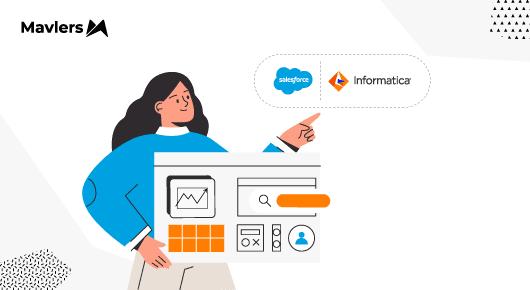
Instead, in true Salesforce fashion, the company dropped a quiet press release into the world, straightforward headline, modest language, almost polite in its understatement: Salesforce signs a definitive agreement to acquire Informatica for $8 billion.
And for a few hours, the tech ecosystem seemed to take the news in stride.
The press and the tech sphere were abuzz with phrases like “Another enterprise acquisition,” “Another data player,” and “Another number with a B in front of it.”
But if you work in CRM, AI, data engineering, or enterprise architecture, you feel something else, something more akin to a pressure drop.
A deal this silent is rarely ever small.
Because beneath the polite headline was a much louder message…
Salesforce didn’t just buy a company.
It bought the missing layer of the modern enterprise, the air traffic control tower for the data-driven world, and the backbone that will determine whether AI becomes a feature or a foundation.
And in doing so, Salesforce redrew the competitive map for the next decade of enterprise software.
Let’s walk through what actually happened, why it matters, and what it means for the businesses that will be relying on this new data-and-AI megastructure.
Decoding the deal ~ What we know sans the spin!
Salesforce confirmed on May 27, 2025, that it would acquire Informatica for $8 billion in equity value, paying $25 per share in cash for both Class A and Class B-1 stock.
Both companies’ boards approved the transaction unanimously.
The stated mission was crisp and surprisingly candid: “To create a unified, governed, enterprise-grade data foundation to power safe, scalable agentic AI across every Salesforce cloud and platform.”
That word, agentic, was doing a lot of work. And the market understood that immediately.
Reuters and AP News published straight-shooting reports stating that this was one of Salesforce’s most strategically significant acquisitions in years, not because of the number, but because of the direction.
The closing timeline was set for early FY27, pending regulatory approvals.
This might seem simple on paper, but it turns out to be pretty monumental in implication.
Why $8 billion wasn’t really about the price tag
An $8B check may seem like a splurge until you look at what Salesforce was really buying.
Informatica wasn’t just “another data vendor.” It was the data vendor enterprises trusted when the data was messy, the governance was nonexistent, the lineage was unknown, the architecture resembled spaghetti, and the business needed to trust the numbers before trusting the AI.
Analysts quickly noted that the valuation aligned with Informatica’s category leadership, particularly in data integration, governance, quality, and Master Data Management (MDM).
Salesforce didn’t pay a premium for the product. It paid a premium for certainty.
AI agents can hallucinate. Data quality should never be the same.
And Salesforce knew that if it wanted Agentforce, its AI agent platform, to become more than a flashy demo, it needed a foundation that could handle identity inconsistencies, schema mismatches, duplicate records, governance requirements, and enterprise-grade compliance.
In short, Salesforce bought the plumbing.
November 18, 2025 ~ The deal goes from theory to reality
By November 18, 2025, Salesforce formally announced that the deal had closed.
Salesforce didn’t buy Informatica to keep it at arm’s length.
It bought Informatica to weave it into the DNA of Salesforce Data Cloud (Data 360), MuleSoft (integration), Tableau (analytics & visualization), Agentforce (AI agents), and the core platform itself.
If Data Cloud was already the lungs of the Salesforce ecosystem, Informatica became the circulatory system, quiet, complex, indispensable.
But doesn’t Salesforce already have Data Cloud?
This was the first question every architect, admin, and CTO asked.
The short answer is that Data Cloud is an activation layer. Informatica is a governance and readiness layer.
Data Cloud does the glamorous work of unification, segmentation, identity resolution, real-time personalization, omnichannel activation, and feeding AI workflows.
Informatica does the spade work of cleansing, deduplication, lineage, metadata, quality checks, policy enforcement, standardization, enterprise-grade integration & MDM.
One creates magic, while the other makes the magic safe.
Salesforce itself acknowledged this explicitly in its acquisition announcement.
AI cannot function without clean, reliable, governed data, not if you want something better than hallucinations wrapped in confidence.
This wasn’t Salesforce saying, “We want better AI features.”
Instead, this was Salesforce saying: “We want AI you can trust, a thing enterprises will stake careers on.”
Data Cloud activates data, while Informatica ensures the data is worthy of activation.
Together, they create what Salesforce needed, an end-to-end data fabric built for enterprise AI.
What this means if you’re an SMB, startup, or scrappy scale-up
Let’s talk about you, the reason half of Salesforce’s roadmap exists.
If you run a business where “data” currently means a Google Sheet named “MASTER_FINAL_FINAL_v3,” this deal matters more than you think.
Because historically, enterprise data management tools stayed far, far away from the mid-market. They were too bulky, too expensive, too “why do I need a governance council for my 12-person company?”
But Salesforce doesn’t buy something for $8B to let it sit behind a velvet rope.
You can expect ripple effects such as:
~ Cleaner, more reliable CRM data — finally within reach for smaller teams.
~ Smarter AI personalization — without the “sorry, we couldn’t match that record” hiccups.
~ More automated integrations that don’t require duct tape, Zapier therapy, or a part-time data engineer.
The dream of “one customer, one profile, one truth”? This deal brings it closer to reality.
Even for the teams that still argue over who accidentally overwrote the lead status column.
Why marketers, revops, and CRM folks are quietly celebrating
Marketers rarely cheer when two enterprise companies merge. Usually, it just means more logins and another invoice.
But this time? The mood is surprisingly optimistic.
Because of the annoying problems, the ones that quietly sabotage your performance month after month are exactly the problems Informatica solves:
Conflicting customer IDs
Broken data pipelines
Inconsistent attribution
Duplicate records that multiply like rabbits
AI models hallucinate because the inputs look like confetti.
If Salesforce fully integrates Informatica’s stack (and all signs suggest they will), marketers may finally have:
A real single source of truth
AI models that don’t rely on wishful thinking
Omnichannel personalization that actually works
It’s not sexy. It’s not flashy. But it’s absolutely transformational.
Answering the industry’s biggest questions (and what the facts suggest)
Q1: Will Informatica remain multi-cloud or become Salesforce-first?
Salesforce has indicated strong platform integration, meaning Salesforce-native use cases will accelerate first.
Source: https://www.salesforce.com/news/press-releases/2025/11/18/salesforce-completes-acquisition-of-informatica/
Q2: Will pricing change?
Analysts predict new bundles and revised pricing models.
Q3: What does this mean for the AI competitive landscape?
This acquisition puts Salesforce in a stronger position against Microsoft Fabric, Google Cloud Cortex, and Databricks.
Source: https://www.reuters.com/sustainability/sustainable-finance-reporting/salesforce-raises-annual-revenue-forecast-2025-05-28/
The road ahead
If you are an SMB owner with a 2-person team, you might be interested in reading ~ A closer look at Salesforce free CRM: Decoding its value, fit, and competitive impact.