 Lifecycle marketing
 Customer data management
 Email campaign production
 Search marketing
 CMS development
 Who we are
 How we work
 Case studies
 Testimonials
 Salesforce Marketing Cloud
 Braze
Braze HubSpot
 Marketo
 Pardot
 DataBricks
 Snowflake
 HighTouch
 RudderStack
 Segment by Twilio
 Videos
Fellow paid search professionals, business/brand owners, and Google Ads enthusiasts in the house, give me a cheer if you resonate with this exact moment.
Your phone rings, you sprint like it’s the Olympics, and the person on the other end asks, “Hey, do you fix washers? Mine won’t drain.”
You run a water-damage restoration business.
Welcome to the world of LSAs, where, when things run smoothly, it’s glorious. When the phone rings, customers are serious and ready to pay without haggling because they actually need your services.
However, on the other end of the spectrum, when the cookie crumbles and things don’t work out as you pictured, it honestly feels like someone is vacuuming your wallet with a Shop-Vac.
The difference between those two outcomes boils down to how well you optimize Google Local Services Ads, not whether you turn them on.
So let’s unpack this like we’re at a bar, on Friday evening, unwinding after a long day of battling Google, clients, spam, and that one guy who always asks for “ballpark pricing.”
Decoding Google Local Service Ads and why Google treats them differently
In simple terms, one may think of LSAs as Google’s attempt to play matchmaker, but with thorough background checks.
This is what it looks like;
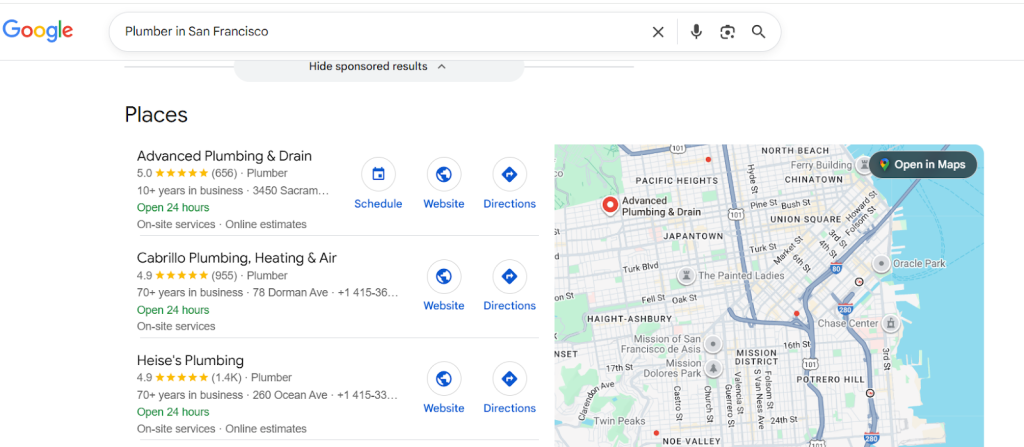
Unlike regular PPC campaigns, you don’t pay per click; you only pay per valid lead, and only qualifying businesses can run them.
It’s basically Google saying, “If we’re going to vouch for you with a green checkmark,
you need to prove you’re legit.”
So you upload licenses, insurance, IDs, basically everything short of your blood type.
Once you’re in, you show up above the search ads with that magical Google Guaranteed stamp.
Why do most advertisers complain about lead quality?
Here’s the real talk that nobody tells you about upfront. LSAs don’t know who your perfect customer is. They know who Google thinks your customer might be.
So, until you train the system, you run the risk of getting tire kickers, DIY advice seekers, job types you never wanted, and service requests from areas that you have no intention of driving to, ever.
To spell it out clearly, your job isn’t to turn on LSAs and pray; it is to shape what Google sends your way.
So let’s shape it.
1. Restrict your service area, like it actually costs gas money to drive there
To be honest, most businesses start with “Let’s target everywhere within 40 miles. We’ll take what we can get.”
And then wonder why they are stuck driving an hour just to give a quote to someone who ghosts them.
In order to avoid that, we recommend picking the ZIPs where you want to do business, where you can get there fast, and where you actually take jobs.
LSAs reward relevance; a broader preference yields junk leads, while tighter boundaries ensure quality leads pour in.
Here’s a pro tip, shrink your radius and watch your conversion rate go up without messing with your budget.
2. Get painfully specific with the services that you offer.
So, if Google gives you 80 checkboxes for services, uncheck 60 of them.
Because if you tick “all plumbing services,” this is what Google hears: “Send me everything from clogged drains to sprinkler systems to sewer inspection calls at 2 AM.”
Choose only jobs that you want, the ones you seek to profit from, you specialize in, and the ones that you can fulfil reliably.
You need to cut out low-ticket jobs and stuff that turns into unpaid consultations.
3. Respond quickly because Google watches like a hawk!
So, responsiveness matters more for LSAs than one might give it credit for.
Google literally tracks missed calls, response delays, calls you send to voicemail, and messages you ignore.
If quality leads are what you seek, you have to be available like a hungry startup, not a sleepy, satiated monopoly.
And yes, people, download the app!
Businesses often leave money on the table by ignoring LSA messages for hours.
4. Reviews are pretty essential
Google pushes the most trusted businesses to the top. So if your competitor has 347 reviews, a 4.9 rating, and you have 27 reviews, a 4.5 rating, you don’t need to flip coins on who gets the calls!
What you need to do is to collect reviews after every job.
Remember to text customers the link, train technicians to request reviews, and make it part of payroll KPIs.
This is the one thing that separates “leads trickling in” from “phone ringing off the hook.”
5. Understand which leads get credited/refunded, and which are the ones that you pay for
Now, this is where LSA rookies get wrecked, so listen up, people!
You will be charged for leads in the following instances;
~ You answered the phone
~ The customer left a voicemail, and you followed up
~ You messaged back a written inquiry
~ Someone submits a booking request
~ The job is in your listed services and area
Interestingly, the bar is much lower for “valid” leads than you would care to think about.
You will NOT get a refund for;
~ Price shoppers
~ Users comparing quotes
~ Calls where the customer never calls back
~ Cancellations
~ Jobs you technically could do, but don’t want
~ Calls outside your preferred hours (set your hours!)
For better understanding, check out the following contrast table.
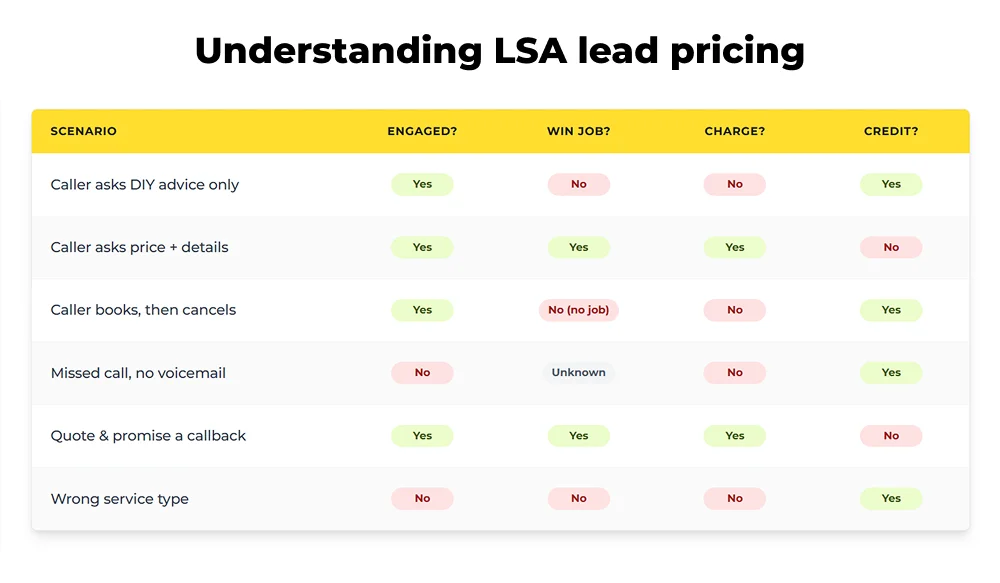
In simple terms, a lead is credited when;
~ You never had a real chance to earn money
~ The caller wasn’t a genuine prospect
~ The job was not one you could take
On the contrary, a lead is charged (not credited) when;
~ You did speak
~ You did quote
~ You could have taken the job
~ The customer intended to hire someone
6. Know when to pause, hit reset, or prune
Sometimes LSAs hit a funk, you know, like a playlist stuck on belting crappy numbers.
So, if you see a junk lead surge, irrelevant job types, and out-of-area calls, it’s probably a sign to hit pause (yes, you can pause Local Service Ads).
Then you need to trim your service list, adjust ZIPs, update business hours, cull low-performing reps, and refresh reviews.
The road ahead
To surmise, the businesses that are staying on top of their LSA game have three things in common;
~ They show up where they’re wanted
~ Respond like lightning
~ Tell Google clearly who to send to them, and more importantly, who NOT to
Want to gain further clarity on the difference between LSA & Google Ads? Then we recommend reading ~ The Fine Line Between Local Service Ads & Google Ads.