 Lifecycle marketing
 Customer data management
 Email campaign production
 Search marketing
 CMS development
 Who we are
 How we work
 Case studies
 Testimonials
 Salesforce Marketing Cloud
 Braze
Braze HubSpot
 Marketo
 Pardot
 DataBricks
 Snowflake
 HighTouch
 RudderStack
 Segment by Twilio
 Videos
Braze offers marketers a fairly impressive toolkit: email, push, in-app, and SMS. As a business, you want to be everywhere your customers are. But before you toggle every channel to ‘on,’ you have to ask: How does your customer actually want to hear from you?
That question cuts through the comfort of theory and forces you to face reality. Asked honestly, it opens up some uncomfortable but necessary follow-ups:
- How do we know which channels our customers truly prefer?
- What if they prefer just one? Do we have the focus and resources to do that one channel well? (Ironically, spreading yourself thin across many often feels easier.)
- Do customers want a multichannel experience or an omnichannel one?
- And are we willing to give up our carefully crafted “omnipresence” for customers who don’t want to hear from us everywhere?
Being customer-centric, it turns out, is much easier to claim than to practice. ““Go where your customers are” is good advice — to a point. If the saturation is high and you’re just getting started, you’re going to need a lot of time, expertise, and budget to cut through the noise and be successful,” says Joe Lambe, marketing consultant at Joseph Lambe Consulting.
Plus, with Braze making it easy to activate multiple channels, the temptation to use them all only grows. That’s precisely why it becomes very critical to consider those questions.
In this post, we’ll explore why the breadth of your reach matters far less than the depth of your connection. Then, we’ll share a few tips for operationalizing engagement in Braze.
Let’s start off with the difference between omnichannel and multichannel marketing.
Omnichannel vs multichannel marketing
Multichannel marketing uses several channels independently, while omnichannel marketing integrates all channels into a single, seamless, customer-centric experience, allowing context to flow between touchpoints so the customer doesn’t repeat themselves. So, the key difference is integration: multichannel focuses on channel presence, whereas omnichannel focuses on a unified customer journey across all touchpoints, making interactions consistent online or offline.
A comprehensive literature review by Wolf and Steul-Fischer (2022) examined over 128 studies on customer channel choice and found that successful omnichannel strategies require understanding both the retailer’s and the customer’s perspective. Their research revealed that “customers tend to choose channels that are able to fulfill their needs in a convenient, low-risk and low-cost manner.” We shall have occasion to refer to this research later in the post.
In light of the difference between the two modes of marketing and the channel-wide capabilities within Braze, let’s try to understand why engagement depth matters more than breadth.
Braze customer engagement: Breadth vs depth
Suppose you’re launching a sales campaign for a premium wearable designed to reduce stress and improve sleep. A multi-channel strategy might look like this:
- Push notification: “Time to get zen! Open the app for your sleep stats.”
- SMS: “Your sale is here! Get 20% off lavender sleep oils.”
- Email: “The Science of Stillness: A 12-page guide to ignoring distractions.”
- In-app pop-up: The moment the user opens the app to meditate, a giant banner blocks the Start button.
So, instead of selling calm, you’ve turned the customer’s phone into a source of stress. By trying to be everywhere at once, you may have actually made them more anxious.
Now, consider engagement depth. First, you review the customer’s engagement history and notice a clear pattern: they interact with your brand exclusively at night. You also see that they’ve opted out of SMS during those hours.
Accordingly, you promote a campaign on their preferred channel, apply the right frequency caps, and time the message for when they’re most likely to engage.
Engaging with millions of customers with no depth is useless, because it won’t sustain monetization. The contrary is also true: engaging deeply with only a few will not have a deep impact on your monetization either.
Brands must learn to balance these two dimensions of engagement to optimize its long-term impact on monetization.
— Dr. Michael Wu, Chief AI Strategist at PROS
Which of the two instances do you think promotes a relationship with your brand? Obviously, the second. Relationship is the keyword here. And that’s why “depth” matters more.
But don’t take our word for it. The data makes it clear that depth outperforms breadth:
- According to Braze’s 2025 Global Customer Engagement Review, 60% of brands that were highly focused on emotional engagement exceeded their revenue goals.
- The same report also shows that 85% of marketing leaders worry their messages are too transactional and lack the depth required to build a real relationship.
When messages are sent simply because a channel exists, relevance disappears, trust erodes, and customers disengage. Depth, on the other hand, is created when brands listen first.
Reflecting on the explosion of channels, Ryan Sheehy, Regional Digital Strategy Director at Townsquare Media, recounts working with a local business that diluted its impact by spreading its budget across seven digital platforms. “We cut it down to three: streaming TV, Google Search, and Facebook. Within three months, leads went up, schedule became consistent, while spending the same total budget, becausewe went deeper instead of wider [italics added],” he says.
Fortunately, with so many channels, Braze does offer you a way of identifying and prioritizing the most effective channel for each individual customer.
Channel capabilities within Braze
Optimizing for engagement depth over breadth is, first and foremost, a strategic decision, one that must remain dynamic enough to evolve alongside the customer relationship.
We’ll unpack that strategic layer shortly.
But before we do, it’s important to understand how Braze turns strategy into execution. While the platform offers a number of features, these three are particularly relevant here:
- Intelligent Channel
- Intelligent Selection
- Intelligent Timing
For the purpose of this discussion, we’ll focus on Intelligent Channel.
What is Intelligent Channel in Braze?
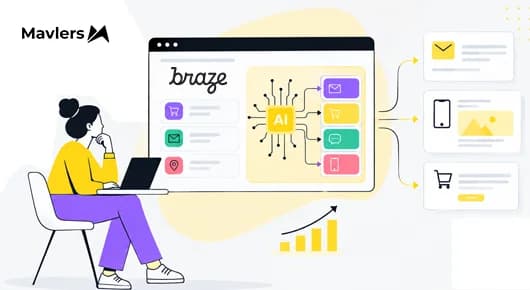
Intelligent Channel in Braze is an AI-powered component that automatically determines which messaging channel a specific customer is most likely to engage with.
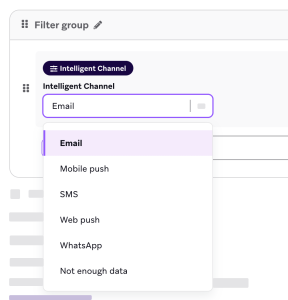
Source: Braze
Instead of a spray-and-pray approach, it analyzes a user’s unique interaction history over the last 90 days to identify their preferred touchpoint:
- It does an engagement analysis by looking at the clickthrough rates and open rates across all available channels for a particular customer or subscriber.
- If the user hasn’t engaged with any channel, you can set a fallback channel to ensure they aren’t lost.
You can say that Intelligent Channel in Braze acts as the strategic bridge between multichannel and omnichannel marketing by shifting the focus from availability to utility.
The role of channel experience
The more experience customers have with a channel, the less they perceive its risks and costs, and the more they perceive its convenience and benefits. This creates channel inertia: customers tend to stick with channels they know. In fact, the research found that “customers tend to use the channels with which they are experienced,” which can explain why adoption of new digital channels is sometimes slow, even when those channels are objectively better.
For brands using Braze, this means two things:
- Respect established preferences: If customers have deep experience with email, forcing them to mobile apps may create friction.
- Build experience strategically: When introducing new channels, do so gradually and with clear value propositions.
So much for the feature to execute your engagement strategy. But the more important question is what engagement strategy should guide its use. AI can optimize channel selection only when it has sufficient data to learn from. In its absence, the responsibility still rests with you to define the strategy and determine which channel makes the most sense for each customer.
But even when sufficient data exists, it’s important to understand how decisions are made. In the event of a tie in engagement rates across channels, Braze prioritizes the channel with the highest number of recent open events. However, this raises a critical issue: email opens are no longer a reliable signal of intent! In that case, what should guide channel selection instead?
How to start with customer engagement in Braze?
Below are a few practical considerations to keep in mind as you think about your customer engagement strategy in Braze:
- Listen to where customers are already reaching out: Review your existing channels. Customers are already telling you where they want to engage.
- Capture zero-party data: Ask customers during onboarding exactly which channel they prefer for specific types of updates. Employ conversational interfaces to gather feedback naturally. Quick, chat-based surveys feel less burdensome and often yield higher response rates and much better sentiment data.
- Maintain context across channels: For those with omnichannel preferences, make sure they don’t have to repeat themselves from channel to channel. A true omnichannel approach means the conversation continues seamlessly regardless of where it happens, with full context maintained across every touchpoint.
- Respect customer preferences and boundaries: If customers are consistently ignoring certain channels or opt out during specific hours, honor those preferences.
- Embed help in niche communities: Based on your customer preferences, consider establishing a presence in the “dark social” spaces they already inhabit, such as dedicated Discord servers, Slack communities, or specific Subreddits.
- Prioritize clicks over opens: Given the unreliability of opens, your strategy should weight clicks, conversions, and in-app actions more heavily than opens.
- Leverage Intelligent Timing: Intelligent Timing is a scheduled delivery option that uses Braze’s Sage AI to determine the optimal send time for each user based on their past interactions with the app and across messaging channels. In the absence of data, you can specify a custom fallback time in the user’s local time zone.
So these are a few starting points to consider.
From the customer’s perspective, channel choice isn’t fixed, which makes it just as important to align your channel strategy with each stage of the customer journey.
The multichannel-omnichannel spectrum
Practically speaking, channels don’t map neatly to funnel stages.
A social media post, for instance, isn’t inherently “top of funnel.” What matters is how well the channel supports the next action you want the customer to take.
It’s also important to recognize that early in the relationship, a multichannel approach often makes sense since you’re still learning a customer’s preferences. Over time, as that relationship deepens, successful brands typically move beyond channel experimentation and toward omnichannel integration, where context carries forward and each interaction builds on the last.
Initiate customer engagement in Braze, with Mavlers
Understanding which channels are connecting best starts with customer behavior. If messages sent through multiple channels fail to generate engagement, that behavior itself is a signal.
It doesn’t necessarily mean a channel should be abandoned, but it does indicate the need to dig deeper into how customers are interacting with the brand. Your subscribers or customers may open emails without clicking, engage with an app without responding to messages, or ignore certain channels altogether. These behaviors provide clues about where customers are spending time and how they prefer to engage. As a marketer, your role is to observe these signals and use them to better understand customer behavior across channels.
Choosing the right channel matters. But choosing the right moment matters more.
Download The Moment-of-Intent Playbook to learn how to build a Braze system that doesn’t just pick the best channel, but shows up at the exact moment intent peaks.