 Lifecycle marketing
 Customer data management
 Email campaign production
 Search marketing
 CMS development
 Who we are
 How we work
 Case studies
 Testimonials
 Work samples
 Salesforce Marketing Cloud
 Braze
Braze HubSpot
 Marketo
 Pardot
 DataBricks
 Snowflake
 HighTouch
 RudderStack
 Segment by Twilio
Last updated: September 9, 2026
TL;DR
- Lifecycle marketing isn’t “marketing across the whole journey.” That description is too loose to run a team on.
- It’s stage-triggered, behavior-driven engagement delivered continuously across a customer’s entire relationship with a brand.
- It’s not tied to a campaign calendar or owned by a single channel.
- A one-off promotion isn’t lifecycle marketing. Neither is top-of-funnel acquisition.
- If it doesn’t survive past a single campaign’s end date, it isn’t lifecycle marketing.
Ask three people on your team where lifecycle marketing starts and a one-off acquisition push ends, and you’ll get three different answers.
Everyone on an enterprise marketing team says they market across the whole customer journey. Fewer can point to where that journey actually starts for their own programs, or where it hands off between teams.
You already know the customer journey concept. That’s not the gap here.
The gap is that lifecycle marketing has become a term stretched loose enough to mean almost anything: a welcome email series, a loyalty program, a retention dashboard, sometimes all three at once.
The cost of a vague definition
This isn’t a semantic quibble. According to Braze’s 2026 Global Customer Engagement Review, 52% of consumers say most brands they encounter online are indistinguishable from one another. That’s a fact, not an opinion: more than half of your customers can’t tell your messaging apart from a competitor’s.
And undifferentiated messaging is hard to fix with a strategy nobody on your team defines the same way twice. If your acquisition lead, your retention manager, and your RevOps director each carry a different mental model of “lifecycle marketing,” you’re not running one strategy. You’re running three, loosely coordinated.
Where this definition used to come from
For most of the last decade, enterprise teams organized around the acquisition funnel: awareness, consideration, conversion. Retention got bolted on afterward, usually owned by a separate CRM or lifecycle sub-team running its own tools and its own KPIs.
That’s the model most org charts still reflect today, even when the strategy deck no longer says so.
What changed the math
Three things made continuous, stage-aware orchestration operationally possible in a way it wasn’t a few years ago: real-time behavioral data, individual-level AI personalization, and simply more channels to coordinate across email, SMS, push, in-app, and RCS. The channel count and the real-time data are visible to anyone running a stack today; the AI shift is the one with numbers behind it. Customer.io’s own 2025 survey of lifecycle marketers found that 85% had increased their AI usage that year, and 45% called the increase “huge.” The tooling caught up to the ambition. What hadn’t caught up, for most enterprise teams, was the definition of what they were actually building.
Why the funnel cracks at enterprise scale
A funnel model assumes one linear path toward one conversion event. Your enterprise customer base doesn’t move that way. Customers re-enter, churn and come back, expand across product lines, and refer new business, often at the same time, across different segments of your base.
When “lifecycle marketing” loosely means “the funnel plus retention,” budget, tooling, and ownership stay split across acquisition and CRM teams. Nobody is accountable for the customer once they convert. It’s an ownership gap,
A working definition of lifecycle marketing
Here’s the definition, stated directly and narrowly:
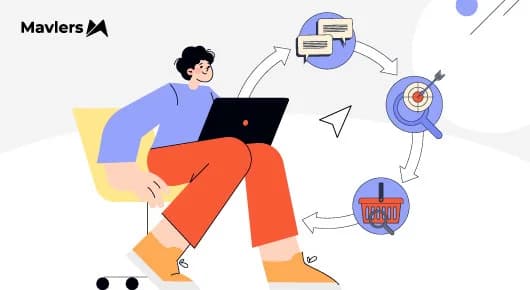
Lifecycle marketing is stage-triggered, behavior-driven engagement delivered continuously across a customer’s entire relationship with a brand. It isn’t bound to a campaign calendar, and it isn’t owned by a single channel.
The mechanism is what makes it lifecycle marketing specifically: the trigger is customer behavior or lifecycle stage, not a launch date or a campaign brief. That’s the line separating customer lifecycle marketing from a campaign, and it’s worth being strict about it.
Two things fall outside this definition, even though people often lump them in:
- A single, well-targeted promotional push isn’t lifecycle marketing. It can feed into a lifecycle program, but it isn’t one on its own.
- Top-of-funnel demand generation and paid acquisition aren’t lifecycle marketing either. They’re inputs to the customer lifecycle. They stop at conversion, while lifecycle marketing continues through activation, retention, expansion, and win-back.
“Marketing across the whole journey” isn’t a definition. It’s a description loose enough to cover almost anything a marketing team does. Quick answers, if you’re skimming:
Is this the same as the marketing funnel? No. A funnel assumes one path to one conversion event. Lifecycle marketing assumes an ongoing relationship with multiple entry and re-entry points.
Does a loyalty program count as lifecycle marketing? Only if it’s triggered by behavior and stage, and runs continuously. A static loyalty tier that never adapts to what a customer actually does isn’t lifecycle marketing. It’s a rules engine wearing a lifecycle marketing name tag.
What this looks like in practice
Fragmented ownership rarely looks dramatic from the outside. It looks like a customer getting a win-back email from the retention team the same week the acquisition team sends them a new-customer discount, because neither system knows the other one is talking to that person.
It looks like conflicting sends, duplicate messaging, and no single number anyone can point to for that customer’s lifetime value. Nobody set out to build it this way. It’s simply what happens by default when acquisition and retention run on separate budgets, separate tools, and separate definitions of success.
What this means for how you run marketing
Three practical implications follow from this definition.
Measurement changes. If lifecycle marketing is defined by continuity and behavior-triggering, campaign-level metrics alone can’t measure it. You need a customer lifetime value (CLV) or stage-conversion metric that survives past any single campaign’s end date.
Alignment becomes a growth lever, not a nice-to-have. According to RevPartners, teams where marketing, sales, and customer success operate as one grow roughly 20% faster annually than misaligned teams, and misaligned teams lose more than 10% of revenue a year. That’s a vendor-reported figure, so treat the exact number as directional. The direction itself is hard to argue with.
Org design follows from the same logic. If lifecycle marketing is continuous and stage-triggered rather than campaign-bound, a structure that splits ownership at the point of conversion- acquisition on one team, retention on another- will keep reproducing the fragmentation this piece opened with, regardless of what the strategy deck says.
That doesn’t mean one team has to own every channel. It means someone has to own the customer across the handoff points, or the handoff points are where the strategy quietly stops being one strategy. Exactly what that structure looks like varies by org size and industry. This is a design principle, not an org chart template.
How Mavlers defines lifecycle marketing for enterprise teams
Defining lifecycle marketing is one thing. Building the platform architecture that runs it is another, and that’s usually where the definition breaks down in practice, not on a whiteboard. Stage-triggered orchestration has to actually live somewhere: inside Braze, Salesforce Marketing Cloud, HubSpot, or whatever stack an enterprise team has standardized on. That’s the piece we work on with enterprise teams, not renaming the model, but building the infrastructure that makes it operational.
One example: Atlantic Coast Automotive needed a single structure across a growing, multi-location dealership network instead of per-location campaigns run in isolation. Here’s how we approached that.
Wrapping up
That brings us to the business end of this article, where it’s fair to say that lifecycle marketing is stage-triggered, behavior-driven engagement that runs continuously across a customer’s whole relationship with your brand. It isn’t a one-off campaign, and it isn’t top-of-funnel acquisition wearing a different name. Those two exclusions do most of the work in keeping the definition honest.
If it doesn’t survive past a single campaign’s end date, it isn’t lifecycle marketing. That’s the line worth holding onto.
Curious how this plays out in practice? Explore our lifecycle marketing services.