
 Lifecycle marketing
 Customer data management
 Email campaign production
 Search marketing
 CMS development
 Who we are
 How we work
 Case studies
 Testimonials
 Salesforce Marketing Cloud
 Braze
Braze HubSpot
 Marketo
 Pardot
 DataBricks
 Snowflake
 HighTouch
 RudderStack
 Segment by Twilio
 Videos

Let me tell you a quick story, one that every developer, designer, and project manager has either lived through or fears more than a production deployment on a Friday evening.
A mid-sized restaurant chain wanted a simple mobile app. Nothing will, just a simple, clean menu, order pickup flow, payment integration, the digital equivalent of “we’d like one cheeseburger, please.”
Everyone shook hands, the requirements were crisp, and the timeline was reasonable.
And then…
Someone, usually named “Marketing” or “The CEO’s cousin who has opinions,” walked in and said, “Hey, could we just add a loyalty program? It’ll really boost engagement.”
You know how this ends. One “just” becomes three, timelines stretch like old rubber bands, developers mutter into their coffee mugs, and the client wonders why the invoice suddenly looks like a gym bill after New Year’s.
Congratulations, you’ve just witnessed scope creep in project management in its purest form.
And on the flip side, when a well-meaning developer says, “You know what would be cool?” and adds a shiny new dashboard no one asked for, that’s gold plating in project management marching confidently into your sprint like it owns the place.
Both are project killers. Both drain budgets, morale, and credibility.
And both are 100% preventable if you understand how they’re born and, more importantly, how to stop them.
Let’s break this down like seasoned web devs and PMs who’ve seen some things.
First things first: understanding what we are even fighting?
Let’s begin with understanding the concept of scope creep. It refers to the uncontrolled expansion of project scope without any documented, formal approval.
It usually sneaks in through tiny, “quick” additions that seem harmless individually but collectively topple your timeline and costs like dominoes.
Common causes of scope creep include:
~ Vague or incomplete requirements
~ Clients changing their minds mid-project
~ Teams not documenting changes
~ Not so on-point project scope management
~ Miscommunication between stakeholders
~ Pressure to “just add it, it’ll take 10 minutes” (the biggest lie in software)
The effects of scope creep are predictable and painful, including delays, burnout, budget overruns, compromised quality, and, in extreme cases, total project failure.
On the other hand, gold plating (a.k.a. “We swear we did it for the client!”) is when the project team adds extra functionality or polish that no one requested.
This might happen because;
~ A dev wants to impress
~ A designer gets creative
~ A team wants to “overdeliver”
Someone confuses “value” with “shiny”
The irony is that clients rarely appreciate unrequested upgrades. They often see them as distractions, risks, or delays, which is exactly what they become.
Scope creep vs. Gold plating ~ The cleanest way to tell them apart
Here’s a quick, simple breakdown.
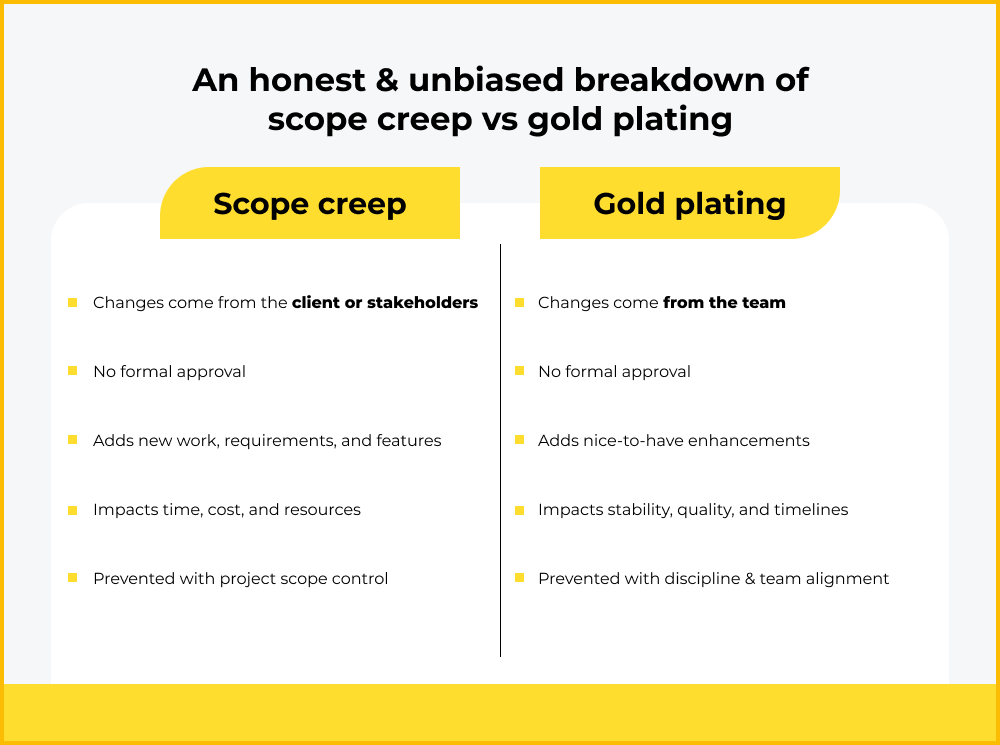
While scope creep might be an outcome of external pressure, gold plating is the result of internal temptation, and honestly, both are dangerous.
Why digital projects attract scope chaos like pigeons at Times Square
If you’ve managed even one digital project, you already know that the internet is an infinite playground of possibilities and opinions.
The risk factors are everywhere:
~ Clients think they know what they want
~ Teams think they know what the client wants
~ New ideas pop up mid-build
~ The industry evolves daily
~ Tech makes “just another feature” seem effortless when it’s anything but
This is why project scope management, the discipline of defining, controlling, and validating what is and isn’t part of the project, directly determines whether your project stays healthy.
Now let’s talk about how to prevent scope creep and stop gold plating before they sabotage your next delivery.
How to avoid scope creep (Without burning bridges or becoming “the rigid PM who hates ideas”)
Here are some simple, tried-and-tested ways to avoid scope creep in your next project.
1. Start with requirements so clear they could survive a cross-examination
Most scope creep begins with fuzziness. Therefore, to put up guardrails early, create a detailed scope statement, a Work Breakdown Structure (WBS), an acceptance criteria for every deliverable, assumptions & exclusions (the most underrated section in scope docs).
A great requirement isn’t poetic; it’s specific.
Not “User can manage profile,” but “User can update name, email, password. No avatar upload in Phase 1.”
Simply put, clarity today protects timelines tomorrow.
2. Use a real change control process (Not a verbal ‘Sure, we can do that’)
This is the backbone of project scope control.
A solid change control process in project management includes a formal Change Request (CR), impact analysis (timeline, cost, dependencies, risks), updated documentation, approval from the sponsor or key stakeholder, and an adjusted project plan.
So, if someone asks, “Can we add a chatbot? It’ll make the app more engaging.” You respond with, “Absolutely, let’s submit a CR so we can scope the impact.”
No defensiveness, resistance, or free work, just the agreed-upon process.
3. Communicate early, often, and without assumptions
Transparent communication is the anti-virus for scope creep.
During planning, clarify expectations; during execution, give frequent updates; and at the time of review, restate what was and wasn’t part of the scope.
Clients rarely set out to cause chaos. They simply don’t know the cost of a change until you explain it.
4. Prioritize like your project depends on it (Because it does)
Use frameworks like MoSCoW (Must-have, Should-have, Could-have, Won’t-have)
This helps you push back, diplomatically, when someone proposes a new idea that does not belong in this phase.
We recommended documenting every “great idea for later” in a backlog so clients feel heard.
5. Track everything, requirements, tasks, changes, decisions
Tools like Jira, ClickUp, Notion, Asana, or MS Project aren’t PM fluff. They’re your evidence, your memory, and your protection.
Implement simple routines such as scope reviews at the end of every sprint, requirements check-ins before every milestone, and weekly updates to CR logs.
If it’s not documented, it doesn’t exist, and if it wasn’t approved, it doesn’t get built. Period.
How to avoid gold plating (Without crushing your team’s creativity)
Gold plating isn’t malicious; it’s basically enthusiasm misdirected.
Here’s how to channel that energy productively.
1. Reinforce this rule, “meet requirements, don’t redefine them.”
It’s important to know that high quality does not equal extra features. Instead, it rather means delivering exactly what was promised, reliably, cleanly, and on time.
Remind your team that “We’re not building the best version of the product we can imagine.
We’re building the version the client approved.”
2. Create a culture where change follows process, not heroics
Gold plating often happens because people want to “help.” So teach the team that changes must go through CR, extra work introduces risk, and “cool ideas” are routed to the backlog.
This protects the project and the team.
3. Review deliverables against scope, ruthlessly but fairly
During QA, sprint reviews, UAT cycles, and demo walkthroughs, verify every item against the scope.
If something isn’t part of the plan, it’s flagged immediately.
4. Encourage discipline, not over-delivery
Rewarding “extra efforts” that violate the scope sends the wrong message.
Instead, it’s a good practice to recognize predictable delivery, risk mitigation, accurate estimations, alignment with requirements, and clean execution.
Gold plating isn’t excellence; it’s scope mismanagement.
Two stories developers tell at bars
Here’s scope creep in one breath.
We were building a restaurant pickup app. Straightforward. Menu browsing, customization, payments. Two weeks before launch, the marketing manager drops, “People love loyalty points. Could you just add a rewards system?”
Then the regional manager adds, “We need push notifications too.”
Nobody documents anything. Nobody adjusts timelines. Suddenly, our dev team is architecting a full loyalty engine and building notification workflows. Timelines slip, costs jump, and everyone’s annoyed.
That right there is the slippery slope of uncontrolled scope expansion.
And here’s an instance of gold plating. We were building a simple HR leave request portal. Two screens. An email flow. Done.
But one developer, bless their caffeinated heart, decided to upgrade the whole experience with a dashboard, animated microcopy, and an AI-ish chatbot for HR FAQs. The client sees it and goes, “This is cute, but not what we asked for.”
Testing gets delayed. Bugs appear. The core workflow breaks.
This wasn’t client-driven chaos. This was internal overenthusiasm wearing a superhero cape.
The line that saves every project
If you forget everything else, remember this one sentence and use it like a mantra:
Scope creep happens when you don’t say no.
Gold plating happens when you don’t have to say yes.
That’s the entire difference between the two. One comes from outside, the other from inside.
But both can bulldoze the cleanest project plan.
Avoiding them isn’t about rigid rules.
It’s about setting respectful boundaries, communicating what’s possible and what isn’t, protecting your team’s focus, keeping the client confident rather than confused, and building a product that matches the promise, not improvisation.
In a world where every new idea feels urgent, every project feels dynamic, and every team is juggling three different time zones, the discipline to hold the line is the most underrated skill in project management.
You don’t prevent chaos by working harder; you prevent it by designing the project so chaos has nowhere to land.
And when you get this right, the entire project feels different.
Cleaner, calmer, predictable, and dare I say, enjoyable?
You ship on time. Teams aren’t burned out. Clients recommend you.
And you end the project feeling like a professional, not a firefighter.
That’s the real win.
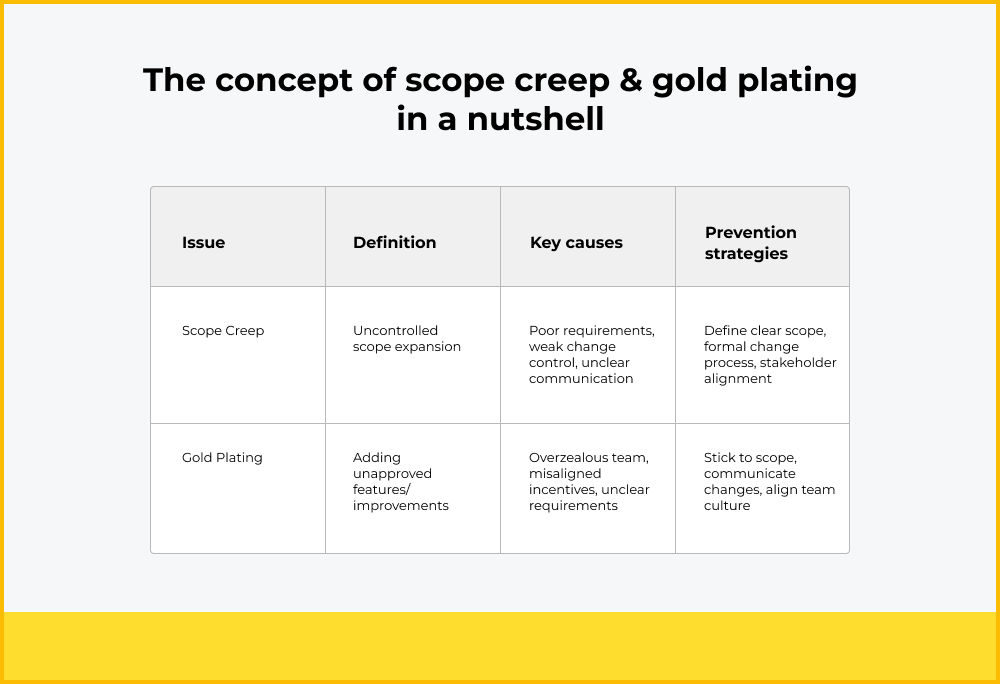
To surmise,
The road ahead
On that note, you might be interested in reading this next ~ How Mavlers Avoid Misaligned Expectations During Projects.