 Lifecycle marketing
 Customer data management
 Email campaign production
 Search marketing
 CMS development
 Who we are
 How we work
 Case studies
 Testimonials
 Salesforce Marketing Cloud
 Braze
Braze HubSpot
 Marketo
 Pardot
 DataBricks
 Snowflake
 HighTouch
 RudderStack
 Segment by Twilio
 Videos
Enterprise software has long been built on a human-first interface. With the rise of autonomous intelligence, that assumption, along with several others, began to be challenged.
Now, it’s been decisively overturned.
At its annual developer conference TDX in March 2026, Salesforce announced Headless 360, a significant architectural shift that makes the browser optional. Every capability Salesforce has built over 25 years is now accessible directly as an API, an MCP tool, or a CLI command. In plain terms, AI agents can now plug into Salesforce’s data, workflows, and business logic without a human ever opening a browser tab. It’s a replatforming, one that has several implications for how businesses build software, deploy AI, and serve customers going forward.
To understand why, it helps to start with what Headless 360 actually is.
What is Salesforce Headless 360?
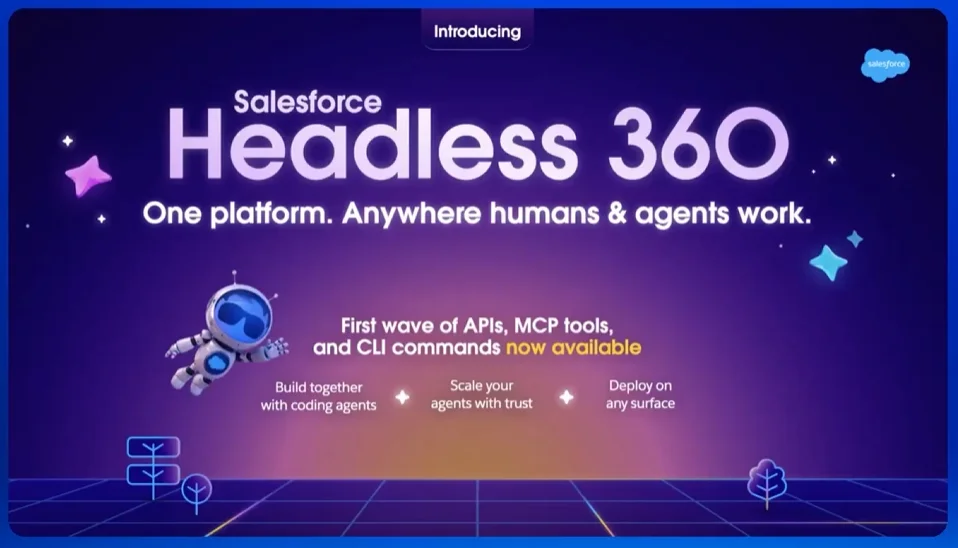
The “headless” in Headless 360 means the browser interface is no longer required. Every capability Salesforce has built over 25 years (e.g. CRM data, customer workflows, approval logic, business rules, compliance controls, and so on) is now accessible directly as:
- An API, a defined request/response channel for software-to-software communication
- An MCP tool, a universal plug-in adapter built on the Model Context Protocol standard, allowing AI assistants to connect
- A CLI command, a direct text-based instruction, no interface required
Think of Salesforce today like Microsoft Windows 95 in its UI-first era, and Headless 360 as the shift toward Windows Server-style APIs. Early enterprise software (SAP, Oracle) was built for humans clicking through interfaces. The UI was the product. Then came ERP integration. Businesses needed systems to talk without human intervention, and APIs and middleware unlocked that. Salesforce Headless 360 is the same shift again, except that this time the “other software” is not middleware, it’s AI agents. Salesforce is replatforming so agents can operate natively, at machine speed, across any surface.
Here’s how the workflow looks like before and after Salesforce’s headless CRM platform.
| Before Salesforce Headless | After Salesforce Headless |
| Human logs into the browser | AI agent receives instructions |
| Clicks through the menus | Calls API, MCP tool, or CLP directly |
| Enters or updates records | Headless 360 returns data+context |
| Data saved | Output delivered to Slack, voice, teams, WhatsApp, etc. |
Consider the example of Engine, a B2B travel management company. Using Agentforce and Headless 360, they built their customer service AI agent, Ava, in just 12 days. Ava now handles 50% of all customer service cases autonomously, without human intervention.
This is what Headless 360 enables in practice: a company with a real customer service challenge can now deploy an AI agent that plugs into their existing Salesforce data, respects their existing security rules, and handles half their case volume, without rebuilding the infrastructure. Behind these capabilities lies the 3 core pillars of Headless 360.
The 3 pillars of Salesforce Headless 360
Salesforce’s official announcement defined three core innovations that Headless 360 offers:
- Build any way you want: 60+ new MCP tools and 30+ coding skills give AI agents like Claude Code, Cursor, and OpenAI Codex complete, live access to Salesforce data, workflows, and business logic, with no browser required.
- Deploy to any surface: The Agentforce Experience Layer renders agent outputs such as approval cards, decision tiles, and data layouts natively across Slack, mobile apps, ChatGPT, Claude, Google Gemini, Microsoft Teams, or any MCP-compatible client.
- Govern what agents do: Testing Center, Custom Scoring Evals, Agent Script, A/B testing, and observability tools give teams control over how agents behave, both before and after launch.
In light of the last pillar i.e. governance, it is critical to appreciate the probabilistic nature of AI agents. Traditional software is like a vending machine: press B4, get a Snickers, every time. AI agents are more like a skilled employee, usually excellent, occasionally unpredictable, and needing oversight. The new governance tools exist precisely because Salesforce knows that shipping an agent and trusting it blindly is not an enterprise-grade strategy.
So much for what Salesforce Headless 360 is.
However, no story is complete nowadays without Anthropic of course. It’s important to appreciate the role and place of Claude in Salesforce’s API-first architecture.
The Salesforce-Anthropic partnership
On February 2, 2026, Salesforce and Anthropic jointly unveiled an expansion of their partnership, marking a deeper strategic alignment. They framed it as delivering “trusted business context and AI actions to Claude through Slack and Agentforce 360.”
The partnership has 3 dimensions:
- Claude is deeply integrated into Salesforce’s tools. Salesforce’s Agentforce Vibes 2.0, the AI coding environment announced at TDX, uses Claude Sonnet as its default AI model. As a result, developers building on Salesforce are, by default, working with Claude.
- MCP connects Claude to Salesforce’s live business data.
- Claude models operate within Salesforce’s Trust Layer, which means that customer data never leaves Salesforce’s security boundary, even when Claude is processing it.
Interestingly, this makes Anthropic the first large language model provider whose models are fully contained within the Salesforce trust boundary.
How does Agentforce work with Claude via MCP?
This is the question that trips most people up. Agentforce and Claude are not the same thing, and they are not rivals; they are complementary, and they are designed to work together.
Refer to the table below to get an idea of how Agentforce and Claude pull together.
| Agentforce | Claude (via MCP) | |
| Where it lives | Inside Salesforce, native to the platform | Outside Salesforce, built by Anthropic |
| What it does best | Deep, governed workflows: case routing, lead scoring, approvals | Conversational reasoning, drafting, code generation, cross-app queries |
| Needs MCP? | No, it is natively part of Salesforce | Yes; MCP is the bridge that connects Claude to Salesforce |
| Setup complexity | Months; requires Data Cloud and implementation costs | Hours; OAuth + connector setup |
| Security model | Inherits all Salesforce permissions natively | Respects Salesforce security via OAuth + Einstein Trust Layer |
| Works with other apps? | Primarily the Salesforce ecosystem | Yes; Gmail, Drive, Slack and more simultaneously |
The partnership is tailored for enterprise setups. As Nick Johnston, SVP of Strategic Tech Partnerships at Salesforce, explains, “Enterprises need more from AI than powerful models. They also need a reliable way for those models to operate inside real business environments. By partnering with Anthropic, we are bringing Salesforce directly into our customers’ flow of work and providing the execution layer with context, data, governance, and trust.”
Imagine a manufacturing company. They hire a brilliant strategy consultant (Claude) who can analyze data, draft reports, answer questions, and help plan what the factory should build next. The consultant has a pass to walk through the factory and see the machines, the inventory, and the output data. But the consultant does not run the machines. The factory floor (Agentforce) does that; it executes the approved workflows, manages the production line, enforces the quality controls. It knows every conveyor belt, every SKU, every supplier constraint. Together, the consultant (Claude) surfaces insights and drafts the plan; the factory floor (Agentforce) executes it, governed by years of accumulated business logic.
What does all this mean for your business?
The browser-centric model served businesses for the last 25 years. But now, going forward, the API-and-agent model is set to drive businesses. Here’s what that means:
- Intelligence alone is not enough. It needs the lifeforce of context. The value is in 25 years of accumulated customer context, workflow logic, and trust infrastructure; Headless 360 is how that context becomes machine-accessible.
- The fact that Headless 360 natively supports competitor AI tools like Claude Code, Cursor, Codex, and Windsurf is deliberate. Salesforce is betting that openness wins in the agentic era. Their moat is not the interface (which is now optional); it is the accumulated data, the trust layer, the business logic, none of which any competitor can replicate quickly.
- Existing Salesforce developers and admins can build enterprise-grade agentic workflows without specialized AI talent, using composable MCP building blocks.
- Once the first agent is built, the infrastructure reuses itself, allowing companies to rapidly expand from a single use case to a full ecosystem of interconnected agents.
The adoption curve shouldn’t be entirely at odds with that of Agentforce when the latter was first rolled out in 2024.
The bottom line
Salesforce is fundamentally repositioning itself as the platform for the agentic enterprise, where humans and AI agents work together across every business workflow, and Headless 360 is their bet that developers don’t need to choose between speed, trust, or flexibility to get there. The core message is simple: the way software is built is changing at warp speed, and Salesforce wants to be the foundation that helps every business make that shift.
From here on, how do you go about adopting the headless enterprise?
To begin with, look at your data, identify a manual and repetitive task your human team is doing, give it to an agent, govern it carefully, and build trust in it before scaling.
Don’t try to boil the ocean. Start small, prove the value, and the foundation you build will make every subsequent agent much easier to deploy.