 Lifecycle marketing
 Customer data management
 Email campaign production
 Search marketing
 CMS development
 Who we are
 How we work
 Case studies
 Testimonials
 Salesforce Marketing Cloud
 Braze
Braze HubSpot
 Marketo
 Pardot
 DataBricks
 Snowflake
 HighTouch
 RudderStack
 Segment by Twilio
 Videos
Suppose you are an SEO expert or a link-building enthusiast working for a brand/business, and you have checked back into work post the holidays in early 2026 (yep, grim, but yeah, it’s gonna happen!) 😉
You’ve just pulled up the latest traffic report for your site. On-page tweaks are humming along. Your content calendar is full. But your referral traffic from high-authority domains is flattish.
You’re asking: “Do I even need to keep building links, or is that old-school SEO window already closed?”
If you’re a digital marketer, business owner, designer, or agency lead seeing stagnant link volume, this is your moment. Because the reality is: yes, links still matter.
But the way they matter has shifted dramatically. Treat link-building like it was 2016, and you could be investing precious budget with minimal ROI. Treat it like 2026-style and you’ll be ahead of most.
Let’s walk through what’s changed, what still works, and how you invest wisely in link-building for 2026, powered by nothing but honest perspective from someone who’s been in the SEO trenches for the past 13+ years.
But first, to spill the good news, yep, link-building still works!
To answer your question in simple terms first, yes, link-building ain’t dead and buried for sure! Let’s explore some studies and numbers that support these claims.
~ In one dataset, pages in Google’s top 10 had, on average, 3.8 × more backlinks than those in positions 2–10.
~ Major publications assert that while the role of links is evolving, they remain a “core part of SEO for now.”
So, if someone tells you “links don’t matter anymore,” they’re half-right. They matter in different ways now, and ignoring them entirely is risky.
Decoding the shift, understanding what’s really changed
Here’s where we take a moment and dig into the nuance, because while links still work, the playbook has been rewritten. Let’s break this down:
- Quality takes precedence over quantity
While massive link spam might have worked (briefly), in 2026, a single link from an authoritative, niche-relevant site can trump dozens of weak or irrelevant ones.
2. Context, relevance & intent matter more than ever.
It’s not enough for a site to link to you; it must also be relevant to your niche. Relevance matters (niche alignment, topic alignment) because search engines and large-language-model (LLM) driven signals are getting smarter about why a link exists. Simply said, a well-placed link inside a genuinely valuable resource trumps many arbitrary links.
3. Link-building is now a part of your content & brand strategy & not an isolated endeavour
While earlier link-building used to be treated as a separate silo (“we’ll get links”). Now it’s baked into content strategy, brand partnerships, and community building.
4. A mix of AI, algorithms, and human signals
With more AI-driven analysis and human-evaluated signals, search engines are smarter about how links are earned and used.
5. Welcoming a diverse mix of link types
Guest posts, resource pages, partnerships, brand mentions, and digital PR are all mixing together. Relying on a single style can be risky.
But will the classic link-building techniques still hold their weight in 2026?
To answer the question, yes, but with caveats.
Let’s take a look at some “classic” tactics and assess their future viability.
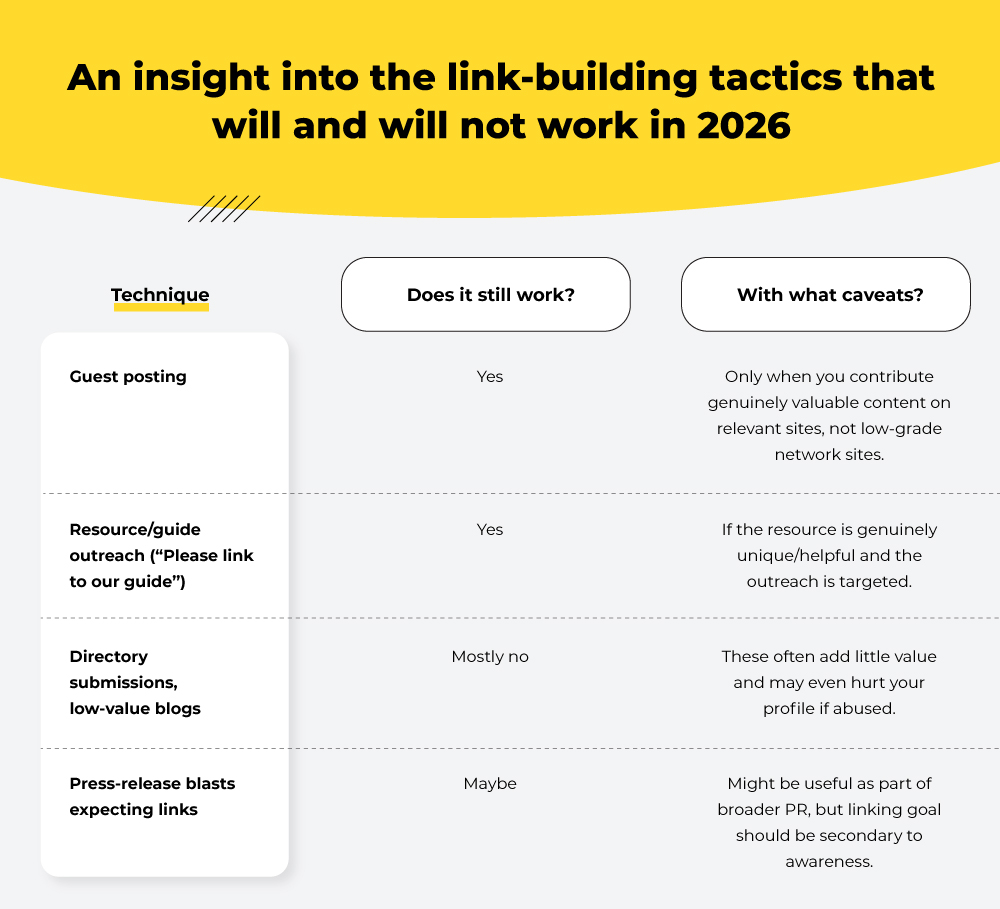
To surmise, while classic tactics can work, success depends on how thoughtfully they’re used.
Your 2026 link-playbook ~ A checklist you’ll thank yourself for!
When you’re about to invest time or budget in link-earning, keep this list handy and ask yourself the following questions:
- Does the linking site share the same niche or audience as ours?
- Is the link placement natural, useful, and relevant, or forced?
- Is the website reputable? Does it bring in good traffic, engagement, a real audience, not just domain-rating hype?
- Will the link drive more than just “SEO juice”? Could it drive referral traffic, increase brand exposure, and build credibility?
- Are we tracking meaningful outcomes such as referral traffic, engagement, conversions, and not just link count?
This checklist will help you pivot from “building links” to “earning meaningful signals.”
What’s new and worth betting on in the 2026 link-building mix?
Let’s talk about the tactics and angles that are increasingly bearing fruit (and will continue to) in the foreseeable future.
~ Podcasts & guest features — Being a guest gives you both exposure and a link from the show notes, relevant to your niche.
~ Original data/studies — Publishing your own research can generate natural editorial links and mentions.
~ Community-based link-earning — Consider digital events, newsletters, niche forums/Slack communities. These help build authentic mentions leading to links.
~ Brand, authority mapping for AI/LLM signals — As one guide puts it, you need links and co-citations (mentions, entity associations) for modern search.
~ Tools and analysis — 82% of SEOs rely on backlink analysis tools for strategy.
Exploring the plausible risks of doing nothing or worse, the wrong thing!
When you neglect links or stick with outdated tactics, here’s what might happen;
~ You risk falling behind competitors who are earning high-value links and A.I./LLM-friendly signals.
~ You may waste budget on “cheap” links that produce zero traction (and possibly raise red flags).
~ You could find your content and site lacking in the contexts modern search engines demand (brand associations, relevance, authority).
Taking the middle road ~ Knowing when to invest in link-building and when to hit the brakes
In order to build a balanced perspective, we recommend investing in link-building when you meet the following criteria:
~ You have a content foundation (good UX, useful content, technically sound site).
~ You’re willing to focus on value over volume (one strong link > 10 weak ones).
~ You’re tracking beyond link count, that is, you measure referral traffic, brand lifts, conversions.
~ You’re prepared to integrate link-earning with broader marketing (PR, events, brand features).
On the other hand, you might delay or choose to scale your link-building endeavours when;
~ Your site has major technical/UX/content issues (it’s always recommended to fix those first).
~ You are considering purely “bulk link” packages with low relevance.
~ You don’t have the team or budget to create content worthy of being linked.
Answering those pertinent FAQs (Because we know you might be thinking of these!)
Q: Are links dead in 2026?
A: No, but links done as an afterthought are pretty much dead.
Q: How many links do I need per month/quarter?
A: There’s no magic number. The better question is, how much value does each link bring? One highly relevant link may beat five mediocre ones. You might wanna read this ~ How Many Backlinks Per Day Is Safe? ~ The Smart Marketer’s Guide To Link Building Without Penalties.
Q: Can I build links with AI-generated content?
A: Maybe, but if the content is shallow/generic/duplicate, you risk little value. If using AI, ensure the content is human-reviewed, unique, and genuinely helpful.
Q: My budget is limited. Should I still invest in link-building?
A: Yes, but smartly. Prioritize one or two strong campaigns (guest expert interviews, data-driven research, partnerships) rather than scattering efforts everywhere.
Q: Should I stop tracking domain authority/link count, etc?
A: Don’t stop but evolve tracking. Measure referral traffic, conversion from linked pages, engagement from linked content, visibility improvement, and not just raw link numbers.
The road ahead
If you are on the lookout for the top backlink audit tools, we have the perfect guide for you, which you might want to bookmark for a later read ~ Top 5 Backlink Audit Tools Reviewed: Which One Helps You Recover Rankings?